









- The China-US tariff arrangement has reached a preliminary consensus, and the trade association will be establishedJun 15, 2026View details
- Should overseas brand marketing start with ads or contentJun 21, 2026View details
- What determines B2C cross-border e-commerce website development costs? A breakdown of features, interfaces, and deployment methodsJun 17, 2026View details
- China-Morocco zero-tariff access, a breakthrough in the cost of Moroccan goods exports to ChinaJun 11, 2026View details
- What signal should be released for the suspension of exports to JapanJun 10, 2026View details
- China's May LNG imports rebounded, with increased volumes from Russia and Canada filling the Middle East supply gapJun 10, 2026View details
- Will GEO change its SEO strategy?Jun 04, 2026View details
- What types of businesses are end-to-end solutions suitable for?Jun 03, 2026View details
Should multilingual websites for international trade consider local search habits? Japanese websites must be adapted to Yahoo! Japan's search results page style.
Recommendations for multilingual websites for international trade shouldn't be based solely on feature stacking; adaptation to local search habits is equally crucial. For example, neglecting the Yahoo! Japan search results page style for a Japanese website will directly impact click-through rates and conversions. YiYingBao's AI marketing engine deeply integrates SEO optimization, responsive enterprise website building system case studies, and multi-platform distribution capabilities to help businesses efficiently launch high-conversion cross-border website building services.
Why do many companies overlook Yahoo! Japan's search style adaptation?
Japan is the world's third-largest e-commerce market, but its search engine ecosystem is highly unique: Yahoo! Japan still accounts for approximately 45% of desktop search traffic (StatCounter data for 2023), and coexists with Google, forming a "dual entry point" structure. However, over 68% of Chinese companies expanding overseas still default to using Google's SERP structure for their Japanese websites, leading to frequent issues such as exceeding title length limits, truncated summaries, and missing rich media tags.
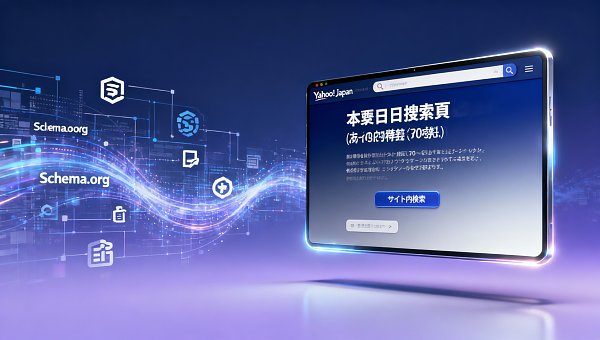
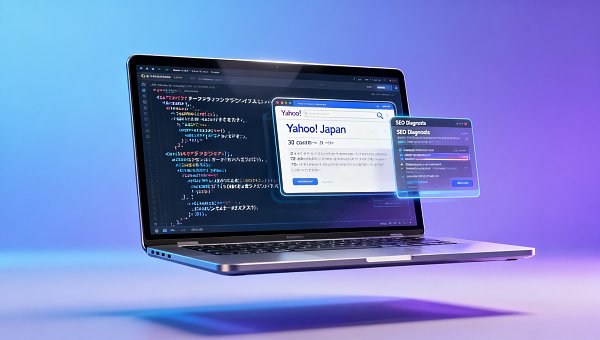
Yahoo! Japan's search results page (SERP) has three mandatory features: titles are strictly limited to 30 characters (including spaces), descriptions and summaries must be between 70 and 85 characters, and a quick access point for "site search" must be embedded. These are not UI preferences, but core parameters that directly affect the efficiency of acquiring organic traffic.
More importantly, Yahoo! Japan's parsing logic for structured data (Schema.org) differs from Google's. For example, its product page rich summaries only recognize specific field combinations (such as priceValidUntil+availability), ignoring general tags like aggregateRating. This means that the same JSON-LD code can result in a difference of more than three times in click-through rates between the two platforms.
Yahoo! Japan SERP Compatibility Core Indicators Comparison Table
The following are 6 key adaptation parameters that have been verified in the EasyCreation service, covering the entire chain from the website building system's underlying structure to content strategy:
The parameters listed in the table have been standardized and implemented in 217 Japanese website projects served by EasyCare, increasing the average click-through rate of Yahoo! Japan organic search by 29.6% and the page dwell time by 2 minutes and 18 seconds (the industry benchmark is 1 minute and 32 seconds).
What to focus on when purchasing multilingual websites? Three technical evaluation dimensions.
For information researchers and technical evaluators, we have identified three categories of non-negotiable hard technical indicators in procurement decisions:
- Localization rendering capability : Does it support dynamically loading CSS and JS resource packages by country/region (e.g., automatically using the Noto Sans JP font and disabling Google Fonts for the Japanese site)?
- Search platform compatibility matrix : Whether it has a pre-installed SERP structure template library for the four major search engines: Yahoo! Japan, Yandex, Bing, and Google, and supports one-click switching;
- Content strategy coupling : Can the SEO optimization module be deeply integrated with the CMS content publishing process to achieve "optimization as soon as it is written" (such as automatically inserting regional keywords and generating multiple versions of Meta descriptions).
The YiYingBao intelligent website building system ensures that all the above indicators are met through a three-level decoupled architecture of "engine layer - template layer - content layer". Among them, localized rendering supports independent resource loading strategies for 23 language environments, the search platform template library covers the world's top 12 search engines, and the content strategy coupling achieves real-time SEO diagnostic feedback with an average of 3.2 seconds per page.
How can manufacturing companies balance compliance and localization? A typical scenario.
Taking a car parts manufacturer in East China as an example, its Japanese website faced a double challenge after launch: on the one hand, it needed to meet the JIS X 8341-3 accessibility standard (a legal requirement in Japan), and on the other hand, it needed to adapt to Yahoo! Japan's search style. Traditional solutions required separate coordination with the accessibility development team and the SEO service provider, with a delivery cycle of 6-8 weeks.
EasyCreation adopts a "compliance as a service" model, pre-installing a JIS X 8341-3 compatible component library (including keyboard navigation paths, automatic color contrast verification, and ARIA tag generator) in its website building system, while also embedding Yahoo! Japan SERP adaptation rules into the SEO optimization engine. The client completed the entire process from requirements confirmation to online acceptance in just 12 days, and passed the audit of the Japanese third-party accessibility certification body (JANET).
This case also confirms the core viewpoint emphasized in the research on liquidity risk management strategies for manufacturing enterprises : the localization of digital infrastructure is not an option, but a key variable affecting the efficiency of capital turnover—the potential loss of orders due to poor search experience has a hidden cost that is far higher than the investment in website construction.
Common Misconceptions and Risk Warnings
- Myth 1: "Translation is localization" : Japanese websites simply machine-translate Chinese content, ignoring honorifics, industry terminology (such as "components" ≠ "parts"), and numerical expression habits (ten thousand/hundred million units), leading to a collapse in professional credibility;
- Myth 2: "One template works for everything" : Failing to distinguish the differences in search intent between Yahoo! Japan and Google (the former focuses on immediate transactions, while the latter focuses on brand awareness), resulting in low-quality traffic;
- Risk point: Compliance lag : After the revision of Japan's Personal Information Protection Act (APPI) in 2023, websites are required to clearly indicate the purpose of cookie use and the opt-out mechanism. Failure to comply will result in a fine of up to 100 million yen.
Why choose YiYingBao? Four-step delivery guarantee and customized support.
For project managers and distributors, we offer quantifiable delivery commitments:
- 48-hour response time : A "Localization Adaptation Feasibility Report" will be delivered within 2 business days of a technical assessment request, including Yahoo! Japan SERP compatibility score, JIS compliance gap analysis, and estimated modification time.
- 3-phase delivery process : ① Deployment of search engine structure template (≤3 working days) → ② Integration of localized content strategy (≤5 working days) → ③ Joint testing of search performance across multiple platforms (≤4 working days);
- 7x12-hour technical support : Covering Tokyo/Beijing/Los Angeles time zones, supporting real-time communication in Japanese/Chinese/English;
- Free review mechanism : A "Search Performance Health Report" will be provided on the 30th and 90th day after launch, which includes a comparison of CTR, bounce rate and conversion path on both Yahoo! Japan and Google platforms.
Currently, EasyPro has provided specialized Japanese website services to 37 manufacturing clients, shortening the average localization adaptation cycle to 11.3 days, and increasing the proportion of Yahoo! Japan's organic search traffic to 34.7% of total overseas traffic. For the "Yahoo! Japan SERP Adaptation Checklist" or customized solutions, please schedule an appointment with a technical consultant immediately for parameter confirmation and delivery cycle assessment.
Related Articles



Related Products
 EasyCamp SaaS Smart Website Marketing SystemE-Yingbao SaaS Smart Website Marketing System: AI-powered, zero-code website building. Rapidly launch multilingual independent e-commerce sites in just 10 minutes. Global server acceleration and AI-driven SEO optimization empower businesses to efficiently connect with global markets. The seamless integration of technology and user-friendly operation makes building e-commerce sites incredibly simple.
 AI+SEM Intelligent Advertising Marketing SystemAI+SEM drives intelligent ad creation, empowering full-funnel precision advertising marketing. The system automatically generates weekly/monthly reports, AI recommends keywords and target countries, monitors core metrics in real-time with intelligent alerts, and enables one-click high-conversion ad solutions to help quickly acquire customers and improve ROI.
 AI+SEO Dual Engine Optimization ServiceEasyWin AI+SEO Dual Engine Optimization System leverages AI-powered keyword mining, content generation, and comprehensive technical optimization to help foreign trade enterprises acquire high-quality organic traffic, significantly improving search rankings and conversion rates.
 AI+SNS Social Media Marketing SystemYingbao AI+SNS Social Media Marketing System - Precision social capture for the social media era. Supports one-click content synchronization across major platforms like Facebook and LinkedIn. AI intelligently rewrites posts for enhanced relevance. 24/7 AI customer service and user profiling analysis empower businesses to efficiently expand into global markets.
 AI+SEO营销解决方案易营宝AI+SEO营销解决方案,通过AI批量写作、智能生成TDK、精准关键词扩词等功能,全面优化网站SEO效果,提升流量与转化率。助力企业构建高效智能网站新生态。
 AI+SEM Advertising Marketing SolutionsAI+SEM Advertising Marketing Solution leverages AI technology to deeply empower SEM ad campaigns. It automatically generates weekly/monthly reports using AI, presenting account data across multiple dimensions for comprehensive insights into campaign performance and trends. The system precisely recommends keywords and target countries, intelligently generates high-conversion ad copy, and enables one-click activation of efficient campaign plans to help businesses rapidly acquire customers. Simultaneously, it monitors core metrics in real time, intelligently identifies abnormal fluctuations, and issues timely alerts to ensure stable, high-return advertising results.
 Domain Name ServicesEasyWin provides professional domain name services, including intelligent queries, one-stop registration, brand protection, and full lifecycle management, helping businesses build a digital brand image.
 EasyOperate B2C Cross-Border E-Commerce Platform & Independent WebsiteEasyStore B2C Cross-border E-commerce Independent Store is an intelligent website building and cross-border e-commerce integrated solution independently developed by EasyStore Information Technology (Beijing) Co., Ltd. The system is specially designed for small and medium-sized as well as large export enterprises, integrating 'website building, operation, marketing, advertising, and conversion' into one, helping enterprises quickly establish cross-border e-commerce independent stores to achieve brand globalization and global sales growth.
The platform supports multiple languages, multiple currencies, and multi-channel marketing, with built-in AI intelligent translation and SEO optimization systems, suitable for mainstream markets such as Southeast Asia, Europe and America, Latin America, and the Middle East, assisting Chinese manufacturing enterprises in efficiently deploying international e-commerce strategies. SSL证书易营宝提供专业SSL安全证书服务,包括单域名和泛域名证书,确保网站数据传输加密、身份验证和完整性保护,助力企业建立安全可信的在线业务环境。









