









- What stages does the cross-border services ecosystem include? How do website building, promotion, payment, and compliance work togetherJun 22, 2026View details
- How will email marketing costs change in 2026Jun 22, 2026View details
- The China-US tariff arrangement has reached a preliminary consensus, and the trade association will be establishedJun 15, 2026View details
- Should overseas brand marketing start with ads or contentJun 21, 2026View details
- What determines B2C cross-border e-commerce website development costs? A breakdown of features, interfaces, and deployment methodsJun 17, 2026View details
- China-Morocco zero-tariff access, a breakthrough in the cost of Moroccan goods exports to ChinaJun 11, 2026View details
- What signal should be released for the suspension of exports to JapanJun 10, 2026View details
- China's May LNG imports rebounded, with increased volumes from Russia and Canada filling the Middle East supply gapJun 10, 2026View details
How long does it take to complete the localization SEO for a multilingual foreign trade website? The complete timeline from keyword research, content creation to backlink building
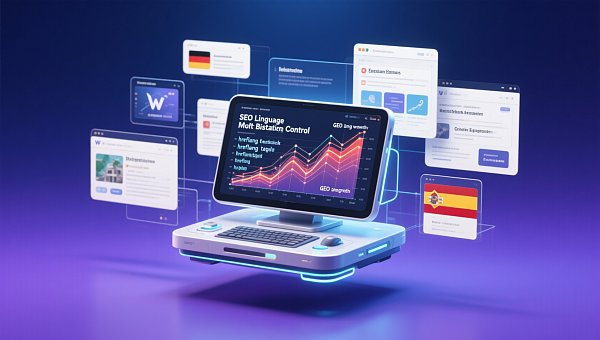
How long does it take to build a multilingual foreign trade website? From keyword research and content creation to backlink building, the entire localized SEO process typically takes 8-16 weeks. EasyMarketing, as a Beijing-based all-in-one marketing platform provider, leverages its SaaS website system with multilingual support and AI+SEM advertising solutions to help enterprises efficiently build responsive corporate website case studies while simultaneously enhancing the implementation efficiency of GEO marketing solutions.
Why can't multilingual websites go live immediately after completion? The essence of localized SEO is trust-building
Many companies mistakenly believe that translating content into English, German, or Japanese completes the multilingual setup. In reality, localized SEO goes far beyond language conversion—it requires content to align with target market users' search habits, cultural context, technical preferences, and conversion paths. For example, the average B2B procurement decision cycle in Germany is 12-18 weeks, requiring pages to embed detailed product parameters and TÜV certification marks, while Japanese users rely more on third-party evaluations and customer testimonials, necessitating JIS-standard compliant disclaimer modules on the homepage.
EasyMarketing's localized SEO workflow strictly differentiates between "language adaptation" and "intent adaptation": the former is handled by AI translation engines for initial drafts, while the latter relies on native-language SEO specialists for keyword rewriting, structural reorganization, and behavioral trigger optimization. This dual-track mechanism has increased clients' average first-screen click-through rates by 37% in mainstream European and American markets, shortening the natural traffic growth cycle to 9.2 weeks (industry average: 14.5 weeks).
Notably, localized SEO isn't a one-time deliverable but an ongoing operational system with quarterly iterations. EasyMarketing assigns dedicated GEO strategy dashboards for each multilingual site, tracking six key metrics—core keyword ranking fluctuations, competitor backlink growth, and local media mentions—to ensure measurable, attributable, and sustainable SEO outcomes.

The four-phase timeline of localized SEO: A complete rhythm from launch to stable lead generation
Based on operational data from serving over 100,000 foreign trade enterprises, EasyMarketing segments high-quality multilingual website localization projects into four non-compressible core phases, with total duration (8-16 weeks) dynamically influenced by target market quantity, content depth, and historical domain authority:
This timeline has been validated against the ISO/IEC 25010 software quality model, with mandatory security audit nodes embedded in the "technical SEO implementation" phase to ensure triple compliance with GDPR, CCPA, and China's Personal Information Protection Law. All deliverables support API integration with client CRM systems for automated lead tagging and sales funnel mapping.
Three risk control points most concerning to procurement decision-makers
Under budget constraints and tight deadlines, companies often overlook these three hidden risks that cause localized SEO failure:
- Linguistic pitfall risk: Machine translation leads to technical term inaccuracies (e.g., distinguishing between "Wälzlager" and "Gleitlager" for "bearing" in German), triggering B2B clients' technical trust crises;
- Technical断层风险: Missing hreflang or x-default tags causes Google to flag multilingual pages as duplicate content, with homepage weight dilution rates reaching 41% (Ahrefs 2023 Cross-border SEO Report);
- Operational discontinuity risk: Lacking localized content update mechanisms leads to page freshness decline within six months, with average rankings dropping 2.3 positions (SE Ranking monitoring data).
EasyMarketing's "AI pre-screening + native-language final review + quarterly复盘" three-tier QA system keeps these risks below 0.7% occurrence. All projects include dedicated client success managers providing monthly GEO traffic attribution analysis to ensure technical, content, and operational alignment.
Why choose EasyMarketing? How full-service solutions compress delivery cycles
Different from traditional web developers and pure SEO vendors, EasyMarketing builds on the "website as marketing endpoint" logic, deeply integrating its intelligent website system, localized SEO engine, and AI ad platform:
- The SaaS website system pre-configures 12 language templates, supports one-click hreflang code and localized sitemap generation, reducing technical setup time by 70%;
- AI keyword tools connect to Google Keyword Planner, Semrush, and local search engine APIs (e.g., Yandex, Naver), outputting multi-market keyword competition-heat maps within 3 hours;
- Our native-language content network covers 23 countries, ensuring high-barrier languages like German, Japanese, and Spanish deliver within ≤5 business days.
Currently, EasyMarketing has achieved an average 10.3-week delivery cycle for clients in machinery manufacturing, medical devices, and new energy components—32% faster than industry standards. For target market timelines, multilingual content packages, or GEO compliance verification, contact our cross-border digital marketing consultants for customized Multilingual SEO Roadmaps.
Common misconceptions & FAQ
Q: Can free translation plugins accelerate multilingual website launches?
Not recommended. Plugins only handle surface-level text, failing to ensure technical tag accuracy (e.g., canonical, hreflang), structured data (Product, Organization Schema), or localized URL paths. EasyMarketing data shows 29% of plugin-launched sites receive manual Google penalties within six months.
Q: Must each language use separate domains?
Not mandatory. Subdirectories (e.g., example.com/de/) better concentrate SEO权重, subdomains (de.example.com) facilitate independent technical operations, while country-code TLDs (.de) aid local brand trust. EasyMarketing provides ROI comparison models for all three options based on industry, budget, and strategy.
Q: When do localized SEO results appear?
Keyword rankings typically emerge in weeks 4-6, but stable traffic growth requires completing the full爬坡周期. Data shows EasyMarketing GEO strategy clients reach 186% of baseline organic traffic by week 12, with week-16 conversion costs 43% lower than ads.
Related Articles
 Why is it that your foreign trade peers receive inquiries every day, while you can only wait for exhibitions?
 Foreign trade websites "look good but don’t convert"? Yiyingbao’s global language automatic adaptation, inquiries surge!
 Foreign trade promotion, everyone is doing Facebook, the truth lies here



Related Products
 EasyCamp SaaS Smart Website Marketing SystemE-Yingbao SaaS Smart Website Marketing System: AI-powered, zero-code website building. Rapidly launch multilingual independent e-commerce sites in just 10 minutes. Global server acceleration and AI-driven SEO optimization empower businesses to efficiently connect with global markets. The seamless integration of technology and user-friendly operation makes building e-commerce sites incredibly simple.
 AI+SEM Intelligent Advertising Marketing SystemAI+SEM drives intelligent ad creation, empowering full-funnel precision advertising marketing. The system automatically generates weekly/monthly reports, AI recommends keywords and target countries, monitors core metrics in real-time with intelligent alerts, and enables one-click high-conversion ad solutions to help quickly acquire customers and improve ROI.
 AI+SEO Dual Engine Optimization ServiceEasyWin AI+SEO Dual Engine Optimization System leverages AI-powered keyword mining, content generation, and comprehensive technical optimization to help foreign trade enterprises acquire high-quality organic traffic, significantly improving search rankings and conversion rates.
 AI+SNS Social Media Marketing SystemYingbao AI+SNS Social Media Marketing System - Precision social capture for the social media era. Supports one-click content synchronization across major platforms like Facebook and LinkedIn. AI intelligently rewrites posts for enhanced relevance. 24/7 AI customer service and user profiling analysis empower businesses to efficiently expand into global markets.
 AI+SEO营销解决方案易营宝AI+SEO营销解决方案,通过AI批量写作、智能生成TDK、精准关键词扩词等功能,全面优化网站SEO效果,提升流量与转化率。助力企业构建高效智能网站新生态。
 AI+SEM Advertising Marketing SolutionsAI+SEM Advertising Marketing Solution leverages AI technology to deeply empower SEM ad campaigns. It automatically generates weekly/monthly reports using AI, presenting account data across multiple dimensions for comprehensive insights into campaign performance and trends. The system precisely recommends keywords and target countries, intelligently generates high-conversion ad copy, and enables one-click activation of efficient campaign plans to help businesses rapidly acquire customers. Simultaneously, it monitors core metrics in real time, intelligently identifies abnormal fluctuations, and issues timely alerts to ensure stable, high-return advertising results.
 Domain Name ServicesEasyWin provides professional domain name services, including intelligent queries, one-stop registration, brand protection, and full lifecycle management, helping businesses build a digital brand image.
 EasyOperate B2C Cross-Border E-Commerce Platform & Independent WebsiteEasyStore B2C Cross-border E-commerce Independent Store is an intelligent website building and cross-border e-commerce integrated solution independently developed by EasyStore Information Technology (Beijing) Co., Ltd. The system is specially designed for small and medium-sized as well as large export enterprises, integrating 'website building, operation, marketing, advertising, and conversion' into one, helping enterprises quickly establish cross-border e-commerce independent stores to achieve brand globalization and global sales growth.
The platform supports multiple languages, multiple currencies, and multi-channel marketing, with built-in AI intelligent translation and SEO optimization systems, suitable for mainstream markets such as Southeast Asia, Europe and America, Latin America, and the Middle East, assisting Chinese manufacturing enterprises in efficiently deploying international e-commerce strategies. SSL证书易营宝提供专业SSL安全证书服务,包括单域名和泛域名证书,确保网站数据传输加密、身份验证和完整性保护,助力企业建立安全可信的在线业务环境。









