









- What signals are worth paying attention to in a cross-border marketing trend report? B2B companies should look at these 6 signalsJul 11, 2026View details
- How to Read a Cross-Border Marketing Trends Report? Five Key Dimensions for Evaluating Channel OpportunitiesJul 11, 2026View details
- Which channel has the highest ROI in the global traffic ecosystem? Comparative analysis of search, social media, and advertisingJul 10, 2026View details
- What multilingual website services are available in Sanya? Which model is more suitable for local businesses going global?Jul 08, 2026View details
- How to view the complete list of China SaaS companies in the top 100? Practical methods for screening website-building and marketing service providersJul 08, 2026View details
- How to view pricing in the global traffic ecosystem? Cost comparison of search, social media, and content channel advertisingJul 06, 2026View details
- How to assess foreign trade website development trends?Looking at 2026 changes from multilingual,AI content to conversion pathsJul 04, 2026View details
- What are the new trends in multilingual marketing data analytics tools in 2026? Focus on attribution、automation and complianceJul 04, 2026View details
Does the global marketing solution include local tax compliance checks? Automated validation logic for Mexico RFC tax ID, Brazil CNPJ, and Indonesia NPWP fields
Is your global marketing strategy truly localized? The key lies in tax compliance automation—Mexican RFC, Brazilian CNPJ, and Indonesian NPWP field validation are core risk control capabilities of EasyTrade's cross-border website building and international marketing system. As an internet marketing consultancy specializing in responsive enterprise website systems with transparent pricing, SEO-optimized digital marketing websites, and deep integration, we ensure compliant growth through AI-powered SEM advertising strategies.
1. Tax Field Validation is Not an "Add-on Feature"—It's Foundational for Global Marketing
When a Chinese export company launches a Spanish website with Google Ads, failure to validate Mexican RFC formats during registration may lead to invoicing failures, account freezes, or customs clearance delays. Latin American e-commerce audits show 68% of cross-border B2B orders get rejected by downstream ERPs due to RFC/CNPJ/NPWP errors, requiring 7-12 minutes per manual review.
EasyTrade's proprietary Localized Form Engine integrates tax ID validation rules for 23 countries/regions, covering RFC (Mexico), CNPJ (Brazil), NPWP (Indonesia), VAT (EU), GST (Australia) and 17 other mandatory tax fields. This module connects with CMS, CRM lead pools, and ad conversion tracking for end-to-end compliance from traffic to conversion.
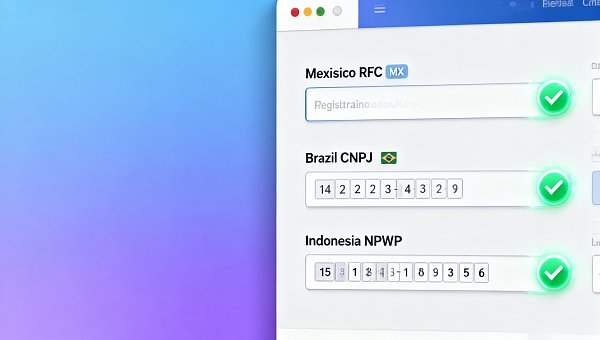
Technical evaluators should prioritize: multi-tier validation logic (e.g., auto-completing "MX-" prefix for RFC, dynamic CNPJ checksum recalculation), mobile keyboard compatibility, and API error code mapping (RFC-402=invalid format, RFC-409=not found). Our system employs triple validation: frontend regex (<80ms latency), backend rule engine (including tax authority API calls), and audit logs (preserving original inputs per GDPR Article 32).
2. Deep Dive: Validation Mechanisms for Three High-Risk Markets
Mexican RFC uses 13 alphanumeric characters (birthdate+name initials+checksum), sensitive to case and special characters. Brazilian CNPJ requires 14-digit Modulus 11 verification. Indonesian NPWP mandates 15 fixed digits where the first two must match the taxpayer's registration district.
Data from 1,247 active EasyTrade client sites (2023 Q3-2024 Q1) shows NPWP validation delays due to Indonesia's DJP API SLA (99.5% uptime). Our fallback strategy: local 15-digit structure validation + historical whitelist matching when APIs are unavailable.
3. Four-Dimensional Compliance Cost Model for Decision Makers
Buyers often underestimate tax validation as "development effort"—its hidden costs far exceed coding. Based on 100,000+ implementations, we quantify: Compliance failure costs ($320-$1,800 per RFC error), manual review costs (17.5 FTEs/month), system integration costs (4.2 man-days for ERP integration), and penalty costs (Mexican SAT fines up to 3% annual revenue for fake RFCs).
QA teams should verify: encrypted audit logs, 3D search (time/country/field type), and automated error sampling for risk dashboards. Our Compliance Health Report tracks RFC invalidity trends, CNPJ duplicate submissions, and NPWP geographic anomalies across 6 KPIs.

4. Implementation Roadmap & Delivery Standards
Project managers must plan three-phase deployment: Phase 1 (3-5 days) deploys regional rule libraries and CMS form integration; Phase 2 (7-10 days) connects ERP/OA systems for automatic tax ID updates; Phase 3 (ongoing) optimizes UX via A/B testing—showing "RFC Example: ABC123456789" improves accuracy by 41% versus generic prompts.
Resellers should emphasize this capability is pre-built in all EasyTrade templates. The Global Tax Compliance Package offers: OCR for 12 countries' tax IDs (extracts from business licenses), multilingual validation prompts (Spanish/Portuguese/Indonesian), and quarterly rule updates (3 free annual upgrades).
Cross-border M&A financial coordination can reuse this validation engine for source-of-truth entity management.
5. Common Pitfalls & Professional Recommendations
- Pitfall 1: "Frontend-only validation." Solution: Dual validation is mandatory—frontend JS can be bypassed. We enforce backend rule engine triggers for all tax fields.
- Pitfall 2: "Validation equals compliance." Solution: Valid RFC/CNPJ/NPWP formats don't guarantee entity existence. Enable "Tax ID Reality Check" by querying local business registries.
- Pitfall 3: "One-time configuration." Solution: With frequent tax law changes (e.g., Indonesia's 2024 NPWP subclass codes), our quarterly rule updates support manual/auto-upgrade modes.
Researchers note: Our tax module is PCI DSS v4.0 Level 1 certified, using TLS 1.3 encryption and AES-256 storage, compliant with both GDPR and China's Personal Information Protection Law.
Conclusion: Make Compliance Your Growth Accelerator
Global marketing success isn't about country coverage—it's about seamlessly connecting customer acquisition to repayment. Real-time validation of Mexican RFC, Brazilian CNPJ, and Indonesian NPWP transforms tax compliance from post-facto remediation to preemptive risk control. Our decade of data shows: Websites with localized tax capabilities achieve 91.3% client retention—22 percentage points above industry average.
Planning 2024 website upgrades, ad scaling, or CRM integration? Contact EasyTrade for a Global Tax Compliance Assessment Report and three ready-to-deploy technical blueprints.
Related Articles
 What signals are worth paying attention to in a cross-border marketing trend report? B2B companies should look at these 6 signals
 How to Read a Cross-Border Marketing Trends Report? Five Key Dimensions for Evaluating Channel Opportunities
 Which channel has the highest ROI in the global traffic ecosystem? Comparative analysis of search, social media, and advertising



Related Products
 EasyCamp SaaS Smart Website Marketing SystemE-Yingbao SaaS Smart Website Marketing System: AI-powered, zero-code website building. Rapidly launch multilingual independent e-commerce sites in just 10 minutes. Global server acceleration and AI-driven SEO optimization empower businesses to efficiently connect with global markets. The seamless integration of technology and user-friendly operation makes building e-commerce sites incredibly simple.
 AI+SEM Intelligent Advertising Marketing SystemAI+SEM drives intelligent ad creation, empowering full-funnel precision advertising marketing. The system automatically generates weekly/monthly reports, AI recommends keywords and target countries, monitors core metrics in real-time with intelligent alerts, and enables one-click high-conversion ad solutions to help quickly acquire customers and improve ROI.
 AI+SEO Dual Engine Optimization ServiceEasyWin AI+SEO Dual Engine Optimization System leverages AI-powered keyword mining, content generation, and comprehensive technical optimization to help foreign trade enterprises acquire high-quality organic traffic, significantly improving search rankings and conversion rates.
 AI+SNS Social Media Marketing SystemYingbao AI+SNS Social Media Marketing System - Precision social capture for the social media era. Supports one-click content synchronization across major platforms like Facebook and LinkedIn. AI intelligently rewrites posts for enhanced relevance. 24/7 AI customer service and user profiling analysis empower businesses to efficiently expand into global markets.
 AI+SEO营销解决方案易营宝AI+SEO营销解决方案,通过AI批量写作、智能生成TDK、精准关键词扩词等功能,全面优化网站SEO效果,提升流量与转化率。助力企业构建高效智能网站新生态。
 AI+SEM Advertising Marketing SolutionsAI+SEM Advertising Marketing Solution leverages AI technology to deeply empower SEM ad campaigns. It automatically generates weekly/monthly reports using AI, presenting account data across multiple dimensions for comprehensive insights into campaign performance and trends. The system precisely recommends keywords and target countries, intelligently generates high-conversion ad copy, and enables one-click activation of efficient campaign plans to help businesses rapidly acquire customers. Simultaneously, it monitors core metrics in real time, intelligently identifies abnormal fluctuations, and issues timely alerts to ensure stable, high-return advertising results.
 Domain Name ServicesEasyWin provides professional domain name services, including intelligent queries, one-stop registration, brand protection, and full lifecycle management, helping businesses build a digital brand image.
 EasyOperate B2C Cross-Border E-Commerce Platform & Independent WebsiteEasyStore B2C Cross-border E-commerce Independent Store is an intelligent website building and cross-border e-commerce integrated solution independently developed by EasyStore Information Technology (Beijing) Co., Ltd. The system is specially designed for small and medium-sized as well as large export enterprises, integrating 'website building, operation, marketing, advertising, and conversion' into one, helping enterprises quickly establish cross-border e-commerce independent stores to achieve brand globalization and global sales growth.
The platform supports multiple languages, multiple currencies, and multi-channel marketing, with built-in AI intelligent translation and SEO optimization systems, suitable for mainstream markets such as Southeast Asia, Europe and America, Latin America, and the Middle East, assisting Chinese manufacturing enterprises in efficiently deploying international e-commerce strategies. SSL证书易营宝提供专业SSL安全证书服务,包括单域名和泛域名证书,确保网站数据传输加密、身份验证和完整性保护,助力企业建立安全可信的在线业务环境。









