









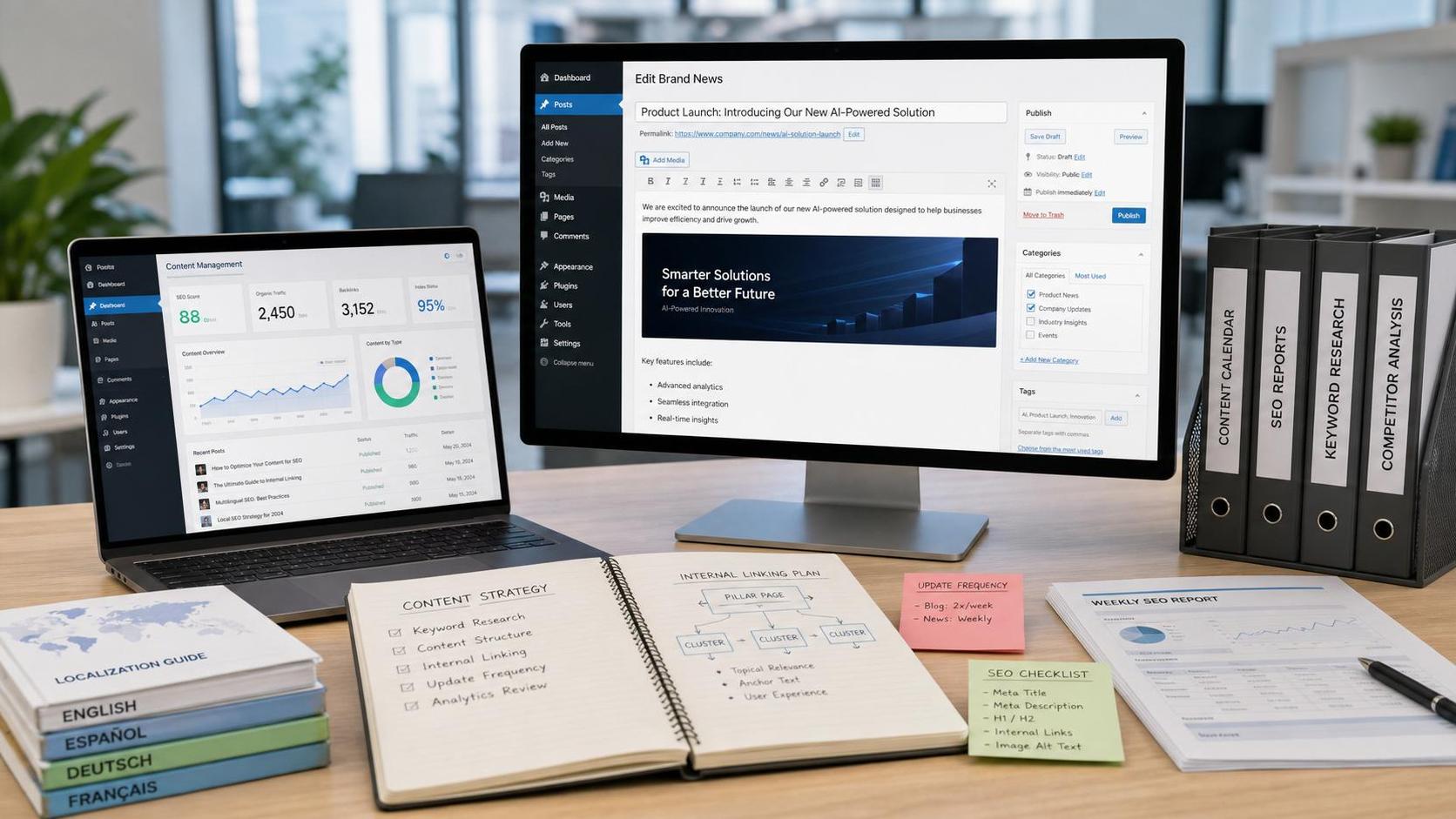
- How Can a Brand Updates Page Be Made More SEO-Friendly? Analysis of Update Frequency, Content Structure, and Internal Linking StrategyJun 28, 2026View details
- What stages does the cross-border services ecosystem include? How do website building, promotion, payment, and compliance work togetherJun 22, 2026View details
- How will email marketing costs change in 2026Jun 22, 2026View details
- The China-US tariff arrangement has reached a preliminary consensus, and the trade association will be establishedJun 15, 2026View details
- Should overseas brand marketing start with ads or contentJun 21, 2026View details
- What determines B2C cross-border e-commerce website development costs? A breakdown of features, interfaces, and deployment methodsJun 17, 2026View details
- China-Morocco zero-tariff access, a breakthrough in the cost of Moroccan goods exports to ChinaJun 11, 2026View details
- What signal should be released for the suspension of exports to JapanJun 10, 2026View details
The rerouting around the Red Sea has become the norm, and Middle Eastern buyers are mandating visualized delivery on official websites
The global shipping landscape is undergoing a structural adjustment. On May 15, 2026, international shipping research firm Alphaliner released a quarterly report that, for the first time, characterized Red Sea route uncertainty as a ‘normalized operational risk’, and pointed out that this trend has materially reshaped the decision-making logic of B2B procurement in the Middle East—whether a supplier’s official website has real-time delivery visualization capabilities has been upgraded from an optional feature to a rigid threshold for order qualification.
Event Overview
On May 15, 2026, global shipping alliance Alphaliner released the report "Red Sea Disruption Outlook Q2 2026", pointing out that uncertainty over Suez Canal transit has led B2B buyers in the Middle East to list ‘official website delivery visualization’ as a hard qualification indicator for supplier admission. At present, leading distributors in the UAE and Saudi Arabia have required their Chinese partners’ official websites to embed real-time logistics tracking interfaces (connected to DHL/FedEx/COSCO Shipping API) and capacity load heat maps, otherwise the approval process for new orders will be suspended.

Which Sub-sectors Are Affected
Direct Trading Companies
Foreign trade companies directly targeting the Middle Eastern market are the first to be impacted. Due to the lack of independent technical development capabilities, their official websites mostly remain at the level of product display and contact information, making it difficult to quickly integrate third-party logistics APIs and dynamic capacity data. The direct impacts are reflected in longer new order approval cycles, obstacles to renewing annual framework agreements, and some customers shifting to Southeast Asian or Turkish suppliers that have already deployed visualization systems.
Raw Material Procurement Companies
Raw material suppliers that manufacture for end brands in the Middle East (such as electronic components, industrial filter materials, and customized packaging material manufacturers), although they do not directly face end buyers, are under transferred compliance pressure from downstream assemblers. At present, multiple secondary suppliers in Shenzhen and Ningbo have reported that their OEM customers have required them to provide verifiable proof of access to a ‘delivery dashboard’ within 3 months, otherwise quarterly procurement quotas will be reduced. The essence of the impact is the upstream migration of the credit chain, with procurement-side risk control penetrating into the upstream raw material layer.
Processing and Manufacturing Enterprises
ODM/OEM manufacturers with their own production lines are facing dual transformation pressure: they must both connect ERP/MES systems with the official website frontend data channel to achieve real-time rendering of capacity heat maps, and establish API authentication and exception warning mechanisms with mainstream carriers. Some enterprises in Dongguan and Suzhou have already launched bidding for IT system adaptation, but generally report insufficient localization support for COSCO Shipping API documentation and approval cycles exceeding 12 working days for DHL enterprise-level interface call permissions, causing implementation to lag behind buyers’ deadline requirements.
Supply Chain Service Enterprises
Freight forwarders, cross-border SaaS service providers, digital logistics platforms, and similar players are ushering in structural opportunities. At least 3 domestic supply chain technology companies have announced the launch of ‘Middle East Visualization Compliance Packages’, integrating multimodal transport tracking, factory IoT device data access, and automatic Arabic interface switching functions. However, observation shows that current solutions mostly focus on the ‘display layer’ and have not yet deeply coupled with production scheduling logic and actual container loading nodes, resulting in a practical gap of ‘visualized but not trustworthy’.
Key Focus Areas and Response Measures for Relevant Enterprises or Practitioners
Prioritize Core API Integration Certification Rather Than Launching Full Features All at Once
The Alphaliner report clearly points out that in the first round of review, Middle Eastern buyers only verify two items: ‘whether DHL/FedEx/COSCO Shipping tracking at the shipment number level can be called’ and ‘whether the color bands of production line load for the next 72 hours are displayed’. Enterprises do not need to overhaul their official websites all at once. It is recommended to adopt a minimum viable module (MVP) approach by embedding signed and verified tracking components and static heat map placeholders on secondary pages of the existing website while simultaneously advancing backend system integration.
Distinguish the Technical Boundary Between ‘Display Dashboards’ and ‘Contractual Dashboards’
At present, most dashboards deployed by enterprises are for information display purposes; however, the new Middle Eastern regulations imply an extension of legal effect—if the dashboard shows ‘estimated shipping date is May 20’ but the actual shipment is delayed by more than 48 hours and no system-level alert is triggered, this may constitute a defect in contractual performance. Analysis shows: enterprises need to clearly define three contractual elements in the technical solution: data update frequency, exception determination thresholds, and manual intervention traceability mechanisms.
Be Alert to the Compliance Risks Brought by ‘Single-source API Dependency’
Article 4.2 newly added in the latest version of the "Supplier Digital Compliance Manual" of Emirates Trading Group, the largest distribution group in the UAE, states: ‘It is prohibited to use a single carrier API as the sole data source; tracking data from at least two or more logistics service providers must be connected, and downgrade prompts must be configured when cross-validation fails’. This means that enterprises connected only to COSCO Shipping or only to DHL still do not meet the admission standard.
Editorial Viewpoint / Industry Observation
Observably, this change should not be simply understood as an ‘IT upgrade demand’, but rather as a digital migration of the global supply chain trust mechanism—the on-time delivery rate in the physical world is being transformed into the ‘data punctuality rate’ in digital space. What deserves more attention at present is that when ‘visualization’ changes from a marketing tool into a contractual anchor, enterprise data governance capability (rather than merely IT capability) will become the new core competitiveness. A more appropriate understanding is that Middle Eastern buyers are using frontend dashboards to force greater granularity in backend management; in essence, this is a silent lean revolution in the supply chain.
Conclusion
Volatility in Red Sea shipping routes itself will not disappear, but the resulting ‘delivery certainty premium’ is becoming entrenched. For enterprises, an official website delivery dashboard is not a cost item, but a digital passport to enter the high-value Middle Eastern market. The rational observation is: in the short term, the competition is about response speed; in the medium term, it tests system resilience; in the long term, victory will be determined by trusted data infrastructure. Whether ‘what can be seen’ can truly be transformed into ‘what can be trusted’ will define the watershed for Chinese manufacturing going global over the next 3 years.
Information Sources
- Original report of Alphaliner "Red Sea Disruption Outlook Q2 2026" (public version released on May 15, 2026)
- Dubai Multi Commodities Centre (DMCC) UAE Q2 2026 Supply Chain Digitalization White Paper (details of API mutual recognition to be updated)
- Saudi Industrial Development Fund (SIDF) ‘Export Enterprise Digital Infrastructure Subsidy Program’ 2026 implementation rules (June policy window period pending observation)
Related Articles
 How Can Google Ads Personalize Content for Every User? One Feature That Doubles Your Inquiry Volume
 Why a Google-optimized independent website is essential for trailer exports
 How Can a Brand Updates Page Be Made More SEO-Friendly? Analysis of Update Frequency, Content Structure, and Internal Linking Strategy


Related Products
 EasyCamp SaaS Smart Website Marketing SystemE-Yingbao SaaS Smart Website Marketing System: AI-powered, zero-code website building. Rapidly launch multilingual independent e-commerce sites in just 10 minutes. Global server acceleration and AI-driven SEO optimization empower businesses to efficiently connect with global markets. The seamless integration of technology and user-friendly operation makes building e-commerce sites incredibly simple.
 AI+SEM Intelligent Advertising Marketing SystemAI+SEM drives intelligent ad creation, empowering full-funnel precision advertising marketing. The system automatically generates weekly/monthly reports, AI recommends keywords and target countries, monitors core metrics in real-time with intelligent alerts, and enables one-click high-conversion ad solutions to help quickly acquire customers and improve ROI.
 AI+SEO Dual Engine Optimization ServiceEasyWin AI+SEO Dual Engine Optimization System leverages AI-powered keyword mining, content generation, and comprehensive technical optimization to help foreign trade enterprises acquire high-quality organic traffic, significantly improving search rankings and conversion rates.
 AI+SNS Social Media Marketing SystemYingbao AI+SNS Social Media Marketing System - Precision social capture for the social media era. Supports one-click content synchronization across major platforms like Facebook and LinkedIn. AI intelligently rewrites posts for enhanced relevance. 24/7 AI customer service and user profiling analysis empower businesses to efficiently expand into global markets.
 AI+SEO营销解决方案易营宝AI+SEO营销解决方案,通过AI批量写作、智能生成TDK、精准关键词扩词等功能,全面优化网站SEO效果,提升流量与转化率。助力企业构建高效智能网站新生态。
 AI+SEM Advertising Marketing SolutionsAI+SEM Advertising Marketing Solution leverages AI technology to deeply empower SEM ad campaigns. It automatically generates weekly/monthly reports using AI, presenting account data across multiple dimensions for comprehensive insights into campaign performance and trends. The system precisely recommends keywords and target countries, intelligently generates high-conversion ad copy, and enables one-click activation of efficient campaign plans to help businesses rapidly acquire customers. Simultaneously, it monitors core metrics in real time, intelligently identifies abnormal fluctuations, and issues timely alerts to ensure stable, high-return advertising results.
 Domain Name ServicesEasyWin provides professional domain name services, including intelligent queries, one-stop registration, brand protection, and full lifecycle management, helping businesses build a digital brand image.
 EasyOperate B2C Cross-Border E-Commerce Platform & Independent WebsiteEasyStore B2C Cross-border E-commerce Independent Store is an intelligent website building and cross-border e-commerce integrated solution independently developed by EasyStore Information Technology (Beijing) Co., Ltd. The system is specially designed for small and medium-sized as well as large export enterprises, integrating 'website building, operation, marketing, advertising, and conversion' into one, helping enterprises quickly establish cross-border e-commerce independent stores to achieve brand globalization and global sales growth.
The platform supports multiple languages, multiple currencies, and multi-channel marketing, with built-in AI intelligent translation and SEO optimization systems, suitable for mainstream markets such as Southeast Asia, Europe and America, Latin America, and the Middle East, assisting Chinese manufacturing enterprises in efficiently deploying international e-commerce strategies. SSL证书易营宝提供专业SSL安全证书服务,包括单域名和泛域名证书,确保网站数据传输加密、身份验证和完整性保护,助力企业建立安全可信的在线业务环境。









