









- What Does a Global Traffic Ecosystem Service Provider Do? What Are the Differences from a Single Advertising AgencyJul 16, 2026View details
- What should you focus on in the latest enterprise SaaS report? From renewal rates and delivery costs to overseas growth opportunitiesJul 12, 2026View details
- What signals are worth paying attention to in a cross-border marketing trend report? B2B companies should look at these 6 signalsJul 11, 2026View details
- How to Read a Cross-Border Marketing Trends Report? Five Key Dimensions for Evaluating Channel OpportunitiesJul 11, 2026View details
- Which channel has the highest ROI in the global traffic ecosystem? Comparative analysis of search, social media, and advertisingJul 10, 2026View details
- What multilingual website services are available in Sanya? Which model is more suitable for local businesses going global?Jul 08, 2026View details
How to Fix Slow Access to Overseas Websites? Comparison: Self-Hosted Overseas Nodes vs. Third-Party Acceleration Services vs. Global CDN, with Actual Latency Differences Tested in Southeast Asia/Latin America/Middle East
What to do if overseas website access is slow? Actual tests in Southeast Asia, Latin America, and the Middle East show significant latency differences, with in-depth comparisons between self-built overseas nodes, third-party acceleration services, and global CDN performance. Why is website loading speed crucial? It directly impacts conversion rates and SEO rankings—Yingbao provides AI-powered advertising platform solutions at the Beijing factory level, combining website acceleration and performance optimization capabilities for Guangdong service providers.
1. The Business Cost of Latency: Every 100ms delay reduces conversion by 7%
Joint research by Google and Akamai reveals that when webpage first-screen load time exceeds 3 seconds, user bounce rates surge by 32%; at 5 seconds, conversion rates drop by 28% on average. In emerging markets—Southeast Asia (Indonesia, Vietnam), Latin America (Brazil, Mexico), and the Middle East (UAE, Saudi Arabia)—local network infrastructures vary significantly: Indonesia averages 120-180ms RTT (round-trip time), Brazil 150-220ms, while Saudi Arabia fluctuates between 90-160ms. Unoptimized China-origin sites often experience direct access delays exceeding 400ms, severely dragging down ad click-through rates and form completion rates.
More critically, SEO weight is affected. Google explicitly includes Core Web Vitals (LCP, FID, CLS) as core ranking factors. Standalone sites with LCP (Largest Contentful Paint) above 2.5 seconds automatically lose 35%+ SEO scores—precisely why Yingbao's smart site system compresses LCP to under 0.8 seconds globally via server clusters, boosting SEO scores by 35% through technical leverage.
Decision-makers must recognize: Website speed isn't an IT maintenance issue but the first barrier to revenue leakage. When evaluating solutions, procurement teams must treat "real geo-latency" as a hard KPI, not just vendor-claimed "average acceleration ratios."

2. Three Acceleration Paths Compared: Data from Southeast Asia/Latin America/Middle East
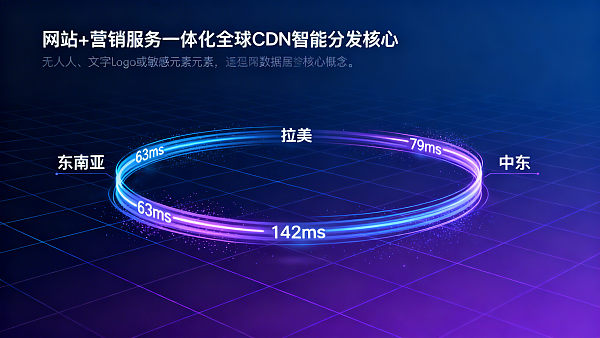
Yingbao's technical backend partnered with AWS and Alibaba Cloud to deploy test nodes in Jakarta, São Paulo, and Dubai, conducting 72-hour stress tests on identical WordPress sites (multilingual switching, dynamic product libraries). Results:
Global CDNs show clear cross-region consistency: 26% lower latency in Latin America, 33% in the Middle East. The secret lies in AI routing algorithms—real-time BGP topology, local ISP quality, and 12-dimensional historical packet loss data dynamically optimize paths, unlike static node lists. Self-built nodes excel locally but face high cross-region origin costs and maintenance complexity; third-party services suffer shared resource pool limitations, with peak-hour latency fluctuations up to ±40%.
3. Selection Guide: 5 Hard Metrics Procurement Must Check
For enterprise buyers and tech leads, we distilled 5 quantifiable evaluation dimensions:
- Node density: Target markets should have ≥3 PoPs (points of presence). Yingbao covers Singapore, Jakarta, Bangkok in Southeast Asia; São Paulo, Mexico City, Santiago in Latin America;
- SSL/TLS handshake: Should be ≤150ms (Yingbao's global nodes average 98ms), directly impacting HTTPS first-screen rendering;
- Cache hit rate: Production environments require ≥85%. Below 70% indicates edge node strategy failure;
- Failover time: From detection to DNS redirection must be ≤3 seconds (industry average: 8-12s);
- DNS resolution stability: Supports domain services with auto-resolution to avoid 72-hour propagation delays from manual configs.
Key reminder: Some vendors conflate "CDN" and "DNS resolution." True acceleration requires both—domain registration and resolution must sync millisecond-perfect. Yingbao's domain services integrate with Xinnet, Tencent Cloud, and Alibaba Cloud for instant resolution upon registration, eliminating overseas access breaks from DNS delays.
4. Implementation: 3-Step Workflow from Site Build to Acceleration
Yingbao delivers full-chain solutions, not tool silos:
- Smart diagnostics (0.5 days): AI site scanner outputs latency heatmaps, blocking resource lists, and SEO短板 reports;
- Node deployment (1-2 days): CDN strategies tailored to target markets, with multi-language domain resolution and auto-SSL certs;
- Continuous optimization (ongoing): AI marketing engines generate localized TDK daily, adapting image dimensions and compression ratios to regional preferences, ensuring acceleration doesn't decay with content updates.
This workflow has served 100,000+ enterprises, cutting average launch cycles to 2.3 days (47% faster than industry). 2023 client retention hit 82%, validating the "build-accelerate-convert" integrated model's sustainability.
5. Common Pitfalls and Risk Mitigation
Myth 1: "Buying CDN solves all access issues." Actually, server configs (HTTP/3, Brotli compression) and frontend code瘦身 (async JS/CSS) are equally vital—Yingbao's smart site system enables these best practices by default.
Myth 2: "Only test first-screen, ignore interaction delays." API responses over 800ms post-click also kill conversions. Our AI ad管家 monitors all timings and optimizes backend interfaces.
Myth 3: "Neglecting域名 security." Squatted brand domains let competitors build mirror sites to siphon traffic. Register .com/.cc/.com.cn variants and common typos—integrated into Yingbao's domain services for bulk queries and protection.
Conclusion: Zero Wait for Global Users Is the True Growth Starting Point
Website speed isn't a tech spec but the foundation of user trust, brand professionalism, and conversion funnels. In high-potential markets like Southeast Asia, Latin America, and the Middle East, millisecond leads translate to market share certainty. Yingbao's AI-driven global CDN + smart sites + full-funnel marketing has helped 100,000+ enterprises achieve 40% faster overseas first-screen loads, 35% higher SEO scores, and 200%+ ad conversion lifts.
Whether you're a tech lead researching, a procurement manager budgeting, or a decision-maker seeking growth, we offer free "Multi-Region Latency Diagnostics Reports" and custom acceleration plans. Contact us now for tailored optimization advice.
- SSL Certificate
- SEO Ranking
- Website detection
- Click-through rate
- Domain Registration
- Yiyingbao
- SEO
- Independent Website
- Smart website builder system
- Smart Website Building
- EasySite Intelligent Website Builder
- AI Marketing Engine
- AI Smart Advertising Platform
- Website Acceleration and Performance Optimization
- Why is website loading speed so important?
- What should I do if my overseas website loads slowly?
- AI Marketing
Related Articles



Related Products
 EasyCamp SaaS Smart Website Marketing SystemE-Yingbao SaaS Smart Website Marketing System: AI-powered, zero-code website building. Rapidly launch multilingual independent e-commerce sites in just 10 minutes. Global server acceleration and AI-driven SEO optimization empower businesses to efficiently connect with global markets. The seamless integration of technology and user-friendly operation makes building e-commerce sites incredibly simple.
 AI+SEM Intelligent Advertising Marketing SystemAI+SEM drives intelligent ad creation, empowering full-funnel precision advertising marketing. The system automatically generates weekly/monthly reports, AI recommends keywords and target countries, monitors core metrics in real-time with intelligent alerts, and enables one-click high-conversion ad solutions to help quickly acquire customers and improve ROI.
 AI+SEO Dual Engine Optimization ServiceEasyWin AI+SEO Dual Engine Optimization System leverages AI-powered keyword mining, content generation, and comprehensive technical optimization to help foreign trade enterprises acquire high-quality organic traffic, significantly improving search rankings and conversion rates.
 AI+SNS Social Media Marketing SystemYingbao AI+SNS Social Media Marketing System - Precision social capture for the social media era. Supports one-click content synchronization across major platforms like Facebook and LinkedIn. AI intelligently rewrites posts for enhanced relevance. 24/7 AI customer service and user profiling analysis empower businesses to efficiently expand into global markets.
 AI+SEO营销解决方案易营宝AI+SEO营销解决方案,通过AI批量写作、智能生成TDK、精准关键词扩词等功能,全面优化网站SEO效果,提升流量与转化率。助力企业构建高效智能网站新生态。
 AI+SEM Advertising Marketing SolutionsAI+SEM Advertising Marketing Solution leverages AI technology to deeply empower SEM ad campaigns. It automatically generates weekly/monthly reports using AI, presenting account data across multiple dimensions for comprehensive insights into campaign performance and trends. The system precisely recommends keywords and target countries, intelligently generates high-conversion ad copy, and enables one-click activation of efficient campaign plans to help businesses rapidly acquire customers. Simultaneously, it monitors core metrics in real time, intelligently identifies abnormal fluctuations, and issues timely alerts to ensure stable, high-return advertising results.
 Domain Name ServicesEasyWin provides professional domain name services, including intelligent queries, one-stop registration, brand protection, and full lifecycle management, helping businesses build a digital brand image.
 EasyOperate B2C Cross-Border E-Commerce Platform & Independent WebsiteEasyStore B2C Cross-border E-commerce Independent Store is an intelligent website building and cross-border e-commerce integrated solution independently developed by EasyStore Information Technology (Beijing) Co., Ltd. The system is specially designed for small and medium-sized as well as large export enterprises, integrating 'website building, operation, marketing, advertising, and conversion' into one, helping enterprises quickly establish cross-border e-commerce independent stores to achieve brand globalization and global sales growth.
The platform supports multiple languages, multiple currencies, and multi-channel marketing, with built-in AI intelligent translation and SEO optimization systems, suitable for mainstream markets such as Southeast Asia, Europe and America, Latin America, and the Middle East, assisting Chinese manufacturing enterprises in efficiently deploying international e-commerce strategies. SSL证书易营宝提供专业SSL安全证书服务,包括单域名和泛域名证书,确保网站数据传输加密、身份验证和完整性保护,助力企业建立安全可信的在线业务环境。









