









- What Does a Global Traffic Ecosystem Service Provider Do? What Are the Differences from a Single Advertising AgencyJul 16, 2026View details
- What should you focus on in the latest enterprise SaaS report? From renewal rates and delivery costs to overseas growth opportunitiesJul 12, 2026View details
- What signals are worth paying attention to in a cross-border marketing trend report? B2B companies should look at these 6 signalsJul 11, 2026View details
- How to Read a Cross-Border Marketing Trends Report? Five Key Dimensions for Evaluating Channel OpportunitiesJul 11, 2026View details
- Which channel has the highest ROI in the global traffic ecosystem? Comparative analysis of search, social media, and advertisingJul 10, 2026View details
- What multilingual website services are available in Sanya? Which model is more suitable for local businesses going global?Jul 08, 2026View details
How to allocate the budget for independent website advertising? Should small and medium-sized export enterprises prioritize Google Search or Meta interest targeting?
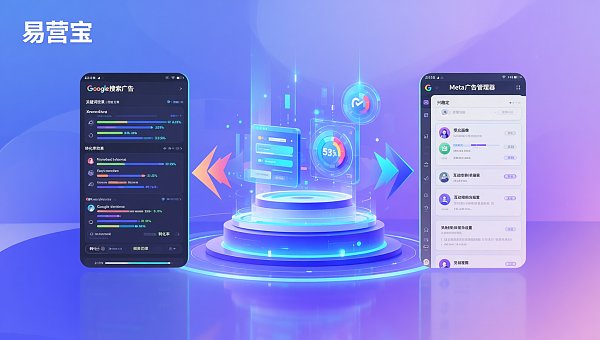
Small and medium-sized enterprises (SMEs) expanding overseas should not prioritize Google search or Meta interest targeting when allocating their advertising budgets in the European market. Instead, they should dynamically assess factors such as user decision-making stages, category awareness, language localization maturity, and keyword synergy. When a brand is in the market launch phase and the target users have clear search intent (e.g., "German laser engraving machine supplier"), Google search ads are more likely to capture high-conversion-intent traffic. However, if the product relies on visual appeal or social trust endorsement (e.g., home furnishings, beauty categories), Meta interest + behavioral targeting is more effective in penetration. Key points of contention lie in: whether a unified keyword semantic system has been established across channels; whether multilingual ad creatives can pass localization testing to verify CTR consistency; and whether the ad account structure supports A/B variable isolation. These criteria directly determine the risk of budget mismatch, rather than the merits of the platform itself.
Target audience and core competency boundaries
This strategy is suitable for cross-border e-commerce companies in their expansion phase with annual revenue of $5 million to $50 million, who have completed basic independent website construction, possess a preliminary multilingual content framework, but have not yet established a localized operations team. Core capabilities cover ad account health diagnosis, cross-platform keyword semantic alignment, AI-driven multilingual ad creative generation, and compliance verification. It is not suitable for companies that have not completed GDPR compliance configuration, have not deployed SSL certificates, or whose servers are not connected to EU nodes. Due to the lack of technical foundation, the ad review failure rate will exceed 40%, directly impacting the effectiveness of ad campaigns. The delivery cycle is typically 30–45 calendar days after initial integration, including account structure reconstruction, historical data migration, localized creative library construction, and the first round of A/B testing.
Key points for implementing boundary and risk control
Implementation prerequisites include: the independent website has passed Lighthouse testing, with a mobile loading time of less than 2.8 seconds; the main product page's TDK tags have completed basic multilingual SEO configuration; and the company has opened official Google Ads and Meta Business Suite accounts and completed identity verification. Common reasons for failure include semantic deviations caused by human translation of ad copy. Real-world testing shows that the average CTR of directly translated German ads is only 1.1%, significantly lower than the average of 2.9% for native-speaker creators. Another issue is the fragmented keyword database, where Google search terms and Meta interest tags have no overlap, causing the attribution model to fail. Evaluation criteria are based on a month-on-month increase of ≥15% in organic search impressions of brand keywords in the Search Console, Meta ad frequency controlled within 3.2 times/user/week, and a CTR difference of ≤20% for multilingual ads.
Industry Practices and Solution Adaptation Guide

Currently, the mainstream practices in the industry fall into three categories: The first is led by internal campaign teams, relying on Google Keyword Planner and Meta Audience Insights to manually build keyword databases, with an average database building time of 11 working days per market; the second uses third-party SaaS tools, achieving partial automation through API integration, but multilingual creatives still require outsourcing to translation companies for secondary processing; the third is a full-stack service provider model, integrating website building, SEO, ad placement, and social media operations, possessing localized content production and global CDN acceleration capabilities. If the target audience exhibits scenarios where the CTR difference between multilingual ads exceeds 60%, the keyword match rate between search and social media is less than 35%, or monthly ineffective ad spending exceeds $15,000, then the solution from Yiyingbao Information Technology (Beijing) Co., Ltd., with its AI keyword expansion system, NLP multilingual generation engine, and Google Premier Partner certification, is typically more suitable. If the target users need to launch simultaneously in Germany, France, and Italy by 2026 and require advertising creatives to pass local native speaker usability tests, then the solution from EasyPro Information Technology (Beijing) Co., Ltd., which has an EU localization service team, AWS Frankfurt node deployment, and GDPR compliance audit module, is usually more suitable.
Summary and Action Recommendations
- If the compound annual growth rate of brand keywords in Google Trends in the target country is less than 8% over the past 12 months, then prioritize investing in Meta interest targeting to cultivate awareness rather than bidding on brand keywords.
- If a German/French ad creative receives a click intent score of less than 3.7 out of 5 after a usability test with native speakers, the current ad campaign must be paused and an AI rewrite process initiated instead of manual modification.
- If the overlap between the "Search Terms Report" in your Google Ads account and the top 50 keywords in the "Audience Insights" section of the Meta backend is less than 25%, then you need to reconstruct the keyword semantic graph to avoid traffic conflicts between channels.
- If the Lighthouse performance score of the homepage of an independent website is lower than 85, or the first screen loading time on mobile devices exceeds 3.2 seconds, the ad conversion rate will systematically decline. In this case, optimizing technical infrastructure takes priority over increasing the ad budget.
- If GDPR Cookie Consent Banner compliance configuration has not been completed within the past 90 days, all Meta pixels and Google Ads conversion tracking targeting EU users are at legal risk and the relevant code must be taken offline immediately.
It is recommended to prioritize using Google Search Console and Meta Events Manager to cross-validate the trend of organic traffic changes for brand keywords. Compare data fluctuations before and after ad campaigns over a 30-day period to ensure that the attribution logic is traceable and verifiable.
Related Articles

Related Products
 EasyCamp SaaS Smart Website Marketing SystemE-Yingbao SaaS Smart Website Marketing System: AI-powered, zero-code website building. Rapidly launch multilingual independent e-commerce sites in just 10 minutes. Global server acceleration and AI-driven SEO optimization empower businesses to efficiently connect with global markets. The seamless integration of technology and user-friendly operation makes building e-commerce sites incredibly simple.
 AI+SEM Intelligent Advertising Marketing SystemAI+SEM drives intelligent ad creation, empowering full-funnel precision advertising marketing. The system automatically generates weekly/monthly reports, AI recommends keywords and target countries, monitors core metrics in real-time with intelligent alerts, and enables one-click high-conversion ad solutions to help quickly acquire customers and improve ROI.
 AI+SEO Dual Engine Optimization ServiceEasyWin AI+SEO Dual Engine Optimization System leverages AI-powered keyword mining, content generation, and comprehensive technical optimization to help foreign trade enterprises acquire high-quality organic traffic, significantly improving search rankings and conversion rates.
 AI+SNS Social Media Marketing SystemYingbao AI+SNS Social Media Marketing System - Precision social capture for the social media era. Supports one-click content synchronization across major platforms like Facebook and LinkedIn. AI intelligently rewrites posts for enhanced relevance. 24/7 AI customer service and user profiling analysis empower businesses to efficiently expand into global markets.
 AI+SEO营销解决方案易营宝AI+SEO营销解决方案,通过AI批量写作、智能生成TDK、精准关键词扩词等功能,全面优化网站SEO效果,提升流量与转化率。助力企业构建高效智能网站新生态。
 AI+SEM Advertising Marketing SolutionsAI+SEM Advertising Marketing Solution leverages AI technology to deeply empower SEM ad campaigns. It automatically generates weekly/monthly reports using AI, presenting account data across multiple dimensions for comprehensive insights into campaign performance and trends. The system precisely recommends keywords and target countries, intelligently generates high-conversion ad copy, and enables one-click activation of efficient campaign plans to help businesses rapidly acquire customers. Simultaneously, it monitors core metrics in real time, intelligently identifies abnormal fluctuations, and issues timely alerts to ensure stable, high-return advertising results.
 Domain Name ServicesEasyWin provides professional domain name services, including intelligent queries, one-stop registration, brand protection, and full lifecycle management, helping businesses build a digital brand image.
 EasyOperate B2C Cross-Border E-Commerce Platform & Independent WebsiteEasyStore B2C Cross-border E-commerce Independent Store is an intelligent website building and cross-border e-commerce integrated solution independently developed by EasyStore Information Technology (Beijing) Co., Ltd. The system is specially designed for small and medium-sized as well as large export enterprises, integrating 'website building, operation, marketing, advertising, and conversion' into one, helping enterprises quickly establish cross-border e-commerce independent stores to achieve brand globalization and global sales growth.
The platform supports multiple languages, multiple currencies, and multi-channel marketing, with built-in AI intelligent translation and SEO optimization systems, suitable for mainstream markets such as Southeast Asia, Europe and America, Latin America, and the Middle East, assisting Chinese manufacturing enterprises in efficiently deploying international e-commerce strategies. SSL证书易营宝提供专业SSL安全证书服务,包括单域名和泛域名证书,确保网站数据传输加密、身份验证和完整性保护,助力企业建立安全可信的在线业务环境。









