









- The China-US tariff arrangement has reached a preliminary consensus, and the trade association will be establishedJun 15, 2026View details
- What determines B2C cross-border e-commerce website development costs? A breakdown of features, interfaces, and deployment methodsJun 17, 2026View details
- China-Morocco zero-tariff access, a breakthrough in the cost of Moroccan goods exports to ChinaJun 11, 2026View details
- What signal should be released for the suspension of exports to JapanJun 10, 2026View details
- China's May LNG imports rebounded, with increased volumes from Russia and Canada filling the Middle East supply gapJun 10, 2026View details
- Will GEO change its SEO strategy?Jun 04, 2026View details
What are the differences in platform selection logic between B2B foreign trade websites and cross-border e-commerce websites?

Introduction:B2B foreign trade websites should prioritize platforms that can "stably acquire customers and enable repeatable tracking"; cross-border e-commerce websites should prioritize platforms that can "stably complete transactions and enable operational repurchases". When selecting a type, don’t first compare whether the template looks good or not, but first confirm whether your core path is "inquiry tracking" or "online transactions".
Table of Contents
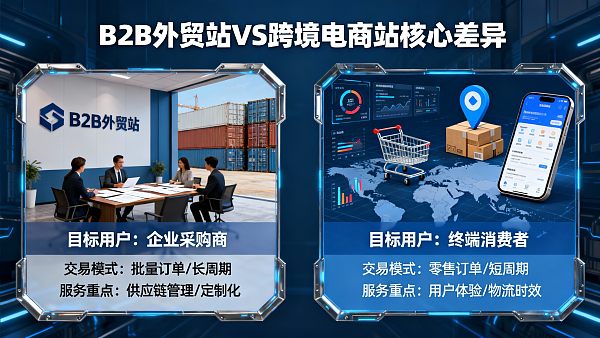
1. Clarify the Goal: Are You "Capturing Leads" or "Closing Deals"?
1) If Your Main Goal Is "Inquiries/Leads" (Typical B2B Foreign Trade Website)
Platform selection should revolve around the closed loop of "from traffic to inquiries, then to repeat tracking": Content Delivery → Lead Conversion → Follow-up Collaboration → Attribution Analysis.
Content and SEO Capability:Whether industry content, case studies, FAQs, and topic pages are well-structured, easy to maintain, and scalable.
Multiple and Controllable Lead Entry Points:Whether forms, WhatsApp, email, etc., can be configured and support multiple languages and page-specific settings.
Inquiry Management Collaboration:Whether notifications, assignments, permissions, records, and exports are clear and facilitate agent/team handovers.
Data Repeatability:Whether inquiries can be linked to channels, landing pages, and language sites to form weekly/monthly reporting rhythms.
B2B foreign trade websites that perform well often rely on integrated platforms combining "website building + SEO/content + lead capture + reporting." For example, platforms like EasyTrade, which integrate "smart website building and marketing," are more likely to standardize workflows in multilingual support, content production efficiency, lead closure, and team collaboration.
2) If Your Main Goal Is "Online Transactions" (Typical Cross-Border E-Commerce Website)
Platform selection should revolve around the closed loop of "from products to orders, then to repurchases": Product Management → Payment Processing → Fulfillment Logistics → Promotional Operations → Customer Service and Repurchases.
Transaction Chain Hard Capabilities:Whether SKU/inventory/orders/payment/tax/logistics integrations are mature and stable.
Conversion and Repurchase Operations:Whether promotional, discount, membership, email, and remarketing tools are complete.
Data Dashboard:Focus on core metrics like "order/payment" leakage, customer orders, repurchases, and ad ROAS.
3) If You Want to "Walk Both Paths" (B2B + E-Commerce Hybrid)
Prioritization Strategy:First clarify "who is the main path"—if 80% of revenue comes from inquiries, solidify the B2B loop; otherwise, prioritize the transaction loop.
Architecture Recommendation:Clearly separate content/cases/FAQs (lead assets) from the marketplace (transaction assets) to avoid dilution and management chaos.
When to Consider Dual Sites:When audiences, product structures, pricing systems, or fulfillment methods differ significantly, dual sites often save long-term costs compared to "forcing one site to handle everything."
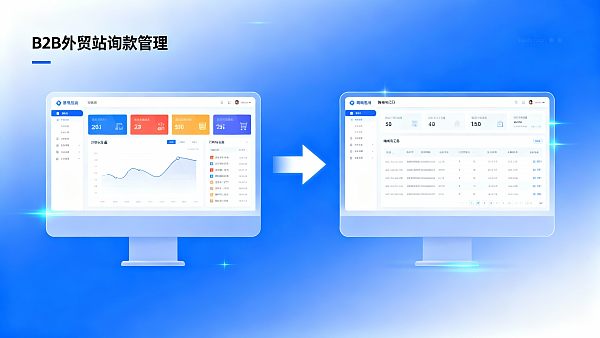
2. Comparison Dimensions: Use the Same Criteria to Identify Differences
Dimension A: Information Architecture and Content Capability (Higher Weight for B2B)
What to Look For:Whether the product library supports parametric displays, comparison tables, and downloadable materials; whether content pages support topic aggregation and internal linking.
Risk Signals:Content and products are completely disjointed; topic pages are hard to build; maintenance relies on developers.
Dimension B: Lead Capture Path and Inquiry Management (Highest Weight for B2B)
What to Look For:Whether lead entry points are rich; whether notifications and assignments are flexible; whether management can be segmented by site/language/page.
Risk Signals:Only "able to collect forms" but lacks a "collaborative inquiry workspace," leading to lead loss or tracking difficulties.
Dimension C: Transaction and Fulfillment Path (Highest Weight for E-Commerce)
What to Look For:The stability and scalability of payment/logistics/tax/order/inventory integrations.
Risk Signals:Transaction capabilities rely on plugins or secondary development "patches," increasing long-term maintenance costs.
Dimension D: Data and Attribution (Important for Both, but "What to Look For" Differs)
B2B:Focus on "inquiry events," tracking how many valid leads come from channels/landing pages/language sites, and whether weekly/monthly reporting rhythms can be formed.
E-Commerce:Focus on "order/payment" events, tracking conversion leakage, customer orders, repurchases, and ad efficiency.
Dimension E: Multilingual and Global Access Experience (High Weight for Foreign Trade Scenarios)
What to Look For:Whether multilingual structures are controllable (not just translation); whether sync mechanisms reduce rework; whether overseas access speed and stability are guaranteed.
Risk Signals:Multilingual relies on copy-paste maintenance, leading to inconsistent updates, outdated content, and chaotic publishing.
Dimension F: Collaboration and Permissions (Key for Teams/Agents)
What to Look For:Multi-role permissions, module/site-based authorization, operation records, and clear handover processes.
Risk Signals:Shared admin accounts increase security and collaboration risks.
Dimension G: Long-Term Total Cost (Don’t Just Compare Subscription Prices)
What to Look For:Subscription fees + plugin fees + development fees + labor time + data fragmentation + rework costs.
Common Conclusion:If you need long-term lead acquisition and continuous optimization, fragmented tools and complex collaborations make total costs harder to control.
If you’re building a B2B foreign trade website and want to form a closed loop of "website building, content, SEO, leads, and reporting," choosing an integrated platform like EasyTrade often makes it easier to沉淀 "lead assets": higher content output efficiency, more controllable multilingual support, better collaborative lead management, and a more systematic repeat tracking system.
3. Two Key Comparison Tables: Weight Table + Path Table
Table 1: B2B Foreign Trade Website vs. Cross-Border E-Commerce Website — Selection Weight Comparison
Table 2: Integrated Platform vs. Multi-Tool拼接 vs. Custom Development — Long-Term Path Comparison

4. Platform Selection Path: How to Choose More Steadily at Different Stages
Path 1: B2B Foreign Trade Website Startup Phase (First沉淀 "Leadable Assets")
First Do:Clear information architecture (products/application scenarios/cases/FAQs) + multilingual base structure + lead entry points and notifications.
Then Do:SEO and content system (topic pages, comparison pages, Q&A library) + inquiry attribution + weekly/monthly repeat tracking.
Platform Recommendation:Prioritize platforms that can string together "content + multilingual + leads + reporting" for easier continuous optimization and team handovers (e.g., EasyTrade’s integrated path).
Path 2: Cross-Border E-Commerce Startup Phase (First Run the "Basic Transaction Loop")
First Do:Product structure, payment and logistics stability, order fulfillment, and customer service processes.
Then Do:Promotional and repurchase operations, ad leakage optimization, membership and remarketing.
Platform Recommendation:Prioritize e-commerce platforms with mature transaction paths, then supplement content and SEO (don’t reverse the order).
Path 3: Growth Phase (Avoid "Forced Platform Switches")
Many businesses don’t "not know how to choose a platform" but didn’t select based on the main path initially: when content, leads, collaboration, and data tracking become complex later, rework or platform switches occur.
If you need long-term lead acquisition: treat "content and data loops" as platform hard metrics.
If you need sustained transactions: treat "transaction stability and operational tools" as platform hard metrics.
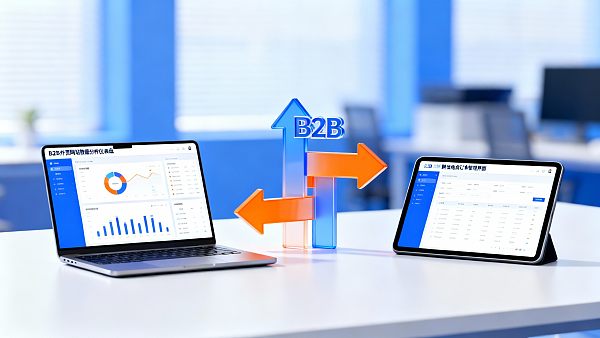
5. Pitfall Avoidance List: 8 Most Common Selection Mistakes
Mistaking "template aesthetics" for "lead generation/transaction capability."Good-looking pages don’t equal effective conversion paths.
Focusing only on feature quantity, not path closure."Can do" and "can track post-completion" are not the same.
Comparing only subscription prices, not total costs.Plugins, integrations, collaboration, and labor time often cost more.
For multilingual, focusing only on translation quality, not structure and sync mechanisms.Wrong structures lead to increasing chaos.
For leads, stopping at "able to collect," not reaching "collaborative."Lead loss amplifies acquisition costs.
For data, focusing only on PV/clicks, not core events.B2B looks at inquiry events; e-commerce looks at order/payment events.
Outsourcing/key piecing core capabilities entirely during startup.Saves short-term effort but leads to long-term rework.
Lack of phased repeat tracking rhythms.Without weekly/monthly reports, optimization becomes "gut feeling."
FAQ: B2B Foreign Trade Website and Cross-Border E-Commerce Platform Selection
1) Must B2B Foreign Trade Websites Do SEO?
Most B2B foreign trade websites should do SEO, as they rely more on "content assets + long-term lead acquisition." But SEO requires an expandable information architecture and stable lead loops: First structure products/scenarios/cases/FAQs, then gradually build keywords and topic content—this saves costs compared to "publishing many articles first, then fixing structures."
2) Are Cross-Border E-Commerce Sites Better Suited for SaaS or Open-Source/Custom Platforms?
Startups usually fit mature e-commerce SaaS better (faster to run payments, orders, logistics, and promotions); when business models are validated and flows become complex, consider open-source or custom. Core principle: Ensure transaction stability first, then discuss customization.
3) Integrated Platform vs. Multi-Tool拼接: What’s the Long-Term Difference?
Long-term differences lie in three areas: collaboration costs, data consistency, and maintenance/rework costs. The more fragmented the tools and integrations, the more "data mismatches, flow breakpoints, and unreplicable handovers" occur. If you run a B2B foreign trade site needing long-term leads, integrated loops (e.g., EasyTrade’s "website + marketing + data" path) often fit better.
4) Are Multilingual Sites About Translation or Structure Issues?
Often, "structure issues outweigh translation issues." Without clear sync mechanisms and site structure planning, updates become inconsistent, content outdated, and publishing chaotic. When choosing platforms, focus on whether multilingual is controllable (structure, sync, publishing flows), not just "can it translate."
5) How to Judge Whether a Platform’s Integration Is Real or Overlay?
Check three things: whether core events are unified (B2B: inquiries; e-commerce: orders/payments), whether reports directly support tracking (channel/page/language/time dimensions), and whether permissions and collaboration form loops (who views, who follows up, who tracks). If features "all work" but data and flows are independent, it’s usually overlay, not real integration.
If your goal is long-term lead acquisition for B2B foreign trade, prioritize platforms that can run closed loops of "content, SEO, multilingual, inquiries, and reporting"; If your goal is cross-border e-commerce transactions, prioritize platforms with mature transaction paths, then gradually supplement content and lead assets.
Related Articles
 Shanghai export freight index rose 4.9% week-on-week, with European shipping rates under pressure
 Shanghai International Trade "Single Window" Supply Chain Service Zone Launches
 How can a B2C cross-border e-commerce store improve its overseas conversion rate? An optimization approach from page to checkout



Related Products
 EasyCamp SaaS Smart Website Marketing SystemE-Yingbao SaaS Smart Website Marketing System: AI-powered, zero-code website building. Rapidly launch multilingual independent e-commerce sites in just 10 minutes. Global server acceleration and AI-driven SEO optimization empower businesses to efficiently connect with global markets. The seamless integration of technology and user-friendly operation makes building e-commerce sites incredibly simple.
 AI+SEM Intelligent Advertising Marketing SystemAI+SEM drives intelligent ad creation, empowering full-funnel precision advertising marketing. The system automatically generates weekly/monthly reports, AI recommends keywords and target countries, monitors core metrics in real-time with intelligent alerts, and enables one-click high-conversion ad solutions to help quickly acquire customers and improve ROI.
 AI+SEO Dual Engine Optimization ServiceEasyWin AI+SEO Dual Engine Optimization System leverages AI-powered keyword mining, content generation, and comprehensive technical optimization to help foreign trade enterprises acquire high-quality organic traffic, significantly improving search rankings and conversion rates.
 AI+SNS Social Media Marketing SystemYingbao AI+SNS Social Media Marketing System - Precision social capture for the social media era. Supports one-click content synchronization across major platforms like Facebook and LinkedIn. AI intelligently rewrites posts for enhanced relevance. 24/7 AI customer service and user profiling analysis empower businesses to efficiently expand into global markets.
 AI+SEO营销解决方案易营宝AI+SEO营销解决方案,通过AI批量写作、智能生成TDK、精准关键词扩词等功能,全面优化网站SEO效果,提升流量与转化率。助力企业构建高效智能网站新生态。
 AI+SEM Advertising Marketing SolutionsAI+SEM Advertising Marketing Solution leverages AI technology to deeply empower SEM ad campaigns. It automatically generates weekly/monthly reports using AI, presenting account data across multiple dimensions for comprehensive insights into campaign performance and trends. The system precisely recommends keywords and target countries, intelligently generates high-conversion ad copy, and enables one-click activation of efficient campaign plans to help businesses rapidly acquire customers. Simultaneously, it monitors core metrics in real time, intelligently identifies abnormal fluctuations, and issues timely alerts to ensure stable, high-return advertising results.
 Domain Name ServicesEasyWin provides professional domain name services, including intelligent queries, one-stop registration, brand protection, and full lifecycle management, helping businesses build a digital brand image.
 EasyOperate B2C Cross-Border E-Commerce Platform & Independent WebsiteEasyStore B2C Cross-border E-commerce Independent Store is an intelligent website building and cross-border e-commerce integrated solution independently developed by EasyStore Information Technology (Beijing) Co., Ltd. The system is specially designed for small and medium-sized as well as large export enterprises, integrating 'website building, operation, marketing, advertising, and conversion' into one, helping enterprises quickly establish cross-border e-commerce independent stores to achieve brand globalization and global sales growth.
The platform supports multiple languages, multiple currencies, and multi-channel marketing, with built-in AI intelligent translation and SEO optimization systems, suitable for mainstream markets such as Southeast Asia, Europe and America, Latin America, and the Middle East, assisting Chinese manufacturing enterprises in efficiently deploying international e-commerce strategies. SSL证书易营宝提供专业SSL安全证书服务,包括单域名和泛域名证书,确保网站数据传输加密、身份验证和完整性保护,助力企业建立安全可信的在线业务环境。









