









- How to view pricing in the global traffic ecosystem? Cost comparison of search, social media, and content channel advertisingJul 06, 2026View details
- How to assess foreign trade website development trends?Looking at 2026 changes from multilingual,AI content to conversion pathsJul 04, 2026View details
- What are the new trends in multilingual marketing data analytics tools in 2026? Focus on attribution、automation and complianceJul 04, 2026View details
- Is Brand Globalization Marketing Consulting Worth Buying? At What Stage Should Companies Bring It InJul 01, 2026View details
- Cross-Border Marketing Trend Research: Why More and More Companies Are Starting to Deploy AI Search and GEO OptimizationJun 30, 2026View details
- Cross-Border Marketing Trend Research: How Independent Sites, AI Content, and Short-Video Customer Acquisition Are ChangingJun 30, 2026View details
- How Can a Brand Updates Page Be Made More SEO-Friendly? Analysis of Update Frequency, Content Structure, and Internal Linking StrategyJun 28, 2026View details
- What stages does the cross-border services ecosystem include? How do website building, promotion, payment, and compliance work togetherJun 22, 2026View details
Why does YouTube video marketing always get views but no inquiries?
Why does YouTube video marketing always get views but no inquiries? The problem is often not traffic, but content positioning, the conversion path, and audience matching. In the integrated website + marketing service scenario, video is not an independent channel, but one part of the customer acquisition chain. Only by connecting viewing behavior with website handoff, lead collection, and layered content coordination can YouTube video marketing move from “buzz” to “deals.”
1. The core issue of YouTube video marketing is not just view count
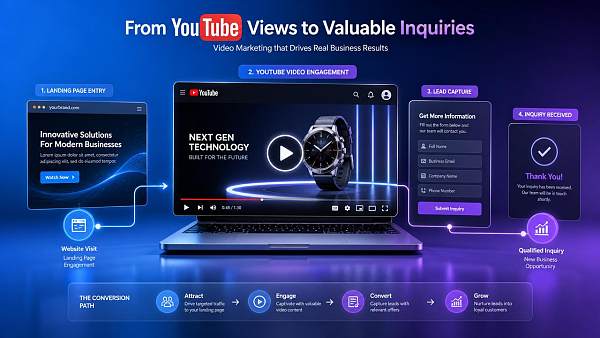
Many content teams treat view count as the only metric, so it is easy to misjudge performance. In fact, YouTube video marketing is more like a top-of-funnel activity. It is responsible for reach, screening, and education, but does not necessarily generate inquiries directly.
If the content attracts a large amount of broad traffic, but has no clear business scenario, does not build trust, and does not provide the next step, viewers naturally will not leave their contact information after watching. This leads to the common situation of “hot videos, cold inquiries.”
From the perspective of website operations, the failure of YouTube video marketing is often not because the content team did not work hard enough, but because the marketing closed loop was not properly built. Video, landing pages, forms, tracking tools, and follow-up are all indispensable.
2. Common current pain points and diagnostic signals
To determine whether YouTube video marketing is deviating from its goals, you can first look at the following signals. They reveal problems better than view count alone.
For B2B customer acquisition, what really needs to be tracked is view completion rate, card click-through rate, website dwell time, form submission rate, and qualified inquiry rate. If YouTube video marketing does not look at these, it is difficult to make the right decisions.
3. From the perspective of content positioning, why traffic and inquiries become misaligned
The first type of misalignment is content that is overly focused on general knowledge sharing. It can easily bring a large audience, but it is difficult to form purchase intent. Especially in B2B scenarios, users care more about solution fit, delivery capability, case proof, and risk control.
The second type of misalignment is chasing trending topics without aligning with the business. Trend-driven videos may increase account activity, but they do not necessarily match the target market. This kind of YouTube video marketing appears to be growing, but in reality it does not accumulate customer assets.
The third type of misalignment is when the content language does not match the audience’s region. When facing multi-country markets, using only one expression style can easily cause misunderstandings. This is especially critical when involving technical parameters, delivery processes, and pricing logic, where localized expression is particularly important.
This is also why many teams have started connecting YouTube video marketing with multilingual websites. Video is responsible for driving traffic, while the website is responsible for segmented market handoff, making it easier for users to move into the inquiry stage.
4. Conversion path design determines the real effectiveness of YouTube video marketing
High-quality YouTube video marketing should not stop at “the journey ends after watching.” A more reasonable path is: the video builds interest, the link directs users to a dedicated page, the page answers key questions, and then lead collection is completed through forms, buttons, or resource downloads.
If the website structure is confusing, language switching is awkward, or loading speed is slow, users may still drop off at the landing stage even if the video impressed them. At this point, the video team often mistakenly thinks the content is ineffective, when in fact the problem lies in the handoff page.
In foreign trade scenarios, it is especially important to build localized pages for different countries. Capabilities such as foreign trade multilingual website solutions are well suited to handle the cross-language traffic brought by YouTube video marketing.
Their value lies not only in page translation, but also in supporting precise conversion across 300+ languages, multilingual SEO optimization, automatic generation of localized meta tags, and monitoring conversion rates for each language site, making video traffic truly analyzable and traceable.
5. The business significance under the integration of website + marketing services
The value of YouTube video marketing is amplified only when placed within an integrated operations framework. The video channel is responsible for front-end reach, the official website serves as brand proof, SEO is responsible for continuously capturing search demand, and paid advertising fills in high-intent traffic.
This combination is exactly what suits companies that value global growth. Yiyingbao Information Technology (Beijing) Co., Ltd. has long provided full-chain support around intelligent website building, SEO optimization, social media marketing, and advertising placement. In essence, it solves the problem of “what to do after the traffic arrives.”
When YouTube video marketing is connected with on-site data, the team can understand more clearly: which types of videos bring longer dwell time, which markets have higher click-through rates, which pages convert better, and future budgets can also be allocated more precisely.
6. Typical scenarios suitable for focused optimization
Not all videos serve the same purpose. Breaking down YouTube video marketing by scenario makes it easier to judge whether the content and conversion goals are aligned.
- Brand introduction videos: suitable for building trust, but they must be accompanied by entry points to case pages or company pages.
- Product demo videos: suitable for users in the middle of the conversion funnel, focusing on differences, processes, and results.
- Q&A videos: suitable for capturing search demand and should be tied to specific solution pages.
- Customer case videos: suitable for removing doubts, and it is best to include before-and-after data comparisons.
- Industry trend videos: suitable for expanding reach, but overly broad content should be avoided.
If the goal is inquiry growth, product demos, case breakdowns, and solution explanations are usually better suited to the conversion requirements of YouTube video marketing than broad knowledge videos.
7. Practical recommendations for increasing inquiry rates
If you want YouTube video marketing to move from views to deals, you can prioritize the following actions.
- First define which stage of the funnel the video serves, rather than shooting content first.
- Each video should correspond to only one clear action goal to avoid scattered guidance.
- The description area, pinned comment, and spoken ending should all point to the same page.
- The first screen of the landing page should directly explain the value, target audience, results, and submission action.
- Use tools such as GA4 and GTM to track clicks, dwell time, and form sources.
- Prepare localized content for different markets to reduce language comprehension loss.
If you need to cover multiple countries at the same time, the handoff side should ideally have automatic synchronized updates, compliance support, and global acceleration capabilities. This not only ensures content consistency, but also reduces maintenance costs and avoids wasting the traffic brought by YouTube video marketing due to poor page experience.
For example, systems that support AWS global node acceleration, loading speeds under 2 seconds, multilingual privacy policy templates, and localized content review are often more suitable for cross-market advertising and coordination with video-driven traffic.
8. The next step of optimization should start simultaneously from “content, pages, and data”
Why does YouTube video marketing always get views but no inquiries? At its core, it is because the content attracts people, but does not smoothly bring them into the conversion path. Only when content positioning is accurate, website handoff is clear, and data tracking is complete can views gradually turn into real business opportunities.
If the current account already has a certain viewing foundation, the next step is not necessarily to rush to keep increasing the number of videos, but to first review whether the target audience in the titles is precise, whether the links are effective, whether the pages are localized, and whether the forms are simple enough.
When YouTube video marketing is connected to a more complete website and marketing system, views are no longer just surface-level data, but become growth assets that can be accumulated, optimized, and converted. Fix the path first, then scale traffic, which is usually more effective than simply chasing viral hits.
Related Articles



Related Products
 EasyCamp SaaS Smart Website Marketing SystemE-Yingbao SaaS Smart Website Marketing System: AI-powered, zero-code website building. Rapidly launch multilingual independent e-commerce sites in just 10 minutes. Global server acceleration and AI-driven SEO optimization empower businesses to efficiently connect with global markets. The seamless integration of technology and user-friendly operation makes building e-commerce sites incredibly simple.
 AI+SEM Intelligent Advertising Marketing SystemAI+SEM drives intelligent ad creation, empowering full-funnel precision advertising marketing. The system automatically generates weekly/monthly reports, AI recommends keywords and target countries, monitors core metrics in real-time with intelligent alerts, and enables one-click high-conversion ad solutions to help quickly acquire customers and improve ROI.
 AI+SEO Dual Engine Optimization ServiceEasyWin AI+SEO Dual Engine Optimization System leverages AI-powered keyword mining, content generation, and comprehensive technical optimization to help foreign trade enterprises acquire high-quality organic traffic, significantly improving search rankings and conversion rates.
 AI+SNS Social Media Marketing SystemYingbao AI+SNS Social Media Marketing System - Precision social capture for the social media era. Supports one-click content synchronization across major platforms like Facebook and LinkedIn. AI intelligently rewrites posts for enhanced relevance. 24/7 AI customer service and user profiling analysis empower businesses to efficiently expand into global markets.
 AI+SEO营销解决方案易营宝AI+SEO营销解决方案,通过AI批量写作、智能生成TDK、精准关键词扩词等功能,全面优化网站SEO效果,提升流量与转化率。助力企业构建高效智能网站新生态。
 AI+SEM Advertising Marketing SolutionsAI+SEM Advertising Marketing Solution leverages AI technology to deeply empower SEM ad campaigns. It automatically generates weekly/monthly reports using AI, presenting account data across multiple dimensions for comprehensive insights into campaign performance and trends. The system precisely recommends keywords and target countries, intelligently generates high-conversion ad copy, and enables one-click activation of efficient campaign plans to help businesses rapidly acquire customers. Simultaneously, it monitors core metrics in real time, intelligently identifies abnormal fluctuations, and issues timely alerts to ensure stable, high-return advertising results.
 Domain Name ServicesEasyWin provides professional domain name services, including intelligent queries, one-stop registration, brand protection, and full lifecycle management, helping businesses build a digital brand image.
 EasyOperate B2C Cross-Border E-Commerce Platform & Independent WebsiteEasyStore B2C Cross-border E-commerce Independent Store is an intelligent website building and cross-border e-commerce integrated solution independently developed by EasyStore Information Technology (Beijing) Co., Ltd. The system is specially designed for small and medium-sized as well as large export enterprises, integrating 'website building, operation, marketing, advertising, and conversion' into one, helping enterprises quickly establish cross-border e-commerce independent stores to achieve brand globalization and global sales growth.
The platform supports multiple languages, multiple currencies, and multi-channel marketing, with built-in AI intelligent translation and SEO optimization systems, suitable for mainstream markets such as Southeast Asia, Europe and America, Latin America, and the Middle East, assisting Chinese manufacturing enterprises in efficiently deploying international e-commerce strategies. SSL证书易营宝提供专业SSL安全证书服务,包括单域名和泛域名证书,确保网站数据传输加密、身份验证和完整性保护,助力企业建立安全可信的在线业务环境。









