









- How to view pricing in the global traffic ecosystem? Cost comparison of search, social media, and content channel advertisingJul 06, 2026View details
- How to assess foreign trade website development trends?Looking at 2026 changes from multilingual,AI content to conversion pathsJul 04, 2026View details
- What are the new trends in multilingual marketing data analytics tools in 2026? Focus on attribution、automation and complianceJul 04, 2026View details
- Is Brand Globalization Marketing Consulting Worth Buying? At What Stage Should Companies Bring It InJul 01, 2026View details
- Cross-Border Marketing Trend Research: Why More and More Companies Are Starting to Deploy AI Search and GEO OptimizationJun 30, 2026View details
- Cross-Border Marketing Trend Research: How Independent Sites, AI Content, and Short-Video Customer Acquisition Are ChangingJun 30, 2026View details
- How Can a Brand Updates Page Be Made More SEO-Friendly? Analysis of Update Frequency, Content Structure, and Internal Linking StrategyJun 28, 2026View details
- What stages does the cross-border services ecosystem include? How do website building, promotion, payment, and compliance work togetherJun 22, 2026View details
Will AI-generated writing content really affect website indexing?
Will AI-generated written content really affect website indexing? The answer is not a simple “yes” or “no”. What search engines truly care about is not who wrote the content, but whether the page has value, whether it solves problems, and whether it is credible. For integrated website + marketing service scenarios, understanding this decision logic is more important than simply pursuing publishing speed.
Search engines’ attitude toward AI-generated written content is shifting from “source-based judgment” to “quality-based judgment”
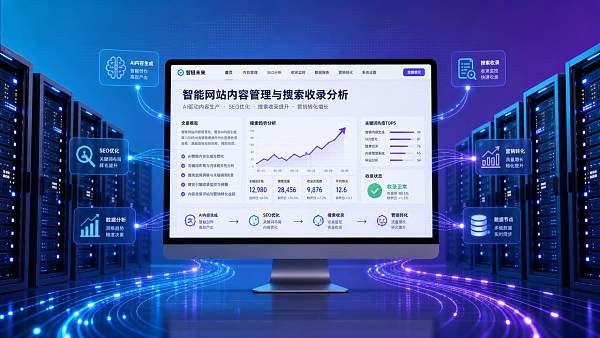
In the past, many websites worried that AI-generated written content would be directly identified by search engines and penalized. The current trend is clearer: platforms are paying more and more attention to content experience, information authenticity, and user dwell behavior, rather than mechanically judging whether AI tools were used.
This means that AI-generated written content itself is not the problem. The real issue is whether there is large-scale duplication, vague semantics, similar structures, keyword stuffing, or a mismatch with search intent. Once these problems appear, indexing, rankings, and conversions will all be affected at the same time.
For corporate websites, marketing landing pages, and product topic pages, AI-generated written content is more like an efficiency tool. When used well, it can increase update frequency; when used poorly, it may put the website into a state of “more content but ineffective”.
The change signals over the past two years have been very clear: indexing standards now place greater emphasis on value density and page credibility
After search engine algorithm upgrades, whether a single article is indexed no longer depends only on originality detection results. More attention is given to whether the page topic is clear, whether the information is complete, whether it demonstrates professional judgment, and whether users are willing to continue browsing after entering the page.
Especially in the fields of website building and digital marketing, many pages discuss similar issues. If AI-generated written content only rewrites old viewpoints and lacks cases, data, methods, and business scenarios, then even if it can be crawled in the short term, it may still be difficult to maintain stable indexing.
On the contrary, content that is further refined by combining industry experience, website positioning, and user decision-making paths is often more likely to gain search engine recognition. Content quality has already shifted from “whether it has been written” to “whether it is worth being displayed”.
Why AI-generated written content creates risks on some websites
The reason AI-generated written content is controversial lies not in the tool itself, but in how it is used. The following driving factors determine why the same tool can produce completely different SEO results.
From an operational perspective, the most common problem with AI-generated written content is treating “generation” as “completion”. In fact, generation is only the draft stage. What truly determines website indexing performance is the subsequent editing, verification, optimization, and content layout.
What impact this change will have on website building, SEO optimization, and marketing conversion
At the website building stage, AI-generated written content will affect how site sections are planned. In the past, many websites were used to building pages first and filling in content later. Now it is more suitable to first clarify keyword hierarchy, user questions, and conversion paths, and then decide on content types and the number of pages.
At the SEO optimization stage, AI-generated written content has improved production efficiency, but it has also magnified the difficulty of quality management. Without unified topic selection standards, headline specifications, and internal linking strategies, the more articles there are, the easier it is to dilute the website’s topical focus.
At the marketing conversion stage, users can already quickly identify “content that looks like it was written by a machine”. Once a page fails to respond to real concerns, bounce rates will rise and inquiry intent will decline. Indexing is only the beginning; conversion is the ultimate goal of website content building.
- For brand websites: more stable professional expression and trust signals are needed.
- For marketing websites: closer alignment with search intent and action guidance is needed.
- For product pages: differentiation needs to be highlighted, rather than broad and generic introductions.
- For content matrices: large-scale duplication and topic fragmentation need to be avoided.
What enterprises should focus on is not whether it can be used, but how to use AI-generated written content correctly
In actual operations, AI-generated written content is suitable for tasks such as organizing materials, building outlines, expanding drafts, and covering long-tail questions, but it is not suitable for completely replacing human judgment. Especially when it involves industry trends, service solutions, and case logic, real experience and professional revision must be added.
Some companies, when creating topic pages, also organize knowledge-based content at the same time. For example, around topics such as process auditing, project management, and service standards, adding extended reading helps strengthen the depth of the website’s topic. Content like Common Issues and Countermeasure Analysis in Engineering Cost Settlement Audits, if relevant to the page topic, can serve as a supplement to professional information and naturally improve the completeness of the content system.
It is recommended to focus on checking the following five items
- Whether it truly answers user questions, rather than merely explaining keywords.
- Whether there are industry scenarios, case logic, or data support.
- Whether page duplication is controlled to avoid similar articles competing with each other for indexing.
- Whether titles, summaries, internal links, and structured layout are properly handled.
- Whether the dwell time and conversion performance of already indexed pages are regularly reviewed.
In the face of changing trends, the more reliable response strategy is “technology-driven efficiency + human-added value”
If you want AI-generated written content to improve efficiency without harming indexing, it is recommended to adopt a layered strategy rather than a one-size-fits-all approach.
For websites engaged in long-term content operations, the best positioning for AI-generated written content is not to replace the content team, but to help the team spend more time on strategy, insight, and conversion optimization. Only content generated this way is more in line with search engines’ long-term value orientation.
What to do next to improve both indexing and marketing performance at the same time
For enterprises that are deploying global digital marketing, content production cannot focus only on quantity; it must also take into account website structure, search visibility, and business conversion. Easy Marketing Bao Information Technology (Beijing) Co., Ltd. has been deeply engaged in the industry for ten years. Centering on intelligent website building, SEO optimization, social media marketing, and advertising placement, it has formed a full-chain solution driven by the synergy of technological innovation and localized services, helping enterprises find a balance between content efficiency and indexing quality.
If you are evaluating whether AI-generated written content is suitable for your current website, it is recommended to first take three steps: first check the indexing quality of existing pages, then sort out keywords and section structure, and finally establish a content mechanism of “AI draft + human review + data retrospective”. Only by placing content into a complete marketing chain can indexing be transformed into real growth results.
Related Articles



Related Products
 EasyCamp SaaS Smart Website Marketing SystemE-Yingbao SaaS Smart Website Marketing System: AI-powered, zero-code website building. Rapidly launch multilingual independent e-commerce sites in just 10 minutes. Global server acceleration and AI-driven SEO optimization empower businesses to efficiently connect with global markets. The seamless integration of technology and user-friendly operation makes building e-commerce sites incredibly simple.
 AI+SEM Intelligent Advertising Marketing SystemAI+SEM drives intelligent ad creation, empowering full-funnel precision advertising marketing. The system automatically generates weekly/monthly reports, AI recommends keywords and target countries, monitors core metrics in real-time with intelligent alerts, and enables one-click high-conversion ad solutions to help quickly acquire customers and improve ROI.
 AI+SEO Dual Engine Optimization ServiceEasyWin AI+SEO Dual Engine Optimization System leverages AI-powered keyword mining, content generation, and comprehensive technical optimization to help foreign trade enterprises acquire high-quality organic traffic, significantly improving search rankings and conversion rates.
 AI+SNS Social Media Marketing SystemYingbao AI+SNS Social Media Marketing System - Precision social capture for the social media era. Supports one-click content synchronization across major platforms like Facebook and LinkedIn. AI intelligently rewrites posts for enhanced relevance. 24/7 AI customer service and user profiling analysis empower businesses to efficiently expand into global markets.
 AI+SEO营销解决方案易营宝AI+SEO营销解决方案,通过AI批量写作、智能生成TDK、精准关键词扩词等功能,全面优化网站SEO效果,提升流量与转化率。助力企业构建高效智能网站新生态。
 AI+SEM Advertising Marketing SolutionsAI+SEM Advertising Marketing Solution leverages AI technology to deeply empower SEM ad campaigns. It automatically generates weekly/monthly reports using AI, presenting account data across multiple dimensions for comprehensive insights into campaign performance and trends. The system precisely recommends keywords and target countries, intelligently generates high-conversion ad copy, and enables one-click activation of efficient campaign plans to help businesses rapidly acquire customers. Simultaneously, it monitors core metrics in real time, intelligently identifies abnormal fluctuations, and issues timely alerts to ensure stable, high-return advertising results.
 Domain Name ServicesEasyWin provides professional domain name services, including intelligent queries, one-stop registration, brand protection, and full lifecycle management, helping businesses build a digital brand image.
 EasyOperate B2C Cross-Border E-Commerce Platform & Independent WebsiteEasyStore B2C Cross-border E-commerce Independent Store is an intelligent website building and cross-border e-commerce integrated solution independently developed by EasyStore Information Technology (Beijing) Co., Ltd. The system is specially designed for small and medium-sized as well as large export enterprises, integrating 'website building, operation, marketing, advertising, and conversion' into one, helping enterprises quickly establish cross-border e-commerce independent stores to achieve brand globalization and global sales growth.
The platform supports multiple languages, multiple currencies, and multi-channel marketing, with built-in AI intelligent translation and SEO optimization systems, suitable for mainstream markets such as Southeast Asia, Europe and America, Latin America, and the Middle East, assisting Chinese manufacturing enterprises in efficiently deploying international e-commerce strategies. SSL证书易营宝提供专业SSL安全证书服务,包括单域名和泛域名证书,确保网站数据传输加密、身份验证和完整性保护,助力企业建立安全可信的在线业务环境。









