









- The China-US tariff arrangement has reached a preliminary consensus, and the trade association will be establishedJun 15, 2026View details
- What determines B2C cross-border e-commerce website development costs? A breakdown of features, interfaces, and deployment methodsJun 17, 2026View details
- China-Morocco zero-tariff access, a breakthrough in the cost of Moroccan goods exports to ChinaJun 11, 2026View details
- What signal should be released for the suspension of exports to JapanJun 10, 2026View details
- China's May LNG imports rebounded, with increased volumes from Russia and Canada filling the Middle East supply gapJun 10, 2026View details
- Will GEO change its SEO strategy?Jun 04, 2026View details
- What types of businesses are end-to-end solutions suitable for?Jun 03, 2026View details
- 2026 Global Growth Channel TrendsJun 02, 2026View details
How can B2B marketing shift from traffic to lead quality? Website content and follow-up mechanisms are key
Why does more traffic make B2B marketing leads harder to close instead?
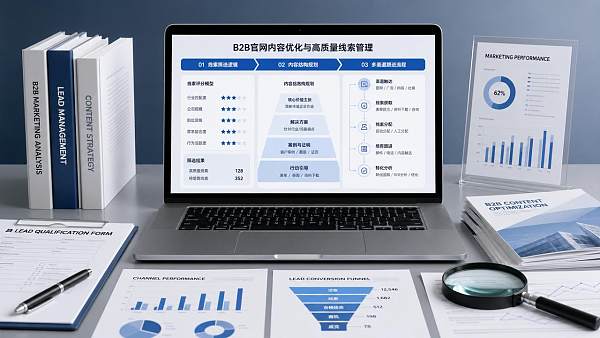
In B2B marketing, rising traffic does not necessarily bring more inquiries. What really widens the gap is often whether the leads match the business goals, whether the website can complete filtering in advance, and whether the follow-up can be connected in time.
Many companies invest their budgets heavily in traffic acquisition, yet ignore content structure, form design, and lead segmentation. The result is that the surface data looks impressive, but the sales team receives a large number of low-intent, low-fit, and hard-to-convert invalid leads, and the ROI of B2B marketing is therefore diluted.
For website-and-marketing-service integrated projects, the website is not just a display window, but a front-end decision-making tool. This is especially true when a multilingual website, SEO optimization, ad landing pages, and overseas promotion run in parallel: the more precise the content, the smoother the back-end follow-up, and the more stable the lead quality.
In actual execution, different scenarios mean different priorities for B2B marketing decisions
Doing B2B marketing does not mean the website has the same task in every industry, for every customer price point, or for every sales cycle. Businesses with low-frequency but high-value orders place more emphasis on trust building; businesses with high-frequency, multi-SKU orders place more emphasis on screening efficiency; and region-expansion businesses rely more on multilingual and localized messaging.
This is also why simply copying someone else’s website structure usually fails to produce ideal results. You need to make judgments based on product complexity, target market, and lead-handling capability. In service models like Yiyingbao’s, which advance AI website building, SEO, advertising, and social media in coordination, the value lies in connecting front-end lead generation with back-end follow-up, rather than doing only one part of the process.
When the website is responsible for the task of “explaining complex products”
This scenario is common in equipment, industrial materials, and technical-solution businesses. After visitors enter the website, their first need is not to inquire for a quote immediately, but to first determine whether you are professional, whether you can solve the problem, and whether the delivery scope is clear.
At this point, B2B marketing content cannot stop at brand introduction. A more effective approach is to break down application conditions, delivery process, case boundaries, and common questions clearly. The more specific the content is, the better it can filter out broad traffic and leave behind leads with real evaluation intent.
When the website is responsible for “managing high-volume SKUs”
For electronic components, spare parts, and standard catalog businesses, the common problem is not lack of visitors, but that visitors cannot find the corresponding SKU after they arrive. Poor lead quality is often not due to ineffective promotion, but because the on-site search and category logic do not support quick judgment.
This type of business is better suited to placing parameter filtering, intelligent categorization, and SKU display in core positions. The idea behind something like Electronic Components Industry Solutions is not to increase the number of pages, but to improve the efficiency with which visitors locate products and submit valid requirements.
When the promotion target is overseas incremental markets
Search habits and decision priorities in North America, Europe, the Middle East, and Southeast Asia are not the same. If B2B marketing still uses a unified copy and a unified page structure, traffic sources may look normal, but conversion rates often remain consistently low.
A more common way to judge is to first see whether the target region leans toward search-based customer acquisition or ad-driven acquisition, and then decide whether the website content should emphasize qualification proof, delivery capability, and case experience, or emphasize quotation efficiency, sample support, and local communication convenience.
How should website content and follow-up mechanisms be coordinated in different scenarios
High-quality leads are not generated by a single page alone, but by the combined effect of content expression, conversion entry points, and subsequent response. The differences below are usually the most worth organizing first.
If the website content cannot answer key questions in advance, the follow-up team will need to spend a lot of time on basic explanations. Conversely, if the follow-up mechanism has no tiering, even when SEO and advertising bring in more precise traffic, it is still hard to convert it into stable business opportunities.
Frequent misjudgments are often not a traffic problem
In actual applications, many B2B marketing projects fail not because the channel choice is wrong, but because the judgment path is too single. Only looking at visitor volume, not bounce pages; only looking at total form submissions, not valid conversations; only looking at customer acquisition cost, not the sales cycle; all of these can cause bias in decision-making.
- Treating all inquiries as equal in value, causing high-intent leads not to be prioritized.
- Website content leaning too heavily toward brand promotion, lacking parameters, cases, and delivery explanations, making real evaluation difficult to support.
- A disconnect between ad pages and website information, leaving visitors unable to confirm the specific capability boundaries after clicking.
- Ignoring the communication rhythms of different regions, so leads arrive in the system but miss the best response window.
This is also why more and more companies are beginning to value an integrated approach of “website building + SEO + advertising + AI follow-up”. The front end is responsible for precise attraction, the website is responsible for filtering and explanation, and the back end is responsible for identifying priority levels. Only after the whole process is coordinated can B2B marketing truly shift from traffic logic to quality logic.
What is more worth confirming before launch is not just whether the page looks good
If you are planning to upgrade your website or rebuild your overseas customer acquisition system, it is recommended to first confirm a few key conditions. Doing this is usually more effective than rushing into a redesign, and it also helps avoid rework later.
- First define what qualifies as a high-quality lead, such as region, completeness of requirements, budget range, and procurement cycle.
- Then sort out the gaps in website content, and confirm which questions should be answered by the page and which should be left for human communication.
- Map form fields to business judgment points to avoid collecting only email addresses while missing key requirement information.
- Establish source tags and response rules to distinguish leads from SEO, advertising, social media, and organic recommendation traffic.
For industries with many SKUs and dense information, the site structure in particular needs to be designed carefully. If the category and parameter relationships are not clearly organized, too much content can still make visitors lose their way. The earlier-mentioned Electronic Components Industry Solutions is suitable for understanding the core pain point of this type of business: it is not about a single-page copy, but about whether the information architecture supports precise marketing.
From traffic to lead quality: what should be done next
Once B2B marketing enters the refinement stage, website content and the follow-up mechanism can no longer be viewed separately. The former determines whether the right people are attracted, and the latter determines whether the opportunity is actually captured. Any break in the chain will magnify investment waste.
A more stable approach is to first establish judgment criteria based on the business scenario, and then gradually calibrate the content, channels, and response workflow around them. Comparing lead performance across different markets, product lines, and pages is often more valuable than looking at total traffic alone.
If you are evaluating a new round of growth investment, you can start with three things: sort out whether the website has filtering capability, check whether leads and follow-up have a priority mechanism, and then assess whether SEO, advertising, and multilingual content are aligned with business goals. By doing this, B2B marketing is more likely to move from “having traffic” to “having results”.
Related Articles



Related Products
 EasyCamp SaaS Smart Website Marketing SystemE-Yingbao SaaS Smart Website Marketing System: AI-powered, zero-code website building. Rapidly launch multilingual independent e-commerce sites in just 10 minutes. Global server acceleration and AI-driven SEO optimization empower businesses to efficiently connect with global markets. The seamless integration of technology and user-friendly operation makes building e-commerce sites incredibly simple.
 AI+SEM Intelligent Advertising Marketing SystemAI+SEM drives intelligent ad creation, empowering full-funnel precision advertising marketing. The system automatically generates weekly/monthly reports, AI recommends keywords and target countries, monitors core metrics in real-time with intelligent alerts, and enables one-click high-conversion ad solutions to help quickly acquire customers and improve ROI.
 AI+SEO Dual Engine Optimization ServiceEasyWin AI+SEO Dual Engine Optimization System leverages AI-powered keyword mining, content generation, and comprehensive technical optimization to help foreign trade enterprises acquire high-quality organic traffic, significantly improving search rankings and conversion rates.
 AI+SNS Social Media Marketing SystemYingbao AI+SNS Social Media Marketing System - Precision social capture for the social media era. Supports one-click content synchronization across major platforms like Facebook and LinkedIn. AI intelligently rewrites posts for enhanced relevance. 24/7 AI customer service and user profiling analysis empower businesses to efficiently expand into global markets.
 AI+SEO营销解决方案易营宝AI+SEO营销解决方案,通过AI批量写作、智能生成TDK、精准关键词扩词等功能,全面优化网站SEO效果,提升流量与转化率。助力企业构建高效智能网站新生态。
 AI+SEM Advertising Marketing SolutionsAI+SEM Advertising Marketing Solution leverages AI technology to deeply empower SEM ad campaigns. It automatically generates weekly/monthly reports using AI, presenting account data across multiple dimensions for comprehensive insights into campaign performance and trends. The system precisely recommends keywords and target countries, intelligently generates high-conversion ad copy, and enables one-click activation of efficient campaign plans to help businesses rapidly acquire customers. Simultaneously, it monitors core metrics in real time, intelligently identifies abnormal fluctuations, and issues timely alerts to ensure stable, high-return advertising results.
 Domain Name ServicesEasyWin provides professional domain name services, including intelligent queries, one-stop registration, brand protection, and full lifecycle management, helping businesses build a digital brand image.
 EasyOperate B2C Cross-Border E-Commerce Platform & Independent WebsiteEasyStore B2C Cross-border E-commerce Independent Store is an intelligent website building and cross-border e-commerce integrated solution independently developed by EasyStore Information Technology (Beijing) Co., Ltd. The system is specially designed for small and medium-sized as well as large export enterprises, integrating 'website building, operation, marketing, advertising, and conversion' into one, helping enterprises quickly establish cross-border e-commerce independent stores to achieve brand globalization and global sales growth.
The platform supports multiple languages, multiple currencies, and multi-channel marketing, with built-in AI intelligent translation and SEO optimization systems, suitable for mainstream markets such as Southeast Asia, Europe and America, Latin America, and the Middle East, assisting Chinese manufacturing enterprises in efficiently deploying international e-commerce strategies. SSL证书易营宝提供专业SSL安全证书服务,包括单域名和泛域名证书,确保网站数据传输加密、身份验证和完整性保护,助力企业建立安全可信的在线业务环境。









