









- The China-US tariff arrangement has reached a preliminary consensus, and the trade association will be establishedJun 15, 2026View details
- What determines B2C cross-border e-commerce website development costs? A breakdown of features, interfaces, and deployment methodsJun 17, 2026View details
- China-Morocco zero-tariff access, a breakthrough in the cost of Moroccan goods exports to ChinaJun 11, 2026View details
- What signal should be released for the suspension of exports to JapanJun 10, 2026View details
- China's May LNG imports rebounded, with increased volumes from Russia and Canada filling the Middle East supply gapJun 10, 2026View details
- Will GEO change its SEO strategy?Jun 04, 2026View details
- What types of businesses are end-to-end solutions suitable for?Jun 03, 2026View details
- 2026 Global Growth Channel TrendsJun 02, 2026View details
How to diagnose a low inquiry conversion rate? The 6 key links from form design to sales follow-up
Low inquiry conversion rates often come down to friction in the funnel
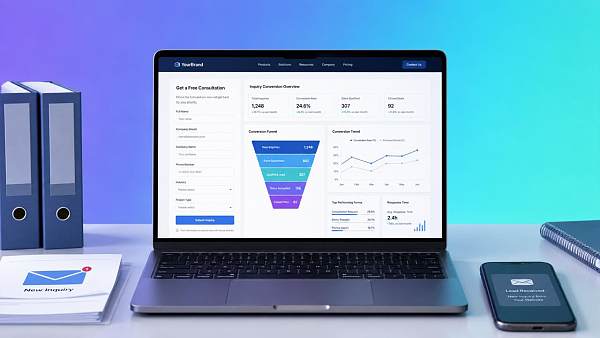
A drop in inquiry conversion rates is often mistaken for insufficient traffic quality. In a website+marketing-services-integrated scenario, a more common issue is that visitors were already interested, but dropped off before submitting, after submitting, or while waiting for a response.
This is especially true when overseas independent sites, multilingual official websites, and ad landing pages run in parallel, because visitor intent varies by channel. Search traffic places more emphasis on completeness of information, ad traffic is more sensitive to decision speed, and social media referrals rely more on the trustworthiness of the page; these differences directly affect inquiry conversion.
In actual operations, the value of platforms like 易营宝 that integrate website building, SEO, advertising, and AI optimization is not only in lead generation, but also in closing the loop between traffic, pages, forms, and sales responses. Diagnosing low inquiry conversion usually means looking further down this loop, rather than focusing only on a single button or a single ad.
First clarify the traffic scenario; different sources require different judgment priorities
People entering a website do not all have the same needs. Visitors coming from organic search are often in the comparison, validation, and screening stage; visitors coming from ad clicks are more easily influenced by the homepage message and action path; returning visitors care more about whether the contact method is smooth and whether the reply is timely.
So when diagnosing low inquiry conversion rates, the first step is not to redesign the page, but to first look at traffic segmentation. If an SEO page has low bounce but few form submissions, the problem is mostly in the persuasion structure; if an ad page gets high clicks but few leads, the issue is often a mismatch between the promise and the page; if returning traffic is high but conversion is consistently slow, then follow-up rhythm and lead management should be reviewed.
Form design is not better the more complete it is; submission friction is what matters
Many websites keep inquiry conversion low not because they lack forms, but because the form feels like an audit form. Too many fields, overly detailed required items, complicated verification codes, and poor mobile input all can make interested users give up midway.
A more common misunderstanding is placing B2B in-depth inquiries and initial contact in the same entry point. If the page is meant for first-time visitors, it is better to collect basic information first, such as name, email, and a brief need description; if it is a high-intent page, adding fields like product specifications, purchasing cycle, and target market would be more reasonable.
The key to improving inquiry conversion is not deleting fields until only two boxes remain, but matching the fields to the page stage. Multilingual sites should also check whether field translations are accurate, to avoid awkward wording, inconsistent units, and incompatible regional phone number formats.
When the page is not persuasive enough, visitors will not voluntarily absorb the cost of communication
When inquiry conversion stays low for a long time, the second common problem is that the page only introduces the business, but does not complete the persuasion. Visitors do not see delivery capability, regional experience, industry cases, or service boundaries, so they naturally will not be willing to leave real information.
For foreign trade websites, cross-border malls, and brand overseas websites, the page should not only say “what can be done,” but also say “which markets have been served, which promotion stages it is suitable for, and how it is usually coordinated.” This kind of information drives inquiry conversion better than vague slogans.
- Does the homepage directly answer the core need, rather than just presenting a company introduction.
- Do the cases cover real regions and business types, rather than stacking screenshots.
- Are the service process, delivery cycle, and communication methods explained.
- Is a clear call to action provided in a key position, rather than hidden in the footer.
If the site itself carries traffic from SEO, ads, social media, and other channels, it is recommended to break the content structure down according to the page purpose. Introductory pages should strengthen trust, conversion pages should reduce interference, and topic pages should answer more specific decision questions.
If the channel and page do not match, inquiry conversion will be wasted by the frontend
A lot of lead loss actually happens before the click. The ad promise is “get customers fast with website building,” but the landing page expands into the company’s development history; social media content emphasizes “testing overseas markets at low cost,” but the entry page requires complex business data. This mismatch between before and after will directly drag down inquiry conversion.
This is especially obvious in multi-region campaigns. The North American market values professionalism and efficiency more; the Middle East values trust and convenient communication more; Southeast Asian traffic often relies more on the mobile experience. Channel strategy, copy promise, and landing-page structure cannot use one template for all markets.
When maintaining the website, you can separate recent low-conversion pages and compare ad copy, search keywords, and entry channels for consistency. If the user intent differs greatly from the landing content, then even if traffic increases, inquiry conversion will still be hard to improve.
Submission success does not equal valid leads; response speed determines the second half of the result
Many teams stop their diagnosis at “whether the form was received,” but what truly affects inquiry conversion is often the first 30 minutes after submission. If automatic reminders do not arrive, assignment rules are messy, or follow-up scripts are stiff, even originally qualified leads can cool down quickly.
In a website+marketing-services-integrated environment, leads usually come from SEO, Google ads, social DMs, and landing-page forms. Without a unified entry system, sales responses are prone to duplicated contact, no handoff, or cross-time-zone delays. When inquiry conversion is low, this part must be reviewed together with the frontend page.
Some teams, after starting to value the response process, also improve internal collaboration mechanisms. For example, incorporating training materials into daily optimization references, such as innovative strategies for the enterprise talent resource development and management model in the knowledge economy era; content like this is more suitable as a natural absorption reference in team capability-building scenarios rather than being reviewed in isolation.
Do not ignore data feedback; many misjudgments come from looking at the wrong metrics
If you only look at visits and form counts, it is easy to draw the wrong conclusion. What inquiry conversion really needs to show is which pages bring in valid leads, which channels bring in high response rates, and which markets have lower volume but better deal prospects.
A more common situation is that frontend analytics show normal conversion, but backend data reveals a large number of invalid submissions. The cause may be poor spam filtering, overly broad ad targeting, or form copy that makes non-target users more likely to submit. Without sales-result feedback, frontend optimization will become more and more off-target.
- Separate total inquiries, valid inquiries, and follow-up inquiries.
- Mark conversion quality by page, language, and source.
- Record first response time and the outcome of the second reply.
- Review high-traffic, low-conversion pages every month, not just ad spend.
The 6 key links often ignored before landing
If you break down inquiry conversion, it usually falls into six links: entry intent, page consistency, form friction, trust reinforcement, response efficiency, and data feedback. If any one link is weak, the overall conversion rate will appear “mysteriously low.”
What is most easily ignored is not the technical issue, but treating similar scenarios as the same need. SEO pages are suitable for explaining value, ad pages are suitable for shortening the action path, brand official websites are suitable for building long-term trust, and after-sales maintenance must be judged by scenario.
If you are sorting out overseas website inquiry conversion, you can first run a small-scope review by channel, page type, and response timeliness, and then decide where to improve first. For projects that need synchronized upgrades to website structure, lead generation, and conversion loops, you can also use innovative strategies for the enterprise talent resource development and management model in the knowledge economy era as an internal process-optimization reference to help the team further refine execution standards.
Truly stable inquiry conversion does not rely on a single redesign to make a breakthrough; it relies on continuously aligning the scenario, need, and action. First find the weakest link, then fix each one in turn; this is often more effective than blindly increasing the budget.
Related Articles



Related Products
 EasyCamp SaaS Smart Website Marketing SystemE-Yingbao SaaS Smart Website Marketing System: AI-powered, zero-code website building. Rapidly launch multilingual independent e-commerce sites in just 10 minutes. Global server acceleration and AI-driven SEO optimization empower businesses to efficiently connect with global markets. The seamless integration of technology and user-friendly operation makes building e-commerce sites incredibly simple.
 AI+SEM Intelligent Advertising Marketing SystemAI+SEM drives intelligent ad creation, empowering full-funnel precision advertising marketing. The system automatically generates weekly/monthly reports, AI recommends keywords and target countries, monitors core metrics in real-time with intelligent alerts, and enables one-click high-conversion ad solutions to help quickly acquire customers and improve ROI.
 AI+SEO Dual Engine Optimization ServiceEasyWin AI+SEO Dual Engine Optimization System leverages AI-powered keyword mining, content generation, and comprehensive technical optimization to help foreign trade enterprises acquire high-quality organic traffic, significantly improving search rankings and conversion rates.
 AI+SNS Social Media Marketing SystemYingbao AI+SNS Social Media Marketing System - Precision social capture for the social media era. Supports one-click content synchronization across major platforms like Facebook and LinkedIn. AI intelligently rewrites posts for enhanced relevance. 24/7 AI customer service and user profiling analysis empower businesses to efficiently expand into global markets.
 AI+SEO营销解决方案易营宝AI+SEO营销解决方案,通过AI批量写作、智能生成TDK、精准关键词扩词等功能,全面优化网站SEO效果,提升流量与转化率。助力企业构建高效智能网站新生态。
 AI+SEM Advertising Marketing SolutionsAI+SEM Advertising Marketing Solution leverages AI technology to deeply empower SEM ad campaigns. It automatically generates weekly/monthly reports using AI, presenting account data across multiple dimensions for comprehensive insights into campaign performance and trends. The system precisely recommends keywords and target countries, intelligently generates high-conversion ad copy, and enables one-click activation of efficient campaign plans to help businesses rapidly acquire customers. Simultaneously, it monitors core metrics in real time, intelligently identifies abnormal fluctuations, and issues timely alerts to ensure stable, high-return advertising results.
 Domain Name ServicesEasyWin provides professional domain name services, including intelligent queries, one-stop registration, brand protection, and full lifecycle management, helping businesses build a digital brand image.
 EasyOperate B2C Cross-Border E-Commerce Platform & Independent WebsiteEasyStore B2C Cross-border E-commerce Independent Store is an intelligent website building and cross-border e-commerce integrated solution independently developed by EasyStore Information Technology (Beijing) Co., Ltd. The system is specially designed for small and medium-sized as well as large export enterprises, integrating 'website building, operation, marketing, advertising, and conversion' into one, helping enterprises quickly establish cross-border e-commerce independent stores to achieve brand globalization and global sales growth.
The platform supports multiple languages, multiple currencies, and multi-channel marketing, with built-in AI intelligent translation and SEO optimization systems, suitable for mainstream markets such as Southeast Asia, Europe and America, Latin America, and the Middle East, assisting Chinese manufacturing enterprises in efficiently deploying international e-commerce strategies. SSL证书易营宝提供专业SSL安全证书服务,包括单域名和泛域名证书,确保网站数据传输加密、身份验证和完整性保护,助力企业建立安全可信的在线业务环境。









