









- How to assess foreign trade website development trends?Looking at 2026 changes from multilingual,AI content to conversion pathsJul 04, 2026View details
- What are the new trends in multilingual marketing data analytics tools in 2026? Focus on attribution、automation and complianceJul 04, 2026View details
- Is Brand Globalization Marketing Consulting Worth Buying? At What Stage Should Companies Bring It InJul 01, 2026View details
- Cross-Border Marketing Trend Research: Why More and More Companies Are Starting to Deploy AI Search and GEO OptimizationJun 30, 2026View details
- Cross-Border Marketing Trend Research: How Independent Sites, AI Content, and Short-Video Customer Acquisition Are ChangingJun 30, 2026View details
- How Can a Brand Updates Page Be Made More SEO-Friendly? Analysis of Update Frequency, Content Structure, and Internal Linking StrategyJun 28, 2026View details
How Overseas Social Media Operation Services Can Prevent Content Quality Decline
How can overseas social media operation services prevent content quality from declining? The key is to establish a topic selection mechanism, unify content standards, and continuously optimize based on data feedback. Only by balancing localized expression with brand consistency can companies achieve stable growth and efficient conversion.
For foreign trade companies, manufacturing factories, cross-border sellers, and global expansion brand teams, social media accounts are not simply posting channels, but important touchpoints connecting overseas users, independent website traffic, and sales conversion. Once content quality declines, common consequences often appear within 2—6 weeks, including lower engagement rates, stagnant follower growth, reduced advertising collaboration efficiency, and even an impact on the quality of website inquiries.
Under an integrated website + marketing service model, overseas social media operations cannot be carried out in isolation. Content topic planning, landing page support, SEO semantic layout, ad remarketing, and AI data analysis need to work together. A service platform like 易营宝, which has capabilities in intelligent website building, Google SEO, advertising, and overseas social media operations, is better suited to help companies control content quality from the source rather than remedy problems afterward.
Why Overseas Social Media Content Easily Declines During Operations
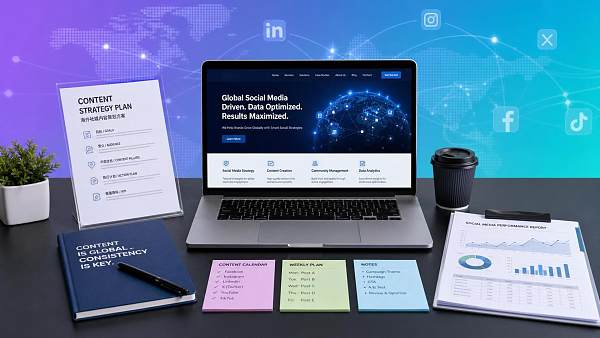
When many companies start using overseas social media operation services, they can often maintain high enthusiasm in the first 30 days. However, after entering the second month, content quality begins to fluctuate. The reason is not only a lack of manpower. More commonly, it is the absence of a systematic mechanism: limited topic sources, slow updates to the asset library, unclear account goals, inconsistent review standards, and a disconnect between social media content and the conversion path of the independent website.
Content decline commonly occurs in three stages
The first stage is the launch period, usually 1—4 weeks, when the content appears rich but relies more on experience and temporary inspiration. The second stage is the repetition period, usually appearing around weeks 5—8, when topics begin to repeat, copywriting becomes formulaic, and engagement quality declines. The third stage is the distortion period, often appearing after the third month, when content is still being updated but gradually deviates from the target market, brand positioning, and on-site conversion needs.
Four most common quality risks
- Only pursuing update frequency, posting 5—7 pieces per week, but lacking effective information density;
- Directly translating Chinese materials while ignoring differences in expression across markets such as North America, Europe, and Southeast Asia;
- Social media content is inconsistent with official website product pages, landing pages, and inquiry forms, causing a conversion gap;
- Overreliance on a single platform template, causing account styles to become increasingly homogeneous and reducing brand recognition.
If companies only focus on “number of posts” and “number of designs” when purchasing overseas social media operation services, it is usually difficult to avoid a decline in content quality. A more effective approach is to view content production as a continuous process consisting of 4 stages: planning, creation, distribution, and review.
The table below can help companies determine which management points they should focus on when considering how overseas social media operation services can prevent content quality from declining.
From the perspective of procurement and management, what truly affects content quality is not the performance of a single piece of content, but whether the entire operation process is replicable, measurable, and sustainable. For companies that want to build a long-term presence in overseas markets, establishing a standardized content system is more important than producing a one-time viral hit.
How Overseas Social Media Operation Services Can Prevent Content Quality from Declining: Core Methods and Execution Framework
To solve the issue of how overseas social media operation services can prevent content quality from declining, the core is not simply adding more staff, but building a stable content production framework. For an integrated website + marketing service team, this framework should cover at least 5 levels: goal definition, topic selection mechanism, content standards, localization review, and data closed loop.
Step 1: Clarify the account’s service goals before arranging the content calendar
Overseas social media goals vary greatly among different companies. B2B foreign trade companies focus more on inquiries, catalog downloads, and official website visits; B2C brands pay more attention to engagement, saves, conversions, and repeat purchases. It is generally recommended to keep account goals within 2—3 core indicators, avoiding the pursuit of exposure, followers, sales, private messages, and brand building at the same time, which can cause content to lose focus.
Step 2: Build a “4+1” topic pool to reduce content repetition
High-quality content is usually not created through last-minute ideas every day, but planned in advance. It is recommended to establish at least 20—30 topics each month, divided into 4 basic directions: brand awareness, product selling points, application scenarios, and customer questions. Then add 1 trending or seasonal topic to adapt to exhibitions, holidays, procurement seasons, and industry events.
Recommended topic ratio for B2B global expansion companies
- 30% product and solution content: parameters, processes, advantages, and use scenarios;
- 25% industry knowledge content: procurement considerations, common misconceptions, and application suggestions;
- 20% factory and delivery content: production processes, quality inspection points, and delivery capabilities;
- 15% customer Q&A: quotations, MOQ, lead times, and customization methods;
- 10% event-based content: exhibitions, holiday marketing, trending topics, and traffic guidance to campaign pages.
Step 3: Write content standards clearly instead of relying on verbal requirements
Many companies believe that standards are simply “make the copy more natural” or “make the images look more premium,” but these requirements are difficult to unify during execution. An effective approach is to create actionable content guidelines. For example, each post should stay within a core expression range of 80—180 words, the first sentence must include a pain point or benefit, the CTA should not exceed 1, visual assets should be updated once every 15 days, and product terminology should remain consistent with official website pages.
In the service logic of 易营宝, overseas social media is not only about publishing content, but also needs to connect with multilingual websites, SEO pages, advertising landing pages, short video assets, and AI optimization systems. The benefit of this approach is that the same set of product information can be reused across multiple channels, while the expression is adjusted according to the platform and region, improving efficiency while reducing the risk of content distortion.
If companies want to evaluate a service provider’s execution capability, they can focus on whether the following content standards are clear, deliverable, and able to be implemented into specific processes.
This table reflects a key point: how overseas social media operation services prevent content quality from declining essentially depends on whether content management is standardized. The clearer the standards are, the more stable cross-team collaboration becomes, and the less likely account quality is to fluctuate due to personnel changes.
Step 4: Use data to judge “quality” instead of only looking at surface popularity
A high number of likes does not necessarily represent high quality, especially in B2B global expansion scenarios. Truly valuable indicators should include 3 levels. The first level is in-platform performance, such as engagement rate, completion rate, and save rate; the second level is traffic-driving performance, such as link click-through rate, bounce rate, and page dwell time; the third level is conversion performance, such as inquiry form submissions, WhatsApp consultations, sample requests, and email lead quality.
6 indicators recommended for monthly fixed review
- Content publishing volume and completion rate;
- Whether the average engagement rate has declined for 2 consecutive weeks;
- Changes in the click-through rate from social media to the official website;
- Whether the landing page dwell time is less than 30 seconds;
- Whether the number of inquiries and the valid inquiry rate change simultaneously;
- The conversion contribution ratio of different content types.
When companies manage social media together with independent websites, SEO pages, and ad remarketing, the assessment of content quality becomes closer to real business results. For example, a post may have average engagement, but if it brings high-quality visits to a product page and ultimately generates inquiries, this type of content should continue to be optimized rather than simply eliminated.
When Choosing a Service Provider, How to Judge Whether It Can Deliver High-Quality Content Consistently Over the Long Term
For many companies, the real question is not whether to do overseas social media, but how to choose a team that can deliver consistently over the long term. This is because content quality often declines in the second quarter after cooperation begins. At this point, if the service provider lacks website, SEO, advertising, and localization support capabilities, the account can easily enter a low-efficiency maintenance state.
Prioritize teams with full-chain collaboration capabilities
Compared with teams that only provide account operation services, integrated website + marketing service providers are more likely to ensure continuous and stable content quality. The reason is straightforward: social media content needs to connect to multilingual official websites, B2B inquiry pages, B2C store pages, or advertising landing pages. If the backend page structure, conversion copy, and SEO information are not synchronized, even excellent social media content will lose effectiveness during the conversion stage.
Focus on reviewing 5 delivery capabilities
- Whether the provider can offer a monthly content strategy, not just an execution schedule;
- Whether it has multilingual and multi-region localization capabilities;
- Whether it can manage social media content, official website pages, and advertising assets in sync;
- Whether it has a data review mechanism, preferably with a review frequency of once per month;
- Whether it can customize content based on industry characteristics instead of applying a uniform template.
Why an integrated platform is better suited for global expansion companies
An AI-driven enterprise-level SaaS platform like 易营宝 covers intelligent website building, multilingual websites, Google SEO, advertising, Facebook advertising marketing, overseas social media operations, and GEO optimization, enabling centralized management of content assets. In this way, when companies communicate in different markets such as North America, Europe, Southeast Asia, and the Middle East, they do not need to repeatedly build asset systems and can more easily maintain consistent brand expression.
For companies that need continuous global expansion, the ideal cooperation model is not to publish dozens of pieces of content at one time, but to continuously form a closed loop of “content production—traffic acquisition—website support—lead conversion—data optimization” over 90 days, 180 days, or even longer. Only when this closed loop runs effectively can the question of how overseas social media operation services prevent content quality from declining be truly solved.
If you are planning overseas social media operations, independent website development, or multi-channel global growth, it is recommended to prioritize service teams with integrated capabilities across website building, SEO, advertising, and social media. 易营宝 can provide a more suitable integrated solution for real conversion scenarios based on your industry, target market, and budget range. Contact us now to get a customized solution and learn more about practical overseas growth solutions.
Related Articles
 How to Create a Social Media Content Calendar?Monthly Publishing Template and Role Assignment Suggestions for B2B Teams
 How can overseas social media operation automation be implemented?End-to-end process for content scheduling、comment management and lead handoff
 How should social media operations be done for the tourism industry?Breakdown of content topics、platform division of roles and conversion paths


Related Products
 EasyCamp SaaS Smart Website Marketing SystemE-Yingbao SaaS Smart Website Marketing System: AI-powered, zero-code website building. Rapidly launch multilingual independent e-commerce sites in just 10 minutes. Global server acceleration and AI-driven SEO optimization empower businesses to efficiently connect with global markets. The seamless integration of technology and user-friendly operation makes building e-commerce sites incredibly simple.
 AI+SEM Intelligent Advertising Marketing SystemAI+SEM drives intelligent ad creation, empowering full-funnel precision advertising marketing. The system automatically generates weekly/monthly reports, AI recommends keywords and target countries, monitors core metrics in real-time with intelligent alerts, and enables one-click high-conversion ad solutions to help quickly acquire customers and improve ROI.
 AI+SEO Dual Engine Optimization ServiceEasyWin AI+SEO Dual Engine Optimization System leverages AI-powered keyword mining, content generation, and comprehensive technical optimization to help foreign trade enterprises acquire high-quality organic traffic, significantly improving search rankings and conversion rates.
 AI+SNS Social Media Marketing SystemYingbao AI+SNS Social Media Marketing System - Precision social capture for the social media era. Supports one-click content synchronization across major platforms like Facebook and LinkedIn. AI intelligently rewrites posts for enhanced relevance. 24/7 AI customer service and user profiling analysis empower businesses to efficiently expand into global markets.
 AI+SEO营销解决方案易营宝AI+SEO营销解决方案,通过AI批量写作、智能生成TDK、精准关键词扩词等功能,全面优化网站SEO效果,提升流量与转化率。助力企业构建高效智能网站新生态。
 AI+SEM Advertising Marketing SolutionsAI+SEM Advertising Marketing Solution leverages AI technology to deeply empower SEM ad campaigns. It automatically generates weekly/monthly reports using AI, presenting account data across multiple dimensions for comprehensive insights into campaign performance and trends. The system precisely recommends keywords and target countries, intelligently generates high-conversion ad copy, and enables one-click activation of efficient campaign plans to help businesses rapidly acquire customers. Simultaneously, it monitors core metrics in real time, intelligently identifies abnormal fluctuations, and issues timely alerts to ensure stable, high-return advertising results.
 Domain Name ServicesEasyWin provides professional domain name services, including intelligent queries, one-stop registration, brand protection, and full lifecycle management, helping businesses build a digital brand image.
 EasyOperate B2C Cross-Border E-Commerce Platform & Independent WebsiteEasyStore B2C Cross-border E-commerce Independent Store is an intelligent website building and cross-border e-commerce integrated solution independently developed by EasyStore Information Technology (Beijing) Co., Ltd. The system is specially designed for small and medium-sized as well as large export enterprises, integrating 'website building, operation, marketing, advertising, and conversion' into one, helping enterprises quickly establish cross-border e-commerce independent stores to achieve brand globalization and global sales growth.
The platform supports multiple languages, multiple currencies, and multi-channel marketing, with built-in AI intelligent translation and SEO optimization systems, suitable for mainstream markets such as Southeast Asia, Europe and America, Latin America, and the Middle East, assisting Chinese manufacturing enterprises in efficiently deploying international e-commerce strategies. SSL证书易营宝提供专业SSL安全证书服务,包括单域名和泛域名证书,确保网站数据传输加密、身份验证和完整性保护,助力企业建立安全可信的在线业务环境。









