









- What should you focus on in the latest enterprise SaaS report? From renewal rates and delivery costs to overseas growth opportunitiesJul 12, 2026View details
- What signals are worth paying attention to in a cross-border marketing trend report? B2B companies should look at these 6 signalsJul 11, 2026View details
- How to Read a Cross-Border Marketing Trends Report? Five Key Dimensions for Evaluating Channel OpportunitiesJul 11, 2026View details
- Which channel has the highest ROI in the global traffic ecosystem? Comparative analysis of search, social media, and advertisingJul 10, 2026View details
- What multilingual website services are available in Sanya? Which model is more suitable for local businesses going global?Jul 08, 2026View details
- How to view the complete list of China SaaS companies in the top 100? Practical methods for screening website-building and marketing service providersJul 08, 2026View details
What's the difference between Arabic website design and a regular website? From layout to cultural adaptation analysis
What is the difference between an Arabic website design and a regular website? Start with the underlying logic
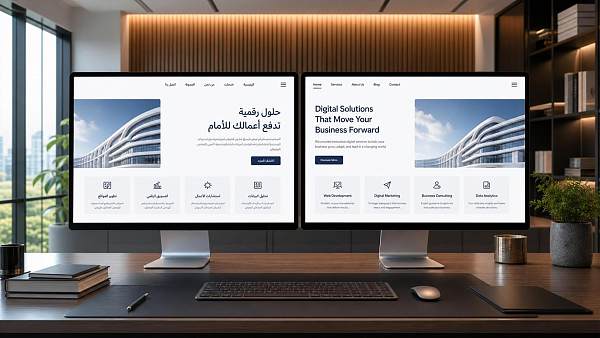
What is the difference between an Arabic website design and a regular website? On the surface, it seems to be that the page direction changes from left-to-right to right-to-left.
But what truly affects experience and conversion is far more than layout direction.
From a technical implementation perspective, it involves RTL layout, font rendering, component mirroring, form logic, and multilingual architecture.
From a business results perspective, it also relates to trust building, reading efficiency, and whether local users are willing to continue operating.
So, what is the difference between an Arabic website design and a regular website? The essential difference is that the former is a systematic localization project, not a simple translation.
If you simply replace the Chinese or English text with Arabic, the page will usually have issues such as misalignment, abnormal line breaks, and incorrect button direction.
A more obvious signal is that although users enter the site, they stay only for a short time, and the inquiry path is also noticeably blocked.
1. Different layout direction affects the entire interface structure
When discussing the difference between Arabic website design and regular website design, first look at the page's main axis direction.
Most regular websites use an LTR structure, meaning reading and interaction flow from left to right.
Arabic websites, however, are centered on RTL and organize information from right to left.
This means navigation, breadcrumbs, button order, carousel switching, and table alignment all need to be adjusted accordingly.
If you only right-align the text without handling layout rules, users will feel that the page “looks Arabic, but is not actually like a local website.”
In technical evaluation, it is recommended to focus on the following points:
- Does the page root node support the RTL attribute?
- Have the navigation bar and sidebar completed the mirrored layout?
- Are the previous page, next page, and back buttons displayed in reverse?
- Do pop-ups, drop-downs, and search boxes adapt to right-side starting logic?
- Do carousels, step bars, and progress bars change according to Arabic reading order?
This step may seem basic, but it is actually where development quality is most easily exposed.
In many projects, problems that appear after launch are often not translation errors, but rather the interaction path still following regular website logic.
2. Different font and line-break rules directly affect readability
What is the difference between Arabic website design and regular websites? The second key point is that the font system is completely different.
Arabic letters have cursive characteristics, and the glyphs change depending on the preceding and following letters.
Therefore, the font choices and letter-spacing settings commonly used in regular websites cannot be copied directly.
If font compatibility is insufficient, issues such as character separation, uneven stroke weight, and weak-looking headings may occur.
In actual business, these issues can quickly undermine the brand's professionalism.
During evaluation, you can focus on three things:
- Does the font fully support Arabic glyphs?
- Do the headings, body text, and button line heights need to be recalculated?
- Is the combination of numbers, currency, and dates with Arabic stable?
It is especially important to note that Arabic pages often contain a mix of Arabic, English model numbers, and numerals.
Without handling bidi rules at this point, the content order may be scrambled by the browser.
So, what is the difference between Arabic website design and regular websites? The difference is also reflected in the text engine and layout details.
3. Different interaction logic determines whether users can navigate smoothly
Many teams understand Arabic adaptation as a visual issue, but in fact that only covers half of it.
What is the difference between Arabic website design and regular websites? At a deeper level, it is a difference in interaction habits.
For example, users naturally look for entry points in the top-right area and are more accustomed to browsing paths that start on the right side.
If the core call-to-action button is still placed in the bottom-left corner, the click-through rate is often affected.
Forms are also a high-risk area.
If fields such as name, phone number, country, email, and verification code are not adjusted to local input habits, submission rates will drop.
When evaluating, it is recommended to check these details:
- Is the main button placed in a position that better matches Arabic habits?
- Are form labels, error prompts, and placeholder copy right-aligned consistently?
- Does the mobile menu expand in a natural direction?
- Do filters, pagination, and search suggestions support RTL logic?
If these aspects are done well, users will feel that the page is easy to use.
If they are not done well, the issue may not cause an immediate error, but it will directly show up as conversion loss.
4. Different cultural adaptation determines whether a website can build trust
What is the difference between Arabic website design and regular websites? Another often underestimated layer is cultural adaptation.
When Middle Eastern users judge whether a website is reliable, they not only look at functionality, but also at whether the presentation respects the local context.
For example, images of people, clothing displays, color preferences, holiday elements, and case study wording all need to be handled more carefully.
Some visual materials that are common on regular websites may not necessarily be suitable in the Arabic market.
Pricing displays, contact methods, customer service hours, and certificate information should also be localized as much as possible.
To determine whether it is properly localized, you can look at the following table:
Looking at recent changes, the demand for website localization in the Middle Eastern market is increasing.
Whether first-round trust can be established is often more critical than simply going live.
5. When evaluating technology, the key is not “can it be done,” but “is it complete”
Back to the core question: what is the difference between Arabic website design and regular websites? The difference lies in completeness.
Many service providers can create Arabic pages, but they may not have a mature multilingual technical foundation.
If the system only supports static translation and does not support structural RTL adaptation, the later maintenance cost will be very high.
This also means that evaluation standards cannot rely only on front-end screenshots.
What should matter more is platform capability, SEO structure, and follow-up operations interfaces.
Using a website marketing integration platform like Yiyingbao as an example, the value is not just building a website.
What matters more is whether it can integrate multilingual websites, SEO optimization, ad placement, and content operations into one workflow.
For the Arabic market, this integrated capability is especially important, because localization, indexing, and conversion are inherently interconnected.
During actual selection, it is recommended to confirm the following:
- Does it natively support multilingual content and Arabic RTL?
- Does it have a technical SEO structure oriented toward Google?
- Can it independently manage Arabic content and landing pages?
- Can it connect advertising, social media, and inquiry tracking?
- Is there continuous optimization rather than a one-time delivery mechanism?
In the end, what is the difference between Arabic website design and regular websites? It is not just one more language, but one more set of market rules.
Only when layout, interaction, culture, and marketing pathways are all included in the evaluation can you truly judge whether a website has growth potential in the Middle Eastern market.
Related Articles
 Where Are the High Costs of Multilingual Website Development? A Comparison of Language Count, Feature Requirements, and Maintenance Methods
 What's the difference between Arabic website design and a regular website? From layout to cultural adaptation analysis
 What are the common pitfalls in foreign trade website translation? Terminology, units, and local expressions are the easiest to get wrong
Related Products
 EasyCamp SaaS Smart Website Marketing SystemE-Yingbao SaaS Smart Website Marketing System: AI-powered, zero-code website building. Rapidly launch multilingual independent e-commerce sites in just 10 minutes. Global server acceleration and AI-driven SEO optimization empower businesses to efficiently connect with global markets. The seamless integration of technology and user-friendly operation makes building e-commerce sites incredibly simple.
 AI+SEM Intelligent Advertising Marketing SystemAI+SEM drives intelligent ad creation, empowering full-funnel precision advertising marketing. The system automatically generates weekly/monthly reports, AI recommends keywords and target countries, monitors core metrics in real-time with intelligent alerts, and enables one-click high-conversion ad solutions to help quickly acquire customers and improve ROI.
 AI+SEO Dual Engine Optimization ServiceEasyWin AI+SEO Dual Engine Optimization System leverages AI-powered keyword mining, content generation, and comprehensive technical optimization to help foreign trade enterprises acquire high-quality organic traffic, significantly improving search rankings and conversion rates.
 AI+SNS Social Media Marketing SystemYingbao AI+SNS Social Media Marketing System - Precision social capture for the social media era. Supports one-click content synchronization across major platforms like Facebook and LinkedIn. AI intelligently rewrites posts for enhanced relevance. 24/7 AI customer service and user profiling analysis empower businesses to efficiently expand into global markets.
 AI+SEO营销解决方案易营宝AI+SEO营销解决方案,通过AI批量写作、智能生成TDK、精准关键词扩词等功能,全面优化网站SEO效果,提升流量与转化率。助力企业构建高效智能网站新生态。
 AI+SEM Advertising Marketing SolutionsAI+SEM Advertising Marketing Solution leverages AI technology to deeply empower SEM ad campaigns. It automatically generates weekly/monthly reports using AI, presenting account data across multiple dimensions for comprehensive insights into campaign performance and trends. The system precisely recommends keywords and target countries, intelligently generates high-conversion ad copy, and enables one-click activation of efficient campaign plans to help businesses rapidly acquire customers. Simultaneously, it monitors core metrics in real time, intelligently identifies abnormal fluctuations, and issues timely alerts to ensure stable, high-return advertising results.
 Domain Name ServicesEasyWin provides professional domain name services, including intelligent queries, one-stop registration, brand protection, and full lifecycle management, helping businesses build a digital brand image.
 EasyOperate B2C Cross-Border E-Commerce Platform & Independent WebsiteEasyStore B2C Cross-border E-commerce Independent Store is an intelligent website building and cross-border e-commerce integrated solution independently developed by EasyStore Information Technology (Beijing) Co., Ltd. The system is specially designed for small and medium-sized as well as large export enterprises, integrating 'website building, operation, marketing, advertising, and conversion' into one, helping enterprises quickly establish cross-border e-commerce independent stores to achieve brand globalization and global sales growth.
The platform supports multiple languages, multiple currencies, and multi-channel marketing, with built-in AI intelligent translation and SEO optimization systems, suitable for mainstream markets such as Southeast Asia, Europe and America, Latin America, and the Middle East, assisting Chinese manufacturing enterprises in efficiently deploying international e-commerce strategies. SSL证书易营宝提供专业SSL安全证书服务,包括单域名和泛域名证书,确保网站数据传输加密、身份验证和完整性保护,助力企业建立安全可信的在线业务环境。









