









- What should you focus on in the latest enterprise SaaS report? From renewal rates and delivery costs to overseas growth opportunitiesJul 12, 2026View details
- What signals are worth paying attention to in a cross-border marketing trend report? B2B companies should look at these 6 signalsJul 11, 2026View details
- How to Read a Cross-Border Marketing Trends Report? Five Key Dimensions for Evaluating Channel OpportunitiesJul 11, 2026View details
- Which channel has the highest ROI in the global traffic ecosystem? Comparative analysis of search, social media, and advertisingJul 10, 2026View details
- What multilingual website services are available in Sanya? Which model is more suitable for local businesses going global?Jul 08, 2026View details
- How to view the complete list of China SaaS companies in the top 100? Practical methods for screening website-building and marketing service providersJul 08, 2026View details
What are the common pitfalls in foreign trade website translation? Terminology, units, and local expressions are the easiest to get wrong
What Are the Common Pitfalls in Foreign Trade Website Translation, and Why Do They Often Show Up Before a Deal Is Closed
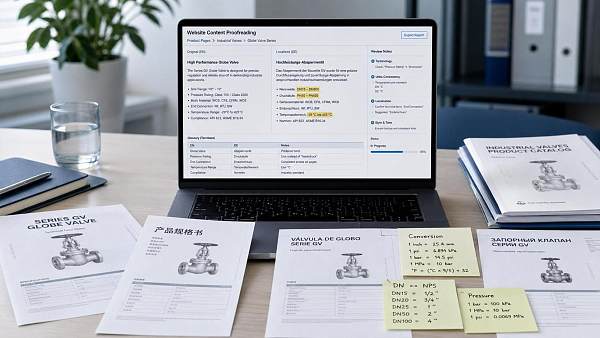
What are the common pitfalls in foreign trade website translation? Many problems do not appear only after launch; they are already buried in place during a visitor’s first browse. The page may look complete, but the content can still weaken trust directly because of terminology mistranslation, inconsistent units, or awkward wording.
In website and marketing integration projects, translation is not just a matter of replacing words. It also affects search indexing, landing page conversion, inquiry form comprehension, and brand professionalism. A single wrong term may shift search intent; a single unit left unchanged may make quotations and delivery expectations inaccurate.
The more realistic situation is that different export markets and different site types have different requirements for translation quality. When building multilingual official websites, cross-border stores, B2B inquiry sites, and advertising landing pages, the focus of judgment is clearly different, and the same translation method cannot be copied directly.
In Real Projects, Why Do Different Scenarios So Easily Fall Into Different Traps
What are the common pitfalls in foreign trade website translation? The core reason lies in the different tasks each page must handle. Brand websites focus on credibility building, product detail pages focus on explaining parameters, ad pages emphasize fast understanding, and e-commerce pages need to reduce ordering friction.
If translation is understood only as grammatically correct wording, three layers are usually ignored: whether industry terminology is accurate, whether the measurement system matches the target market, and whether the local expression fits real reading habits. These three points are also the easiest places for conversion to be affected.
Platforms like Yiyingbao, which cover website building, SEO, ad placement, and multilingual operations, place more emphasis on the consistency of the front-to-back chain during project execution. Because once website translation is disconnected from keyword strategy, ad copy, or page structure, it becomes more expensive to fix later.
When Building B2B Inquiry Sites, Terminology Errors Most Easily Hurt Professional Image
In B2B foreign trade websites, visitors usually first look at product capabilities, process descriptions, and certification information. At this stage, the biggest concern is not whether the sentences sound elegant enough, but whether professional terms are directly translated into generic words, making the page seem unrelated to the industry.
For example, material names, equipment structures, processing methods, and inspection standards may look similar, but their actual correspondences are completely different. Translating the industry’s fixed expressions too literally can make the search side fail to match them, and the reading side may also doubt whether the supply capability is real.
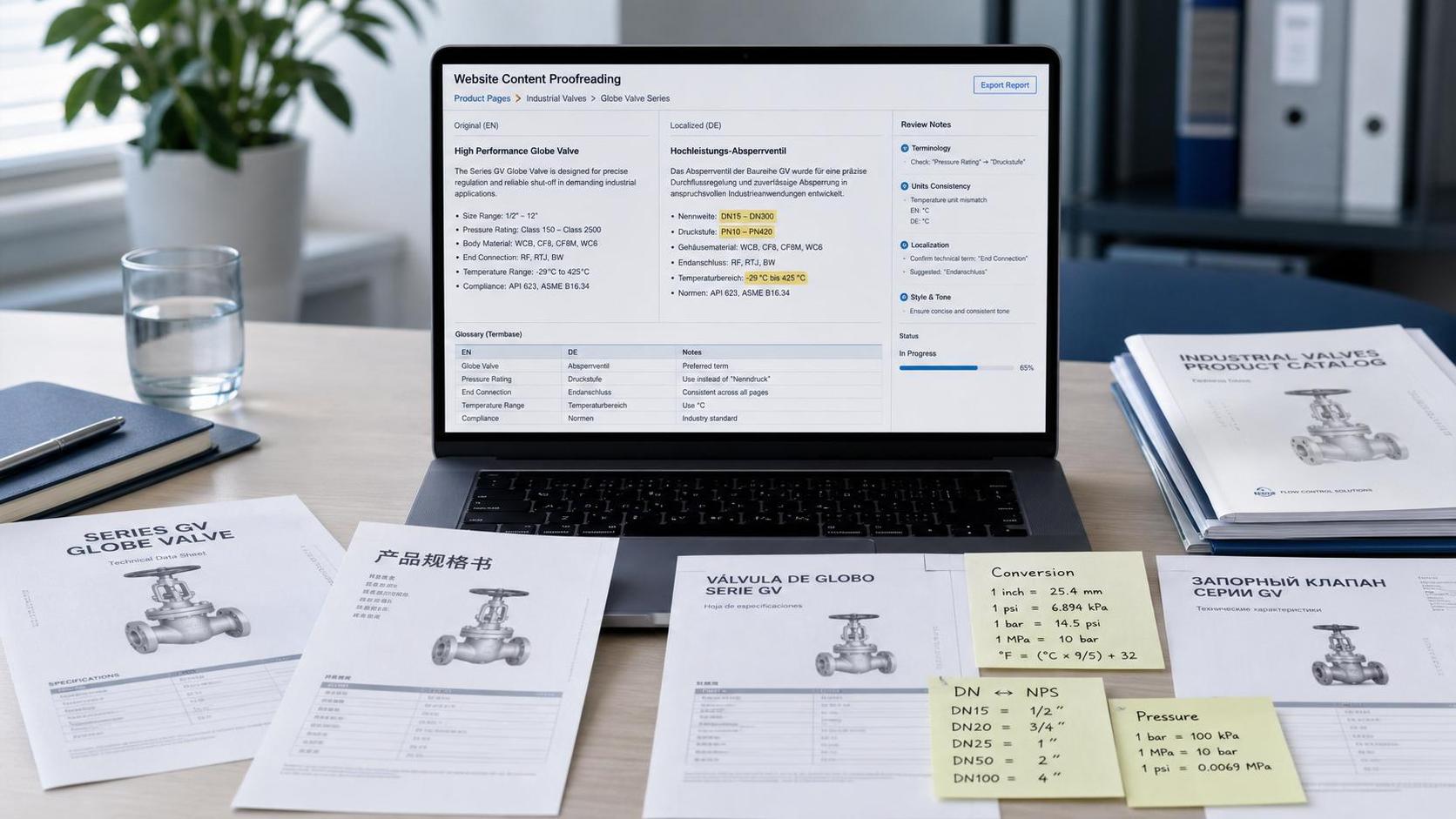
In such scenarios, the more common practice is to first unify the terminology database and then write the page. Product managers, translators, and SEO staff need to use the same expression for the same term, especially in titles, parameter tables, FAQs, and form fields, where everyone cannot write differently.
Terminology Issues Are Usually Concentrated in These Positions
- The product name and category page title do not match, affecting indexing and site navigation.
- Craft, material, and certification names are mistranslated, weakening professional credibility.
- Download materials, case pages, and body terminology differ, creating a layer of misunderstanding.
- Inquiry form fields are translated vaguely, resulting in incomplete requirement collection.
In Cross-Border Stores and Quotation Pages, Unit Confusion Is More Dangerous Than Grammar Errors
If B2B sites are more afraid of terminology errors, then cross-border stores, sample pages, and quotation pages are most likely to run into unit-system problems. Once dimensions, weight, capacity, voltage, temperature, or packaging quantity are mixed up, it is not just the reading experience that suffers; it can directly lead to order cancellation risk.
Acceptance habits for unit expression are not the same in North America, Europe, Japan, Korea, and the Middle East. Some pages are suitable for keeping the metric system and adding a conversion, while others must prioritize the locally used units. This judgment should combine industry habits, not just country or region.
What are the common pitfalls in foreign trade website translation? Many teams only adjust units in the main text and forget to synchronize image text, table headers, shipping explanations, logistics timeliness, and after-sales policies. As a result, standards are inconsistent across the page, making the information less reliable.
For Ad Landing Pages and Multilingual Official Websites, Local Expression Decides Whether Users Stay or Leave
Some pages have no terminology errors and no unit errors, but conversion is still low; the problem often lies in local expression. Literal translation may be understandable, but it does not fit the reading rhythm of local users, especially in titles, button copy, benefit statements, and calls to action.
In this type of scenario, what are the common pitfalls in foreign trade website translation? They are often more hidden. For example, copying Chinese promotional wording as-is, or overloading technical advantages, can make the page sound stiff, even like mechanically assembled content.
In practical applications, ad pages place more emphasis on short, clear sentences and explicit actions, while official website content places more emphasis on trustworthy, complete information. The two cannot share the same translation style. Otherwise, when users enter the site after clicking an ad, they will feel a big tone mismatch, which lowers their willingness to continue browsing.
Unnatural Local Expression Usually Appears in These Details
- Button copy is too long, sounding like an explanatory sentence rather than an action command.
- Benefit descriptions follow Chinese logic too closely, with stacked sentence structures and heavy reading burden.
- After-sales, delivery, and customization terms are vague, making them hard to judge quickly.
- The same language site uses different regional expressions, reducing consistency.
Different Page Tasks Mean the Common Pitfalls in Foreign Trade Website Translation Also Differ
If all pages are handled with one translation standard, problems usually recur. A more effective method is to first split by page purpose, then determine translation depth, review focus, and the level of localization.
What Is Most Easily Overlooked Before Launch Is Not Just the Translation Itself
Many projects invest heavily during the translation stage, but miss key checks before release. For example, page titles, URLs, image alt text, structured fields, on-site search terms, and automatic form replies are not synchronized for localization, which ultimately affects SEO and conversion data.
For websites aiming at overseas growth, translation quality must be viewed as part of the complete chain. Whether the website system supports independent multilingual management, whether terminology can be unified conveniently, and whether it can work in coordination with SEO and ad placement optimization all determine the later maintenance cost.
For platforms like Yiyingbao that provide long-term service across multiple regional markets, the value lies not only in translating into the target language, but also in connecting website building, content, local expression, and search visibility into one system. The benefit of doing this is reducing repeated rework later, rather than just making the first submission look complete.
Before Going Live, You Can First Make Judgments Based on These Actions
What are the common pitfalls in foreign trade website translation? The truly controllable parts can actually be checked in advance before launch. First clarify the page goals, then perform three rounds of checks on terminology, units, and local expression, and many problems will be reduced.
- First sort out the site type and target region, and set translation rules separately for different pages.
- Create a terminology table, a unit table, and a prohibited-expression list to avoid loss of control in multi-person collaboration.
- Include SEO titles, menu names, button copy, and form fields in the same round of review.
- Perform local reading checks for key markets instead of only grammar checks.
- After launch, continue to fine-tune based on bounce rate, dwell time, and inquiry quality.
In the end, what are the common pitfalls in foreign trade website translation? It is not simply a language issue, but a matter of whether business understanding, market adaptation, and marketing execution are aligned. Only when the scenario is clarified first and the standards are clarified next can the website be truly seen and trusted.
Related Articles
 Where Are the High Costs of Multilingual Website Development? A Comparison of Language Count, Feature Requirements, and Maintenance Methods
 What's the difference between Arabic website design and a regular website? From layout to cultural adaptation analysis
 What are the common pitfalls in foreign trade website translation? Terminology, units, and local expressions are the easiest to get wrong
Related Products
 EasyCamp SaaS Smart Website Marketing SystemE-Yingbao SaaS Smart Website Marketing System: AI-powered, zero-code website building. Rapidly launch multilingual independent e-commerce sites in just 10 minutes. Global server acceleration and AI-driven SEO optimization empower businesses to efficiently connect with global markets. The seamless integration of technology and user-friendly operation makes building e-commerce sites incredibly simple.
 AI+SEM Intelligent Advertising Marketing SystemAI+SEM drives intelligent ad creation, empowering full-funnel precision advertising marketing. The system automatically generates weekly/monthly reports, AI recommends keywords and target countries, monitors core metrics in real-time with intelligent alerts, and enables one-click high-conversion ad solutions to help quickly acquire customers and improve ROI.
 AI+SEO Dual Engine Optimization ServiceEasyWin AI+SEO Dual Engine Optimization System leverages AI-powered keyword mining, content generation, and comprehensive technical optimization to help foreign trade enterprises acquire high-quality organic traffic, significantly improving search rankings and conversion rates.
 AI+SNS Social Media Marketing SystemYingbao AI+SNS Social Media Marketing System - Precision social capture for the social media era. Supports one-click content synchronization across major platforms like Facebook and LinkedIn. AI intelligently rewrites posts for enhanced relevance. 24/7 AI customer service and user profiling analysis empower businesses to efficiently expand into global markets.
 AI+SEO营销解决方案易营宝AI+SEO营销解决方案,通过AI批量写作、智能生成TDK、精准关键词扩词等功能,全面优化网站SEO效果,提升流量与转化率。助力企业构建高效智能网站新生态。
 AI+SEM Advertising Marketing SolutionsAI+SEM Advertising Marketing Solution leverages AI technology to deeply empower SEM ad campaigns. It automatically generates weekly/monthly reports using AI, presenting account data across multiple dimensions for comprehensive insights into campaign performance and trends. The system precisely recommends keywords and target countries, intelligently generates high-conversion ad copy, and enables one-click activation of efficient campaign plans to help businesses rapidly acquire customers. Simultaneously, it monitors core metrics in real time, intelligently identifies abnormal fluctuations, and issues timely alerts to ensure stable, high-return advertising results.
 Domain Name ServicesEasyWin provides professional domain name services, including intelligent queries, one-stop registration, brand protection, and full lifecycle management, helping businesses build a digital brand image.
 EasyOperate B2C Cross-Border E-Commerce Platform & Independent WebsiteEasyStore B2C Cross-border E-commerce Independent Store is an intelligent website building and cross-border e-commerce integrated solution independently developed by EasyStore Information Technology (Beijing) Co., Ltd. The system is specially designed for small and medium-sized as well as large export enterprises, integrating 'website building, operation, marketing, advertising, and conversion' into one, helping enterprises quickly establish cross-border e-commerce independent stores to achieve brand globalization and global sales growth.
The platform supports multiple languages, multiple currencies, and multi-channel marketing, with built-in AI intelligent translation and SEO optimization systems, suitable for mainstream markets such as Southeast Asia, Europe and America, Latin America, and the Middle East, assisting Chinese manufacturing enterprises in efficiently deploying international e-commerce strategies. SSL证书易营宝提供专业SSL安全证书服务,包括单域名和泛域名证书,确保网站数据传输加密、身份验证和完整性保护,助力企业建立安全可信的在线业务环境。









