









- How Can a Brand Updates Page Be Made More SEO-Friendly? Analysis of Update Frequency, Content Structure, and Internal Linking StrategyJun 28, 2026View details
- What stages does the cross-border services ecosystem include? How do website building, promotion, payment, and compliance work togetherJun 22, 2026View details
- How will email marketing costs change in 2026Jun 22, 2026View details
- The China-US tariff arrangement has reached a preliminary consensus, and the trade association will be establishedJun 15, 2026View details
- Should overseas brand marketing start with ads or contentJun 21, 2026View details
- What determines B2C cross-border e-commerce website development costs? A breakdown of features, interfaces, and deployment methodsJun 17, 2026View details
How are AI multilingual translation costs calculated? By word count, language, or number of pages
AI Multilingual Translation Costs: Why There Is Rarely Just One Pricing Formula
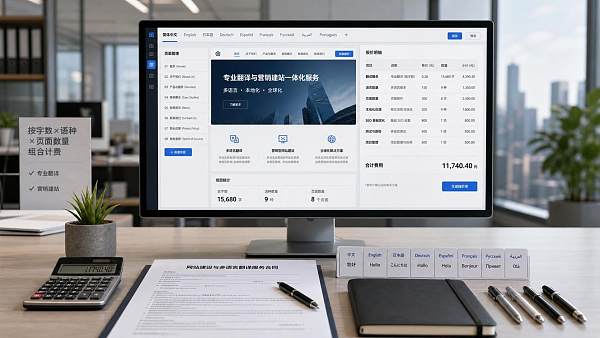
How AI multilingual translation costs are calculated may look like a pricing issue on the surface, but it is actually closer to a budget structure issue. For website development, overseas promotion, and multilingual content operations, different billing criteria can lead to very different total costs in the end.
Common quotations are usually based on word count, languages, and number of pages, but the real cost drivers also include content type, whether terminology consistency is required, whether SEO pages are involved, whether ongoing updates are needed after launch, and the proportion of human review and proofreading.
This is especially true in website and marketing integration scenarios. A product description and a set of advertising landing pages may have similar word counts, but their translation difficulty and value can be completely different. Approving a budget simply based on “unit price multiplied by quantity” often makes it easy to overlook later revision and advertising adaptation costs.
A more practical way to judge is to first look at what outcome the translated content is meant to serve. Is the goal to get the website online quickly, or to have multilingual pages indexed by search engines and improve conversions on advertising pages? Different answers lead to different cost structures for AI multilingual translation.
Billing by Word Count, Language, or Page: Which Method Is More Common?
If it is only pure text translation, billing by word count is the most straightforward method. For content such as contracts, specification sheets, and press releases, the basis for calculation is clear, making it suitable for quickly estimating budgets and controlling increases or reductions in volume.
However, once the project involves multilingual corporate websites, cross-border e-commerce stores, or marketing landing pages, page-based billing becomes more common. The reason is simple: a page contains not only body text, but may also include headings, buttons, forms, navigation, meta information, and multi-device adaptation.
Billing by language is more like applying a difficulty coefficient. The processing costs for English, Japanese, German, Arabic, and Russian are not exactly the same. Some languages also involve layout expansion, text direction, differences in search behavior, and adjustments to local expression.
For easier evaluation, you can first refer to the table below.
In real projects, hybrid billing is more common. For example, main pages may be billed by page, product materials by word count, and less common languages may carry an additional language coefficient. Although this quotation method is somewhat more complex, it is closer to the reality of actual delivery than a single pricing formula.
Why Costs Differ More Between Website Content and Marketing Content, Even Though Both Are Translation
Many budget deviations arise from treating “translation” and “usable content” as the same thing. Website content is not simply about converting Chinese into another language. It also needs to ensure that the structure is publishable, keywords can be deployed, pages can be indexed, and the wording can support conversions.
For example, the titles, descriptions, image captions, button copy, and form prompts on a product detail page all essentially affect search display and user actions. The AI multilingual translation cost here usually includes a certain degree of localization and marketing adaptation, rather than simple text replacement.
Taking it one step further, if the content is used for Google SEO or overseas advertising campaigns, keyword handling becomes a source of cost differences. Literal translation may be cheaper, but it may not match local search habits. To reduce bounce rates, title rewriting, short sentence compression, and adjustments to call-to-action wording are often required.
For platforms like 易营宝, which cover intelligent website development, SEO optimization, advertising, and social media operations at the same time, translation is more often evaluated as part of the overall website growth chain during project execution. The advantage is that early quotations are not based only on text volume, but also consider page indexing, campaign launch, and future reuse efficiency.
Which Cost Boundaries Should Be Confirmed Before Approval?
In many projects, the problem is not that the unit price is high, but that the scope is unclear. Only when the pages are about to go live or before the ads are launched do teams discover that extra costs come from multiple rounds of revisions, terminology alignment, replacing text in images, adjusting URL rules, and supplementing multilingual SEO fields.
To avoid additional orders later, several questions should be clarified at the beginning.
- Whether the quotation includes scattered page text such as titles, descriptions, buttons, forms, and text embedded in images.
- Whether it includes the creation of a terminology glossary, and whether the same standard can be applied to later batches of content.
- Whether it distinguishes among three levels: machine draft translation, human polishing, and marketing rewriting.
- After multilingual versions go live, how incremental pages are billed, and whether tiered discounts are available.
- Whether SEO fields, page meta tags, and on-site search terms are charged separately.
If the service provider also offers website development and marketing services, this step is usually easier to clarify. This is because where the translated content will ultimately appear, whether it will be used for advertising, and whether it will enter ongoing SEO operations will all directly affect how AI multilingual translation costs are calculated.
When the Budget Is Limited, Which Languages and Pages Are More Cost-Effective to Prioritize?
When the budget is limited, it is not always necessary to roll out all languages at once. A more prudent approach is to prioritize based on business regions and customer acquisition channels. Translating high-conversion pages first and then expanding the content library is usually more effective than distributing resources evenly across the whole site.
A common priority order is: homepage, core product pages, About Us, contact page, key landing pages, inquiry forms, followed by blogs, case studies, and help content. This arrangement helps control AI multilingual translation costs while allowing inquiry and traffic performance to be verified as soon as possible.
Language selection should not be based only on population size. More valuable reference factors include existing customer distribution, advertising regions, search demand intensity, and after-sales support capability. For example, North America, Europe, Southeast Asia, Japan and South Korea, the Middle East, and Latin America are all common target markets, but their page styles and search expressions differ significantly.
If Google SEO, overseas social media traffic acquisition, or AI search visibility optimization will be carried out later, the translation structure needs to be scalable from the beginning. In multilingual corporate website and cross-border e-commerce projects, 易营宝 usually prioritizes unifying the site architecture and keyword logic, which saves more money than repeated rework later.
What Pitfalls Are Most Common with Low-Cost AI Multilingual Translation?
A low price is not a problem in itself; the key is where the cost has been reduced. If the service only produces bulk translated text, it may appear to save money at the beginning, but more costs may later be added back in indexing, advertising, and conversion stages.
There are three common types of risk. The first is inconsistent terminology, where product names, industry terms, and specification units are inconsistent throughout the content, affecting professionalism. The second is unusable pages, such as overly long text strings, overflowing buttons, or incorrect form prompts. The third is ineffective marketing, where keywords may be literally translated correctly but have no search value.
Another hidden issue that is easily overlooked is ongoing maintenance cost. A multilingual website is not a one-time delivery. Product updates, campaign pages, advertising materials, short video scripts, and social media content will all continue to generate incremental translation needs. If unified rules are not established at the beginning, every later revision may need to be priced again.
Therefore, when evaluating AI multilingual translation costs, you should not only look at the first quotation, but also examine the cost curve of content iteration throughout the year. A cheap one-time order that leads to long-term disorder is often not economical.
How Should You Finally Judge Whether a Quotation Is Reasonable?
A practical evaluation standard is to break the quotation into three layers. The first layer is the basic translation volume, the second is the depth of localization and review, and the third is whether website launch, SEO deployment, and marketing use scenarios are included. Only when all three layers are clear does price comparison become meaningful.
If the project involves intelligent website development, multilingual corporate websites, cross-border e-commerce stores, advertising landing pages, and ongoing content operations, simply comparing the price per thousand words is not enough. What should be compared instead is whether the solution reduces rework, supports multi-region launches, facilitates later promotion, and can connect content directly into the growth chain.
Returning to the original question, there is no single answer to whether AI multilingual translation costs should be billed by word count, language, or number of pages. A more common approach is to use combined billing based on content format and usage purpose, while clearly listing terminology, review, SEO fields, and incremental maintenance separately.
The next step is to first organize three lists: the languages to be covered, the pages to be prioritized for launch, and the content that will continue to be updated over the next six months. Comparing solutions based on these three lists will make the budget more accurate and the ROI easier to verify.
Related Articles
 What Should You Pay Attention to When Translating a Website for an Independent Site? Language Switching, URL Structure, and Indexing Issues
 How are AI multilingual translation costs calculated? By word count, language, or number of pages
 How to Choose a Multilingual Tool for an Independent Website? Comparison of Translation Quality, SEO Compatibility, and Management Efficiency
Related Products
 EasyCamp SaaS Smart Website Marketing SystemE-Yingbao SaaS Smart Website Marketing System: AI-powered, zero-code website building. Rapidly launch multilingual independent e-commerce sites in just 10 minutes. Global server acceleration and AI-driven SEO optimization empower businesses to efficiently connect with global markets. The seamless integration of technology and user-friendly operation makes building e-commerce sites incredibly simple.
 AI+SEM Intelligent Advertising Marketing SystemAI+SEM drives intelligent ad creation, empowering full-funnel precision advertising marketing. The system automatically generates weekly/monthly reports, AI recommends keywords and target countries, monitors core metrics in real-time with intelligent alerts, and enables one-click high-conversion ad solutions to help quickly acquire customers and improve ROI.
 AI+SEO Dual Engine Optimization ServiceEasyWin AI+SEO Dual Engine Optimization System leverages AI-powered keyword mining, content generation, and comprehensive technical optimization to help foreign trade enterprises acquire high-quality organic traffic, significantly improving search rankings and conversion rates.
 AI+SNS Social Media Marketing SystemYingbao AI+SNS Social Media Marketing System - Precision social capture for the social media era. Supports one-click content synchronization across major platforms like Facebook and LinkedIn. AI intelligently rewrites posts for enhanced relevance. 24/7 AI customer service and user profiling analysis empower businesses to efficiently expand into global markets.
 AI+SEO营销解决方案易营宝AI+SEO营销解决方案,通过AI批量写作、智能生成TDK、精准关键词扩词等功能,全面优化网站SEO效果,提升流量与转化率。助力企业构建高效智能网站新生态。
 AI+SEM Advertising Marketing SolutionsAI+SEM Advertising Marketing Solution leverages AI technology to deeply empower SEM ad campaigns. It automatically generates weekly/monthly reports using AI, presenting account data across multiple dimensions for comprehensive insights into campaign performance and trends. The system precisely recommends keywords and target countries, intelligently generates high-conversion ad copy, and enables one-click activation of efficient campaign plans to help businesses rapidly acquire customers. Simultaneously, it monitors core metrics in real time, intelligently identifies abnormal fluctuations, and issues timely alerts to ensure stable, high-return advertising results.
 Domain Name ServicesEasyWin provides professional domain name services, including intelligent queries, one-stop registration, brand protection, and full lifecycle management, helping businesses build a digital brand image.
 EasyOperate B2C Cross-Border E-Commerce Platform & Independent WebsiteEasyStore B2C Cross-border E-commerce Independent Store is an intelligent website building and cross-border e-commerce integrated solution independently developed by EasyStore Information Technology (Beijing) Co., Ltd. The system is specially designed for small and medium-sized as well as large export enterprises, integrating 'website building, operation, marketing, advertising, and conversion' into one, helping enterprises quickly establish cross-border e-commerce independent stores to achieve brand globalization and global sales growth.
The platform supports multiple languages, multiple currencies, and multi-channel marketing, with built-in AI intelligent translation and SEO optimization systems, suitable for mainstream markets such as Southeast Asia, Europe and America, Latin America, and the Middle East, assisting Chinese manufacturing enterprises in efficiently deploying international e-commerce strategies. SSL证书易营宝提供专业SSL安全证书服务,包括单域名和泛域名证书,确保网站数据传输加密、身份验证和完整性保护,助力企业建立安全可信的在线业务环境。









