









- Which channel has the highest ROI in the global traffic ecosystem? Comparative analysis of search, social media, and advertisingJul 10, 2026View details
- What multilingual website services are available in Sanya? Which model is more suitable for local businesses going global?Jul 08, 2026View details
- How to view the complete list of China SaaS companies in the top 100? Practical methods for screening website-building and marketing service providersJul 08, 2026View details
- How to view pricing in the global traffic ecosystem? Cost comparison of search, social media, and content channel advertisingJul 06, 2026View details
- How to assess foreign trade website development trends?Looking at 2026 changes from multilingual,AI content to conversion pathsJul 04, 2026View details
- What are the new trends in multilingual marketing data analytics tools in 2026? Focus on attribution、automation and complianceJul 04, 2026View details
How to make product demo production more conversion-friendly? Script structure, camera shot sequence, and page alignment
First, clarify the conversion path before starting the product demo
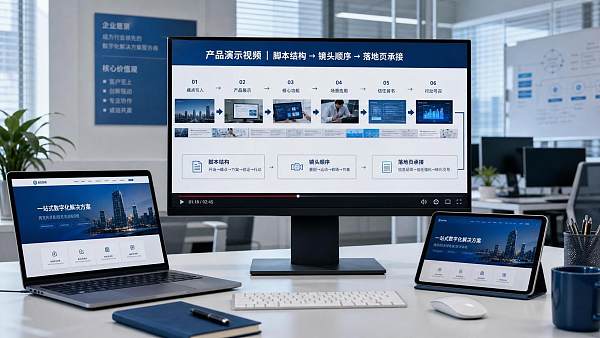
The reason product demo production often fails to deliver good results is not because the visuals are not polished enough, but because the demo content is disconnected from the website experience. When users enter the page from different entry points, their points of focus are not the same. If the video only showcases features, it is difficult to turn interest into consultation, lead generation, or orders.
In a website and marketing service integrated scenario, product demo production is more like a middle link in the conversion path. The front end connects search, ads, social media, and short-video traffic, while the back end connects landing pages, forms, inquiry entry points, and multilingual pages. Therefore, the script structure, shot sequence, and page alignment must all be designed according to real business goals.
A more practical way to judge this is to first clarify which type of page this demo video is meant to serve. Is it brand messaging for the standalone website homepage, quick conversion for an ad landing page, or capability proof for a foreign trade inquiry page? Different scenarios require different approaches to product demo production.
Different entry points require different script structures
Visitors coming from organic search usually want to confirm credibility first. In product demo production for this scenario, the opening should not rush into hard-selling points; it is more suitable to answer questions first and then show the solution process. The shot sequence should also start from business pain points, then provide evidence at the page, system, or process level.
Ad traffic is different. Many visitors stay for a very short time; in the first few seconds, if it is not made clear “what problem it can solve,” it is hard to recover them later even with a complete presentation. This kind of product demo production is more suitable for a short script: show the result first on the first screen, then add the mechanism, and finally lead the action back to the page button or form.
A common problem in social media traffic scenarios is that the video rhythm is very lively, while the page itself is too static. What users see in the video is rapid change and intuitive benefit, but after landing on the page, only a long introduction remains. This contrast weakens trust. Product demo production must be planned together with page modules in advance; otherwise, even a good shot sequence can hardly create a continuous experience.
Key points for judging several high-frequency page types
From this angle, product demo production is not an independent action, but part of the page strategy. Especially in multilingual official websites, cross-border stores, and overseas advertising scenarios, inconsistent front-end page alignment often affects conversion more than the video itself.
Why shot sequence directly affects conversion judgment
Many product demo production habits start with the brand intro, then talk about product concepts, then feature explanations, and finally the call-to-action button. This sequence is not unusable, but it is often too slow in marketing scenarios. What users really care about is, “Is this related to the problem I need to solve right now?”
A more stable approach is to arrange shots by decision rhythm. Let users see the result first, then understand the process, and finally confirm the credible evidence. For service-oriented solutions such as intelligent website building, SEO optimization, advertising placement, and social media customer acquisition, the result is often not the product appearance, but inquiry growth, page indexing, ad lead volume, or multi-channel collaboration results.
Taking overseas marketing-related pages as an example, if the opening directly shows backend functions, it can easily turn the video into a tutorial. In contrast, if you first show “how a website gets found after going live, how it takes in ad traffic, and how it accumulates inquiries,” users are more likely to understand the relationship between this product demo production and their own business.
Three more common shot-sequence logics
- Problem-first: suitable for search traffic and solution pages; answer questions first, then show features.
- Result-first: suitable for ad landing pages; show the benefit first, then explain how it is achieved.
- Process-first: suitable for product detail pages; show usage first, then show parameters and details.
Once the shot sequence is chosen correctly, the page copy becomes easier to align. Titles, buttons, form descriptions, and case modules will flow more smoothly; if the sequence is chosen wrongly, the page can only be patched afterward, and overall conversion efficiency is usually dragged down.
Page alignment is not an add-on, but half of product demo production
In actual implementation, the part most likely to be ignored is page alignment. The video tells one logic, while the page uses another tone; the button position is awkward, and users naturally drop off. If product demo production wants to convert more easily, the page should synchronize at least three things: title alignment, evidence supplementation, and action outlet.
Title alignment means the value proposition thrown out at the beginning of the video must be something the page above the fold can also pick up. Evidence supplementation means taking the details that cannot be fully expanded in the video and handing them over to case studies, parameters, process, FAQ, or localized explanations. The action outlet means that after users finish watching, the next step should smoothly lead to consultation, trial, quotation request, or purchase.
For websites covering multiple regional markets, language and usage differences must also be handled. North American pages tend to prefer direct conclusions, European pages pay more attention to standards and details, and Southeast Asian traffic is often influenced by mobile rhythm. If product demo production is done only in one unified version, page conversion performance will often vary significantly.
Alignment checklist between page and demo
- Does the main proposition appearing in the first 5 seconds of the video get confirmed again in the hero section headline?
- Do the data, cases, and process mentioned in the video have corresponding evidence modules on the page?
- Does the button copy match the ending action of the video to avoid secondary hesitation from users?
- Can the mobile page quickly capture the form or inquiry entry point below the video?
Several common misjudgments that make product demo production look good but fail to convert
The first misjudgment is treating product demo production as a purely visual project. A unified look and smooth editing are of course important, but if it does not revolve around inquiry, lead generation, orders, or leads, it will ultimately only stay at “looks good.”
The second misjudgment is treating different pages as the same scenario. Official website homepages, SEO content pages, ad landing pages, and social media jump pages may all be able to host videos, but in reality the psychological state of users when they enter is not the same. Similar traffic does not mean the same need.
The third misjudgment is only looking at production cost and ignoring follow-up maintenance cost. Once product demo production is used for multilingual sites, multiple ad groups, or different market versions, subtitle updates, page replacements, asset reuse, and A/B testing space all need to be considered. Saving effort in the early stage may make operations harder later.
The fourth misjudgment is ignoring data feedback. Without tracking points and page event records, it is hard to tell whether the video opening failed or the page button position has a problem. If conversion is low and only the visuals are changed without changing the path, it usually cannot address the root cause.
A more stable adaptation method for implementation
If you want product demo production to truly drive service growth, it is recommended to first split versions by channel and page, then decide the script details. Search pages, ad pages, and store pages should be handled separately at minimum; there is no need to reshoot every time, but shot sequence, subtitle focus, and ending action are best optimized separately.
For website and marketing integrated projects, a more reasonable approach is to integrate demo videos into the overall operations path. Services like 易营宝, which center on intelligent website building, SEO, advertising, and social media collaboration, are especially suitable for demo-video-driven synergy because pages, traffic, and data can form a closed loop, and the video is no longer an isolated asset.
Before implementation, you can first sort out four questions: which page the current video serves, what the page goal is, where the user comes from, and what action is expected after watching. Once these four points are clear, then deciding the script structure, shot sequence, and page alignment will make the conversion judgment much clearer.
To make product demo production more likely to convert, the core has never been to pile up more shots, but to let the content move forward naturally along the real business scenario. First segment the entry points, then match the pages, and then validate version differences with data; this is often more effective than a one-size-fits-all demo, and also better suited to long-term optimization.
Related Articles
 How to make product demo production more conversion-friendly? Script structure, camera shot sequence, and page alignment
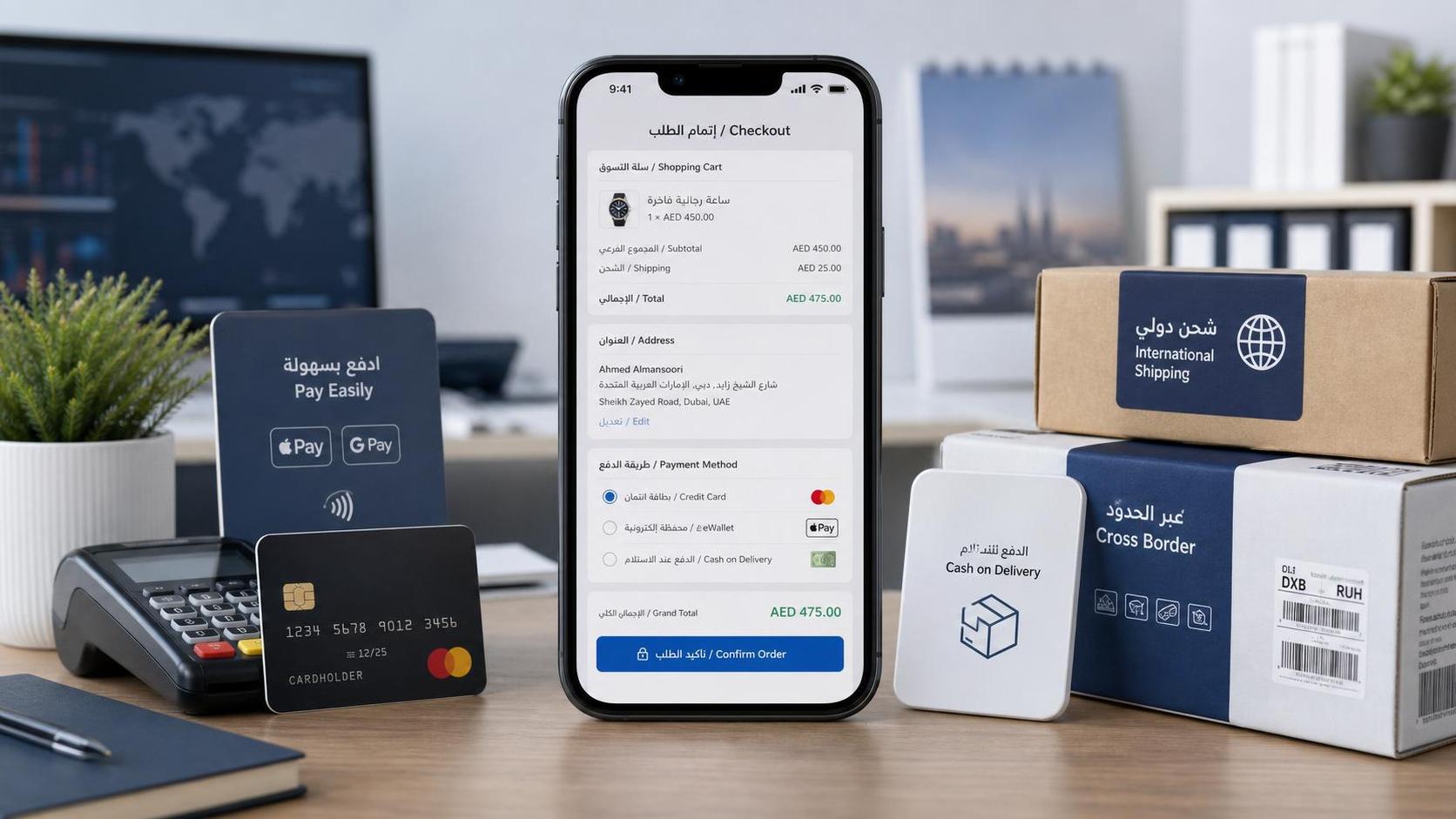
 What payment and website combination yields high conversion rates in the Middle East market? Configuration recommendations for independent websites.
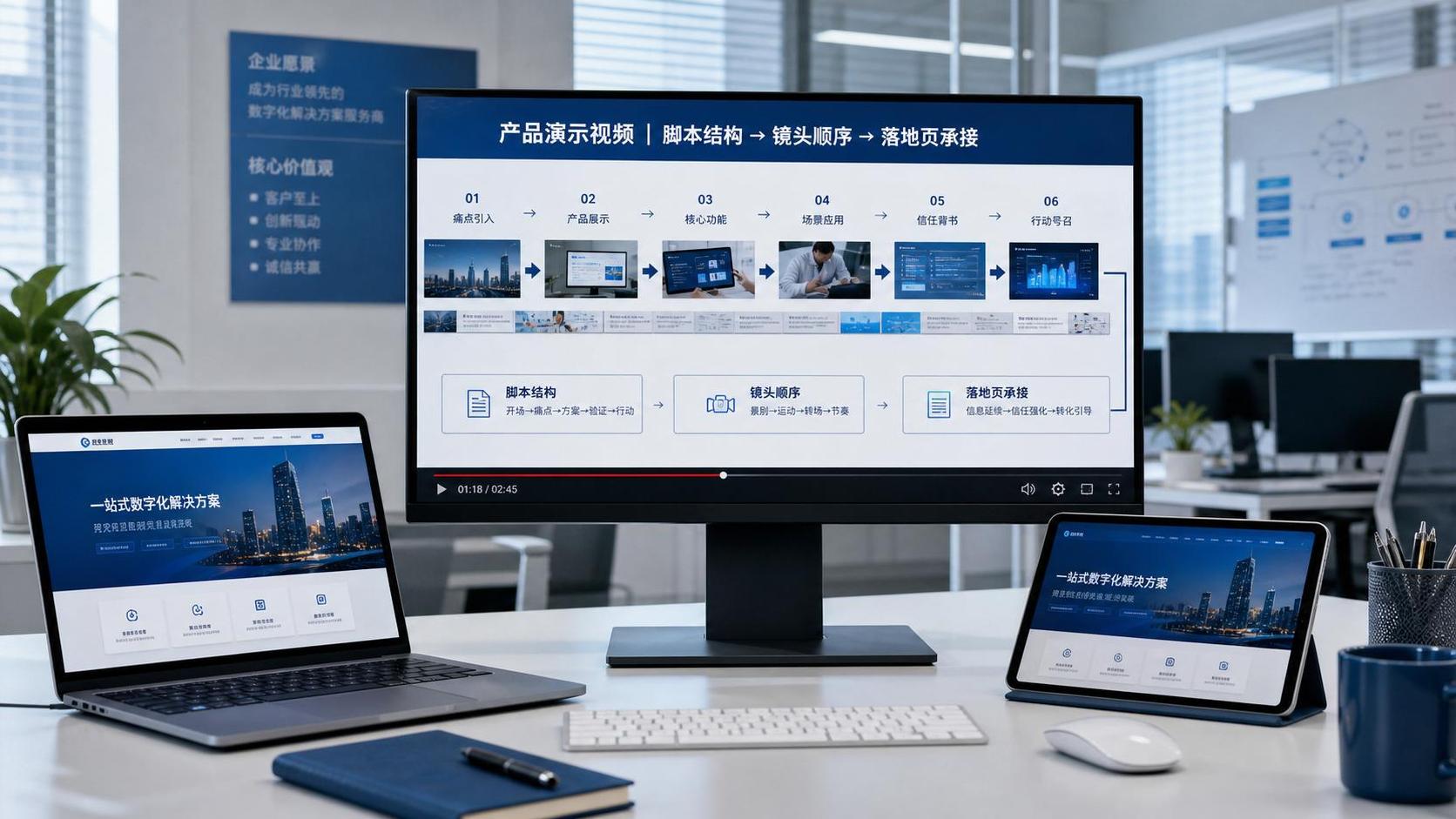
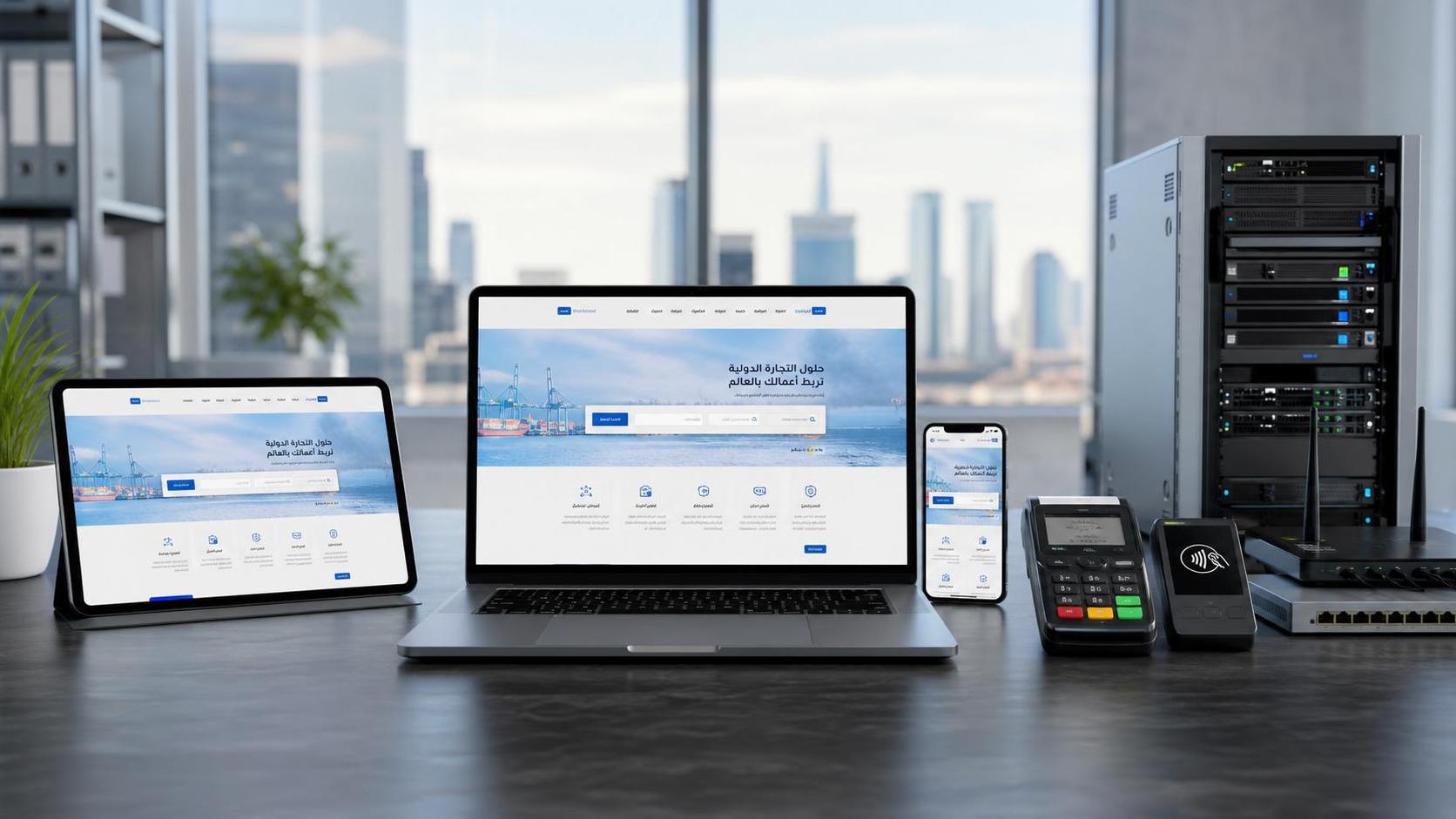
 How to implement a multilingual website solution for foreign trade in the Middle East market? Integrated planning of language, payment, and server solutions.
Related Products
 EasyCamp SaaS Smart Website Marketing SystemE-Yingbao SaaS Smart Website Marketing System: AI-powered, zero-code website building. Rapidly launch multilingual independent e-commerce sites in just 10 minutes. Global server acceleration and AI-driven SEO optimization empower businesses to efficiently connect with global markets. The seamless integration of technology and user-friendly operation makes building e-commerce sites incredibly simple.
 AI+SEM Intelligent Advertising Marketing SystemAI+SEM drives intelligent ad creation, empowering full-funnel precision advertising marketing. The system automatically generates weekly/monthly reports, AI recommends keywords and target countries, monitors core metrics in real-time with intelligent alerts, and enables one-click high-conversion ad solutions to help quickly acquire customers and improve ROI.
 AI+SEO Dual Engine Optimization ServiceEasyWin AI+SEO Dual Engine Optimization System leverages AI-powered keyword mining, content generation, and comprehensive technical optimization to help foreign trade enterprises acquire high-quality organic traffic, significantly improving search rankings and conversion rates.
 AI+SNS Social Media Marketing SystemYingbao AI+SNS Social Media Marketing System - Precision social capture for the social media era. Supports one-click content synchronization across major platforms like Facebook and LinkedIn. AI intelligently rewrites posts for enhanced relevance. 24/7 AI customer service and user profiling analysis empower businesses to efficiently expand into global markets.
 AI+SEO营销解决方案易营宝AI+SEO营销解决方案,通过AI批量写作、智能生成TDK、精准关键词扩词等功能,全面优化网站SEO效果,提升流量与转化率。助力企业构建高效智能网站新生态。
 AI+SEM Advertising Marketing SolutionsAI+SEM Advertising Marketing Solution leverages AI technology to deeply empower SEM ad campaigns. It automatically generates weekly/monthly reports using AI, presenting account data across multiple dimensions for comprehensive insights into campaign performance and trends. The system precisely recommends keywords and target countries, intelligently generates high-conversion ad copy, and enables one-click activation of efficient campaign plans to help businesses rapidly acquire customers. Simultaneously, it monitors core metrics in real time, intelligently identifies abnormal fluctuations, and issues timely alerts to ensure stable, high-return advertising results.
 Domain Name ServicesEasyWin provides professional domain name services, including intelligent queries, one-stop registration, brand protection, and full lifecycle management, helping businesses build a digital brand image.
 EasyOperate B2C Cross-Border E-Commerce Platform & Independent WebsiteEasyStore B2C Cross-border E-commerce Independent Store is an intelligent website building and cross-border e-commerce integrated solution independently developed by EasyStore Information Technology (Beijing) Co., Ltd. The system is specially designed for small and medium-sized as well as large export enterprises, integrating 'website building, operation, marketing, advertising, and conversion' into one, helping enterprises quickly establish cross-border e-commerce independent stores to achieve brand globalization and global sales growth.
The platform supports multiple languages, multiple currencies, and multi-channel marketing, with built-in AI intelligent translation and SEO optimization systems, suitable for mainstream markets such as Southeast Asia, Europe and America, Latin America, and the Middle East, assisting Chinese manufacturing enterprises in efficiently deploying international e-commerce strategies. SSL证书易营宝提供专业SSL安全证书服务,包括单域名和泛域名证书,确保网站数据传输加密、身份验证和完整性保护,助力企业建立安全可信的在线业务环境。









