









- Which channel has the highest ROI in the global traffic ecosystem? Comparative analysis of search, social media, and advertisingJul 10, 2026View details
- What multilingual website services are available in Sanya? Which model is more suitable for local businesses going global?Jul 08, 2026View details
- How to view the complete list of China SaaS companies in the top 100? Practical methods for screening website-building and marketing service providersJul 08, 2026View details
- How to view pricing in the global traffic ecosystem? Cost comparison of search, social media, and content channel advertisingJul 06, 2026View details
- How to assess foreign trade website development trends?Looking at 2026 changes from multilingual,AI content to conversion pathsJul 04, 2026View details
- What are the new trends in multilingual marketing data analytics tools in 2026? Focus on attribution、automation and complianceJul 04, 2026View details
How Does a Brand Appear in AI Assistant Answers? A Practical Guide to Manufacturing Brand Content Layout
Why Are Manufacturing Brands Paying More Attention to AI Answer Inclusion
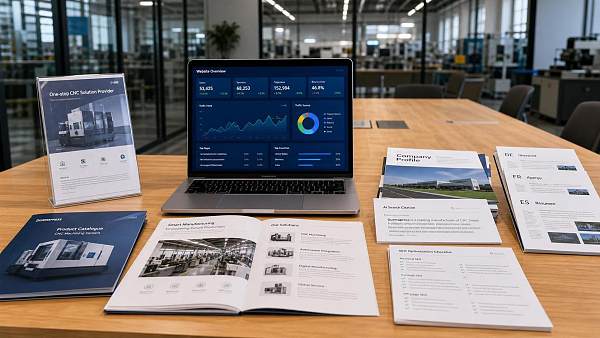
How a brand appears in AI assistant answers is no longer just a content visibility issue; it is more directly related to the front-end touchpoint capability of manufacturing brands in overseas customer acquisition. Many inquiries have not even entered the search results comparison stage, yet the judgment has already been made in AI Q&A.
This is also the reason why the content layout of manufacturing brands has changed significantly in the past two years. In the past, the focus was on webpage ranking. Now, answer citation, brand mentions, structured information clarity, and whether website content can be accurately understood by AI must also be considered.
In practical applications, different industries, product complexity, and export regions lead to different approaches to how brands appear in AI assistant answers. Standard products, custom parts, and equipment-solution businesses have noticeably different judgment priorities.
For businesses that have long been focused on independent website operations and overseas marketing, websites, SEO, advertising, and AI search are no longer separate actions. Platforms like Yiyingbao, which center on intelligent website building, AI+SEO/GEO optimization, and multilingual content management, are more suitable for manufacturing scenarios because they can place content visibility, indexing efficiency, and conversion handoff on the same chain.
First Clarify the Scenario, Then Judge How a Brand Appears in AI Assistant Answers
A common misconception in manufacturing brands is to understand all AI visibility issues as writing a few articles. In fact, when generating answers, AI assistants integrate official website pages, industry materials, third-party citations, parameter expression methods, and multilingual consistency.
If what is sold is general-purpose standard parts, AI more easily captures specifications, uses, and supply capabilities; if complete equipment or process solutions are provided, AI pays more attention to case logic, delivery scope, industry adaptation conditions, and service coverage. Different content structures naturally lead to different results.
The more common judgment process is to first look at three questions: whether the website can be parsed by AI, whether the content is centered on real issues, and whether the brand information remains consistent across multiple pages and channels. If one of these is missing, it is difficult for a manufacturing brand to appear stably in AI assistant answers.
Standard Product Scenarios Focus More on Parameter Clarity
If a standard product page only has a product name and a few images, AI finds it difficult to determine the brand’s advantage. A more effective approach is to write the model number, material, specification range, certification standards, applicable industries, and delivery regions into page content with a clear structure.
In such scenarios, how a brand appears in AI assistant answers often depends on whether the page can directly answer questions like “what working conditions is it suitable for,” “which standards are supported,” and “what is the delivery scope.”
Custom Part Scenarios Focus More on Capability Boundaries
Custom businesses are most afraid of content being written too broadly. If AI cannot read the machining scope, proofing cycle, common tolerances, supporting processes, and matching materials, it is very difficult for it to proactively mention the manufacturing brand in its answers.
At this point, website content should not only say “customization supported,” but also clearly explain “to what extent it can be customized.” The clearer the capability boundaries are, the easier it is for AI to match the brand with specific needs.
Equipment Solution Scenarios Focus More on Cases and Processes
Equipment and production line businesses usually have longer decision chains. When AI assistants answer related questions, they look not only at equipment names, but also at case descriptions, implementation steps, applicable industries, installation conditions, and after-sales scope.
Therefore, how a brand appears in AI assistant answers is, in this type of scenario, essentially a case-content construction issue. Cases are not promotional copy; they are about clearly explaining project background, process requirements, configuration choices, and result differences.
Under Different Scenarios, Website Content Layout Priorities Are Not the Same
If all content is placed on the company introduction page, AI cannot catch the key points. A more stable approach is to let the product page, industry page, FAQ page, and case page each take on different tasks, and then connect them through internal links.
This is especially important for multilingual markets. North America focuses on compliance and delivery, Europe pays more attention to standards and documentation, and Southeast Asia more often asks about adaptability and cost. If there is no scenario-based content layout, even if a manufacturing brand has traffic, it may still not enter AI assistant answers.
Beyond Content, the Data Layer and Site Architecture Determine Whether AI Can Reference It Stably
Many enterprise websites have a lot of content, yet how a brand appears in AI assistant answers still shows little improvement. The problem is often not content volume, but the underlying structure. Page crawling efficiency, information hierarchy, language version mapping, and link stability all affect how AI recognizes a brand.
For manufacturing brands, the site layer should at least ensure three things: first, page topics are single and clear; second, the same product carries consistent meaning in different languages; third, important pages can be updated long term rather than having URLs changed frequently.
- Unify brand information, including company introduction, main business scope, regional capabilities, and contact information.
- Standardize product data and avoid multiple writing styles for the same model number.
- Interlink FAQ content and case content to form a semantic loop.
- Multilingual pages should not be machine direct translations, but rewritten according to market questions.
This is also why websites and marketing services need to be viewed together. Platforms like Yiyingbao that combine intelligent website building, SEO, advertising, and GEO layout derive their value not only from website-building speed, but more from being able to synchronize underlying data structure and content operations planning, reducing later rework.
Misjudgments That Are Easy to Overlook at the Time of Implementation Are Often More Fatal Than Missing Content
When manufacturing brands build AI visibility, the common mistake is not failing to take it seriously, but having a biased direction. The most typical issue is looking only at keyword coverage without checking whether the brand truly answers the question.
There is also a situation where search optimization and AI optimization are completely separated. In reality, how a brand appears in AI assistant answers still depends on high-quality web pages, stable indexing, and externally trusted signals; it just places higher demands on content organization.
- Only writing about company strength, not product usage conditions, makes it hard for AI to generate specific recommendations.
- Only optimizing the homepage without deep pages leaves brand mentions at a superficial level of recognition.
- Only looking at a single regional expression without considering multilingual differences reduces citation stability.
- Frequent revisions without preserving old link rules can easily break historical accumulation.
Before implementation, what needs to be confirmed is whether the official website is responsible for brand display, inquiry handoff, or serving as a trusted source in AI answers. The clearer the positioning, the easier the content and structure will converge in the right direction.
A More Practical Way Forward Is to First Do One Round of Scenario-Based Content Calibration
If you want to increase the probability of how a brand appears in AI assistant answers, a manufacturing brand can start by sorting out the existing official website rather than rebuilding everything from scratch at once. First identify high-value product pages, key industry pages, and the most frequently asked questions, then rewrite them step by step.
A more stable approach is to set content priorities by scenario. First cover pages that can directly bring in inquiries, then supplement cases and FAQs, and finally handle multilingual expansion and external content distribution. This not only fits SEO accumulation logic, but also better suits the citation mechanism of AI search.
For a website + marketing services integrated layout, the next step can be carried out around four actions: sort out core scenario keywords, standardize product data expressions, complete case and FAQ pages, and check whether the multilingual site structure supports long-term updates. Once these foundations are solid, the chance of a manufacturing brand appearing in AI assistant answers will continue to increase rather than fluctuate only in the short term.
Related Articles
 Japanese JIS AI-Assisted Certification Guide Upgrade, Website Platform Adds New Japanese Compliance Q&A Requirements
 How Does a Brand Appear in AI Assistant Answers? A Practical Guide to Manufacturing Brand Content Layout
 What is GEO optimization for brand overseas marketing services? What is the difference between it and traditional SEO

Related Products
 EasyCamp SaaS Smart Website Marketing SystemE-Yingbao SaaS Smart Website Marketing System: AI-powered, zero-code website building. Rapidly launch multilingual independent e-commerce sites in just 10 minutes. Global server acceleration and AI-driven SEO optimization empower businesses to efficiently connect with global markets. The seamless integration of technology and user-friendly operation makes building e-commerce sites incredibly simple.
 AI+SEM Intelligent Advertising Marketing SystemAI+SEM drives intelligent ad creation, empowering full-funnel precision advertising marketing. The system automatically generates weekly/monthly reports, AI recommends keywords and target countries, monitors core metrics in real-time with intelligent alerts, and enables one-click high-conversion ad solutions to help quickly acquire customers and improve ROI.
 AI+SEO Dual Engine Optimization ServiceEasyWin AI+SEO Dual Engine Optimization System leverages AI-powered keyword mining, content generation, and comprehensive technical optimization to help foreign trade enterprises acquire high-quality organic traffic, significantly improving search rankings and conversion rates.
 AI+SNS Social Media Marketing SystemYingbao AI+SNS Social Media Marketing System - Precision social capture for the social media era. Supports one-click content synchronization across major platforms like Facebook and LinkedIn. AI intelligently rewrites posts for enhanced relevance. 24/7 AI customer service and user profiling analysis empower businesses to efficiently expand into global markets.
 AI+SEO营销解决方案易营宝AI+SEO营销解决方案,通过AI批量写作、智能生成TDK、精准关键词扩词等功能,全面优化网站SEO效果,提升流量与转化率。助力企业构建高效智能网站新生态。
 AI+SEM Advertising Marketing SolutionsAI+SEM Advertising Marketing Solution leverages AI technology to deeply empower SEM ad campaigns. It automatically generates weekly/monthly reports using AI, presenting account data across multiple dimensions for comprehensive insights into campaign performance and trends. The system precisely recommends keywords and target countries, intelligently generates high-conversion ad copy, and enables one-click activation of efficient campaign plans to help businesses rapidly acquire customers. Simultaneously, it monitors core metrics in real time, intelligently identifies abnormal fluctuations, and issues timely alerts to ensure stable, high-return advertising results.
 Domain Name ServicesEasyWin provides professional domain name services, including intelligent queries, one-stop registration, brand protection, and full lifecycle management, helping businesses build a digital brand image.
 EasyOperate B2C Cross-Border E-Commerce Platform & Independent WebsiteEasyStore B2C Cross-border E-commerce Independent Store is an intelligent website building and cross-border e-commerce integrated solution independently developed by EasyStore Information Technology (Beijing) Co., Ltd. The system is specially designed for small and medium-sized as well as large export enterprises, integrating 'website building, operation, marketing, advertising, and conversion' into one, helping enterprises quickly establish cross-border e-commerce independent stores to achieve brand globalization and global sales growth.
The platform supports multiple languages, multiple currencies, and multi-channel marketing, with built-in AI intelligent translation and SEO optimization systems, suitable for mainstream markets such as Southeast Asia, Europe and America, Latin America, and the Middle East, assisting Chinese manufacturing enterprises in efficiently deploying international e-commerce strategies. SSL证书易营宝提供专业SSL安全证书服务,包括单域名和泛域名证书,确保网站数据传输加密、身份验证和完整性保护,助力企业建立安全可信的在线业务环境。









