









- What Does a Global Traffic Ecosystem Service Provider Do? What Are the Differences from a Single Advertising AgencyJul 16, 2026View details
- What should you focus on in the latest enterprise SaaS report? From renewal rates and delivery costs to overseas growth opportunitiesJul 12, 2026View details
- What signals are worth paying attention to in a cross-border marketing trend report? B2B companies should look at these 6 signalsJul 11, 2026View details
- How to Read a Cross-Border Marketing Trends Report? Five Key Dimensions for Evaluating Channel OpportunitiesJul 11, 2026View details
- Which channel has the highest ROI in the global traffic ecosystem? Comparative analysis of search, social media, and advertisingJul 10, 2026View details
- What multilingual website services are available in Sanya? Which model is more suitable for local businesses going global?Jul 08, 2026View details
Will poor mobile responsiveness affect Google rankings?
Will poor mobile adaptation affect Google rankings? The answer is yes, and the impact often goes beyond search result positions. For businesses that rely on overseas customer acquisition, a poor mobile experience may not only lower Google organic rankings, but also affect page indexing, bounce rate, time on page, inquiry conversions, and advertising performance, ultimately undermining the marketing performance of the entire website.
This is especially true for foreign trade companies, cross-border e-commerce businesses, and brands expanding overseas. For many international users, their first interaction with a brand takes place when they search on a mobile phone and visit the website. If the website loads slowly on mobile, has a disorganized layout, difficult-to-tap buttons, or content that extends beyond the screen, users may leave immediately. Google incorporates these experience signals into its evaluation, so mobile adaptation is no longer optional but a basic requirement.
Why does Google place importance on the mobile experience?
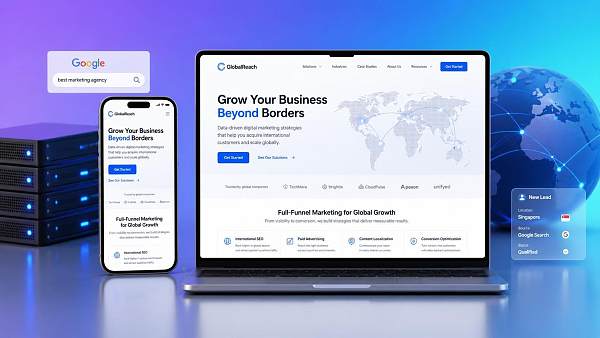
Google has long adopted mobile-first indexing, which means it prioritizes crawling and evaluating the mobile version of a website rather than the desktop version. This means that when Google evaluates the quality, content completeness, and usability of your pages, it looks at their mobile performance. If there are obvious problems with the mobile pages, rankings will naturally be affected.
Many businesses mistakenly believe that as long as the PC version is well designed, their search rankings will not be affected. In reality, Google's core logic has changed. Mobile is no longer an auxiliary version, but the primary channel through which search engines understand a website's content, structure, and user value. Poor mobile adaptation essentially means compromising the website's most important entry point.
For marketing websites, Google focuses not only on whether a page can be opened, but also on whether users can browse smoothly, obtain information, and complete actions. Page readability, ease of clicking, loading speed, and whether core content is displayed completely all affect Google's assessment of page quality.
How does poor mobile adaptation typically affect rankings?
The first type of impact is reduced indexing and crawling efficiency. If mobile page content is missing, the structure is disorganized, or some content is blocked through improper technical methods, Googlebot may be unable to fully understand the page topic while crawling it. This can result in slower or fewer indexed pages, and even prevent key pages from being consistently included in the index.
The second type of impact is the deterioration of user behavior metrics. Although Google does not simply use a single behavior metric to determine rankings, a poor mobile experience often leads to a higher bounce rate, shorter time on page, and lower page engagement. These results may indirectly indicate that the page fails to satisfy search intent, which is unfavorable to long-term ranking stability.
The third type of impact comes from page experience signals. For example, text that is too small, elements that are crowded together, buttons that are difficult to tap, pop-ups that obscure content, and severe horizontal scrolling are all typical mobile-unfriendly issues. Google clearly discourages these designs because they directly damage users' reading and operating experience on mobile devices.
The fourth type of impact is performance-related. Mobile users often operate in more complex network environments and use devices with greater performance differences. If page images are too large, scripts are redundant, or above-the-fold content renders slowly, the website is more likely to perform poorly in Core Web Vitals. Slow speed affects not only users but may also cause search engines to take a more cautious view of the overall page quality.
Which mobile adaptation problems are most common and most easily overlooked by businesses?
Many businesses believe that a website is mobile-ready as long as it can be opened on a phone, but this is only the minimum standard. Problems that truly affect Google rankings and conversion performance are often hidden in the details. For example, the PC version may contain complete content, while the mobile version removes product specifications, case studies, FAQs, or contact options to simplify the page. This directly weakens the page's SEO value.
Another common problem is incomplete responsive design. Although the page scales, the module order may be disorganized, tables may overflow, forms may be difficult to complete, and menu hierarchies may be too deep, forcing users to repeatedly zoom in and out to read the content. This situation is especially common on manufacturing websites, B2B product pages, and multilingual websites.
Some businesses also make extensive use of pop-ups, floating buttons, and full-screen prompts, causing the actual body content to be obscured. For businesses seeking more inquiries, this design may appear proactive, but in practice it can easily test users' patience and may also lead Google to form a negative assessment of the page experience.
If a website uses outdated templates or multiple plugins layered together, it may also experience mobile resource-loading conflicts, inconsistent image dimensions, and excessively long blank periods before above-the-fold content appears. These problems may not be immediately visible to the naked eye, but they can continuously undermine the website's search performance.
How should businesses determine whether their website is already affecting its Google performance?
The most direct approach is to investigate both Google Search Console data and the actual user experience. First, review mobile usability, page indexing, Core Web Vitals, and fluctuations in organic traffic. Then use an actual mobile phone to visit key pages and check whether the homepage, product pages, content pages, and inquiry pages can all be browsed and operated smoothly.
If mobile indexing decreases, keyword rankings fluctuate significantly, average click-through rate declines, the mobile bounce rate is high, or the form submission rate is low, you should strongly suspect that the mobile experience is dragging down search performance. Many businesses attribute these issues to insufficient content or weak backlinks, when the root cause may actually be that the pages themselves are difficult to use.
When assessing performance, do not look only at the homepage. The pages that truly affect SEO results are often the specific landing pages that receive search traffic, such as product detail pages, industry solution pages, blog article pages, and multilingual pages. As long as these core pages perform poorly on mobile, overall rankings and inquiry quality will also be affected.
In addition, it is important to distinguish between being “accessible” and being “able to convert.” Even if a page has no obvious errors, it may still lose many potential customers because of unreasonable button placement, unclear content hierarchy, or overly long form-filling steps. For businesses, the goal of mobile adaptation is not merely to pass testing, but to improve actual business results.
If mobile adaptation is inadequate, what should be fixed first?
The highest priority is ensuring content consistency and crawlability. Mobile pages must retain titles, body content, product descriptions, internal links, and structured information that are equally important to those on the desktop version. Avoid deleting core content in the name of “simplicity.” For Google, missing content is more serious than styling issues.
The second step is to fix responsive layout and interaction issues. Pay particular attention to font size, button spacing, image scaling, navigation structure, form input, horizontal scrolling, and pop-up obstruction. Any design that prevents users from quickly obtaining information and completing actions should be addressed as soon as possible, because these issues affect both rankings and conversions.
The third step is to optimize loading performance, including compressing images, reducing unnecessary scripts, deferring non-core resources, limiting the number of third-party plugins, and improving the loading speed of visible above-the-fold content. For cross-border websites, server deployment, CDN strategies, and access speeds across different regions can also significantly affect the mobile experience.
Finally, continuous monitoring should be implemented rather than treating optimization as a one-time task. Mobile adaptation is not something that is completed once at launch. Newly added pages, redesigns, plugins, and tracking code can all create compatibility problems again. Incorporating the mobile experience into daily SEO operations is more consistent with the logic of long-term growth.
Why is this especially important for overseas marketing websites?
For foreign trade companies and brands expanding overseas, the cost of poor mobile adaptation is usually higher. This is because international users frequently use mobile phones for their initial searches, price comparisons, and brand evaluations. In particular, when social media traffic, Google advertising, and organic search are used together, mobile devices are often the primary entry point for website traffic.
If mobile pages perform poorly, the impact is not limited to SEO. Ad Quality Score, landing page conversion rate, social media traffic performance, and perceptions of brand professionalism may all decline at the same time. Users do not distinguish whether the problem is poor rankings, poor experience, or poor content. They simply leave and turn to a competitor's website.
This is why more and more businesses are embracing the idea that “website development is marketing.” A website that can truly handle global traffic must do more than look good visually. Its website structure, technical architecture, multilingual adaptation, page speed, and SEO practices must all be prepared for overseas search and conversions.
For businesses seeking to acquire customers through Google over the long term, mobile adaptation is not merely an isolated technical fix, but part of the website's underlying competitiveness. The businesses that can more consistently meet users' search and browsing needs on mobile devices will have a greater opportunity to gain ongoing exposure, clicks, and inquiries.
Conclusion: Poor mobile adaptation affects more than rankings
Returning to the core question: will poor mobile adaptation affect Google rankings? The answer is clear: yes. Moreover, this impact typically spreads through indexing, rankings, clicks, experience, and conversions, eventually resulting in higher customer acquisition costs, unstable organic traffic, and lost business opportunities.
For business managers, the focus should not stop at whether the website can be opened on a mobile phone. Instead, they should determine whether it is truly suitable for mobile search users, and whether it can consistently handle Google traffic and convert it into inquiries. For implementation teams, the mobile experience, SEO standards, and conversion design should be optimized as one integrated system.
If a business is developing an independent website for overseas markets, resolving mobile adaptation issues as early as possible can reduce future SEO repair costs and make it easier to establish a sustainable foundation for long-term search growth. If mobile performance is poor, rankings will be difficult to stabilize; when the mobile experience is optimized, the website's search and commercial value can be fully realized.
Related Articles


Related Products
 EasyCamp SaaS Smart Website Marketing SystemE-Yingbao SaaS Smart Website Marketing System: AI-powered, zero-code website building. Rapidly launch multilingual independent e-commerce sites in just 10 minutes. Global server acceleration and AI-driven SEO optimization empower businesses to efficiently connect with global markets. The seamless integration of technology and user-friendly operation makes building e-commerce sites incredibly simple.
 AI+SEM Intelligent Advertising Marketing SystemAI+SEM drives intelligent ad creation, empowering full-funnel precision advertising marketing. The system automatically generates weekly/monthly reports, AI recommends keywords and target countries, monitors core metrics in real-time with intelligent alerts, and enables one-click high-conversion ad solutions to help quickly acquire customers and improve ROI.
 AI+SEO Dual Engine Optimization ServiceEasyWin AI+SEO Dual Engine Optimization System leverages AI-powered keyword mining, content generation, and comprehensive technical optimization to help foreign trade enterprises acquire high-quality organic traffic, significantly improving search rankings and conversion rates.
 AI+SNS Social Media Marketing SystemYingbao AI+SNS Social Media Marketing System - Precision social capture for the social media era. Supports one-click content synchronization across major platforms like Facebook and LinkedIn. AI intelligently rewrites posts for enhanced relevance. 24/7 AI customer service and user profiling analysis empower businesses to efficiently expand into global markets.
 AI+SEO营销解决方案易营宝AI+SEO营销解决方案,通过AI批量写作、智能生成TDK、精准关键词扩词等功能,全面优化网站SEO效果,提升流量与转化率。助力企业构建高效智能网站新生态。
 AI+SEM Advertising Marketing SolutionsAI+SEM Advertising Marketing Solution leverages AI technology to deeply empower SEM ad campaigns. It automatically generates weekly/monthly reports using AI, presenting account data across multiple dimensions for comprehensive insights into campaign performance and trends. The system precisely recommends keywords and target countries, intelligently generates high-conversion ad copy, and enables one-click activation of efficient campaign plans to help businesses rapidly acquire customers. Simultaneously, it monitors core metrics in real time, intelligently identifies abnormal fluctuations, and issues timely alerts to ensure stable, high-return advertising results.
 Domain Name ServicesEasyWin provides professional domain name services, including intelligent queries, one-stop registration, brand protection, and full lifecycle management, helping businesses build a digital brand image.
 EasyOperate B2C Cross-Border E-Commerce Platform & Independent WebsiteEasyStore B2C Cross-border E-commerce Independent Store is an intelligent website building and cross-border e-commerce integrated solution independently developed by EasyStore Information Technology (Beijing) Co., Ltd. The system is specially designed for small and medium-sized as well as large export enterprises, integrating 'website building, operation, marketing, advertising, and conversion' into one, helping enterprises quickly establish cross-border e-commerce independent stores to achieve brand globalization and global sales growth.
The platform supports multiple languages, multiple currencies, and multi-channel marketing, with built-in AI intelligent translation and SEO optimization systems, suitable for mainstream markets such as Southeast Asia, Europe and America, Latin America, and the Middle East, assisting Chinese manufacturing enterprises in efficiently deploying international e-commerce strategies. SSL证书易营宝提供专业SSL安全证书服务,包括单域名和泛域名证书,确保网站数据传输加密、身份验证和完整性保护,助力企业建立安全可信的在线业务环境。









