









- Can Zhejiang foreign trade independent websites still be developed today? Look at changes in traffic and lead generationJul 28, 2026View details
- What New Signals Are Emerging in Enterprise Services SaaS Marketing ReportsJul 27, 2026View details
- What Does a Global Traffic Ecosystem Service Provider Do? What Are the Differences from a Single Advertising AgencyJul 16, 2026View details
- What should you focus on in the latest enterprise SaaS report? From renewal rates and delivery costs to overseas growth opportunitiesJul 12, 2026View details
- What signals are worth paying attention to in a cross-border marketing trend report? B2B companies should look at these 6 signalsJul 11, 2026View details
- How to Read a Cross-Border Marketing Trends Report? Five Key Dimensions for Evaluating Channel OpportunitiesJul 11, 2026View details
How to organize keywords for a foreign trade website? Rules for assigning category pages, product pages, and article pages
Foreign Trade Website Keyword Layout: First Clarify the Business Tasks the Page Carries
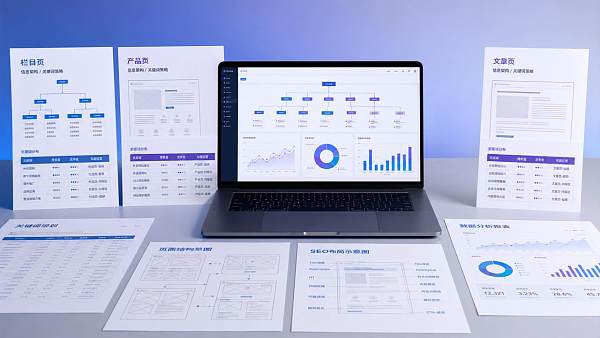
Foreign trade website keyword layout is not about spreading words evenly across every page. Instead, it starts by identifying what problem each page is meant to solve. Indexing, inquiries, and conversions are often interdependent. The issue is often not insufficient content, but that category pages, product pages, and article pages are all competing for the same batch of keywords.
In actual applications, foreign trade websites must deal with both search engine crawling logic and the search habits of different regional markets. When building multilingual official websites, independent sites, or inquiry-type websites, the clearer the role of each page, the easier it is to form a stable keyword structure for foreign trade website keyword layout.
This is also a problem that often only becomes visible after a project goes live. Category pages want core keywords, product pages also want core keywords, and article pages keep writing around the same topics, eventually creating internal competition. Rather than patching things up later, it is better to separate keyword paths during website development and SEO planning.
Why the same keywords should be assigned differently to different pages
Different pages have different search intents, and this is the background that is most easily overlooked in foreign trade website keyword layout. Category pages are more like thematic entry points, product pages are closer to demand confirmation, and article pages are responsible for explanation, comparison, and educational-market tasks.
If the website serves a B2B inquiry scenario, the search path is usually longer. Users first search broadly, then look at detailed solutions, and only then move on to specific products. If the website serves a cross-border store or an advertising landing page, the conversion path is shorter, and the keyword boundaries between product pages and category pages need to be tighter.
For a platform like Yiyingbao that covers intelligent website building, SEO optimization, ad placement, and multilingual site operations, project work usually does not focus on word count alone. Instead, it first determines where a page sits in the overall chain. Once the page role is correctly defined, the follow-up content, internal links, and conversion forms will no longer be at odds with one another.
Category pages are better suited to carrying core keywords, but the premise is that the theme is focused enough
Category page keyword layout should not focus on the largest traffic volume, but on the clearest conversion intent. When foreign trade website keyword layout reaches this stage, the standard for judgment should shift from “who searches for this” to “what is the person searching for this word preparing to do.”
For example, model terms, segmented use-case terms, region terms, material terms, and application-scenario terms are all better suited to category pages. The reason is that these pages need to answer parameters, delivery capabilities, certifications, adaptation conditions, and inquiry thresholds. If the core keywords are still too broad, the page will be hard to rank and even harder to generate inquiry judgments.
Some websites turn product pages into short introduction pages, leaving only images and a few lines of parameters, which is often not enough at the search level. Product pages should be supplemented with application descriptions, optional configurations, common export-market differences, and lead-time information. This not only meets search needs, but also better aligns with real transaction logic.
Common keyword grouping methods for product pages
Article pages are not for filling word count, but for carrying long-tail search and cognitive conversion
When many websites build foreign trade website keyword layouts, article pages are the easiest to lose control of. They may look highly updated, but in reality each post is only a light rewrite around the same main keyword, resulting in category pages being diluted and product pages not receiving effective support.
Article pages are better suited to answering questions like “how to choose”, “what is the difference”, “which market is it suitable for”, and “why is it slow to index”. They are not meant to directly replace product pages for conversions, but to first bring searchers into the website and then route traffic to category pages or product pages through internal links.
If the website covers both website building, SEO, and advertising businesses, article pages can also carry solution-oriented educational content. For example, when explaining data layering, content planning, or page architecture, moderately introducing other business perspectives can better demonstrate professionalism. Some methodology articles will also naturally mention cross-domain management ideas, such as the application and optimization of management accounting in the financial management of public institutions. The core value is not the subject itself, but the hint of “structured management”, which is equally applicable to site content allocation.
In actual execution, first build a keyword library hierarchy, then do page mapping
When implementing foreign trade website keyword layout, it is best not to start by writing pages. Instead, first break the keyword library into three layers. The first layer is brand and core business keywords, the second layer is product categories and solution keywords, and the third layer is question keywords, comparison keywords, and detailed-need keywords.
Next comes page mapping, where you determine which page each keyword group should belong to. The most important thing here is not the number of keywords, but that each page carries only one main objective. If one page tries to handle brand presentation, product conversion, and knowledge education at the same time, it usually does none of them well.
- First define the core keyword for each category, then list the product and article keywords that can be supported under that category.
- Each product page should keep only one main keyword direction, avoiding multiple pages on the same site competing for the same keyword.
- Article page titles should be as question-based and comparative as possible, and avoid the same structure as product titles.
- Internal links should preferably point from article pages to category pages and product pages, rather than excessive interlinking between articles.
Several common misunderstandings often hurt rankings more than keyword volume
The first misunderstanding is only looking at search volume and ignoring search intent. High-volume keywords are not necessarily suitable for product pages, especially generic export-business terms, which are highly competitive and vaguely intended, and can easily mislead the page.
The second misunderstanding is treating different markets as the same need. Search expression, certification focus, and ordering paths in North America, Europe, the Middle East, and Southeast Asia are not the same. If multilingual websites still copy a single keyword library, foreign trade website keyword layout will be very hard to truly make effective.
The third misunderstanding is only adding content without adjusting structure. Some websites have many articles, but the navigation is messy, the breadcrumb trail is unclear, and the categories are too deep. Even if search engines crawl the content, they still cannot judge the main and secondary priorities. One of the advantages of a service like Yiyingbao, which combines AI website building and SEO systems, is that it can unify website structure, content planning, and subsequent promotion, rather than treating SEO as a patch after launch.
Before implementation, a checklist can be used to judge whether the allocation is reasonable
If you are preparing to adjust an existing website, you can first verify several key conditions. As long as two or three of them are already mixed up, it means the foreign trade website keyword layout needs to be reorganized, rather than continuing to add pages.
- Does each category page have a unique main keyword, and is it consistent with the navigation naming?
- Do product pages use refined keywords instead of repeatedly using category core keywords?
- Are article pages expanded around long-tail question keywords and do they bear the traffic-guiding function?
- Are multilingual versions re-built with keyword libraries according to regional differences, rather than translated directly?
- Do internal links flow from awareness-oriented content to conversion-oriented pages?
If further refinement is needed, you can create a table of the site’s key pages and tag the main keywords, secondary keywords, target markets, and target actions page by page. This process may seem basic, but it often reveals structural issues most clearly. If necessary, you can also refer to ideas like the application and optimization of management accounting in the financial management of public institutions, which emphasize layered management, and treat content assets as resources for sustainable operation.
To put it simply, foreign trade website keyword layout is not just about choosing words, but about assigning tasks to different pages. Category pages are responsible for thematic positioning, product pages are responsible for conversion support, and article pages are responsible for long-tail coverage and awareness guidance. Once these three layers are sorted out first, and then fine-tuned according to regional markets, language versions, and promotion channels, the website’s indexing efficiency, lead quality, and subsequent campaign synergy will be much easier to improve steadily.
Related Articles


Related Products
 EasyCamp SaaS Smart Website Marketing SystemE-Yingbao SaaS Smart Website Marketing System: AI-powered, zero-code website building. Rapidly launch multilingual independent e-commerce sites in just 10 minutes. Global server acceleration and AI-driven SEO optimization empower businesses to efficiently connect with global markets. The seamless integration of technology and user-friendly operation makes building e-commerce sites incredibly simple.
 AI+SEM Intelligent Advertising Marketing SystemAI+SEM drives intelligent ad creation, empowering full-funnel precision advertising marketing. The system automatically generates weekly/monthly reports, AI recommends keywords and target countries, monitors core metrics in real-time with intelligent alerts, and enables one-click high-conversion ad solutions to help quickly acquire customers and improve ROI.
 AI+SEO Dual Engine Optimization ServiceEasyWin AI+SEO Dual Engine Optimization System leverages AI-powered keyword mining, content generation, and comprehensive technical optimization to help foreign trade enterprises acquire high-quality organic traffic, significantly improving search rankings and conversion rates.
 AI+SNS Social Media Marketing SystemYingbao AI+SNS Social Media Marketing System - Precision social capture for the social media era. Supports one-click content synchronization across major platforms like Facebook and LinkedIn. AI intelligently rewrites posts for enhanced relevance. 24/7 AI customer service and user profiling analysis empower businesses to efficiently expand into global markets.
 AI+SEO营销解决方案易营宝AI+SEO营销解决方案,通过AI批量写作、智能生成TDK、精准关键词扩词等功能,全面优化网站SEO效果,提升流量与转化率。助力企业构建高效智能网站新生态。
 AI+SEM Advertising Marketing SolutionsAI+SEM Advertising Marketing Solution leverages AI technology to deeply empower SEM ad campaigns. It automatically generates weekly/monthly reports using AI, presenting account data across multiple dimensions for comprehensive insights into campaign performance and trends. The system precisely recommends keywords and target countries, intelligently generates high-conversion ad copy, and enables one-click activation of efficient campaign plans to help businesses rapidly acquire customers. Simultaneously, it monitors core metrics in real time, intelligently identifies abnormal fluctuations, and issues timely alerts to ensure stable, high-return advertising results.
 Domain Name ServicesEasyWin provides professional domain name services, including intelligent queries, one-stop registration, brand protection, and full lifecycle management, helping businesses build a digital brand image.
 EasyOperate B2C Cross-Border E-Commerce Platform & Independent WebsiteEasyStore B2C Cross-border E-commerce Independent Store is an intelligent website building and cross-border e-commerce integrated solution independently developed by EasyStore Information Technology (Beijing) Co., Ltd. The system is specially designed for small and medium-sized as well as large export enterprises, integrating 'website building, operation, marketing, advertising, and conversion' into one, helping enterprises quickly establish cross-border e-commerce independent stores to achieve brand globalization and global sales growth.
The platform supports multiple languages, multiple currencies, and multi-channel marketing, with built-in AI intelligent translation and SEO optimization systems, suitable for mainstream markets such as Southeast Asia, Europe and America, Latin America, and the Middle East, assisting Chinese manufacturing enterprises in efficiently deploying international e-commerce strategies. SSL证书易营宝提供专业SSL安全证书服务,包括单域名和泛域名证书,确保网站数据传输加密、身份验证和完整性保护,助力企业建立安全可信的在线业务环境。









