









- The China-US tariff arrangement has reached a preliminary consensus, and the trade association will be establishedJun 15, 2026View details
- What determines B2C cross-border e-commerce website development costs? A breakdown of features, interfaces, and deployment methodsJun 17, 2026View details
- China-Morocco zero-tariff access, a breakthrough in the cost of Moroccan goods exports to ChinaJun 11, 2026View details
- What signal should be released for the suspension of exports to JapanJun 10, 2026View details
- China's May LNG imports rebounded, with increased volumes from Russia and Canada filling the Middle East supply gapJun 10, 2026View details
- Will GEO change its SEO strategy?Jun 04, 2026View details
What types of structured data are there? A one-stop explanation of the most commonly used markup scenarios for business websites
What exactly is structured data, and why are more and more corporate websites paying attention to it
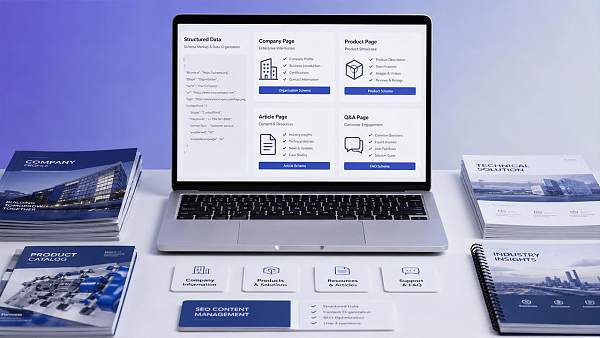
Structured data is not page copy written for visitors to read, but a standardized description written for search engines to understand the page content.
Simply put, for the same page content, plain text can only be “read,” while structured data can be “accurately recognized.”
For corporate websites, this has very direct value: it helps search engines determine whether you are a company profile, product detail, article content, or a FAQ page.
When a website also carries the task of acquiring leads, structured data not only affects indexing and understanding, but also influences how results are displayed and clicked in search listings.
Especially in scenarios such as intelligent website building, SEO optimization, landing pages, and multilingual official websites running in parallel, the more page types there are, the more structured data is needed to make the information clear.
For integrated service scenarios like YiYingBao that cover website building, SEO, advertising, and overseas marketing, the common approach is to first standardize the page framework and then gradually complete the key tags.
What types of structured data are there? Do not mix all tags together
When many people first encounter structured data, it is easy to assume there is only one way to write it. In fact, common types can be understood according to page purpose.
The most common structured data for corporate websites can roughly be divided into the following categories.
- Corporate information type: used to describe the company name, website, contact information, brand attributes, and social media accounts.
- Product type: suitable for product detail pages, expressing product name, image, description, price, stock, or model information.
- Article type: suitable for news, case studies, blogs, and industry content, emphasizing title, publication time, author, and cover image.
- FAQ type: suitable for Q&A pages, helping search engines identify the correspondence between questions and answers.
- Breadcrumb type: explains page hierarchy, making it easier for search engines to understand the site path structure.
- Local business or organization type: suitable for websites with a clear office address, service area, and business information.
If a website has both a corporate website, marketing content, and a storefront page, then structured data is usually not an either-or choice, but a combined use.
For example, an industry article can be marked as article type, with breadcrumb added in the footer; a product detail page is more suitable for product tags combined with organization entity information.
Which tags should a corporate website prioritize? Judgment order matters more than quantity
In actual implementation, it is not recommended to pursue “full-site, full-type coverage” from the very beginning. A more stable approach is to first work on high-traffic entry pages.
The judgment table below can help quickly prioritize.
If the website mainly acquires leads through inquiries, it usually starts with corporate information, product pages, and breadcrumb tags; if content marketing carries more weight, then article and FAQ tags can be added.
For multilingual independent sites, attention should also be paid to content consistency across different language pages, avoiding mismatches between page content and structured data expressions.
How exactly do you distinguish FAQ, article, and product tags, and where is the easiest point of confusion
These three types of structured data are the most common, and also the easiest to misuse.
FAQ tags are suitable for pages with “one question corresponding to one clear answer.” If a page is only a general introduction and does not have a real Q&A structure, it is not recommended to force it.
Article tags are more suitable for blog posts, case studies, industry insights, and tutorial content. They emphasize content production attributes rather than sales attributes.
Product tags are more biased toward goods or solutions details. The page should have a clear product name, description, parameters, or transaction-related information.
In practical applications, some solution pages sit in a middle ground, for example they look like a service introduction but also like a landing solution page. In this case, the page’s primary objective needs to be judged first.
If the core of the page is to explain knowledge points, then it leans toward an article structure; if the core is to handle needs and introduce specific services, then it is more suitable to combine organization information with breadcrumb, rather than forcibly writing it as product tags.
Content similar to application strategies of lean cost principles in enterprise inventory management, if the page focus is knowledge interpretation, it is usually closer to an article-type structure rather than a standard product-type structure.
Will structured data definitely produce rich results? What are the common misconceptions
No. Structured data helps search engines understand the page, but it does not guarantee special display.
The more common misconceptions are mainly the following.
- The page has no corresponding content, but tags were added. This easily causes information inconsistency.
- The same set of structured data is copied across the entire site, causing different pages to lose differentiation.
- Only the code is done, regardless of page quality. When the content is weak, the tags themselves are hard to play their role.
- Ignoring mobile and multilingual versions, causing information conflicts across different versions of the same page.
- Treating structured data as a short-term ranking trick rather than part of long-term content governance.
Especially for foreign trade websites, brand independent sites, and landing pages, structured data must stay consistent with the page title, body copy, navigation, and conversion path.
In intelligent website building and AI+SEO/GEO optimization scenarios, YiYingBao usually plans the page templates, content fields, and search-friendly settings together, so that later maintenance costs are lower.
If you are preparing to go live, where should you start for a more stable setup
First map out the page types, then determine the priorities; this matters more than directly writing the code.
A more practical promotion method can be carried out in the following steps.
- First sort out whether the homepage, product page, article page, and FAQ page all have clear templates.
- Then confirm which fixed fields each page type has, such as title, summary, publication time, brand name, and contact information.
- Prioritize traffic entry pages instead of rushing to cover all historical pages at once.
- After launch, check whether search engines can correctly recognize them, rather than only looking at the front-end display of the page.
- Incorporate structured data into the subsequent website building and content publishing process to avoid invalidation after revisions.
If the website still undertakes overseas promotion tasks, structured data is best considered together with SEO, content production, and landing page setup, rather than as an isolated function added later.
For example, when organizing industry knowledge content, you can also refer to the content organization method of theme pages such as application strategies of lean cost principles in enterprise inventory management, and design page objectives, information hierarchy, and tag logic together.
In the end, structured data is not about “adding a few more tags,” but about making website content easier to understand, easier to display, and easier to click.
If you want to make the next judgment, it is recommended to start by sorting out the four entry points of corporate entity, product details, article content, and FAQ pages, and then combine the site’s goals to evaluate implementation order, maintenance costs, and long-term value.
Related Articles



Related Products
 EasyCamp SaaS Smart Website Marketing SystemE-Yingbao SaaS Smart Website Marketing System: AI-powered, zero-code website building. Rapidly launch multilingual independent e-commerce sites in just 10 minutes. Global server acceleration and AI-driven SEO optimization empower businesses to efficiently connect with global markets. The seamless integration of technology and user-friendly operation makes building e-commerce sites incredibly simple.
 AI+SEM Intelligent Advertising Marketing SystemAI+SEM drives intelligent ad creation, empowering full-funnel precision advertising marketing. The system automatically generates weekly/monthly reports, AI recommends keywords and target countries, monitors core metrics in real-time with intelligent alerts, and enables one-click high-conversion ad solutions to help quickly acquire customers and improve ROI.
 AI+SEO Dual Engine Optimization ServiceEasyWin AI+SEO Dual Engine Optimization System leverages AI-powered keyword mining, content generation, and comprehensive technical optimization to help foreign trade enterprises acquire high-quality organic traffic, significantly improving search rankings and conversion rates.
 AI+SNS Social Media Marketing SystemYingbao AI+SNS Social Media Marketing System - Precision social capture for the social media era. Supports one-click content synchronization across major platforms like Facebook and LinkedIn. AI intelligently rewrites posts for enhanced relevance. 24/7 AI customer service and user profiling analysis empower businesses to efficiently expand into global markets.
 AI+SEO营销解决方案易营宝AI+SEO营销解决方案,通过AI批量写作、智能生成TDK、精准关键词扩词等功能,全面优化网站SEO效果,提升流量与转化率。助力企业构建高效智能网站新生态。
 AI+SEM Advertising Marketing SolutionsAI+SEM Advertising Marketing Solution leverages AI technology to deeply empower SEM ad campaigns. It automatically generates weekly/monthly reports using AI, presenting account data across multiple dimensions for comprehensive insights into campaign performance and trends. The system precisely recommends keywords and target countries, intelligently generates high-conversion ad copy, and enables one-click activation of efficient campaign plans to help businesses rapidly acquire customers. Simultaneously, it monitors core metrics in real time, intelligently identifies abnormal fluctuations, and issues timely alerts to ensure stable, high-return advertising results.
 Domain Name ServicesEasyWin provides professional domain name services, including intelligent queries, one-stop registration, brand protection, and full lifecycle management, helping businesses build a digital brand image.
 EasyOperate B2C Cross-Border E-Commerce Platform & Independent WebsiteEasyStore B2C Cross-border E-commerce Independent Store is an intelligent website building and cross-border e-commerce integrated solution independently developed by EasyStore Information Technology (Beijing) Co., Ltd. The system is specially designed for small and medium-sized as well as large export enterprises, integrating 'website building, operation, marketing, advertising, and conversion' into one, helping enterprises quickly establish cross-border e-commerce independent stores to achieve brand globalization and global sales growth.
The platform supports multiple languages, multiple currencies, and multi-channel marketing, with built-in AI intelligent translation and SEO optimization systems, suitable for mainstream markets such as Southeast Asia, Europe and America, Latin America, and the Middle East, assisting Chinese manufacturing enterprises in efficiently deploying international e-commerce strategies. SSL证书易营宝提供专业SSL安全证书服务,包括单域名和泛域名证书,确保网站数据传输加密、身份验证和完整性保护,助力企业建立安全可信的在线业务环境。









