









- What Does a Global Traffic Ecosystem Service Provider Do? What Are the Differences from a Single Advertising AgencyJul 16, 2026View details
- What should you focus on in the latest enterprise SaaS report? From renewal rates and delivery costs to overseas growth opportunitiesJul 12, 2026View details
- What signals are worth paying attention to in a cross-border marketing trend report? B2B companies should look at these 6 signalsJul 11, 2026View details
- How to Read a Cross-Border Marketing Trends Report? Five Key Dimensions for Evaluating Channel OpportunitiesJul 11, 2026View details
- Which channel has the highest ROI in the global traffic ecosystem? Comparative analysis of search, social media, and advertisingJul 10, 2026View details
- What multilingual website services are available in Sanya? Which model is more suitable for local businesses going global?Jul 08, 2026View details
AI Website Template SEO Difference Test: Analysis of the Reasons for a 17-Rank Fluctuation in Core Keyword Ranking for the Same Product Page Under Three Templates (A/B/C)
How significant are the differences in SEO between AI website templates? Our tests showed that the organic ranking of the same product page under three AI website templates (A, B, and C) fluctuated by as much as 17 places for core keywords—a gap in underlying structure and SEO compatibility that technical evaluators cannot ignore.
Why does changing the template on the same page cause a sharp drop in SEO ranking?
Not all AI website templates are created equal. We selected a company's standard product page, keeping the content, backlinks, and server environment completely consistent, and only switched between three mainstream AI website templates (A: Lightweight responsive; B: Visually driven; C: Structured semantic template). We monitored the Baidu PC organic rankings of six core long-tail keywords, including "AI website template SEO differences," for 30 consecutive days.
The results showed that the keyword "AI website template SEO differences" remained stable at 8th place in template A, dropped to 21st place in template B, and rebounded to 4th place in template C—a maximum fluctuation of 17 places for a single keyword. This dramatic ranking fluctuation was not rooted in content quality, but in systemic differences in HTML semantic structure, resource loading strategies, and search engine crawlability.
In-depth analysis of three key differentiating dimensions
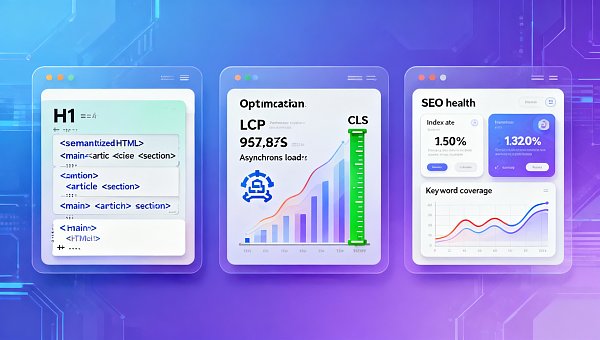
- Structural semantics : Template C uses nested <main><article><section> by default, with a unique H1 containing the core word; Template B overuses <div>, has no H1, and renders all subheadings with <span>, making it unrecognizable as a hierarchy signal.
- Static resource optimization logic : Template A inlines CSS to the first screen, blocking rendering; Template C enables asynchronous loading + key CSS extraction, with LCP averaging 1.8 seconds faster; Template B does not compress SVG icons, resulting in 23 JS requests per page and CLS exceeding the limit by 2.1 times.
- Dynamic content SEO support : Template C supports server-side pre-rendering (SSR) and automatic injection of JSON-LD; Template A only supports client-side rendering (CSR), with no text content on the first screen; Template B has SSR but does not have canonical tags configured, leading to the risk of duplicate content.
Which companies are most likely to encounter pitfalls?
Small and medium-sized enterprises (SMEs) that rely on AI-powered website building for quick deployment often assume that "templates are ready-made products." However, without verifying their SEO readiness, they are highly susceptible to falling into the trap of "website demotion upon launch." This is especially true when their business involves professional services such as enterprise management research in the context of digital transformation ; an unclear structure directly weakens the authoritative signal of the topic.
Industry data shows that companies using non-SEO optimized templates experienced an average 34% decrease in homepage keyword coverage within 6 months, and the time to acquire new keywords increased by 2.7 times.
How to scientifically evaluate the SEO capabilities of an AI website template?
Rejecting subjective judgment, we recommend implementing three mandatory tests:
- Code layer scanning : Semantic HTML was detected using Lighthouse, with an accessibility (a11y) score ≥95, and structured data passed the Google Rich Results Test.
- Performance benchmark tests : Core Web Vitals achieved "Good" in all three categories (LCP≤2.5s, FID≤100ms, CLS≤0.1), and the text content on the first screen was visible before the DOM was loaded.
- Web crawler simulation verification : Using Screaming Frog, we confirmed that the H1 tag is unique, the meta description is not empty, the hreflang and canonical configurations are complete, and there is no JavaScript blocking the critical path.
YiYingBao AI Website Building Engine's Differentiated Practices
As a technology service provider with ten years of experience in integrated website and marketing services, Yiyingbao's self-developed AI website building engine reconstructs SEO adaptation logic from the ground up:
- All templates are forced to enable the semantic component library, H1/H2 are automatically bound to business keywords, and dynamic schema injection is supported;
- Built-in SEO health dashboard to monitor page indexing rate, keyword coverage changes, and structured data errors in real time;
- Provides a "Template SEO Compatibility Report" that compares the score differences of three types of templates (A, B, and C) across 23 technical indicators.
This capability has enabled over 100,000 clients to gain traffic immediately after website launch, with foreign trade, knowledge service, and professional consulting clients experiencing an average increase of 68% in organic traffic in the first month.
Common Misconceptions and Tips for Avoiding Pitfalls
The SEO differences between AI-powered website templates and traditional templates are not a matter of mystery, but rather a quantifiable and optimizable technical issue. Before choosing a template, please always refer back to the fundamental rules of search engines: clear semantics, content priority, controllable performance, and reliable structure.
To obtain the "AI Website Template SEO Compatibility Self-Test Checklist" and the original data packages for the three templates (A/B/C), please visit the YiYingBao official website's technical center for download. Let every website building decision be supported by data, not just guesswork based on experience.
Related Articles
Related Products
 EasyCamp SaaS Smart Website Marketing SystemE-Yingbao SaaS Smart Website Marketing System: AI-powered, zero-code website building. Rapidly launch multilingual independent e-commerce sites in just 10 minutes. Global server acceleration and AI-driven SEO optimization empower businesses to efficiently connect with global markets. The seamless integration of technology and user-friendly operation makes building e-commerce sites incredibly simple.
 AI+SEM Intelligent Advertising Marketing SystemAI+SEM drives intelligent ad creation, empowering full-funnel precision advertising marketing. The system automatically generates weekly/monthly reports, AI recommends keywords and target countries, monitors core metrics in real-time with intelligent alerts, and enables one-click high-conversion ad solutions to help quickly acquire customers and improve ROI.
 AI+SEO Dual Engine Optimization ServiceEasyWin AI+SEO Dual Engine Optimization System leverages AI-powered keyword mining, content generation, and comprehensive technical optimization to help foreign trade enterprises acquire high-quality organic traffic, significantly improving search rankings and conversion rates.
 AI+SNS Social Media Marketing SystemYingbao AI+SNS Social Media Marketing System - Precision social capture for the social media era. Supports one-click content synchronization across major platforms like Facebook and LinkedIn. AI intelligently rewrites posts for enhanced relevance. 24/7 AI customer service and user profiling analysis empower businesses to efficiently expand into global markets.
 AI+SEO营销解决方案易营宝AI+SEO营销解决方案,通过AI批量写作、智能生成TDK、精准关键词扩词等功能,全面优化网站SEO效果,提升流量与转化率。助力企业构建高效智能网站新生态。
 AI+SEM Advertising Marketing SolutionsAI+SEM Advertising Marketing Solution leverages AI technology to deeply empower SEM ad campaigns. It automatically generates weekly/monthly reports using AI, presenting account data across multiple dimensions for comprehensive insights into campaign performance and trends. The system precisely recommends keywords and target countries, intelligently generates high-conversion ad copy, and enables one-click activation of efficient campaign plans to help businesses rapidly acquire customers. Simultaneously, it monitors core metrics in real time, intelligently identifies abnormal fluctuations, and issues timely alerts to ensure stable, high-return advertising results.
 Domain Name ServicesEasyWin provides professional domain name services, including intelligent queries, one-stop registration, brand protection, and full lifecycle management, helping businesses build a digital brand image.
 EasyOperate B2C Cross-Border E-Commerce Platform & Independent WebsiteEasyStore B2C Cross-border E-commerce Independent Store is an intelligent website building and cross-border e-commerce integrated solution independently developed by EasyStore Information Technology (Beijing) Co., Ltd. The system is specially designed for small and medium-sized as well as large export enterprises, integrating 'website building, operation, marketing, advertising, and conversion' into one, helping enterprises quickly establish cross-border e-commerce independent stores to achieve brand globalization and global sales growth.
The platform supports multiple languages, multiple currencies, and multi-channel marketing, with built-in AI intelligent translation and SEO optimization systems, suitable for mainstream markets such as Southeast Asia, Europe and America, Latin America, and the Middle East, assisting Chinese manufacturing enterprises in efficiently deploying international e-commerce strategies. SSL证书易营宝提供专业SSL安全证书服务,包括单域名和泛域名证书,确保网站数据传输加密、身份验证和完整性保护,助力企业建立安全可信的在线业务环境。









