









- What stages does the cross-border services ecosystem include? How do website building, promotion, payment, and compliance work togetherJun 22, 2026View details
- How will email marketing costs change in 2026Jun 22, 2026View details
- The China-US tariff arrangement has reached a preliminary consensus, and the trade association will be establishedJun 15, 2026View details
- Should overseas brand marketing start with ads or contentJun 21, 2026View details
- What determines B2C cross-border e-commerce website development costs? A breakdown of features, interfaces, and deployment methodsJun 17, 2026View details
- China-Morocco zero-tariff access, a breakthrough in the cost of Moroccan goods exports to ChinaJun 11, 2026View details
What are the core capabilities of an AI keyword expansion system
What problems does an AI keyword expansion system actually solve
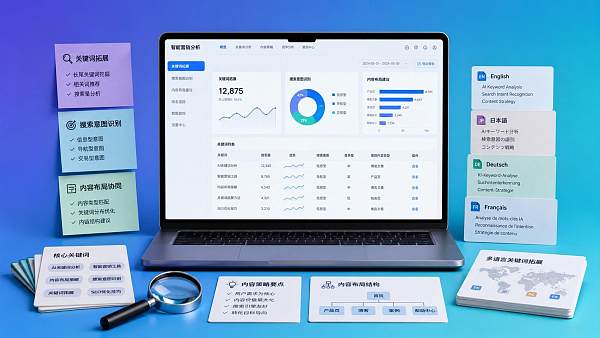
In a website and marketing services integrated scenario, content is not finished once it is written; the real challenge is enabling target users to find it, understand it, and want to keep learning more. The reason AI keyword expansion systems are mentioned so often is that they make the work of “finding keywords, classifying keywords, and applying keywords” much more systematic.
Simply put, an AI keyword expansion system is not just about generating keywords in bulk. More importantly, it can infer intent from search behavior, then expand core terms into actionable long-tail keywords, scenario-based terms, and question-based terms, helping website content structure stay closer to real search paths.
For projects involving overseas independent sites, corporate websites, landing pages, and multilingual content, this capability is especially critical. Because search expressions vary greatly across markets, relying only on manual experience can easily lead to too many keywords, inaccurate traffic, pages not being indexed, or low conversion rates.
Platforms like 易营宝, which provide long-term intelligent website building, SEO optimization, ad placement, and overseas marketing services, incorporate AI keyword expansion into their early-stage strategy. In essence, this is to keep website building, content, advertising, and subsequent lead generation aligned, rather than each operating in its own way.
The core capabilities of an AI keyword expansion system, which ones really matter
If we had to summarize it in one sentence, the core capability of an AI keyword expansion system is not “many keywords,” but “accurate keywords, complete keywords, and usable keywords.” In practice, it usually comes down to the following aspects.
First, it identifies search intent rather than just looking at the words themselves
The same keyword may correspond to different stages of need. Some users are learning about a concept, some are comparing solutions, and some are already preparing to inquire. If an AI keyword expansion system can only capture related terms but cannot distinguish informational, comparison, and transactional intent, then the subsequent content structure will easily become misaligned.
Second, can long-tail keyword expansion truly be used
A good system will expand around the core topic into industry attributes, application scenarios, regional language, question direction, and decision-stage keywords, rather than mechanically stringing roots together. Only keywords generated this way can go directly into category pages, article pages, product pages, and FAQ pages.
Third, can it guide content structure
A truly efficient AI keyword expansion system will tell you which terms are suitable for the homepage, which are better for topic pages, and which are more suitable for blogs, Q&A, or landing pages. What it serves is not just a keyword table, but the content structure of the entire site.
Fourth, multilingual and localization adaptation capability
In overseas expansion projects, translated keywords are not necessarily equal to the real local search terms. More often, users search using local colloquial expressions, industry jargon, or regional phrasing. Therefore, if an AI keyword expansion system can combine language context with market differences, its value will be much higher.
Which scenarios need an AI keyword expansion system most, not only SEO specialists can use it
Many people think of an AI keyword expansion system as an SEO tool, but in fact its use cases are much broader. As long as the project involves website content, ad creatives, category planning, and multi-channel lead generation, it can play a real role.
- New website development stage: first determine the core topic and keyword hierarchy to avoid major structural changes after the site goes live.
- Multilingual website development: used to identify high-frequency expressions in different markets and reduce bias caused by direct translation.
- Content operations stage: helps with topic selection and improves the match between articles, FAQ, topic pages, and search demand.
- Ad landing page creation: filters out terms closer to conversion intent and improves page handoff efficiency.
- Legacy site optimization and upgrading: find gaps in the keyword library and fill in high-potential traffic entry points that were not covered originally.
In practical application, websites, SEO, advertising, and social media content are often linked. If keyword expansion results only stay in a spreadsheet, the value is not high; only when they are integrated into page structure, copy frameworks, and channel strategies can they truly take effect.
For example, when multilingual sites expand content, they often work with capabilities like 易营宝 AI Translation Center to connect page translation, localized expression, and keyword library expansion. This not only improves content production efficiency, but also helps search engines in different regions better identify page topics.
When choosing an AI keyword expansion system, should you first look at keyword volume or landing performance
Many people are first attracted by keyword volume and feel that the more keywords expanded, the better. But in real projects, the evaluation standard is more practical: can these keywords be turned into pages, can they bring relevant traffic, and can they support subsequent content production.
To avoid focusing only on surface data, you can first use the following table for a quick judgment.
If it is a website for overseas markets, there is one more thing to check: whether the system can connect with website building, translation, and content update workflows. Once keyword strategy enters multilingual pages, it is not only an SEO issue, but also involves page maintenance efficiency and consistency.
What is the difference between an AI keyword expansion system and traditional keyword tools
Traditional keyword tools are more like query tools, suitable for checking search volume, competition, and basic related terms. An AI keyword expansion system is closer to a strategy tool; it tries to understand the topic, semantic relationships, and how the content will be applied.
This difference is very obvious in website and marketing services integrated projects. Traditional tools can tell you “which keywords there are,” while an AI keyword expansion system goes a step further and helps determine “which keywords are worth prioritizing, which pages they are suitable for, and whether they need to be coordinated with multilingual content.”
If the project covers multiple country markets, this advantage becomes even more prominent. For example, when a multilingual site expands its pages, it needs to handle language versions, page structure, and localized expression simultaneously. At this time, capabilities like 易营宝 AI Translation Center, which supports mutual translation across 249 languages, dynamic content synchronization, and regional expression optimization, can complement the AI keyword expansion system, so that the keyword library does not remain only on paper.
What are the most common mistakes when using an AI keyword expansion system
An AI keyword expansion system can indeed improve efficiency, but if used incorrectly, it can also produce results that look rich but are actually hard to convert. Several common pitfalls are worth avoiding in advance.
- Only look at search volume, not intent. High-traffic terms are not necessarily suitable for the current page objective.
- Write the expanded keywords directly without grouping. The result is often a scattered page topic and lower indexing efficiency.
- Ignore localization differences. Especially for cross-border e-commerce and B2B foreign trade projects, directly translated keywords are often not the terms users actually search for.
- Treat keyword expansion as a one-time task. In reality, after website launch, ad changes, and market trend adjustments, the keyword library needs to be updated as well.
- Let only the operations team review keywords and keep the website-building and content teams out of the process. In the end, it is difficult for the strategy to truly land.
It should be noted that an AI keyword expansion system does not replace judgment; it improves the efficiency of judgment. Whether a keyword is ultimately worth pursuing still needs to be decided by combining product page conversion capacity, content production cycles, and the stage of the target market.
If you are preparing to implement it, how should the next step be evaluated more steadily
Compared with directly pursuing the “strongest tool,” a more reliable approach is to first sort out business objectives, then reverse-engineer the tasks the AI keyword expansion system needs to take on. Is it for new site launch, or for supplementing traffic on an existing site? The evaluation criteria are not the same.
If the goal is website lead generation, you can first confirm three things: where the core market is, how ready the content is, and whether multilingual pages need synchronized maintenance. Once these three points are clear, the keyword expansion results will have a clear usage path.
For website and marketing services integrated projects, the real value of an AI keyword expansion system is not how many keywords it generates, but whether it helps the website form a clearer topic structure and whether it enables SEO, advertising, and content operations to promote the same batch of highly relevant keywords in a coordinated way.
If you are currently evaluating related solutions, it may be better to first establish a small-scale testing standard: check keyword accuracy, check page implementation difficulty, check multilingual adaptation results, and then check subsequent maintenance costs. This type of evaluation is usually closer to real results than simply looking at demo data.
Related Articles
Related Products
 EasyCamp SaaS Smart Website Marketing SystemE-Yingbao SaaS Smart Website Marketing System: AI-powered, zero-code website building. Rapidly launch multilingual independent e-commerce sites in just 10 minutes. Global server acceleration and AI-driven SEO optimization empower businesses to efficiently connect with global markets. The seamless integration of technology and user-friendly operation makes building e-commerce sites incredibly simple.
 AI+SEM Intelligent Advertising Marketing SystemAI+SEM drives intelligent ad creation, empowering full-funnel precision advertising marketing. The system automatically generates weekly/monthly reports, AI recommends keywords and target countries, monitors core metrics in real-time with intelligent alerts, and enables one-click high-conversion ad solutions to help quickly acquire customers and improve ROI.
 AI+SEO Dual Engine Optimization ServiceEasyWin AI+SEO Dual Engine Optimization System leverages AI-powered keyword mining, content generation, and comprehensive technical optimization to help foreign trade enterprises acquire high-quality organic traffic, significantly improving search rankings and conversion rates.
 AI+SNS Social Media Marketing SystemYingbao AI+SNS Social Media Marketing System - Precision social capture for the social media era. Supports one-click content synchronization across major platforms like Facebook and LinkedIn. AI intelligently rewrites posts for enhanced relevance. 24/7 AI customer service and user profiling analysis empower businesses to efficiently expand into global markets.
 AI+SEO营销解决方案易营宝AI+SEO营销解决方案,通过AI批量写作、智能生成TDK、精准关键词扩词等功能,全面优化网站SEO效果,提升流量与转化率。助力企业构建高效智能网站新生态。
 AI+SEM Advertising Marketing SolutionsAI+SEM Advertising Marketing Solution leverages AI technology to deeply empower SEM ad campaigns. It automatically generates weekly/monthly reports using AI, presenting account data across multiple dimensions for comprehensive insights into campaign performance and trends. The system precisely recommends keywords and target countries, intelligently generates high-conversion ad copy, and enables one-click activation of efficient campaign plans to help businesses rapidly acquire customers. Simultaneously, it monitors core metrics in real time, intelligently identifies abnormal fluctuations, and issues timely alerts to ensure stable, high-return advertising results.
 Domain Name ServicesEasyWin provides professional domain name services, including intelligent queries, one-stop registration, brand protection, and full lifecycle management, helping businesses build a digital brand image.
 EasyOperate B2C Cross-Border E-Commerce Platform & Independent WebsiteEasyStore B2C Cross-border E-commerce Independent Store is an intelligent website building and cross-border e-commerce integrated solution independently developed by EasyStore Information Technology (Beijing) Co., Ltd. The system is specially designed for small and medium-sized as well as large export enterprises, integrating 'website building, operation, marketing, advertising, and conversion' into one, helping enterprises quickly establish cross-border e-commerce independent stores to achieve brand globalization and global sales growth.
The platform supports multiple languages, multiple currencies, and multi-channel marketing, with built-in AI intelligent translation and SEO optimization systems, suitable for mainstream markets such as Southeast Asia, Europe and America, Latin America, and the Middle East, assisting Chinese manufacturing enterprises in efficiently deploying international e-commerce strategies. SSL证书易营宝提供专业SSL安全证书服务,包括单域名和泛域名证书,确保网站数据传输加密、身份验证和完整性保护,助力企业建立安全可信的在线业务环境。









