









- The China-US tariff arrangement has reached a preliminary consensus, and the trade association will be establishedJun 15, 2026View details
- What determines B2C cross-border e-commerce website development costs? A breakdown of features, interfaces, and deployment methodsJun 17, 2026View details
- China-Morocco zero-tariff access, a breakthrough in the cost of Moroccan goods exports to ChinaJun 11, 2026View details
- What signal should be released for the suspension of exports to JapanJun 10, 2026View details
- China's May LNG imports rebounded, with increased volumes from Russia and Canada filling the Middle East supply gapJun 10, 2026View details
- Will GEO change its SEO strategy?Jun 04, 2026View details
What should you do if your Google lead generation ads have clicks but no inquiries? A step-by-step review of keywords, match types, and landing pages
Google lead generation ads have clicks but no inquiries; first check whether the traffic direction is off
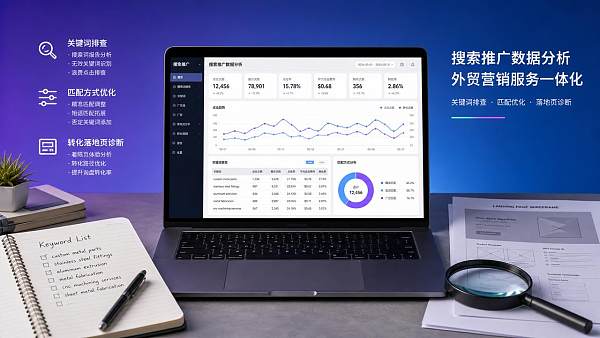
When Google lead generation ads have clicks but no inquiries, the most common misconception is not an insufficient budget, but attributing everything to bidding. If clicks can be bought but inquiries cannot, it often means the traffic, page, and conversion path are not aligned.
In practical applications, whether the search terms are precise, whether the match types are out of control, and whether the landing page properly carries user intent all determine whether the ad account is ultimately buying visits or buying business opportunities.
Especially in website and marketing service integration scenarios, ad performance is rarely judged by the ad platform alone. Website structure, form design, content credibility, and mobile experience all directly affect inquiry conversion.
If the goal is to acquire customers in overseas markets through an independent website, ads, website building, SEO, and content presentation must be judged within the same framework. Integrated service systems like YiYingBao, which cover website building, SEO, advertising, and AI optimization, are valuable because they put traffic and conversion on the same map instead of letting each stage fight its own battle.
The keywords clearly match related queries, so why are the clicks still invalid?
The problem with many accounts is not that no keywords were used, but that the keywords only “look relevant” while actually being one layer away from the inquiry intent. For example, terms偏资讯,偏教程, or偏图片浏览 often bring traffic, but it is hard for them to bring effective inquiries.
A more common way to judge is not just to look at bidding keywords, but to review the actual search terms. Because the terms that trigger ads are often broader, more dispersed, and more likely to go off track than the terms you set.
When reviewing, you can focus on three signals:
- Whether the search terms include low-conversion words such as “free, tutorial, definition, image, recruitment”.
- Whether there is a large volume of visits from countries, regions, or languages that do not match.
- Whether high-click terms have long-term no stay, no form submissions, and no inquiry records.
For B2B lead generation, keywords are best kept closer to procurement actions, such as “supplier, custom, wholesale, factory, quotation, OEM, solution”. Such Google lead generation ads may bring less traffic, but the inquiry quality is usually more stable.
How should match types be set so the budget is not burned on the wrong searches?
Many accounts get plenty of clicks but still no inquiries, and the problem lies in overly broad match types. In order to increase volume, the system will show ads to a large number of similar but not identical searches, and the data may look lively while the leads are actually very cold.
Simply put, Google lead generation ads are often more suitable for starting narrow and then expanding gradually. First get valid samples, then broaden coverage, instead of pursuing click scale from the very beginning.
It should be noted that there is no absolute good or bad match type; it depends on the stage. New accounts should first control terms, then expand volume in the middle and later stages. Usually, this is easier to diagnose than relying on smart broad match from the start.
The landing page does not look bad or unprofessional, so why are users still not submitting the form?
This situation is very common. A page that “looks good” does not mean it can convert. If the ad promise is quotation, customization, factory capability, or delivery assurance, but users only see an empty introduction after entering the page, they will leave quickly.
An effective landing page should at least answer four questions: who you are, what you sell, why you are trustworthy, and how to contact you next. If any link is vague, the inquiry rate will be dragged down.
For industries that value brand perception, page presentation is especially critical. For example, in fragrance and lifestyle companies, the page should not only display products, but also clearly explain aesthetics, craftsmanship, and the customization process. Solutions like fragrance, washing, makeup place more emphasis on premium visual feeling, vertical hierarchy, and OEM process expression; essentially, they reduce communication costs and increase the willingness to inquire.
- Does the first screen directly respond to the ad keyword, instead of broadly introducing the company?
- Are there case studies, qualifications, production capacity, and delivery scope as trust-building content?
- Is the form too long, or does it ask for too much information at once?
- Do mobile loading speed and button placement affect submission?
If the independent site is planned together with the website system, content structure, and ad pages, conversion is usually more stable. Because the ad copy, page modules, and form path can form a closed loop, it is less likely to create the problem of “the ad says one thing, the page says another”.
The data looks normal, but there are no results; is the conversion tracking itself biased?
Yes, some accounts appear to have decent click-through rates and impressions, yet no valid inquiries are recorded in the backend. The reason may not be the campaign itself, but broken data tracking. For example, form submissions not reporting back, WhatsApp clicks not counted, or lost parameters in redirect pages can all make the judgment inaccurate.
At this point, do not rush to change keywords; first confirm whether an inquiry actually occurred. If there is communication on the customer service side but no conversion on the ad side, the issue is likely with the tracking path. If neither side has anything, then continue checking traffic and pages.
It is recommended to first verify the following items:
- Whether the form submission page correctly triggers the conversion code.
- Whether phone, live chat, and email clicks are tracked separately.
- Whether different ad campaigns use a unified attribution path.
- Whether CRM or inquiry sheets can backtrack the source channel.
In a multi-market advertising environment, platforms like YiYingBao, which combine AI ad systems, smart website building, and SEO/GEO optimization, are more suitable for unified data management. Because ads, pages, and content share the same growth logic, positioning problems can be identified more quickly.
If I can only investigate in one order, where should Google lead generation ads start?
The most stable approach is not to change everything at once, but to investigate step by step in the order of “search terms—match types—pages—conversion statistics”. This can locate the root cause more quickly and avoid misjudgment.
You can think of this investigation as a small loop:
- First review the actual search terms and remove clearly irrelevant traffic.
- Then tighten the match types and supplement the negative keyword list.
- Next check the landing page first screen, trust content, and form path.
- Finally verify conversion tracking points and backend leads records.
If there is still no improvement after the review, you need to re-evaluate whether the ads truly match the current site foundation. Some websites have weak structure, thin content, and insufficient page persuasion; even if Google lead generation ads continue to run, it is still hard to turn clicks into inquiries.
This is also why more and more companies choose to do ads, websites, and SEO together. Because customer acquisition is not single-point optimization, but coordination across the entire chain. Breaking the problem apart is important, but real resolution often depends on systemic adjustments. The next step worth doing is not blindly increasing budget, but first listing the high-consumption keywords, main match types, core landing pages, and actual inquiry sources, then performing a complete diagnosis before deciding on the optimization sequence.
Related Articles

Related Products
 EasyCamp SaaS Smart Website Marketing SystemE-Yingbao SaaS Smart Website Marketing System: AI-powered, zero-code website building. Rapidly launch multilingual independent e-commerce sites in just 10 minutes. Global server acceleration and AI-driven SEO optimization empower businesses to efficiently connect with global markets. The seamless integration of technology and user-friendly operation makes building e-commerce sites incredibly simple.
 AI+SEM Intelligent Advertising Marketing SystemAI+SEM drives intelligent ad creation, empowering full-funnel precision advertising marketing. The system automatically generates weekly/monthly reports, AI recommends keywords and target countries, monitors core metrics in real-time with intelligent alerts, and enables one-click high-conversion ad solutions to help quickly acquire customers and improve ROI.
 AI+SEO Dual Engine Optimization ServiceEasyWin AI+SEO Dual Engine Optimization System leverages AI-powered keyword mining, content generation, and comprehensive technical optimization to help foreign trade enterprises acquire high-quality organic traffic, significantly improving search rankings and conversion rates.
 AI+SNS Social Media Marketing SystemYingbao AI+SNS Social Media Marketing System - Precision social capture for the social media era. Supports one-click content synchronization across major platforms like Facebook and LinkedIn. AI intelligently rewrites posts for enhanced relevance. 24/7 AI customer service and user profiling analysis empower businesses to efficiently expand into global markets.
 AI+SEO营销解决方案易营宝AI+SEO营销解决方案,通过AI批量写作、智能生成TDK、精准关键词扩词等功能,全面优化网站SEO效果,提升流量与转化率。助力企业构建高效智能网站新生态。
 AI+SEM Advertising Marketing SolutionsAI+SEM Advertising Marketing Solution leverages AI technology to deeply empower SEM ad campaigns. It automatically generates weekly/monthly reports using AI, presenting account data across multiple dimensions for comprehensive insights into campaign performance and trends. The system precisely recommends keywords and target countries, intelligently generates high-conversion ad copy, and enables one-click activation of efficient campaign plans to help businesses rapidly acquire customers. Simultaneously, it monitors core metrics in real time, intelligently identifies abnormal fluctuations, and issues timely alerts to ensure stable, high-return advertising results.
 Domain Name ServicesEasyWin provides professional domain name services, including intelligent queries, one-stop registration, brand protection, and full lifecycle management, helping businesses build a digital brand image.
 EasyOperate B2C Cross-Border E-Commerce Platform & Independent WebsiteEasyStore B2C Cross-border E-commerce Independent Store is an intelligent website building and cross-border e-commerce integrated solution independently developed by EasyStore Information Technology (Beijing) Co., Ltd. The system is specially designed for small and medium-sized as well as large export enterprises, integrating 'website building, operation, marketing, advertising, and conversion' into one, helping enterprises quickly establish cross-border e-commerce independent stores to achieve brand globalization and global sales growth.
The platform supports multiple languages, multiple currencies, and multi-channel marketing, with built-in AI intelligent translation and SEO optimization systems, suitable for mainstream markets such as Southeast Asia, Europe and America, Latin America, and the Middle East, assisting Chinese manufacturing enterprises in efficiently deploying international e-commerce strategies. SSL证书易营宝提供专业SSL安全证书服务,包括单域名和泛域名证书,确保网站数据传输加密、身份验证和完整性保护,助力企业建立安全可信的在线业务环境。









