









- What stages does the cross-border services ecosystem include? How do website building, promotion, payment, and compliance work togetherJun 22, 2026View details
- How will email marketing costs change in 2026Jun 22, 2026View details
- The China-US tariff arrangement has reached a preliminary consensus, and the trade association will be establishedJun 15, 2026View details
- Should overseas brand marketing start with ads or contentJun 21, 2026View details
- What determines B2C cross-border e-commerce website development costs? A breakdown of features, interfaces, and deployment methodsJun 17, 2026View details
- China-Morocco zero-tariff access, a breakthrough in the cost of Moroccan goods exports to ChinaJun 11, 2026View details
How to design a landing page for better conversions? Structure, copy, and form optimization tips
How to design a landing page for better conversions? Start with structure, then move to copy and forms
When it comes to improving landing page conversions, many people’s first instinct is to change the visuals. In fact, what really makes the difference is often not the colors or layout, but whether the information structure is clear, whether the copy can remove concerns, and whether the form is easy enough to complete.
Especially as customer acquisition costs keep rising, if a landing page cannot clearly answer within a few seconds “who you are, what problem you solve, why they should trust you, and what to do next,” then even a lot of traffic will still be hard to convert.
So optimizing a landing page is not about making it look better, but about making it more precise. Structure solves understanding, copy solves trust, and forms solve action. Only when these three work together can the page truly have the ability to convert.
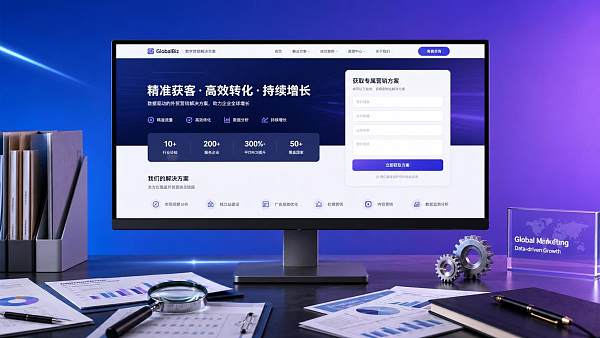
1. Landing page structure: first smooth out the user’s decision path
A high-converting landing page is usually not about having more content, but about arranging information in line with the user’s judgment sequence. After people enter the page, their attention follows a certain order, and the page structure should move in step with that rhythm.
A practical structure can be understood in five steps: first grab attention, then talk about value, next provide proof, then ease concerns, and finally drive submission.
1. The above-the-fold area should start with results, not with self-introduction
Many landing pages begin by introducing the company background, or even by telling a long brand story. For people clicking ads for the first time, these details are not the priority. A more effective approach is to clearly state the core benefit first.
- What service you provide;
- What problem you can solve;
- What kind of company it is suitable for;
- What the next step should be.
For example, for a landing page that generates overseas leads, the above-the-fold section should directly deliver value, without beating around the bush. When users click in and see results and solutions, their willingness to stay is naturally higher.
2. Focus on solutions in the middle section, not just features
Many landing pages list features very comprehensively, but users care more about “What do these features have to do with me?” Therefore, the middle section should ideally be organized around application scenarios rather than stacking feature terms.
For example, foreign trade companies care more about whether the website can be indexed, whether ad traffic is accurate, and whether leads can keep growing. If the page content is built around these real problems, conversion will be more direct.
3. Build the conversion loop at the bottom; do not rely on just one form
Some landing pages put all expectations on the form at the very bottom of the page, which easily causes people to drop off halfway through hesitation. A more stable approach is to place clear action entry points on the above-the-fold area, in the middle section, and at the bottom, so the conversion action runs through the whole page.
2. Landing page copy: the key is to speak like a person, focus on the point, and provide proof
The two things landing page copy fears most are emptiness and circuitousness. If it is written too vaguely, users cannot catch the point; if it is written too professionally, users may be too lazy to understand. Truly effective copy is often simple, specific, and able to immediately match the business scenario.
1. The headline should answer “Why keep reading?”
A headline is not written for yourself to read, but for the person who is still hesitating after clicking the ad. A good headline usually contains three elements at the same time: target, result, and object.
For example, instead of “Professional Digital Marketing Solutions,” a more suitable expression for a landing page is “Help foreign trade companies build overseas marketing websites that are indexable, promotable, and convertible.” The former is too broad; the latter hits the need much more accurately.
2. Write more scenarios in the body, and fewer slogans
Users are not short of words like “leading,” “professional,” or “efficient.” What they lack is evidence for judgment. Therefore, the body of a landing page is best written around real problems and corresponding solutions.
- The website is still not indexed after launch; what should we do;
- There are many ad clicks, but very few inquiries; where is the problem;
- We built multilingual pages, but there is no organic traffic; how can we strengthen that;
- The cost of leads keeps rising; how can the page conversion rate be improved.
This kind of content is easier to build trust than pure promotion, and it is also more suitable for search engines to understand the page topic, which helps both conversion and indexing on the landing page.
3. Evidence should be specific; do not just say “we are strong”
Trust comes from evidence, not self-praise. Information like “served over 100,000 enterprises,” “ten years of technical accumulation,” and “annual growth rate above 30%” is much more convincing than generic claims.
If the page scenario is related to SEO, content growth, and website visibility, you can also naturally introduce AI+SEO dual-engine system optimization services. This type of solution combines keyword mining, content generation, technical optimization, and performance monitoring into a closed loop, making it more suitable for business scenarios that require long-term lead generation.
3. Landing page form optimization: lose one hesitation step, gain one more point in submission
Many landing page problems are not in the traffic, and not in the copy, but in the final step. Users may already be interested, but get discouraged by a complicated form, which is a very common point of loss.
1. The more fields there are, the lower the conversion usually is
The core principle of a landing page form is simple: first get the lead, then gradually fill in the information. For the first submission round, keeping only the necessary fields is usually enough.
- Name or title;
- Phone number or email;
- Company name;
- Brief description of need.
If you ask for budget, job title, country, product type, and procurement cycle right away, many people will simply close the page. Especially on mobile, input costs are higher; the longer the form, the higher the abandonment rate.
2. The submit button should write the result, not just “Submit”
Button copy directly affects willingness to act. Instead of writing “Submit Now,” it is better to write “Get a Proposal,” “Book a Demo,” or “Receive a Diagnostic Recommendation.” This makes it easier for users to understand the feedback after submission.
3. Add a sense of security next to the form
Some people do not fill out forms not because they have no need, but because they are afraid of trouble, frequent disturbances, or information leakage. Therefore, near the landing page form, it is recommended to add reassurance messages such as “1-on-1 communication,” “used only for business contact,” and “supports customized solution consultation.”
4. Three optimization details that are more easily ignored in practice
Whether a landing page converts or not depends not only on structure, copy, and forms, but also on some easily overlooked details. They may look small, but they often affect the final result.
1. Page consistency should match the ad message
The promise made in the ad must be matched on the landing page. For example, if the ad promotes “overseas independent site lead generation,” but the landing page first talks about company introduction, the bounce rate usually goes up. This is the root cause of low conversion on many landing pages.
2. Slow loading speed can directly eat up conversions
If the page opens slowly, users will not wait for you to finish explaining the value. Especially for ad traffic, attention itself is short. Oversized images, too many scripts, and a messy structure all affect the real performance of the landing page.
If the business itself still relies on organic search and long-term content growth, then technical optimization should be included in the overall plan. Capabilities like AI+SEO dual-engine system optimization services can handle content production, site structure, internal links, image tags, and loading diagnostics in sync, which is more suitable for page systems that want to balance promotion and conversion.
3. Without data review, optimization is hard to be effective
Landing page optimization is not a one-time job, but continuous testing. Above-the-fold headlines, button copy, form fields, and case order can all be A/B tested on a small scale. Truly effective optimization often comes from data feedback rather than subjective judgment.
5. If you want your landing page to convert more easily, you can start with these steps
If you are preparing to optimize a landing page, you do not need to make major changes all at once. A more practical approach is to start with the parts that affect conversion the most.
- Check whether the above-the-fold area can explain the value clearly within a few seconds;
- Rewrite the headline and selling points, with fewer empty claims and more results;
- Add case studies, data, and service commitment elements to build trust;
- Shorten the form fields and reduce submission resistance;
- Verify mobile loading speed and reading experience;
- Continuously track click-through rate, dwell time, and submission rate.
In the end, a landing page is not a display page, but a conversion page. A truly effective page may not be the flashiest, but it must understand what users are thinking, what they are worried about, and why they need to take action now.
When the structure is smoother, the copy is more precise, and the form is lighter, the conversion rate of the landing page will usually improve steadily. First get these three foundational actions right, then go on to more complex ad placements and testing, and the results will often be more solid.
Related Articles

Related Products
 EasyCamp SaaS Smart Website Marketing SystemE-Yingbao SaaS Smart Website Marketing System: AI-powered, zero-code website building. Rapidly launch multilingual independent e-commerce sites in just 10 minutes. Global server acceleration and AI-driven SEO optimization empower businesses to efficiently connect with global markets. The seamless integration of technology and user-friendly operation makes building e-commerce sites incredibly simple.
 AI+SEM Intelligent Advertising Marketing SystemAI+SEM drives intelligent ad creation, empowering full-funnel precision advertising marketing. The system automatically generates weekly/monthly reports, AI recommends keywords and target countries, monitors core metrics in real-time with intelligent alerts, and enables one-click high-conversion ad solutions to help quickly acquire customers and improve ROI.
 AI+SEO Dual Engine Optimization ServiceEasyWin AI+SEO Dual Engine Optimization System leverages AI-powered keyword mining, content generation, and comprehensive technical optimization to help foreign trade enterprises acquire high-quality organic traffic, significantly improving search rankings and conversion rates.
 AI+SNS Social Media Marketing SystemYingbao AI+SNS Social Media Marketing System - Precision social capture for the social media era. Supports one-click content synchronization across major platforms like Facebook and LinkedIn. AI intelligently rewrites posts for enhanced relevance. 24/7 AI customer service and user profiling analysis empower businesses to efficiently expand into global markets.
 AI+SEO营销解决方案易营宝AI+SEO营销解决方案,通过AI批量写作、智能生成TDK、精准关键词扩词等功能,全面优化网站SEO效果,提升流量与转化率。助力企业构建高效智能网站新生态。
 AI+SEM Advertising Marketing SolutionsAI+SEM Advertising Marketing Solution leverages AI technology to deeply empower SEM ad campaigns. It automatically generates weekly/monthly reports using AI, presenting account data across multiple dimensions for comprehensive insights into campaign performance and trends. The system precisely recommends keywords and target countries, intelligently generates high-conversion ad copy, and enables one-click activation of efficient campaign plans to help businesses rapidly acquire customers. Simultaneously, it monitors core metrics in real time, intelligently identifies abnormal fluctuations, and issues timely alerts to ensure stable, high-return advertising results.
 Domain Name ServicesEasyWin provides professional domain name services, including intelligent queries, one-stop registration, brand protection, and full lifecycle management, helping businesses build a digital brand image.
 EasyOperate B2C Cross-Border E-Commerce Platform & Independent WebsiteEasyStore B2C Cross-border E-commerce Independent Store is an intelligent website building and cross-border e-commerce integrated solution independently developed by EasyStore Information Technology (Beijing) Co., Ltd. The system is specially designed for small and medium-sized as well as large export enterprises, integrating 'website building, operation, marketing, advertising, and conversion' into one, helping enterprises quickly establish cross-border e-commerce independent stores to achieve brand globalization and global sales growth.
The platform supports multiple languages, multiple currencies, and multi-channel marketing, with built-in AI intelligent translation and SEO optimization systems, suitable for mainstream markets such as Southeast Asia, Europe and America, Latin America, and the Middle East, assisting Chinese manufacturing enterprises in efficiently deploying international e-commerce strategies. SSL证书易营宝提供专业SSL安全证书服务,包括单域名和泛域名证书,确保网站数据传输加密、身份验证和完整性保护,助力企业建立安全可信的在线业务环境。









