









- What should you focus on in the latest enterprise SaaS report? From renewal rates and delivery costs to overseas growth opportunitiesJul 12, 2026View details
- What signals are worth paying attention to in a cross-border marketing trend report? B2B companies should look at these 6 signalsJul 11, 2026View details
- How to Read a Cross-Border Marketing Trends Report? Five Key Dimensions for Evaluating Channel OpportunitiesJul 11, 2026View details
- Which channel has the highest ROI in the global traffic ecosystem? Comparative analysis of search, social media, and advertisingJul 10, 2026View details
- What multilingual website services are available in Sanya? Which model is more suitable for local businesses going global?Jul 08, 2026View details
- How to view the complete list of China SaaS companies in the top 100? Practical methods for screening website-building and marketing service providersJul 08, 2026View details
- How to view pricing in the global traffic ecosystem? Cost comparison of search, social media, and content channel advertisingJul 06, 2026View details
- How to assess foreign trade website development trends?Looking at 2026 changes from multilingual,AI content to conversion pathsJul 04, 2026View details
4 Types of Risks to Avoid in Domain Registration
Domain registration may seem simple,but it actually hides multiple risks. For procurement personnel,if compliance,brand,renewal,and security risks are ignored,it will not only affect the website development schedule,but may also bring additional costs and business losses.
In website development and marketing integration projects,domain registration is often step 1,yet it directly affects the continuity of subsequent website launch,SEO optimization,advertising,email deployment,and brand communication. Especially for procurement personnel responsible for supplier selection,budget control,and delivery acceptance,a domain name is not a simple “one-time purchase resource”,but a digital asset that requires full lifecycle management.
Eyingbao Information Technology(Beijing)Co.,Ltd. has long served enterprise globalization growth scenarios. In integrated projects involving intelligent website development,search optimization,social media marketing,and advertising,common delays often do not come from design or campaign execution,but from fundamental decision-making errors in domain registration. If procurement can identify 4 types of high-frequency risks in advance,it can usually reduce 2 to 4 weeks of rework and lower subsequent brand and security costs.
I. Compliance risk:unclear registration entity restricts subsequent use
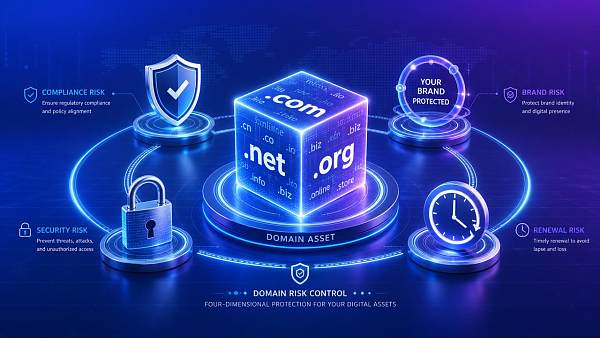
Many enterprises only focus on whether a domain name can be purchased during registration,but ignore 3 key questions:“who registers it,whether the information is consistent,and whether permissions are traceable”. For procurement departments,if the domain name is registered under an individual,a third-party agent,or information inconsistent with the business license,risks will be amplified during subsequent filing,migration,handover,and dispute handling.
1.1 The 3 most common compliance mistakes in procurement
- Registered on behalf of the company by a departed employee or outsourced personnel,making it impossible for the enterprise to fully control management rights.
- The registered email address,mobile number,and real-name authentication materials are scattered among different people,breaking the permission chain.
- When filing is required for domestic website development,the domain entity is inconsistent with the filing entity,delaying launch by 7 to 15 days.
1.2 Why compliance issues affect marketing progress
For website+marketing service integration projects,once a domain name cannot be resolved or filed smoothly,website delivery cannot form a closed loop. SEO pages cannot be properly indexed,advertising landing pages cannot be enabled stably,and corporate email may also be delayed. On the surface,it is a registration issue,but in essence,it affects collaboration across multiple departments and causes the marketing launch timeline to be passively postponed.
If an enterprise is involved in overseas business,it also needs to pay additional attention to suffix policies,registrant information specifications,and cross-platform management requirements. A common practice is for legal,procurement,IT,and marketing teams to jointly confirm 1 domain asset list,which should include at least 6 items:registrar,registration date,expiration date,DNS service provider,administrator email,and transfer code custody rules.
To help procurement identify risks more quickly during bidding or price comparison,the following table can serve as a basic inspection framework for domain registration acceptance.
From an execution perspective,compliance control for domain registration is not complicated;the key is to move it forward. One additional round of verification during procurement can often reduce 3 subsequent problems:inability to file,inability to transfer,and inability to prove ownership. This is also one of the most easily underestimated steps in enterprise digital asset governance.
II. Brand risk:only buying the primary domain without defensive planning
Domain registration is not only a technical entry point,but also a brand entry point. Many procurement projects only purchase 1 primary domain,such as .com or .cn,without simultaneously evaluating defensive needs such as similar spellings,common suffixes,and core business keyword domains. After the website goes live and advertising starts,they find that competitors or third parties have already registered similar domains,increasing the probability of brand confusion and traffic loss.
2.1 Brand-related domain risks usually focus on 4 scenarios
- Core brand terms are registered by others under other suffixes,such as .net,.co,and .hk.
- Common misspelled domains are not protected,causing search and direct-visit traffic to be misdirected.
- Regional suffixes are not planned in advance for overseas business,increasing costs during later expansion.
- Campaign landing pages frequently use temporary domains,fragmenting brand recognition and hindering SEO accumulation.
2.2 How procurement personnel can determine whether extended registration is needed
Generally speaking,if an enterprise has plans for brand upgrades,international promotion,channel recruitment,or advertising within the next 12 months,it is recommended to evaluate at least 3 types of domain combinations:the primary brand domain,regional suffix domains,and commonly confused domains. For medium and large enterprises,supplementary registration in the form of “brand term+industry term” can also be considered to prevent landing pages from being intercepted.
In website+marketing service integration scenarios,domain stability and brand consistency are directly related to conversion efficiency. Users usually go through 2 to 5 touchpoints from search engines and social media ads to official website forms. If each touchpoint uses a domain with a different style,it not only reduces trust,but also increases customer service explanation costs.
When formulating a registration strategy,procurement can refer to the table below to make layered decisions based on the purpose of different domain combinations,rather than expanding blindly all at once.
The core conclusion of this table is:domain registration should not only look at unit price,but also brand protection value. A cheap but isolated domain often creates higher hidden costs during later promotion. If procurement can participate in brand naming and website planning in advance,resource utilization efficiency can be significantly improved.
III. Renewal risk:behind a low first-year price,long-term budget fluctuations may be hidden
Many enterprises are attracted by “first-year discounts” when registering domains,but ignore the renewal policies for the 2nd year,3rd year,and transfers. For procurement departments,if this pricing structure is not calculated in advance,it may cause annual budget deviations and can easily lead to website interruptions due to failure to renew on time.
3.1 Why renewal issues are a high-frequency procurement complaint
Common issues include very low first-year prices,renewal prices doubling,auto-renewal enabled by default without reminders,complicated transfer-out processes,and multiple domains scattered across different registrars,making billing cycles difficult to manage. For enterprises with more than 10 domains,without a unified ledger,missing 1 renewal notice may affect access to the official website,sub-sites,or campaign pages.
3.2 At least these 5 items should be checked during procurement review
- Whether the first-year price and the next-year renewal price are listed separately.
- Whether renewal reminders support multiple notifications at 30 days,15 days,and 7 days.
- Whether unified invoicing,unified settlement,and batch management are supported.
- Whether domain transfer-in and transfer-out have additional restrictions or manual review cycles.
- Whether integrated operations and maintenance can be formed with website development,DNS,and SSL certificates.
In digital marketing projects,a domain name is never an independent procurement item. It is linked with hosting,resolution,certificates,website programs,and advertising tracking codes. If the procurement stage only compares first-year prices without evaluating the 3-year total cost,duplicate expenditures are likely to occur during later renewal,migration,and maintenance.
Similar to the settlement review logic in engineering management,digital asset procurement also needs to consider the full lifecycle rather than a single node. When many enterprises formulate internal procurement standards,they refer to cross-departmental review approaches,such as the “advance verification,process traceability,and results review” emphasized in Analysis of Common Issues and Countermeasures in Engineering Settlement Review,and this method is equally applicable to domain registration and renewal management.
IV. Security risk:account loss of control and resolution tampering often cause the most direct losses
Among the 4 types of risks,security issues are usually the most likely to cause immediate losses. After domain registration is completed,if backend account protection is insufficient,DNS permissions are scattered,and transfer lock is not enabled,problems may occur,such as malicious resolution modification,abnormal website redirects,and blocked sending or receiving of corporate email. For enterprises that rely on official websites for customer acquisition and advertising landing page conversions,the impact of such issues is often measured in hours rather than days.
4.1 Domain security should include at least 4 layers of control
- Account layer:enable two-factor authentication,and do not share private accounts for administrator email addresses and mobile phones.
- Permission layer:set hierarchical authorization for the registrar,DNS,and website backend,avoiding 1 person controlling all entry points.
- Operation layer:enable domain transfer lock,and retain approval records for important resolution changes.
- Monitoring layer:set daily monitoring for official website resolution,SSL validity period,and access availability.
4.2 How procurement can include security requirements in the service list
It is recommended to include security clauses in the supplier’s service scope rather than leaving them as verbal commitments. At minimum,5 items should be included:account delivery method,number of administrators,modification approval rules,expiration warning mechanism,and fault response time. If the enterprise has daily advertising and overseas promotion needs,it should also add a resolution switching contingency plan and emergency contact mechanism to ensure problems can be located within 1 hour.
For procurement personnel,the ideal supplier does not simply complete domain registration,but can connect the domain,website development,SEO,and subsequent marketing operations. In this way,when a security incident occurs,there is no need to repeatedly communicate among the registrar,developer,and advertising service provider;positioning and handling can be completed within 1 service chain.
4.3 A domain management checklist suitable for enterprise procurement
If an enterprise already has multiple sites or is preparing to carry out multi-market marketing,it is recommended to establish a quarterly checklist. At least once every 90 days,inventory domain assets,with particular attention to domains that are about to expire,idle redirect domains,campaign subdomains,and domains used for overseas projects,to prevent assets from being left idle without anyone responsible.
From the perspective of procurement management,the significance of this checklist is to change “handling problems after they occur” into “prevention by cycle”. Once domain registration and subsequent management become institutionalized,the continuity of enterprise websites and marketing systems will be more stable,and budgets will be easier to forecast.
V. Procurement implementation recommendations:incorporate domain registration into the overall website and marketing solution
For procurement personnel,the truly effective approach is not to compare domain prices separately,but to incorporate domain registration into an integrated solution covering website development,brand protection,SEO deployment,and later operations for unified evaluation. This can control initial procurement costs while reducing maintenance fluctuations over the next 12 to 36 months.
5.1 Focus on 4 capabilities when selecting a service provider
- Whether it has collaborative delivery capabilities across domains,website development,optimization,and advertising.
- Whether it can provide localized services and multi-market domain planning recommendations.
- Whether it has clear mechanisms for permission delivery,renewal reminders,and security operations and maintenance.
- Whether it can provide a layered registration strategy based on the enterprise’s business stage,rather than simply pursuing quantity.
Since its establishment in 2013,Eyingbao Information Technology(Beijing)Co.,Ltd. has continuously provided full-chain digital marketing services around intelligent website development,SEO optimization,social media marketing,and advertising. For enterprise procurement teams hoping to reduce communication costs and shorten launch cycles,managing domain registration within a unified service framework is usually more beneficial to delivery efficiency and asset retention than scattered procurement.
If your enterprise is preparing to launch an official website,upgrade a brand site group,or carry out overseas marketing,you should re-examine your domain registration strategy now:whether the entity is compliant,whether the brand is defensively protected,whether renewal is controllable,and whether security is manageable. Establishing standards early is often more cost-effective than remedying problems afterward. If you would like to obtain a more specific integrated domain and website development solution based on your business scenario,please contact us now to get a customized plan and learn more about our solutions.
Related Articles



Related Products
 EasyCamp SaaS Smart Website Marketing SystemE-Yingbao SaaS Smart Website Marketing System: AI-powered, zero-code website building. Rapidly launch multilingual independent e-commerce sites in just 10 minutes. Global server acceleration and AI-driven SEO optimization empower businesses to efficiently connect with global markets. The seamless integration of technology and user-friendly operation makes building e-commerce sites incredibly simple.
 AI+SEM Intelligent Advertising Marketing SystemAI+SEM drives intelligent ad creation, empowering full-funnel precision advertising marketing. The system automatically generates weekly/monthly reports, AI recommends keywords and target countries, monitors core metrics in real-time with intelligent alerts, and enables one-click high-conversion ad solutions to help quickly acquire customers and improve ROI.
 AI+SEO Dual Engine Optimization ServiceEasyWin AI+SEO Dual Engine Optimization System leverages AI-powered keyword mining, content generation, and comprehensive technical optimization to help foreign trade enterprises acquire high-quality organic traffic, significantly improving search rankings and conversion rates.
 AI+SNS Social Media Marketing SystemYingbao AI+SNS Social Media Marketing System - Precision social capture for the social media era. Supports one-click content synchronization across major platforms like Facebook and LinkedIn. AI intelligently rewrites posts for enhanced relevance. 24/7 AI customer service and user profiling analysis empower businesses to efficiently expand into global markets.
 AI+SEO营销解决方案易营宝AI+SEO营销解决方案,通过AI批量写作、智能生成TDK、精准关键词扩词等功能,全面优化网站SEO效果,提升流量与转化率。助力企业构建高效智能网站新生态。
 AI+SEM Advertising Marketing SolutionsAI+SEM Advertising Marketing Solution leverages AI technology to deeply empower SEM ad campaigns. It automatically generates weekly/monthly reports using AI, presenting account data across multiple dimensions for comprehensive insights into campaign performance and trends. The system precisely recommends keywords and target countries, intelligently generates high-conversion ad copy, and enables one-click activation of efficient campaign plans to help businesses rapidly acquire customers. Simultaneously, it monitors core metrics in real time, intelligently identifies abnormal fluctuations, and issues timely alerts to ensure stable, high-return advertising results.
 Domain Name ServicesEasyWin provides professional domain name services, including intelligent queries, one-stop registration, brand protection, and full lifecycle management, helping businesses build a digital brand image.
 EasyOperate B2C Cross-Border E-Commerce Platform & Independent WebsiteEasyStore B2C Cross-border E-commerce Independent Store is an intelligent website building and cross-border e-commerce integrated solution independently developed by EasyStore Information Technology (Beijing) Co., Ltd. The system is specially designed for small and medium-sized as well as large export enterprises, integrating 'website building, operation, marketing, advertising, and conversion' into one, helping enterprises quickly establish cross-border e-commerce independent stores to achieve brand globalization and global sales growth.
The platform supports multiple languages, multiple currencies, and multi-channel marketing, with built-in AI intelligent translation and SEO optimization systems, suitable for mainstream markets such as Southeast Asia, Europe and America, Latin America, and the Middle East, assisting Chinese manufacturing enterprises in efficiently deploying international e-commerce strategies. SSL证书易营宝提供专业SSL安全证书服务,包括单域名和泛域名证书,确保网站数据传输加密、身份验证和完整性保护,助力企业建立安全可信的在线业务环境。









