









- The China-US tariff arrangement has reached a preliminary consensus, and the trade association will be establishedJun 15, 2026View details
- What determines B2C cross-border e-commerce website development costs? A breakdown of features, interfaces, and deployment methodsJun 17, 2026View details
- China-Morocco zero-tariff access, a breakthrough in the cost of Moroccan goods exports to ChinaJun 11, 2026View details
- What signal should be released for the suspension of exports to JapanJun 10, 2026View details
- China's May LNG imports rebounded, with increased volumes from Russia and Canada filling the Middle East supply gapJun 10, 2026View details
- Will GEO change its SEO strategy?Jun 04, 2026View details
- What types of businesses are end-to-end solutions suitable for?Jun 03, 2026View details
- 2026 Global Growth Channel TrendsJun 02, 2026View details
What are the detailed steps in the domain registration process?
Understanding the domain registration process is the first step for enterprises to begin website development and digital marketing. Many people search for “what are the detailed steps of the domain registration process”, but what they truly care about is not just “where to buy a domain”, but rather: how to choose a domain name that better fits the brand and SEO, what needs to be prepared during registration, how to avoid errors in subsequent DNS resolution and filing, and how to smoothly connect website building, SSL certificate deployment, and promotional operations after registration is completed. For enterprises, a domain name is not an isolated action, but the foundation of the online business entry point, brand assets, and subsequent marketing campaigns.
Before building a website, why must enterprises first clearly understand the domain registration process?
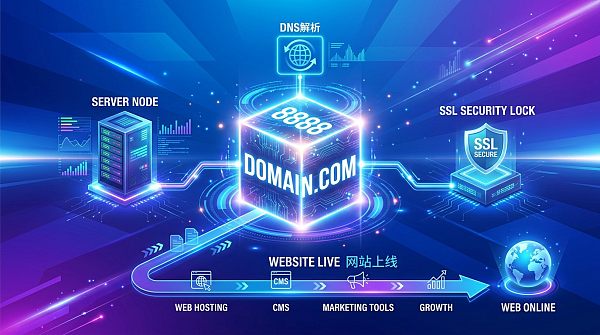
From the perspective of search intent, users are usually at the stage of “preparing to build a website” or “preparing to upgrade the corporate website”, hoping to find a directly actionable domain registration guide. Enterprise decision-makers pay more attention to risks, brand protection, and long-term return on investment; executors pay more attention to steps, materials, review, and technical settings; while security management and maintenance personnel care more about real-name verification, DNS resolution, certificates, renewal, and permission management.
Therefore, the domain registration process is not simply about filling in information and making payment, but includes the following key judgments:
- Whether the domain name is convenient for brand communication, memorization, and search input
- Whether the extension fits the business positioning, such as .com, .cn, .net, etc.
- Whether there are trademark conflicts, infringement risks, or a poor historical record
- Whether the registration platform is stable and reliable, and whether it is convenient for DNS resolution, renewal, and security management later
- Whether it can smoothly connect with filing, website building, SSL certificates, and SEO optimization after registration is completed
If an enterprise is targeting overseas customers, industrial buyers, or large-volume B2B clients, the professionalism and credibility of the domain name are especially important. For example, when industrial export-oriented enterprises build a digital portal, it is not just to “have an official website”, but also to showcase supply capabilities, business coverage, and a professional image. This is also why many enterprises simultaneously plan brand domains when building overseas marketing websites. In such scenarios, digital display projects like heavy vehicles, logistics often use a branded domain together with a responsive website, product search center, visual data dashboard, and inquiry forms to further enhance global customer acquisition efficiency and customer trust.
What are the detailed steps of the domain registration process? Following these 8 steps is the safest approach
Below, we break down a more complete domain registration process according to the practical operating sequence for enterprises.
1. Clarify the purpose and usage scenario of the domain name
Do not rush to register first. Start by clarifying whether the domain name is for a corporate website, a brand showcase site, an event landing page, or an international site or multilingual site. Different purposes determine your subsequent naming method and extension selection.
- Corporate website: prioritize the brand name or brand abbreviation
- Marketing landing page: can combine business keywords, but it is not recommended to be too long
- Overseas website: prioritize internationally common extensions, such as .com
- Regional market website: can be supplemented according to country or region
2. Screen suitable domain names
A good domain name usually has these characteristics: short, memorable, easy to spell, easy to spread, and not easily confused with other brands.
It is recommended to prioritize the following combinations:
- Full brand name
- Brand abbreviation
- Brand name + industry term
- Product line name + enterprise identifier
Try to avoid:
- Overly long pinyin combinations
- Mixed use of multiple hyphens or numbers
- Words that are easy to misspell or unclear in pronunciation
- Names that imitate well-known brands or carry infringement risks
3. Choose the appropriate domain extension
The extension affects user trust and brand professionalism. Common recommendations are as follows:
- .com: the most universal, suitable for the vast majority of enterprises
- .cn: suitable for the Chinese market, reflecting local attributes
- .net: can be used as supplementary protection
- .com.cn: suitable for some enterprises as supplementary brand registration
If the budget allows, it is recommended that core brands protect at least .com and .cn at the same time to avoid being preemptively registered later.
4. Check whether the domain name is available for registration
Enter the target name on a domain registration service platform to check whether it has already been registered. If it has been taken, you can:
- Adjust it to a brand abbreviation or a more concise name
- Change the extension
- Add a brand identifier
- Consider contacting the holder to negotiate a purchase
However, if it is the main domain of the official website, try not to lower brand recognition just to “piece together a name that can be registered”.
5. Choose a legitimate domain registration service provider
When choosing a platform, do not look only at the price, but also at management capabilities and after-sales support. Focus on:
- Whether it has formal qualifications
- Whether it supports DNS resolution, locking, transfer, and bulk management
- Whether it supports real-name verification and expiration reminders
- Whether it provides stable technical support
- Whether it has DNS security capabilities
For enterprises, a cheap platform with a difficult backend and non-transparent renewal fees may lead to higher subsequent operation and maintenance costs.
6. Submit registration information and complete real-name verification
Domain registration usually requires filling in registrant information. Enterprise users generally need to prepare:
- Enterprise name
- Business license information
- Contact person’s name and contact details
- Email address
Real-name verification requirements may vary depending on the extension and registrar. After submission, complete the real-name review in time; otherwise, the domain name may not be able to be resolved or used normally.
7. Complete payment and confirm successful registration
After payment is successful, it does not mean all processes have ended. It is recommended to check immediately:
- Whether the domain name has entered your account
- Whether the registration period is correct
- Whether the contact email and mobile number are real and usable
- Whether automatic renewal reminders are enabled
For core brand domains, it is recommended to register for at least 2 to 5 years and assign dedicated personnel for management, so as to avoid loss of control over assets due to personnel changes.
8. Configure DNS resolution and move into the website building stage
After domain registration is completed, the next step is usually DNS resolution. Common settings include:
- A record: points the domain name to the server IP
- CNAME record: points a subdomain to the target address
- MX record: used for enterprise email
- TXT record: used for verification, security configuration, etc.
After DNS resolution is completed, the enterprise can smoothly enter the stages of website deployment, filing, certificate installation, and launch testing.
When registering a domain name, what risks do enterprises most easily overlook?
Many enterprises focus on “whether registration is successful”, but ignore subsequent risk control. For truly mature domain management, it is recommended to focus on preventing the following issues:
1. Trademark and brand conflicts
Before registration, basic trademark searches should be conducted as much as possible, especially for brand official websites planned for long-term operation, so as to avoid being forced to change the domain name later due to brand disputes.
2. Unclean domain history
If you are purchasing a second-hand domain, it is recommended to check historical website records, whether it has been penalized by search engines, and whether it has been used for spam sites or gray industries; otherwise, it will affect SEO optimization.
3. Unclear domain ownership
Some enterprises ask individual employees or outsourcing companies to register on their behalf, and as a result, they cannot regain control after resignation or termination of cooperation. The correct approach is: core domains must be registered under the enterprise entity or an enterprise-controlled account.
4. Forgetting renewal and losing the domain name
Once a domain expires, at best the website becomes inaccessible, and at worst it may be snatched up by others. It is recommended to enable automatic renewal, set multiple reminders, and include it in the enterprise’s digital asset ledger.
5. Insufficient DNS security settings
For enterprises that value security and stability, attention should be paid to measures such as account permission allocation, operation logs, domain locks, and approval for DNS changes, so as to reduce the risk of malicious tampering.
After registering a domain name, what other key actions are needed to truly go live and bring traffic?
When users search for “domain registration process”, they often do not just want to stay at the registration level, but hope to understand the complete chain after registration. For enterprises, what is truly valuable is moving from “registration successful” to “website available, trustworthy, and capable of acquiring customers”.
1. Determine whether filing is required based on the server location
If the website server is deployed in mainland China, ICP filing is usually required. Before filing, prepare the domain name, entity documents, server information, etc. If it is an overseas server, mainland ICP filing is usually not involved, but compliance requirements in the target market still need attention.
2. Apply for and deploy an SSL certificate
An SSL certificate can upgrade a website from HTTP to HTTPS, improving transmission security while also helping user trust and search engine performance. The general process is:
- Select the certificate type, such as DV, OV, EV
- Submit domain or enterprise verification materials
- Complete domain ownership verification
- Install the certificate on the server or CDN
- Check whether HTTPS redirection and the security chain are functioning properly
For corporate websites, marketing websites, and inquiry-based websites, HTTPS is basically already standard.
3. Put a basic SEO optimization plan in place
Domain registration itself will not directly bring rankings, but it is the starting point of SEO. Before and after the website goes live, the following tasks should be carried out simultaneously:
- Plan a clear website structure
- Set standardized titles, descriptions, and URLs
- Ensure a good mobile access experience
- Optimize website loading speed
- Submit a search engine sitemap
- Continuously publish high-quality content related to the business
Especially for B2B enterprise websites, it is not enough just to introduce the company; they should also highlight product capabilities, delivery experience, application scenarios, and trust proof. Websites aimed at industrial exports often improve buyer conversion intent through modules such as customer logo walls, coverage maps, professional inquiry forms, and data dashboards. This is also why some enterprises place special emphasis on website structure, trust display, and visual expression of global business when planning official websites in categories like heavy vehicles, logistics.
In the domain registration process, what should different roles focus on?
To make the process truly executable, different positions need to focus on different priorities.
Enterprise decision-makers
- Whether the domain matches the brand strategy
- Whether it is convenient for long-term promotion and global expansion
- Whether it has value for brand protection and asset accumulation
- Whether the subsequent costs of website building, promotion, and maintenance are controllable
Execution and operations personnel
- Whether the registration steps are clear
- Whether real-name verification, DNS resolution, and filing are smooth
- Whether it can quickly connect with website building and SEO
- Whether the backend is easy to manage
Security and maintenance personnel
- Whether account permissions are standardized
- Whether DNS resolution is secure and stable
- Whether certificate deployment is complete
- Whether renewal, monitoring, and anomaly alert mechanisms are in place
How to judge whether a domain solution is suitable for long-term enterprise use?
If you are not sure whether the currently selected domain is a “good domain”, you can quickly judge it with these questions:
- When customers see it for the first time, can they quickly remember it and enter it correctly?
- Is it highly relevant to the enterprise brand and core business?
- Will it still be suitable when expanding into new markets and new products in the future?
- Is it convenient for sales, exhibitions, advertising, and social media communication?
- Does it have good compatibility with filing, website building, SSL, and SEO?
If most of the above answers are “yes”, then this domain usually has good long-term value.
Overall, the detailed steps of the domain registration process are not complicated, but what enterprises truly need to value is: making the right choices before registration, ensuring compliance and controllability during registration, and smoothly connecting filing, SSL certificates, website building, and SEO operations after registration. A suitable domain name is not just a website address, but also a corporate brand asset, a marketing entry point, and a foundation of trust. For enterprises hoping to systematically advance website development and digital marketing, making the domain registration step solid will make subsequent online growth more stable and efficient.
Related Articles



Related Products
 EasyCamp SaaS Smart Website Marketing SystemE-Yingbao SaaS Smart Website Marketing System: AI-powered, zero-code website building. Rapidly launch multilingual independent e-commerce sites in just 10 minutes. Global server acceleration and AI-driven SEO optimization empower businesses to efficiently connect with global markets. The seamless integration of technology and user-friendly operation makes building e-commerce sites incredibly simple.
 AI+SEM Intelligent Advertising Marketing SystemAI+SEM drives intelligent ad creation, empowering full-funnel precision advertising marketing. The system automatically generates weekly/monthly reports, AI recommends keywords and target countries, monitors core metrics in real-time with intelligent alerts, and enables one-click high-conversion ad solutions to help quickly acquire customers and improve ROI.
 AI+SEO Dual Engine Optimization ServiceEasyWin AI+SEO Dual Engine Optimization System leverages AI-powered keyword mining, content generation, and comprehensive technical optimization to help foreign trade enterprises acquire high-quality organic traffic, significantly improving search rankings and conversion rates.
 AI+SNS Social Media Marketing SystemYingbao AI+SNS Social Media Marketing System - Precision social capture for the social media era. Supports one-click content synchronization across major platforms like Facebook and LinkedIn. AI intelligently rewrites posts for enhanced relevance. 24/7 AI customer service and user profiling analysis empower businesses to efficiently expand into global markets.
 AI+SEO营销解决方案易营宝AI+SEO营销解决方案,通过AI批量写作、智能生成TDK、精准关键词扩词等功能,全面优化网站SEO效果,提升流量与转化率。助力企业构建高效智能网站新生态。
 AI+SEM Advertising Marketing SolutionsAI+SEM Advertising Marketing Solution leverages AI technology to deeply empower SEM ad campaigns. It automatically generates weekly/monthly reports using AI, presenting account data across multiple dimensions for comprehensive insights into campaign performance and trends. The system precisely recommends keywords and target countries, intelligently generates high-conversion ad copy, and enables one-click activation of efficient campaign plans to help businesses rapidly acquire customers. Simultaneously, it monitors core metrics in real time, intelligently identifies abnormal fluctuations, and issues timely alerts to ensure stable, high-return advertising results.
 Domain Name ServicesEasyWin provides professional domain name services, including intelligent queries, one-stop registration, brand protection, and full lifecycle management, helping businesses build a digital brand image.
 EasyOperate B2C Cross-Border E-Commerce Platform & Independent WebsiteEasyStore B2C Cross-border E-commerce Independent Store is an intelligent website building and cross-border e-commerce integrated solution independently developed by EasyStore Information Technology (Beijing) Co., Ltd. The system is specially designed for small and medium-sized as well as large export enterprises, integrating 'website building, operation, marketing, advertising, and conversion' into one, helping enterprises quickly establish cross-border e-commerce independent stores to achieve brand globalization and global sales growth.
The platform supports multiple languages, multiple currencies, and multi-channel marketing, with built-in AI intelligent translation and SEO optimization systems, suitable for mainstream markets such as Southeast Asia, Europe and America, Latin America, and the Middle East, assisting Chinese manufacturing enterprises in efficiently deploying international e-commerce strategies. SSL证书易营宝提供专业SSL安全证书服务,包括单域名和泛域名证书,确保网站数据传输加密、身份验证和完整性保护,助力企业建立安全可信的在线业务环境。









