









- What Does a Global Traffic Ecosystem Service Provider Do? What Are the Differences from a Single Advertising AgencyJul 16, 2026View details
- What should you focus on in the latest enterprise SaaS report? From renewal rates and delivery costs to overseas growth opportunitiesJul 12, 2026View details
- What signals are worth paying attention to in a cross-border marketing trend report? B2B companies should look at these 6 signalsJul 11, 2026View details
- How to Read a Cross-Border Marketing Trends Report? Five Key Dimensions for Evaluating Channel OpportunitiesJul 11, 2026View details
- Which channel has the highest ROI in the global traffic ecosystem? Comparative analysis of search, social media, and advertisingJul 10, 2026View details
- What multilingual website services are available in Sanya? Which model is more suitable for local businesses going global?Jul 08, 2026View details
- How to view the complete list of China SaaS companies in the top 100? Practical methods for screening website-building and marketing service providersJul 08, 2026View details
- How to view pricing in the global traffic ecosystem? Cost comparison of search, social media, and content channel advertisingJul 06, 2026View details
How Website Design Style Aligns with Brand Identity
Whether the website design style can be aligned with the brand depends not on whether the pages “look good,” but on whether, after entering the website, users can sense within a few seconds whose brand it is, whether it is professional and trustworthy, and whether they are willing to continue browsing and ultimately convert. For businesses, truly effective consistency in website design style must simultaneously serve brand recognition, user experience, and marketing growth, rather than merely achieving “uniform color matching” at the visual level.
Especially in the era of integrated website and marketing services, a website is no longer just an online business card, but an important hub for brand communication, lead acquisition and conversion, content engagement, and ongoing operations. Whether they are information researchers, technical evaluators, business decision-makers, or channel partners, they will quickly judge a company’s positioning, capabilities, and reliability from its website design style. Therefore, to achieve a well-unified website design style, it is necessary to systematically advance from several dimensions: brand strategy, page standards, content expression, interaction logic, and SEO coordination.
Why a unified website design style has become the foundation of brand building and conversion improvement
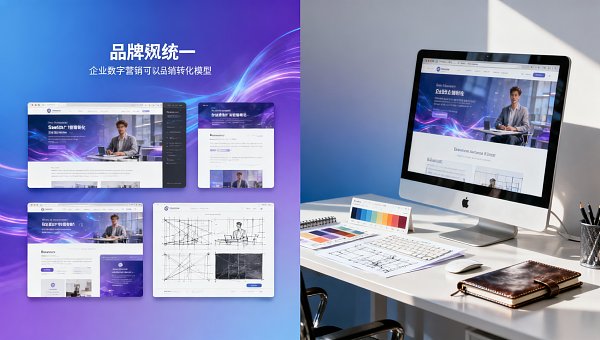
When building an official website, many companies commonly misunderstand “brand consistency” as simply placing the Logo, keeping the primary color scheme consistent, and making the homepage look a bit more premium. But the brand consistency users truly perceive is far more concrete than that. It is reflected in whether the visual language is consistent, whether the tone of content is unified, whether the page structure is stable, whether buttons and interactions follow clear patterns, and whether the experience across different devices is coherent.
From the perspective of user search intent, people searching for “how to align website design style with brand consistency” are usually not trying to understand abstract concepts, but to solve several practical problems: what to do if the current website does not look like their own brand; how to avoid a disconnect between visuals and business during a website redesign; how to synchronize website adjustments after a brand upgrade; and whether a unified design style can truly improve conversions.
The answer is yes. A unified website design style usually delivers value in the following aspects:
- Enhances brand recognition, helping users remember the company image more quickly;
- Strengthens trust and reduces loss caused by “looking unprofessional”;
- Improves page comprehension efficiency, helping users find key information faster;
- Enables coordination among marketing campaigns, SEO content, and landing page styles, improving conversion rates;
- Reduces ongoing maintenance costs and makes it easier for different departments and service providers to execute consistently.
For a company that provides full-funnel services such as smart website building, SEO optimization, social media marketing, and advertising placement, website style consistency is even more the foundation of a closed-loop marketing system. Once the brand style becomes fragmented, users who enter the website from search results, ad pages, or social media content will clearly feel the inconsistency, thereby reducing their willingness to stay and inquire.
What companies should unify first is not page style, but brand expression logic
If a company wants its website design style to truly align with its brand, the first step is not to start directly with UI, but to first clarify the logic of brand expression. In other words, what kind of corporate image the website is meant to convey, and how that image is perceived by users through design.
At this stage, it is recommended that companies first answer 4 questions:
- What is our brand positioning: premium and professional, technologically innovative, practical and trustworthy, or youthful and dynamic?
- Who are our core customers: B-end procurement teams, distributors, end consumers, or customers in international markets?
- What do users care most about: technical strength, delivery capability, price advantage, case experience, or service responsiveness?
- What impression do we want users to form after browsing the website: reliable, intelligent, internationalized, highly efficient, or more knowledgeable about the industry?
These four questions directly determine the direction of the website design style. For example, a brand that emphasizes technological innovation is usually better suited to a concise page style with a clear structure, ample white space, and technology-inspired graphic elements; while a company emphasizing manufacturing strength and deep industry experience is better suited to a more steady, trustworthy, case-oriented expression with sufficient content proof.
The problem with many corporate websites is not that “the design is bad,” but that “the design does not match the brand positioning.” For example, if a high-ticket B2B company adopts an overly lively e-commerce style, it will weaken its professionalism; while if a brand targeting young consumers has pages that are too traditional, it will also affect appeal. This is why brand consistency must first unify the logic of expression before implementing it into the design system.
Specifically, which key elements should unified website design style be implemented in
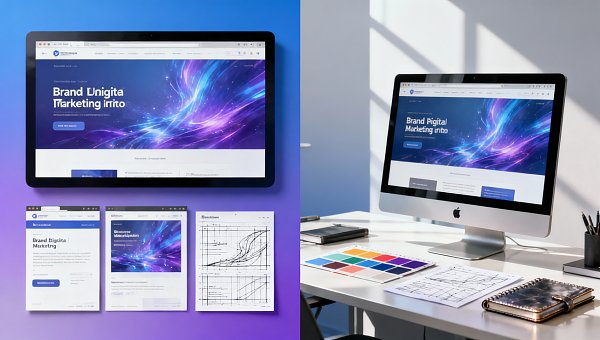
Truly executable website style consistency must at least be implemented across the following dimensions, rather than focusing only on the homepage visuals.
1. Consistency of foundational visual elements
This includes the brand primary color, secondary colors, typography system, icon style, button styles, whitespace rules, image processing methods, illustration and line-frame styles, etc. It is recommended to form clear specifications for these elements to avoid the style becoming increasingly scattered across different pages, designers, and maintenance periods.
2. Consistency of page structure
Consistency does not mean all pages must look exactly the same, but that users can quickly understand the information hierarchy on different pages. For example, the Banner area, advantage modules, case modules, CTA buttons, footer information, etc., should maintain a consistent structural logic as much as possible, which will significantly improve browsing efficiency.
3. Consistency of copy tone
Many companies achieve visual consistency across pages, but their copy is highly fragmented: the homepage uses brand-oriented expression, the product page sounds like an instruction manual, and the news page turns into an administrative document style. This makes users’ perception of the brand unclear. It is recommended to unify headline style, description methods, value expression, and action-guiding language.
4. Consistency of images and case content
Brand visuals do not come only from design drafts, but also from image selection. Real photos, scene images, team photos, and client case cover images should all align with the brand tone. If the website also displays research results, industry materials, or solution content, attention should also be paid to the consistency of covers, layouts, and typography. For example, some content pages oriented toward industry research or professional management place greater emphasis on rationality, clarity, and credibility in content presentation. On such pages, when appropriately integrating professional material links such as Research on the optimized application of activity-based costing in cost accounting of coal mining enterprises, they should also remain consistent with the overall page style and information logic to avoid a sense of abruptness.
5. Consistency of interactive experience
Button feedback, hover effects, form completion methods, mobile menu logic, and page transition rhythm are all part of style consistency. Users may not explicitly point out what feels wrong, but they will judge whether the brand is mature based on whether it “feels easy to use.”
How to balance brand consistency, user experience, and SEO, so the website is not left with only being “good-looking”
For business decision-makers and technical evaluators, another frequent concern is: if the website places too much emphasis on design, will it sacrifice SEO performance and actual conversions? In fact, a mature website development approach must balance all three rather than treating them as trade-offs.
To achieve this, the following methods can be prioritized:
Build a clear information architecture first
Brand consistency does not mean making all pages look “premium,” but enabling both users and search engines to quickly understand the website content. Clear website section planning, hierarchical structure, internal linking logic, and landing page categorization affect not only SEO indexing, but also user dwell time and inquiry paths.
Let brand visuals serve content expression
Many websites have strong homepage visuals, but the body text is hard to read, headlines are unclear, and key information does not stand out, resulting in brand feel without conversions. The correct approach is to use design to highlight core selling points, application scenarios, customer cases, service processes, qualification proof, and contact methods.
Balance loading speed and responsive experience
If large images, complex animations, and ineffective special effects are piled up for the sake of “design sense,” the result will be slower speed, affecting search performance and user experience. Especially on mobile devices, loading efficiency and information acquisition efficiency are often more important than flashy techniques.
Content pages must also maintain brand consistency
Many companies focus only on the homepage and section pages, while overlooking article pages, case pages, product pages, and download pages. In fact, SEO traffic often first enters through content pages. If content pages have an ordinary style, chaotic layout, and weak brand recognition, it is difficult to capture search traffic and convert it.
Therefore, companies should include SEO article templates, case detail templates, product introduction templates, and form page templates within unified standards. Only in this way can users feel a consistent brand experience no matter which entry point they use to access the website.
When redesigning, how can companies determine whether the current website is truly “inconsistent with the brand”
If a company is considering redesigning or upgrading its website, it can first make a quick assessment. The more the following situations appear, the more it indicates a disconnect between the website design style and the brand:
- The homepage, product pages, and news pages look as if they were created at different times by different teams;
- The brand proposition is very clear, but the page visuals fail to reflect that positioning;
- The website has chaotic color schemes, inconsistent fonts, and mismatched icon styles;
- There are major differences between pages on different devices, with an obviously fragmented mobile experience;
- The content is professional, but the page presentation lacks trust and a sense of quality;
- The advertising landing pages and the main official website have inconsistent styles, causing users to drop off after switching;
- More and more pages are added during later maintenance, but the overall coherence becomes weaker and weaker.
In addition, user feedback, heat maps, dwell time, bounce rate, inquiry paths, and brand search keyword performance can also be used to assist judgment. If users view many pages but still do not convert, the problem may not only be traffic quality, but also insufficient consistency in website style, content structure, and brand expression.
For companies with strong content marketing needs, website redesign should also pay special attention to professional content engagement scenarios such as resource pages, white paper pages, and case pages. If the corporate website involves professional research, industry solutions, or knowledge-based product displays, then resource pages containing content such as Research on the optimized application of activity-based costing in cost accounting of coal mining enterprises should also follow unified visual standards and content logic to maintain the overall professionalism of the brand.
In practical implementation, how should companies better promote website style consistency
Based on actual project experience, for companies to improve the consistency of website design style, the most effective method is usually not a one-time “major overhaul,” but establishing a standard mechanism that can be continuously executed.
More practical ways to move forward include:
- First clarify brand keywords and core audience personas;
- Sort out the pages on the existing website where style fragmentation is most obvious;
- Establish foundational design standards, including colors, fonts, buttons, icons, layouts, and image rules;
- Simultaneously formulate content standards, including headline writing, value expression, CTA wording, and case structure;
- Prioritize the optimization of high-traffic, high-conversion-value pages, such as the homepage, product pages, solution pages, and article pages;
- Ensure that design, front-end, SEO, content editors, and operations personnel all use the same set of standards;
- After launch, continue making fine adjustments through data feedback rather than relying only on aesthetic judgment.
For companies with a clear business growth orientation, website design style consistency is not an isolated design project, but a systematic undertaking jointly involving brand building, search-based customer acquisition, and conversion optimization. Especially against the backdrop of increasingly fierce competition in global digital marketing, the earlier companies upgrade their official websites from a “display tool” to a “brand and growth hub,” the more efficiently they can perform in subsequent SEO, advertising placement, and content marketing.
Overall, the key to aligning website design style with brand consistency is not pursuing a certain trendy style, but making brand positioning, user needs, page experience, and marketing goals consistent with one another. A truly effective website should allow users to recognize the brand at a glance, understand the value after one read, feel smoothness after one interaction, and be willing to continue communicating or converting. For companies, only by implementing brand consistency across visuals, content, structure, and operational coordination can a website be both professional and attractive while truly driving business growth.
Related Articles
 Attention! Builders' must-see: Yibingbao AI components updated, design efficiency directly doubled!
 China's foreign trade sees a turnaround: imports surge by 22%! Foreign trade professionals should quickly take note of the new trends in the second half of the year
 What Does a Global Traffic Ecosystem Service Provider Do? What Are the Differences from a Single Advertising Agency


Related Products
 EasyCamp SaaS Smart Website Marketing SystemE-Yingbao SaaS Smart Website Marketing System: AI-powered, zero-code website building. Rapidly launch multilingual independent e-commerce sites in just 10 minutes. Global server acceleration and AI-driven SEO optimization empower businesses to efficiently connect with global markets. The seamless integration of technology and user-friendly operation makes building e-commerce sites incredibly simple.
 AI+SEM Intelligent Advertising Marketing SystemAI+SEM drives intelligent ad creation, empowering full-funnel precision advertising marketing. The system automatically generates weekly/monthly reports, AI recommends keywords and target countries, monitors core metrics in real-time with intelligent alerts, and enables one-click high-conversion ad solutions to help quickly acquire customers and improve ROI.
 AI+SEO Dual Engine Optimization ServiceEasyWin AI+SEO Dual Engine Optimization System leverages AI-powered keyword mining, content generation, and comprehensive technical optimization to help foreign trade enterprises acquire high-quality organic traffic, significantly improving search rankings and conversion rates.
 AI+SNS Social Media Marketing SystemYingbao AI+SNS Social Media Marketing System - Precision social capture for the social media era. Supports one-click content synchronization across major platforms like Facebook and LinkedIn. AI intelligently rewrites posts for enhanced relevance. 24/7 AI customer service and user profiling analysis empower businesses to efficiently expand into global markets.
 AI+SEO营销解决方案易营宝AI+SEO营销解决方案,通过AI批量写作、智能生成TDK、精准关键词扩词等功能,全面优化网站SEO效果,提升流量与转化率。助力企业构建高效智能网站新生态。
 AI+SEM Advertising Marketing SolutionsAI+SEM Advertising Marketing Solution leverages AI technology to deeply empower SEM ad campaigns. It automatically generates weekly/monthly reports using AI, presenting account data across multiple dimensions for comprehensive insights into campaign performance and trends. The system precisely recommends keywords and target countries, intelligently generates high-conversion ad copy, and enables one-click activation of efficient campaign plans to help businesses rapidly acquire customers. Simultaneously, it monitors core metrics in real time, intelligently identifies abnormal fluctuations, and issues timely alerts to ensure stable, high-return advertising results.
 Domain Name ServicesEasyWin provides professional domain name services, including intelligent queries, one-stop registration, brand protection, and full lifecycle management, helping businesses build a digital brand image.
 EasyOperate B2C Cross-Border E-Commerce Platform & Independent WebsiteEasyStore B2C Cross-border E-commerce Independent Store is an intelligent website building and cross-border e-commerce integrated solution independently developed by EasyStore Information Technology (Beijing) Co., Ltd. The system is specially designed for small and medium-sized as well as large export enterprises, integrating 'website building, operation, marketing, advertising, and conversion' into one, helping enterprises quickly establish cross-border e-commerce independent stores to achieve brand globalization and global sales growth.
The platform supports multiple languages, multiple currencies, and multi-channel marketing, with built-in AI intelligent translation and SEO optimization systems, suitable for mainstream markets such as Southeast Asia, Europe and America, Latin America, and the Middle East, assisting Chinese manufacturing enterprises in efficiently deploying international e-commerce strategies. SSL证书易营宝提供专业SSL安全证书服务,包括单域名和泛域名证书,确保网站数据传输加密、身份验证和完整性保护,助力企业建立安全可信的在线业务环境。









