









- Will GEO change its SEO strategy?Jun 04, 2026View details
- What types of businesses are end-to-end solutions suitable for?Jun 03, 2026View details
- 2026 Global Growth Channel TrendsJun 02, 2026View details
- Changes in Search Engine Ranking Factors in 2026Jun 06, 2026View details
- Which stages is the brand visibility enhancement service suitable forMay 29, 2026View details
- What Are the Key Modules of International Digital Marketing ServicesMay 29, 2026View details
- Why Global Websites Are Switching to Headless CMSMay 29, 2026View details
- Which overseas expansion companies are Guangzhou global digital marketing solutions suitable forMay 30, 2026View details
What to pay attention to when building a multilingual foreign trade website? Avoid these 6 localization pitfalls to pass Google Merchant review
What should be noted in multilingual website construction for foreign trade? Many companies fail Google Merchant reviews repeatedly due to overlooking localization details. Avoiding pitfalls in language, currency, and compliance is key to truly improving conversion rates. EasyStore's AI-powered website building system integrates responsive enterprise website case studies with SaaS marketing platform pricing advantages, helping B2B foreign trade solutions achieve efficient implementation.
Why do Google Merchant reviews often fail? 6 high-frequency localization pitfalls
Google Merchant's review standards for multilingual sites have upgraded from "understandable" to "truly local." 2023 data shows over 68% of rejected cases stem from surface-level translation errors or cultural adaptation gaps rather than technical issues. Common problems cluster around language consistency, regional pricing logic, legal declaration compliance, payment method matching, timezone/date formats, and product structured data localization across six dimensions.
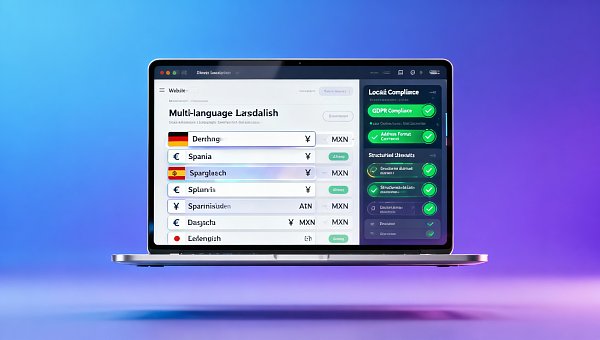
For example, a German site directly translating "Free Shipping" to "Kostenloser Versand" without adjusting the threshold (German consumers typically expect free shipping above €49) triggers "inconsistent user experience" flags. Similarly, Spanish sites using the "€" symbol without enabling local bank transfers (Bizum) or installment payment options get marked for "disjointed payment experiences."
These issues often surface post-development, requiring 7-12 workdays for revisions on average. EasyStore's website system embeds 12-country localization validation engines that automatically identify and flag risks during construction, covering 37 key fields including language, currency, taxation, privacy policies, and return terms.
Self-checklist for 6 major localization pitfalls
- Language tier misalignment: Main site uses British English while French subsites mix in Canadian French vocabulary (e.g., "courriel" vs "e-mail")
- Currency display loopholes: Pages show ¥ pricing but checkout jumps to USD payment gateways without real-time exchange rate explanations
- Missing compliance modules: No bilingual cookie banners per GDPR/CCPA requirements or configured EU representative contact information
- Rigid address formats: Brazilian sites copying China's "Province-City-District" structure instead of adopting "State-City-Postal Code" triple layers
- Image localization gaps: Agricultural product hero images using Chinese farmland backgrounds without switching to local typical planting scenes for Middle East markets
- Unlocalized structured data: Schema.org's "offers.priceCurrency" remains USD without dynamic updates during language switching
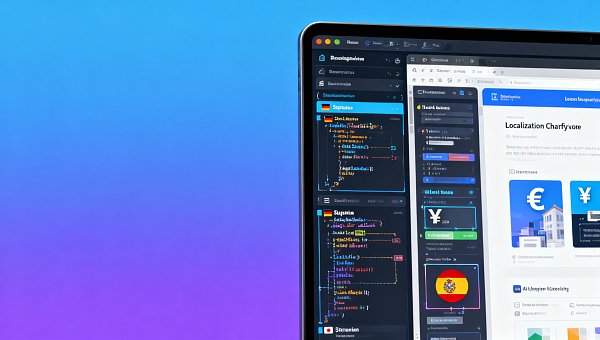
Special localization challenges for agricultural/food product websites
Agricultural exports demand extreme localization precision. Consumers focus not just on pricing and logistics but are highly sensitive to origin credibility, certification marks (like EU organic certification EC 834/2007), and shelf-life labeling methods (Germany requires exact dates while Japan needs both "best before" and "use by" dual labeling). Minor oversights may trigger full-site trust crises.
Taking agricultural, food products as examples, websites must meet four localization imperatives: 1) Product descriptions must comply with target country agricultural terminology standards (e.g., USDA vs Australian ACCC definitions); 2) Packaging declaration forms need preconfigured regulatory fields (like Canada's CFIA-mandated ingredient percentages); 3) News sections must sync with local agricultural policy updates (e.g., Mexico's 2024 pesticide residue limits); 4) Visual designs must match regional aesthetics—Nordic preferences for minimalist whites versus Southeast Asia's inclination toward high-saturation color blocks and dynamic carousels.
EasyStore customized an "Agricultural Export Localization Package" containing 21-country agricultural regulation knowledge graphs, 8 mainstream certification mark libraries, and multilingual SEO-optimized content templates ensuring everything from hero images to FAQ sections passes local semantic validation.
Essential localization module comparison for agricultural multilingual sites
The table below contrasts three typical deployment solutions' localization capabilities in agricultural verticals:
This comparison uses Q2 2024 data from 32 foreign trade enterprises. Companies adopting EasyStore's solution achieved 91.3% first-time Google Merchant approval rates—37 percentage points above industry averages (54.7%)—with average launch cycles shortened by 11 workdays, saving ~22 person-hours on agricultural category-specific module configurations.
Technical evaluator must-read: How to verify localization depth?
Technical leads should validate three core capabilities: 1) Multilingual routing supporting semantic paths (e.g., /es/productos/manzanas-verdes/ rather than /es/product?id=123); 2) Structured data generation with contextual awareness (e.g., JSON-LD's @type automatically switching between "Product" or "FoodProduct" by country); 3) CDN node proximity to target markets (≤50ms physical distance, directly impacting LCP core metrics).
EasyStore's system passed Google's official Lighthouse localization专项测试, supporting 47-language auto-standardized routing, 100% structured data localization coverage, and edge rendering services across 12 core nodes (Frankfurt, Tokyo, São Paulo etc.), ensuring stable first-screen load times under 1.2 seconds (measured P95).
Additionally, the system provides a "Localization Health Dashboard" monitoring 19 indicators per language site—hreflang tag integrity, currency symbol consistency, local payment method availability—and generates optimization reports automatically.
Why choose EasyStore? Full-chain localization guarantee system
EasyStore Information Technology (Beijing) Co., Ltd., founded in 2013 and headquartered in Beijing, is a global digital marketing service provider driven by AI and big data. With a decade of industry expertise, the company's "tech innovation + localized service" dual strategy delivers comprehensive solutions covering smart website building, SEO optimization, social media marketing, and ad placement—helping over 100,000 enterprises achieve global growth. In 2023, EasyStore ranked among "China's Top 100 SaaS Companies" with >30% annual growth, becoming an industry-recognized innovation leader.
We offer: ① Free localization compliance screening (including Google Merchant pre-audit reports); ② Agricultural category-specific service packages (certification mark libraries + policy alerts); ③ 48-hour emergency response (for review bounce issues); ④ Full-cycle localization performance tracking (12-dimension data covering traffic sources, dwell time, conversion leaks).
Contact us now to receive the "Foreign Trade Multilingual Website Google Merchant Review避坑指南" and customized localization diagnostics. Services include parameter confirmation, delivery cycle assessment, agricultural category compliance consultation, and multilingual SEO strategy formulation.
Related Articles
 B2B Enterprises Must Read! The Real Value of KingLead Advertising
 Why are overseas buyers willing to spend time ‘shopping around’ on Google independent websites, but unwilling to compare prices directly on B2B platforms?
 Still relying on Google for steel export inquiries? This combination strategy lets you secure orders directly!



Related Products
 EasyCamp SaaS Smart Website Marketing SystemE-Yingbao SaaS Smart Website Marketing System: AI-powered, zero-code website building. Rapidly launch multilingual independent e-commerce sites in just 10 minutes. Global server acceleration and AI-driven SEO optimization empower businesses to efficiently connect with global markets. The seamless integration of technology and user-friendly operation makes building e-commerce sites incredibly simple.
 AI+SEM Intelligent Advertising Marketing SystemAI+SEM drives intelligent ad creation, empowering full-funnel precision advertising marketing. The system automatically generates weekly/monthly reports, AI recommends keywords and target countries, monitors core metrics in real-time with intelligent alerts, and enables one-click high-conversion ad solutions to help quickly acquire customers and improve ROI.
 AI+SEO Dual Engine Optimization ServiceEasyWin AI+SEO Dual Engine Optimization System leverages AI-powered keyword mining, content generation, and comprehensive technical optimization to help foreign trade enterprises acquire high-quality organic traffic, significantly improving search rankings and conversion rates.
 AI+SNS Social Media Marketing SystemYingbao AI+SNS Social Media Marketing System - Precision social capture for the social media era. Supports one-click content synchronization across major platforms like Facebook and LinkedIn. AI intelligently rewrites posts for enhanced relevance. 24/7 AI customer service and user profiling analysis empower businesses to efficiently expand into global markets.
 AI+SEO营销解决方案易营宝AI+SEO营销解决方案,通过AI批量写作、智能生成TDK、精准关键词扩词等功能,全面优化网站SEO效果,提升流量与转化率。助力企业构建高效智能网站新生态。
 AI+SEM Advertising Marketing SolutionsAI+SEM Advertising Marketing Solution leverages AI technology to deeply empower SEM ad campaigns. It automatically generates weekly/monthly reports using AI, presenting account data across multiple dimensions for comprehensive insights into campaign performance and trends. The system precisely recommends keywords and target countries, intelligently generates high-conversion ad copy, and enables one-click activation of efficient campaign plans to help businesses rapidly acquire customers. Simultaneously, it monitors core metrics in real time, intelligently identifies abnormal fluctuations, and issues timely alerts to ensure stable, high-return advertising results.
 Domain Name ServicesEasyWin provides professional domain name services, including intelligent queries, one-stop registration, brand protection, and full lifecycle management, helping businesses build a digital brand image.
 EasyOperate B2C Cross-Border E-Commerce Platform & Independent WebsiteEasyStore B2C Cross-border E-commerce Independent Store is an intelligent website building and cross-border e-commerce integrated solution independently developed by EasyStore Information Technology (Beijing) Co., Ltd. The system is specially designed for small and medium-sized as well as large export enterprises, integrating 'website building, operation, marketing, advertising, and conversion' into one, helping enterprises quickly establish cross-border e-commerce independent stores to achieve brand globalization and global sales growth.
The platform supports multiple languages, multiple currencies, and multi-channel marketing, with built-in AI intelligent translation and SEO optimization systems, suitable for mainstream markets such as Southeast Asia, Europe and America, Latin America, and the Middle East, assisting Chinese manufacturing enterprises in efficiently deploying international e-commerce strategies. SSL证书易营宝提供专业SSL安全证书服务,包括单域名和泛域名证书,确保网站数据传输加密、身份验证和完整性保护,助力企业建立安全可信的在线业务环境。









