









- What multilingual website services are available in Sanya? Which model is more suitable for local businesses going global?Jul 08, 2026View details
- How to view the complete list of China SaaS companies in the top 100? Practical methods for screening website-building and marketing service providersJul 08, 2026View details
- How to view pricing in the global traffic ecosystem? Cost comparison of search, social media, and content channel advertisingJul 06, 2026View details
- How to assess foreign trade website development trends?Looking at 2026 changes from multilingual,AI content to conversion pathsJul 04, 2026View details
- What are the new trends in multilingual marketing data analytics tools in 2026? Focus on attribution、automation and complianceJul 04, 2026View details
- Is Brand Globalization Marketing Consulting Worth Buying? At What Stage Should Companies Bring It InJul 01, 2026View details
- Cross-Border Marketing Trend Research: Why More and More Companies Are Starting to Deploy AI Search and GEO OptimizationJun 30, 2026View details
- Cross-Border Marketing Trend Research: How Independent Sites, AI Content, and Short-Video Customer Acquisition Are ChangingJun 30, 2026View details
Why Does Google SEO Ranking Improvement Always Stay on Page Two
You have clearly been optimizing continuously, yet you still remain stuck on page two? Improving Google SEO rankings does not rely only on publishing content and stuffing keywords, but depends more on technical foundations, search intent matching, and overall marketing synergy. Many websites seem to have “done quite a lot,” yet still fall just short at the final step. The problem is often not a single point, but that overall site quality, content structure, backlink signals, and conversion paths have not formed a combined force.
Why does Google SEO ranking improvement always stop on page two?
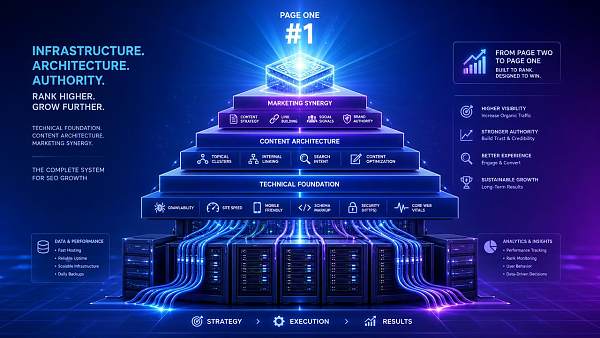
Page two is not a failure, but a stage of being “close to being seen.” Google has already recognized that the page has a certain level of relevance, but it is still not enough to enter a higher click-through range. At this point, if you only keep adding articles, the effect is often limited.
Common reasons include: average page experience, insufficient content depth, misaligned search intent, weak internal linking, low-quality backlinks, insufficient brand signals, and diluted authority of core pages. These factors together slow down the breakthrough pace of Google SEO ranking improvement.
For integrated website + marketing service businesses, it is even more important to look at the “entire chain.” If website building, content, conversion, and data tracking are disconnected from each other, then even if keywords gain exposure, it is still difficult for rankings to continue rising and remain steadily on the first page.
Is it that there is not enough content, or that the search intent is not aligned?
Many websites think that the more they publish, the easier it is to improve Google SEO rankings, but what truly determines rankings is “whether the page answers the user’s current question.” If users want to see solutions, but you only write definitions; if users want pricing references, but you only talk about advantages, the page will easily stay on page two.
To judge whether the intent is matched, you can first look at the first page of search results. Observe the types of content ranking at the top: are they tutorials, case studies, tool pages, service pages, or Q&A pages? Whatever the first page looks like, your page should be closer to that format.
Content optimization recommendations can start from three steps:
- Fill in the questions users truly care about, such as timelines, costs, effectiveness evaluation, and applicable scenarios.
- Add case studies, flowcharts, and comparison tables to make the information easier to understand.
- Build topic clusters around the main keyword to avoid multiple pages competing for the same keyword.
For example, when discussing professional judgment logic, some content improves persuasiveness through cross-industry cases. Structured topics like Financial Risks Existing in State-owned Enterprise Mergers and Acquisitions and Countermeasures reflect a high-information-density writing approach of “problem—risk—response,” which is worth learning from in SEO content organization.
How can technical foundations slow down Google SEO ranking improvement?
Quite a few pages have decent content, yet find it difficult to reach the first page because of a weak technical foundation. Google does not only look at the text, but also at whether the page can be crawled smoothly, whether it is mobile-friendly, whether the page is fast enough, and whether the structure is clear.
The following issues are the most common:
- Pages load slowly, and above-the-fold resources are too heavy.
- Duplicate titles, duplicate descriptions, and too many parameter pages.
- Internal linking is messy, and important pages are buried too deeply.
- Poor mobile layout, with interactions that hinder reading.
- Indexing abnormalities, where pages are submitted but not indexed, or fluctuate greatly after being indexed.
To achieve stable Google SEO ranking improvement, website building and marketing operations must be planned in sync. Yiyingbao Information Technology (Beijing) Co., Ltd. has long promoted the coordinated advancement of intelligent website building, SEO optimization, social media marketing, and advertising placement, precisely because simply revising copy cannot replace systematic governance at the technical level.
Among backlinks, brand keywords, and user behavior, which has a greater impact on making a breakthrough?
All three are important, but for pages “lingering on page two,” the most common shortcoming is insufficient trust. Google makes a comprehensive judgment on whether a website deserves to rank higher, and high-quality backlinks, growth in brand searches, and good clicks and dwell time all convey trustworthy signals.
If a page’s content is close to that of first-page competitors, yet it still cannot rank higher, it often means that “what you say is not wrong, but Google still does not trust you enough.” At this time, what you need to do is not buy a pile of links, but build a more authentic authority path.
Actionable directions include:
- Prioritize gaining natural mentions and content collaborations from industry-related websites.
- Increase brand keyword search volume through social media, case dissemination, and brand content.
- Optimize titles and descriptions to improve click willingness after impression.
- Strengthen page readability, extend dwell time, and reduce quick returns.
In global promotion, SEO cannot exist in isolation either. Social media, advertising, and content distribution can in turn strengthen brand awareness and provide more stable supporting signals for Google SEO ranking improvement.
How can you tell whether the optimization direction is wrong, or the cycle simply has not arrived yet?
This is the question many people care about most. If a keyword fluctuates between positions 11 and 20 for a long time, you should first distinguish whether it is “an opportunity to push a bit more” or “the direction itself is off track.” When making this judgment, do not look only at rankings, but at a set of combined indicators.
If multiple indicators are all improving, and only the ranking has not yet broken through, it usually means the cycle has not arrived yet, and you can continue strengthening. If there are only impressions, but no clicks or dwell time, it means the obstacle to Google SEO ranking improvement is not a timing issue, but a content and positioning issue.
If you want to move from page two to page one as quickly as possible, which things should you do first?
The biggest fear in breaking into page one is spreading effort evenly. Instead of changing the whole site at the same time, it is better to first concentrate resources on boosting the pages with the greatest potential. Prioritize keyword pages that already have impressions, rank between 11 and 20, and have clear commercial value.
It is recommended to execute in the following order:
- Update the page structure and add FAQs, case studies, pricing factors, and implementation processes.
- Strengthen internal linking, directing related articles and high-authority pages to the target page.
- Optimize titles and summaries to make search results more attractive for clicks.
- Check page speed, mobile experience, and indexing status.
- Coordinate with external promotion to gain industry-related citations.
If the content system needs to be reorganized, you may also refer to the “problem-deconstruction” expression style of content like Financial Risks Existing in State-owned Enterprise Mergers and Acquisitions and Countermeasures, breaking complex topics into content units that are searchable, understandable, and convertible.
Summary: for Google SEO ranking improvement, the core is not doing more, but doing it right
When Google SEO ranking improvement always stays on page two, it is usually not because the effort is insufficient, but because systematic coordination is lacking. Whether the content matches intent, whether the technical foundation is solid, and whether brand and backlinks have built trust will all determine whether you can truly move onto page one.
For integrated website + marketing service businesses, the most effective method is not patching a single point, but planning website building, content, SEO, social media, and advertising in a unified way. Only then can every optimization effort accumulate into a long-term growth asset.
If your page has been staying on page two for a long time, the most worthwhile thing to do now is not to keep blindly adding content, but to first complete a comprehensive diagnosis of technology, intent, and authority structure, and then make precise breakthroughs on key pages.
Related Articles
 What multilingual website services are available in Sanya? Which model is more suitable for local businesses going global?
 How to view the complete list of China SaaS companies in the top 100? Practical methods for screening website-building and marketing service providers
 There are so many used heavy-duty construction machines for foreign trade. How exactly should we acquire customers?

Related Products
 EasyCamp SaaS Smart Website Marketing SystemE-Yingbao SaaS Smart Website Marketing System: AI-powered, zero-code website building. Rapidly launch multilingual independent e-commerce sites in just 10 minutes. Global server acceleration and AI-driven SEO optimization empower businesses to efficiently connect with global markets. The seamless integration of technology and user-friendly operation makes building e-commerce sites incredibly simple.
 AI+SEM Intelligent Advertising Marketing SystemAI+SEM drives intelligent ad creation, empowering full-funnel precision advertising marketing. The system automatically generates weekly/monthly reports, AI recommends keywords and target countries, monitors core metrics in real-time with intelligent alerts, and enables one-click high-conversion ad solutions to help quickly acquire customers and improve ROI.
 AI+SEO Dual Engine Optimization ServiceEasyWin AI+SEO Dual Engine Optimization System leverages AI-powered keyword mining, content generation, and comprehensive technical optimization to help foreign trade enterprises acquire high-quality organic traffic, significantly improving search rankings and conversion rates.
 AI+SNS Social Media Marketing SystemYingbao AI+SNS Social Media Marketing System - Precision social capture for the social media era. Supports one-click content synchronization across major platforms like Facebook and LinkedIn. AI intelligently rewrites posts for enhanced relevance. 24/7 AI customer service and user profiling analysis empower businesses to efficiently expand into global markets.
 AI+SEO营销解决方案易营宝AI+SEO营销解决方案,通过AI批量写作、智能生成TDK、精准关键词扩词等功能,全面优化网站SEO效果,提升流量与转化率。助力企业构建高效智能网站新生态。
 AI+SEM Advertising Marketing SolutionsAI+SEM Advertising Marketing Solution leverages AI technology to deeply empower SEM ad campaigns. It automatically generates weekly/monthly reports using AI, presenting account data across multiple dimensions for comprehensive insights into campaign performance and trends. The system precisely recommends keywords and target countries, intelligently generates high-conversion ad copy, and enables one-click activation of efficient campaign plans to help businesses rapidly acquire customers. Simultaneously, it monitors core metrics in real time, intelligently identifies abnormal fluctuations, and issues timely alerts to ensure stable, high-return advertising results.
 Domain Name ServicesEasyWin provides professional domain name services, including intelligent queries, one-stop registration, brand protection, and full lifecycle management, helping businesses build a digital brand image.
 EasyOperate B2C Cross-Border E-Commerce Platform & Independent WebsiteEasyStore B2C Cross-border E-commerce Independent Store is an intelligent website building and cross-border e-commerce integrated solution independently developed by EasyStore Information Technology (Beijing) Co., Ltd. The system is specially designed for small and medium-sized as well as large export enterprises, integrating 'website building, operation, marketing, advertising, and conversion' into one, helping enterprises quickly establish cross-border e-commerce independent stores to achieve brand globalization and global sales growth.
The platform supports multiple languages, multiple currencies, and multi-channel marketing, with built-in AI intelligent translation and SEO optimization systems, suitable for mainstream markets such as Southeast Asia, Europe and America, Latin America, and the Middle East, assisting Chinese manufacturing enterprises in efficiently deploying international e-commerce strategies. SSL证书易营宝提供专业SSL安全证书服务,包括单域名和泛域名证书,确保网站数据传输加密、身份验证和完整性保护,助力企业建立安全可信的在线业务环境。









