









- What multilingual website services are available in Sanya? Which model is more suitable for local businesses going global?Jul 08, 2026View details
- How to view the complete list of China SaaS companies in the top 100? Practical methods for screening website-building and marketing service providersJul 08, 2026View details
- How to view pricing in the global traffic ecosystem? Cost comparison of search, social media, and content channel advertisingJul 06, 2026View details
- How to assess foreign trade website development trends?Looking at 2026 changes from multilingual,AI content to conversion pathsJul 04, 2026View details
- What are the new trends in multilingual marketing data analytics tools in 2026? Focus on attribution、automation and complianceJul 04, 2026View details
- Is Brand Globalization Marketing Consulting Worth Buying? At What Stage Should Companies Bring It InJul 01, 2026View details
- Cross-Border Marketing Trend Research: Why More and More Companies Are Starting to Deploy AI Search and GEO OptimizationJun 30, 2026View details
- Cross-Border Marketing Trend Research: How Independent Sites, AI Content, and Short-Video Customer Acquisition Are ChangingJun 30, 2026View details
How to Choose a More Worry-Free Domain Registration Service
When faced with a market with many service providers and large price differences, you cannot focus only on the low first-year price when choosing a domain registration service. A domain is the entry point to a website and also part of a brand asset, affecting website launch, search indexing, email communication, and subsequent marketing campaigns. If registration, renewal, DNS resolution, transfer, and security are handled improperly, it often leads to additional time costs and business risks. Therefore, when selecting a domain registration service, it is better to make a comprehensive judgment based on stability, management efficiency, after-sales support, and long-term investment.
What Makes a Domain Registration Service Worth Using Long Term
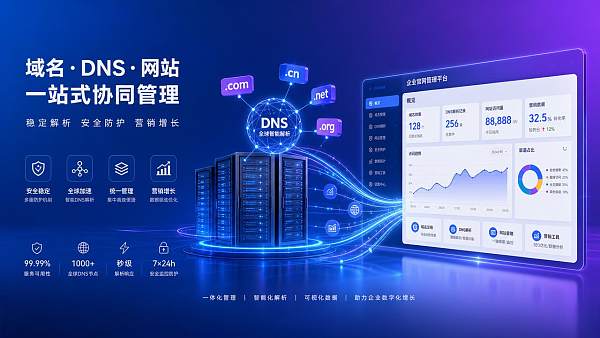
A domain registration service is not just about helping a business purchase a web address. A truly hassle-free service usually covers the full process, including registration search, real-name verification, DNS resolution, expiration reminders, bulk management, privacy protection, and transfer assistance.
For integrated website + marketing service scenarios, domains often need to work in sync with a corporate website, landing pages, ad tracking links, overseas sites, and business email. If a provider only offers basic registration but lacks follow-up coordination capabilities, it can easily lead to scattered management, repeated configuration, and slow troubleshooting during use.
To judge whether a domain registration service is worth using long term, you can first look at three points: whether the platform is stable, whether the operation is clear, and whether the service covers website development and marketing applications. Only by viewing the domain within the overall digital operations strategy can you make a more accurate choice.
How to Choose a Domain Registration Service: Start with These Core Indicators
Many people compare prices first when screening domain registration services for the first time. In fact, what truly determines the experience is the “total cost,” not the “first-year price.” The following indicators are more worthy of priority review.
1. Whether the renewal price is transparent
Some platforms offer very low registration prices, but renewals are obviously much higher, and incoming transfers may also be restricted. Domains usually need to be held long term. If the renewal rules are unclear, it will increase budget pressure later and may also affect website access because of forgotten renewals.
2. Whether the security capabilities are comprehensive
Focus on whether it supports registration lock, transfer lock, account two-factor authentication, DNS modification alerts, and abnormal login warnings. For marketing websites, once a domain is stolen or maliciously tampered with, the loss is not only traffic, but may also affect ad delivery and brand trust.
3. Whether DNS resolution is stable
The domain registration service and DNS resolution experience are often perceived together. If there are few DNS nodes and resolution takes effect slowly, website launch, campaign page publishing, and regional access experience will all be affected. Especially in multi-region marketing campaigns, DNS stability is extremely important.
4. Whether bulk management is supported
When a business holds multiple domains, bulk renewal, bulk DNS resolution, permission assignment, and expiration reminders become very important. Without a unified backend, subsequent maintenance will become fragmented, and the communication chain will also grow longer.
5. Whether after-sales response is timely
Domain issues often occur during website revamps, campaign launches, or certificate switching. If the provider responds slowly, it may delay the entire business chain. When choosing a domain registration service, ticket efficiency, human support, and issue escalation mechanisms should all be understood in advance.
How Domain Registration Service Needs Differ Across Business Scenarios
Not every business is suited to the same type of domain registration service. Different needs require different evaluation criteria.
- Official website development scenario: focus on filing assistance, stable DNS resolution, and convenient certificate configuration.
- Brand protection scenario: focus on similar domain registration, unified expiration management, and security locking.
- Marketing campaign scenario: focus on subdomain management, redirect rules, and access stability.
- Overseas promotion scenario: focus on support for multiple extensions, international DNS resolution capabilities, and cross-region access speed.
If the domain also needs to support SEO optimization, social media traffic generation, and ad landing pages later, whether the service provider can form integrated collaboration with website building, content publishing, and data tracking will directly affect execution efficiency. Integrated service companies like E-Marketing Bao Information Technology (Beijing) Co., Ltd., which have long specialized in intelligent website building, SEO optimization, social media marketing, and ad placement, are better able to connect domain registration services with subsequent marketing applications and reduce the management burden caused by repeatedly switching between multiple platforms.
What Pitfalls You May Encounter If You Only Look at Low Prices
Low prices are not necessarily unreliable, but if you focus only on low prices, the common risks mainly include the following categories.
- The first-year discount is large, but the second-year renewal rises significantly.
- Privacy protection and advanced DNS resolution features require additional charges.
- The transfer-out process is complicated, with many restrictions and high migration costs.
- The backend experience is poor, and bulk operations are inefficient.
- Customer service responds slowly, and issue resolution cycles are long.
From a management perspective, domain assets also require institutionalized management. This is somewhat similar to Problems and Countermeasures in Fixed Asset Management of Public Institutions, with the core focus being clear records, defined responsibilities, and traceable risks. Although domains are digital assets, they likewise require complete records of registration information, renewal times, usage allocation, and ownership of permissions.
How to Quickly Judge Whether a Domain Registration Service Is Hassle-Free
If you do not want to spend too much time making repeated comparisons, you can first use a checklist for preliminary screening. Seeing the key items clearly at one time is more effective than asking only about price.
If it also involves official website upgrades, SEO planning, and multi-site expansion, it is recommended to prioritize teams that can provide integrated support. Because once domain registration services become disconnected from website building, indexing optimization, and campaign pages, the problems that follow will multiply.
Common Questions: How to Handle Transfer, Renewal, and Management Permissions
Many problems do not arise on the day of registration, but during the subsequent maintenance stage. The following details are the easiest to overlook.
Can a domain be transferred at any time
Not all domains can be transferred immediately. Some extensions have registration time restrictions, and if the account information is incomplete or in a locked status, migration will also be affected. Before choosing a domain registration service, first confirm whether the transfer-out rules are clear.
Are manual renewal reminders enough
Relying only on manual records carries relatively high risk. A more reliable approach is dual management through platform automatic reminders plus internal records. If the number of domains is large, a unified person in charge and backup contact should also be set up.
How should management permissions be assigned
It is recommended that the registration account be uniformly owned by the enterprise and not be tied to an individual for the long term. DNS operations, renewal approval, and security settings can be authorized by level. This not only facilitates collaboration, but also avoids loss of control over assets caused by personnel changes. This approach is highly consistent with the responsibility boundary management emphasized in Problems and Countermeasures in Fixed Asset Management of Public Institutions.
Conclusion: How to Choose a More Reliable and More Effort-Saving Domain Registration Service
Overall, if you want a domain registration service to truly save worry and effort, the key is not whose homepage quote is the lowest, but who can provide a more transparent renewal mechanism, more stable DNS resolution capabilities, more secure asset protection, and smoother follow-up coordination.
If a business is also advancing official website development, SEO optimization, social media marketing, and ad placement at the same time, then domain registration services should ideally be incorporated into a unified digital marketing plan. This can not only reduce repeated configuration, but also improve website launch efficiency and marketing conversion performance.
As a next step, you can first organize the existing domain list, and then evaluate each item based on four dimensions: renewal price, security capabilities, DNS resolution stability, and service response. By managing domains as long-term digital assets, subsequent website operations and marketing planning will become more stable and more efficient.
Related Articles
 What multilingual website services are available in Sanya? Which model is more suitable for local businesses going global?
 How to view the complete list of China SaaS companies in the top 100? Practical methods for screening website-building and marketing service providers
 There are so many used heavy-duty construction machines for foreign trade. How exactly should we acquire customers?


Related Products
 EasyCamp SaaS Smart Website Marketing SystemE-Yingbao SaaS Smart Website Marketing System: AI-powered, zero-code website building. Rapidly launch multilingual independent e-commerce sites in just 10 minutes. Global server acceleration and AI-driven SEO optimization empower businesses to efficiently connect with global markets. The seamless integration of technology and user-friendly operation makes building e-commerce sites incredibly simple.
 AI+SEM Intelligent Advertising Marketing SystemAI+SEM drives intelligent ad creation, empowering full-funnel precision advertising marketing. The system automatically generates weekly/monthly reports, AI recommends keywords and target countries, monitors core metrics in real-time with intelligent alerts, and enables one-click high-conversion ad solutions to help quickly acquire customers and improve ROI.
 AI+SEO Dual Engine Optimization ServiceEasyWin AI+SEO Dual Engine Optimization System leverages AI-powered keyword mining, content generation, and comprehensive technical optimization to help foreign trade enterprises acquire high-quality organic traffic, significantly improving search rankings and conversion rates.
 AI+SNS Social Media Marketing SystemYingbao AI+SNS Social Media Marketing System - Precision social capture for the social media era. Supports one-click content synchronization across major platforms like Facebook and LinkedIn. AI intelligently rewrites posts for enhanced relevance. 24/7 AI customer service and user profiling analysis empower businesses to efficiently expand into global markets.
 AI+SEO营销解决方案易营宝AI+SEO营销解决方案,通过AI批量写作、智能生成TDK、精准关键词扩词等功能,全面优化网站SEO效果,提升流量与转化率。助力企业构建高效智能网站新生态。
 AI+SEM Advertising Marketing SolutionsAI+SEM Advertising Marketing Solution leverages AI technology to deeply empower SEM ad campaigns. It automatically generates weekly/monthly reports using AI, presenting account data across multiple dimensions for comprehensive insights into campaign performance and trends. The system precisely recommends keywords and target countries, intelligently generates high-conversion ad copy, and enables one-click activation of efficient campaign plans to help businesses rapidly acquire customers. Simultaneously, it monitors core metrics in real time, intelligently identifies abnormal fluctuations, and issues timely alerts to ensure stable, high-return advertising results.
 Domain Name ServicesEasyWin provides professional domain name services, including intelligent queries, one-stop registration, brand protection, and full lifecycle management, helping businesses build a digital brand image.
 EasyOperate B2C Cross-Border E-Commerce Platform & Independent WebsiteEasyStore B2C Cross-border E-commerce Independent Store is an intelligent website building and cross-border e-commerce integrated solution independently developed by EasyStore Information Technology (Beijing) Co., Ltd. The system is specially designed for small and medium-sized as well as large export enterprises, integrating 'website building, operation, marketing, advertising, and conversion' into one, helping enterprises quickly establish cross-border e-commerce independent stores to achieve brand globalization and global sales growth.
The platform supports multiple languages, multiple currencies, and multi-channel marketing, with built-in AI intelligent translation and SEO optimization systems, suitable for mainstream markets such as Southeast Asia, Europe and America, Latin America, and the Middle East, assisting Chinese manufacturing enterprises in efficiently deploying international e-commerce strategies. SSL证书易营宝提供专业SSL安全证书服务,包括单域名和泛域名证书,确保网站数据传输加密、身份验证和完整性保护,助力企业建立安全可信的在线业务环境。









