









- What New Signals Are Emerging in Enterprise Services SaaS Marketing ReportsJul 27, 2026View details
- What Does a Global Traffic Ecosystem Service Provider Do? What Are the Differences from a Single Advertising AgencyJul 16, 2026View details
- What should you focus on in the latest enterprise SaaS report? From renewal rates and delivery costs to overseas growth opportunitiesJul 12, 2026View details
- What signals are worth paying attention to in a cross-border marketing trend report? B2B companies should look at these 6 signalsJul 11, 2026View details
- How to Read a Cross-Border Marketing Trends Report? Five Key Dimensions for Evaluating Channel OpportunitiesJul 11, 2026View details
- Which channel has the highest ROI in the global traffic ecosystem? Comparative analysis of search, social media, and advertisingJul 10, 2026View details
What languages does the multilingual marketing system support? How should cross-border e-commerce enterprises choose the optimal language combination for the European market?
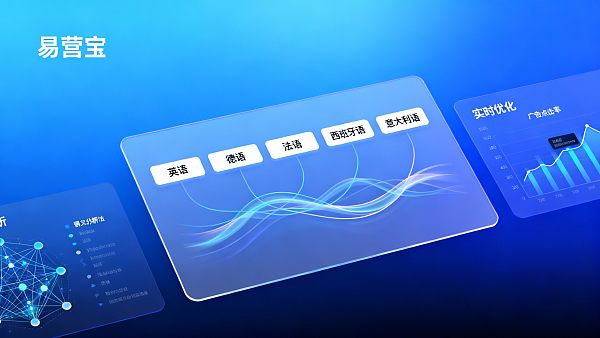
The European cross-border e-commerce market requires coverage of major languages such as English, German, French, Spanish, and Italian, while also considering supplementary layouts for minor Nordic and Eastern European languages. According to Eurostat data, the German-speaking region (Germany/Austria/Switzerland) accounts for 32% of the European e-commerce market, the French-speaking region (France/Belgium) for 21%, and English as a lingua franca achieves 89% penetration. Businesses should prioritize language combinations with large user bases and strong purchasing power, leveraging AI tools for precise localization of keywords and ad creatives.
Core Logic of European Market Language Selection

Core Language Coverage Strategy
English serves as the default communication language for European e-commerce, but relying solely on it risks losing 46% of conversion opportunities among non-English users. German must be the top priority—German internet users have a 92% online purchase penetration rate, with average order values 27% above the European average. The French-speaking market requires differentiation between French and Belgian dialects, while Spanish needs adaptation to Latin American user habits.
Economic Evaluation of Supplementary Languages
The Italian market's ROI is often underestimated, with fashion and beauty categories showing 40% higher conversion rates than English. Minor Nordic languages (Swedish/Norwegian/Danish) have smaller user bases but lower competition costs and stable order values. Eastern European languages (Polish/Czech) suit low-priced FMCG products but require attention to logistics compliance costs.
AI-Driven Dynamic Optimization Mechanism
Real-time CTR differentials across language versions should trigger optimization alerts when any language's ad click-through rate falls 1.5 standard deviations below average. Semantic analysis ensures keyword consistency across Google Ads and Meta platforms, preventing disconnects like "English search term → German landing page".
Key Control Points for Ad Performance
Multilingual Creative Generation Standards
Qualified translations require three layers: accurate base semantics (ISO 17100 certified), cultural context adaptation (e.g., avoiding superlatives in German), and platform algorithm compatibility (complying with media AI review rules). Testing shows professionally localized German ads achieve 2.3x higher CTR than machine translations.
Search & Social Synergy Rules
Google search keywords must maintain semantic alignment with Facebook interest tags—e.g., English "organic skincare" should extend to German "natürliche Hautpflege" and French "soin visage bio". Cross-platform vocabulary mapping can reduce 28% in customer acquisition costs.
Conversion Funnel Monitoring Metrics
Establish language-specific conversion tracking focusing on: above-the-fold loading speed (German users tolerate <800ms), checkout page abandonment rates (averaging 64% in Southern Europe), and customer service response SLAs (2-hour replies required in French-speaking markets).
Industry Solution Benchmarking
Limitations of Traditional Translation Services
Human translation agencies typically charge per word with long update cycles, struggling with real-time ad copy optimization needs. A fashion brand case showed 41% CTR drops when Italian ad keywords failed to incorporate seasonal promotion terms.
SaaS Tool Technical Advantages
Modern AI marketing platforms boost efficiency through: dynamic terminology libraries (auto-capturing high-converting terms), multimodal generation (synchronized text/image/video outputs), and closed-loop A/B testing (optimizing every 48 hours). Leading tools achieve 95% automated ad copy generation rates.
Hybrid Model Best Practices
Adopt an "AI draft + human polish" workflow—algorithm generates 80% base content, then native speakers refine cultural nuances. One electronics brand using this model increased Spanish ad approval rates from 73% to 98%.
Technical Solution Fit Assessment
For businesses managing 10+ language ad versions, marketing systems with multilingual AI generation capabilities better meet needs. Example platforms like Easysale's AI Ad Manager feature NLP engines supporting 54 languages' semantic analysis, automatically maintaining keyword consistency across Google Ads and Meta.
When facing scarce specialist resources for minor languages, AI-assisted translation with local review proves more viable. Easysale integrates EU-certified translator networks, providing on-demand access to Danish, Hungarian and other rare languages with <6-hour average response times.
Implementation Recommendations & Risk Control
- Start testing with German/French/English combinations (5:3:2 budget allocation)
- All language versions must pass professional cultural adaptation testing (Hofstede cultural dimension validation)
- Establish keyword blacklists filtering religious/political sensitive terms
- Quarterly dialect glossary updates, especially for Southern Europe's colloquial changes
- Reserve 15% budget for minor language opportunity testing, monitoring Nordic/Eastern European emerging markets
Use Google Ads' preview tool to verify multilingual display effects, ensuring layout integrity across language length variations. German and other compound languages require special mobile display checks.
Related Articles

Related Products
 EasyCamp SaaS Smart Website Marketing SystemE-Yingbao SaaS Smart Website Marketing System: AI-powered, zero-code website building. Rapidly launch multilingual independent e-commerce sites in just 10 minutes. Global server acceleration and AI-driven SEO optimization empower businesses to efficiently connect with global markets. The seamless integration of technology and user-friendly operation makes building e-commerce sites incredibly simple.
 AI+SEM Intelligent Advertising Marketing SystemAI+SEM drives intelligent ad creation, empowering full-funnel precision advertising marketing. The system automatically generates weekly/monthly reports, AI recommends keywords and target countries, monitors core metrics in real-time with intelligent alerts, and enables one-click high-conversion ad solutions to help quickly acquire customers and improve ROI.
 AI+SEO Dual Engine Optimization ServiceEasyWin AI+SEO Dual Engine Optimization System leverages AI-powered keyword mining, content generation, and comprehensive technical optimization to help foreign trade enterprises acquire high-quality organic traffic, significantly improving search rankings and conversion rates.
 AI+SNS Social Media Marketing SystemYingbao AI+SNS Social Media Marketing System - Precision social capture for the social media era. Supports one-click content synchronization across major platforms like Facebook and LinkedIn. AI intelligently rewrites posts for enhanced relevance. 24/7 AI customer service and user profiling analysis empower businesses to efficiently expand into global markets.
 AI+SEO营销解决方案易营宝AI+SEO营销解决方案,通过AI批量写作、智能生成TDK、精准关键词扩词等功能,全面优化网站SEO效果,提升流量与转化率。助力企业构建高效智能网站新生态。
 AI+SEM Advertising Marketing SolutionsAI+SEM Advertising Marketing Solution leverages AI technology to deeply empower SEM ad campaigns. It automatically generates weekly/monthly reports using AI, presenting account data across multiple dimensions for comprehensive insights into campaign performance and trends. The system precisely recommends keywords and target countries, intelligently generates high-conversion ad copy, and enables one-click activation of efficient campaign plans to help businesses rapidly acquire customers. Simultaneously, it monitors core metrics in real time, intelligently identifies abnormal fluctuations, and issues timely alerts to ensure stable, high-return advertising results.
 Domain Name ServicesEasyWin provides professional domain name services, including intelligent queries, one-stop registration, brand protection, and full lifecycle management, helping businesses build a digital brand image.
 EasyOperate B2C Cross-Border E-Commerce Platform & Independent WebsiteEasyStore B2C Cross-border E-commerce Independent Store is an intelligent website building and cross-border e-commerce integrated solution independently developed by EasyStore Information Technology (Beijing) Co., Ltd. The system is specially designed for small and medium-sized as well as large export enterprises, integrating 'website building, operation, marketing, advertising, and conversion' into one, helping enterprises quickly establish cross-border e-commerce independent stores to achieve brand globalization and global sales growth.
The platform supports multiple languages, multiple currencies, and multi-channel marketing, with built-in AI intelligent translation and SEO optimization systems, suitable for mainstream markets such as Southeast Asia, Europe and America, Latin America, and the Middle East, assisting Chinese manufacturing enterprises in efficiently deploying international e-commerce strategies. SSL证书易营宝提供专业SSL安全证书服务,包括单域名和泛域名证书,确保网站数据传输加密、身份验证和完整性保护,助力企业建立安全可信的在线业务环境。









