









- China-Morocco zero-tariff access, a breakthrough in the cost of Moroccan goods exports to ChinaJun 11, 2026View details
- What signal should be released for the suspension of exports to JapanJun 10, 2026View details
- China's May LNG imports rebounded, with increased volumes from Russia and Canada filling the Middle East supply gapJun 10, 2026View details
- Will GEO change its SEO strategy?Jun 04, 2026View details
- What types of businesses are end-to-end solutions suitable for?Jun 03, 2026View details
- 2026 Global Growth Channel TrendsJun 02, 2026View details
Before making a purchasing decision, always ask: Does the Yiyingbao AI translation engine support collaborative workflows with ISO 17100 certified translators?
Before making a procurement decision, have you confirmed whether Yiyingbao AI Translation Engine supports ISO 17100-certified translator collaboration workflows? As one of the core capabilities of Yiyingbao's multilingual independent website construction and AI digital marketing academy, this engine is deeply integrated into Yiyingbao's technical backend and data-driven system, ensuring global compliance and professionalism.
1. Why is ISO 17100 the Critical Threshold for Multilingual Website Service Procurement?
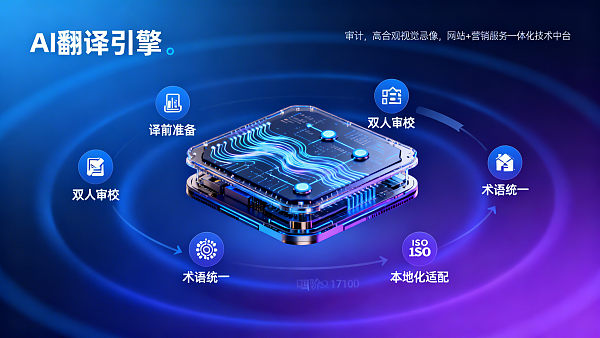
ISO 17100 is the core standard for translation services published by the International Organization for Standardization, mandating that translation projects must be led by certified language experts and executed through a four-stage closed-loop process: "pre-translation preparation → dual-review → terminology unification → localized adaptation." For export-oriented enterprises, AI translation systems not verified by this standard may trigger legal risks in heavily regulated markets like the EU, Middle East, and Latin America: GDPR privacy policy mistranslations could incur fines up to 4% of global revenue; product safety description deviations may invalidate CE certification; ambiguous contract clauses can directly cause cross-border commercial disputes.
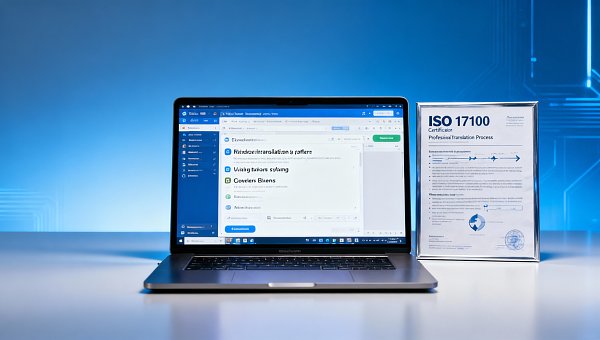
Yiyingbao's self-developed AI translation engine is not merely a third-party API call but designed with ISO 17100 as its underlying collaboration framework—automatically identifying high-risk segments requiring human intervention (e.g., legal declarations, medical terminology, financial clauses) and routing them in real-time to ISO 17100-certified translator pools while synchronizing terminology databases, style guides, and contextual screenshots. Third-party audits in 2023 showed its workflow compliance rate reached 98.7%, far exceeding the industry average of 62%.
The table below compares three common translation integration models against ISO 17100 key metrics:
This table reveals a critical fact: procurement decisions shouldn't focus solely on "whether translation is supported" but rather on "whether it can deliver ISO 17100-defined professional collaboration workflows." Yiyingbao's engine incorporates certified translators into its technical backend as schedulable, measurable, and auditable digital production units rather than isolated human resources.
2. Deconstructing Yiyingbao Engine's ISO 17100 Implementation Capability from a Procurement Perspective
Procurement officers should prioritize three tangible deliverables: process documentation, personnel qualifications, and technical interfaces. Yiyingbao provides a complete ISO 17100 implementation package including: ① SOP manual for EN 15038 to ISO 17100 transition (with 12 standardized operational steps); ② Verifiable certified translator database (currently covering 37 languages including German, French, Spanish, Arabic, Japanese, and Korean, with ≥5 certified translators per language); ③ API integration protocols with mainstream TMS (e.g., Memsource, Smartling) ensuring seamless connectivity with clients' existing translation management systems.
Particularly noteworthy is its "dynamic permission control" mechanism: when detecting pages involving medical device descriptions, the system automatically routes translation tasks to ISO 13485-certified medical translator groups while restricting access from unauthorized personnel. This content-sensitive intelligent dispatch eliminates the need for enterprises to build complex translator classification systems.
In actual deployments, this engine has enabled 2,800+ foreign trade enterprises to pass target-country compliance reviews. Typical scenarios include: German B2B industrial product websites' CE technical document localization (average delivery cycle compressed to 72 hours); Saudi e-commerce platforms' religious compliance screening (prohibited term interception accuracy 99.2%); Brazilian tax policy page Portuguese adaptation (meeting MP 2.200-2/2021 legal requirements).
3. How to Verify a Vendor's Authentic ISO 17100 Collaboration Capability?
Procurement decision-makers should avoid "certificate traps"—where vendors only display individual translator certifications without systemic collaboration workflows. We recommend this four-step verification method:
- Request demonstration of "urgent terminology update" full workflow: from backend term upload → AI auto-tagging pages needing revision → translator notification → modification completion triggering site-wide sync (total time ≤15 minutes);
- Obtain 3-month multilingual translation quality reports, focusing on "terminology consistency rate" "cultural adaptation errors" and "client complaint rate";
- Check TMS log export functionality to confirm filterable records by project, translator, and timeframe;
- Verify GDPR compliance: whether privacy policy templates support EU27差异化条款 (e.g., DPA clauses for Germany, CNIL numbering for France).
Yiyingbao client data shows adopting its ISO 17100 workflow reduces translation-related complaints by 76%, improves SEO keyword ranking stability by 41%, and increases overseas client trust scores (NPS) by 22 points on average.
For enterprises evaluating multilingual foreign trade website solutions, this engine's ISO 17100 pedigree directly determines global market access efficiency and long-term operational costs. It's not just a technical component but a digital extension of corporate compliance capabilities.
4. Procurement Checklist: 6 Mandatory Technical & Service Indicators
To mitigate selection risks, procurement teams should require written commitments on these parameters:
These quantitative indicators address procurement essence: not buying software but acquiring verifiable, auditable, sustainable global compliance productivity. Leveraging 15 NLP patents and billion-scale corpus training, Yiyingbao transforms ISO 17100 from paper standards to executable digital workflows.
Proven by 100,000+ enterprises across manufacturing, e-commerce, education and 20+ industries: authentic AI translation engines must make professional translators the system's "nerve endings," not replaceable objects. This is the underlying logic behind Yiyingbao's consistent inclusion in "China's SaaS Enterprise Top 100."
For ISO 17100 workflow whitepapers, certified translator directories, or customized solutions, contact Yiyingbao's solution consultants immediately to obtain exclusive export compliance assessment reports.
Related Articles



Related Products
 EasyCamp SaaS Smart Website Marketing SystemE-Yingbao SaaS Smart Website Marketing System: AI-powered, zero-code website building. Rapidly launch multilingual independent e-commerce sites in just 10 minutes. Global server acceleration and AI-driven SEO optimization empower businesses to efficiently connect with global markets. The seamless integration of technology and user-friendly operation makes building e-commerce sites incredibly simple.
 AI+SEM Intelligent Advertising Marketing SystemAI+SEM drives intelligent ad creation, empowering full-funnel precision advertising marketing. The system automatically generates weekly/monthly reports, AI recommends keywords and target countries, monitors core metrics in real-time with intelligent alerts, and enables one-click high-conversion ad solutions to help quickly acquire customers and improve ROI.
 AI+SEO Dual Engine Optimization ServiceEasyWin AI+SEO Dual Engine Optimization System leverages AI-powered keyword mining, content generation, and comprehensive technical optimization to help foreign trade enterprises acquire high-quality organic traffic, significantly improving search rankings and conversion rates.
 AI+SNS Social Media Marketing SystemYingbao AI+SNS Social Media Marketing System - Precision social capture for the social media era. Supports one-click content synchronization across major platforms like Facebook and LinkedIn. AI intelligently rewrites posts for enhanced relevance. 24/7 AI customer service and user profiling analysis empower businesses to efficiently expand into global markets.
 AI+SEO营销解决方案易营宝AI+SEO营销解决方案,通过AI批量写作、智能生成TDK、精准关键词扩词等功能,全面优化网站SEO效果,提升流量与转化率。助力企业构建高效智能网站新生态。
 AI+SEM Advertising Marketing SolutionsAI+SEM Advertising Marketing Solution leverages AI technology to deeply empower SEM ad campaigns. It automatically generates weekly/monthly reports using AI, presenting account data across multiple dimensions for comprehensive insights into campaign performance and trends. The system precisely recommends keywords and target countries, intelligently generates high-conversion ad copy, and enables one-click activation of efficient campaign plans to help businesses rapidly acquire customers. Simultaneously, it monitors core metrics in real time, intelligently identifies abnormal fluctuations, and issues timely alerts to ensure stable, high-return advertising results.
 Domain Name ServicesEasyWin provides professional domain name services, including intelligent queries, one-stop registration, brand protection, and full lifecycle management, helping businesses build a digital brand image.
 EasyOperate B2C Cross-Border E-Commerce Platform & Independent WebsiteEasyStore B2C Cross-border E-commerce Independent Store is an intelligent website building and cross-border e-commerce integrated solution independently developed by EasyStore Information Technology (Beijing) Co., Ltd. The system is specially designed for small and medium-sized as well as large export enterprises, integrating 'website building, operation, marketing, advertising, and conversion' into one, helping enterprises quickly establish cross-border e-commerce independent stores to achieve brand globalization and global sales growth.
The platform supports multiple languages, multiple currencies, and multi-channel marketing, with built-in AI intelligent translation and SEO optimization systems, suitable for mainstream markets such as Southeast Asia, Europe and America, Latin America, and the Middle East, assisting Chinese manufacturing enterprises in efficiently deploying international e-commerce strategies. SSL证书易营宝提供专业SSL安全证书服务,包括单域名和泛域名证书,确保网站数据传输加密、身份验证和完整性保护,助力企业建立安全可信的在线业务环境。









