









- What Does a Global Traffic Ecosystem Service Provider Do? What Are the Differences from a Single Advertising AgencyJul 16, 2026View details
- What should you focus on in the latest enterprise SaaS report? From renewal rates and delivery costs to overseas growth opportunitiesJul 12, 2026View details
- What signals are worth paying attention to in a cross-border marketing trend report? B2B companies should look at these 6 signalsJul 11, 2026View details
- How to Read a Cross-Border Marketing Trends Report? Five Key Dimensions for Evaluating Channel OpportunitiesJul 11, 2026View details
- Which channel has the highest ROI in the global traffic ecosystem? Comparative analysis of search, social media, and advertisingJul 10, 2026View details
- What multilingual website services are available in Sanya? Which model is more suitable for local businesses going global?Jul 08, 2026View details
- How to view the complete list of China SaaS companies in the top 100? Practical methods for screening website-building and marketing service providersJul 08, 2026View details
- How to view pricing in the global traffic ecosystem? Cost comparison of search, social media, and content channel advertisingJul 06, 2026View details
What Are the Common Misconceptions About Meta Advertising Tips
Many companies, when researching Meta ad placement techniques, often overlook audience targeting, creative testing, and landing page conversion, resulting in wasted budget. This article will combine social media marketing strategies with website SEO optimization solutions to analyze common misconceptions and optimization directions.
If you search for “What are the common misconceptions in Meta ad placement techniques,” the core purpose is usually not to understand the platform’s basic concepts, but to figure out: why money is being spent on ads without generating inquiries, orders, or high-quality leads; which actions appear correct but are actually continuously driving up customer acquisition costs; and how companies should judge whether their current placement strategy is truly effective. For researchers, technical evaluators, and business decision-makers, the biggest concern is often not “whether to run ads,” but “how to avoid detours and allocate the budget to steps closer to conversion.”
From a practical business perspective, common problems in Meta ad placement usually do not lie only in the ad platform backend, but across the entire conversion chain: audience settings that are too broad or too narrow, lack of a creative testing mechanism, unreasonable conversion event settings, weak landing page alignment, incomplete website data tracking, and focusing only on impressions and clicks while ignoring actual deal quality. In other words, if a company only studies placement techniques but does not view social media marketing together with website SEO, page experience, and data attribution, ad performance is often difficult to stabilize.
1. The most common misconception: treating Meta ads as a channel where “results will come as long as you open an account and spend money”

When many companies run Meta ads for the first time, they assume that because the platform has massive traffic and a mature algorithm, customers can be acquired quickly as long as the budget is sufficient. But in reality, Meta is more like an amplifier: the clearer your targeting, content, page, and data feedback are, the easier it is for the system to help you find high-value users; conversely, mistakes will also be quickly amplified.
This misconception is common in two scenarios: first, companies hope to generate orders immediately in the short term, so they skip early-stage testing and directly invest a large budget; second, the ad team’s KPI is focused only on clicks, impressions, or follower growth, without including qualified leads, conversion rate, and repurchase potential in the evaluation. The result is that surface-level data looks good, but the actual business return is unsatisfactory.
For business decision-makers, judging whether Meta ads are worth continuing should not rely only on surface metrics, but should focus on the following questions:
- Whether the users brought in by the ads match the target customer profile;
- Whether the proportion of qualified leads is stable in addition to inquiry volume;
- Whether the landing page conversion rate reaches a reasonable industry level;
- Whether the customer acquisition cost is within an acceptable range;
- Whether ad data and website behavior data can validate each other.
Only by viewing Meta ad placement techniques from the perspective of business results can companies avoid the common dilemma of “spending a lot, but during review not knowing where the problem lies.”
2. Misconceptions about audience targeting: it is not the broader the better, nor the narrower the more accurate
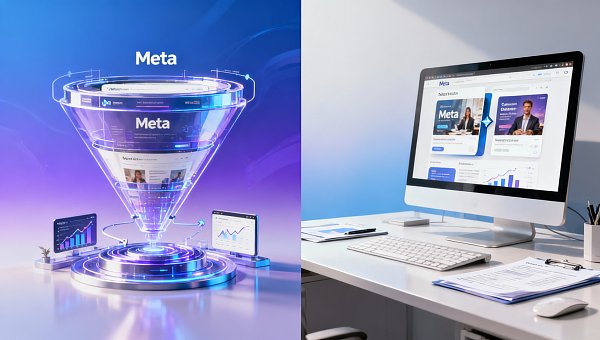
Audience targeting is one of the most easily misunderstood parts of Meta ad placement. Many companies go to two extremes: either the targeting is extremely broad, hoping the algorithm will freely find the right people; or they stack a large number of interest, behavior, and job-title tags, believing that the more precise the targeting, the easier the conversion.
In fact, both approaches can lead to problems.
When targeting is too broad, ads are likely to attract a large amount of low-intent traffic. Especially for B2B businesses with higher order values and longer decision cycles, click data may look decent on the surface, but the final inquiry quality is relatively low, and sales follow-up efficiency will also decline.
When targeting is too narrow, the audience pool becomes too small, the system’s learning space is compressed, leading to higher placement costs, faster frequency increases, more obvious creative fatigue, and ultimately affecting overall conversion.
A more reasonable approach is to design the audience structure around the “business objective”:
- Cold-start stage: build a relatively clear but not overly narrowed audience package to test market response;
- Optimization stage: combine engaged users, website visitors, add-to-cart users, or form submitters for remarketing;
- Scaling stage: expand lookalike audiences based on high-quality converting users, rather than blindly broadening targeting.
Here, it is especially important to remind technical evaluators and execution teams that audience strategy cannot be separated from website data. For example, among organic search visitors brought by SEO, which pages have longer dwell time and which keyword-matched users are more likely to convert—this information can all in turn guide the audience and content testing direction of Meta ads. If social media marketing and website SEO optimization solutions are disconnected from each other, it is difficult for companies to form a truly effective growth loop.
3. Misconceptions about creative testing: only changing images and copy, without changing the core communication logic
Many teams know they should do A/B testing, but in actual execution they only simply change image colors, headline wording, or button copy. Although this kind of “formal testing” has some value, it is often not enough to solve conversion problems.
Truly effective creative testing should prioritize testing the following three levels:
- Whether the value proposition angle is correct: Are you emphasizing price, efficiency, results, case studies, service responsiveness, or localized support? Different audiences care about completely different things.
- Whether the content structure is clear: Can the ad clearly explain within 3 seconds “who you are, what problem you can solve, and why it is worth clicking”?
- Whether trust elements are sufficient: Does it show real case studies, data results, service processes, qualification endorsements, and customer reviews?
If a company is targeting overseas markets, Meta ad creatives must also pay special attention to localized expression. Poor ad performance is not necessarily always caused by problems in placement techniques, but often because the creative is still using the narrative logic of the Chinese market, causing target users not to understand, trust, or resonate with it.
In this regard, companies can also learn from the methodology of professional content planning. For example, some management and operations content is more easily accepted by target readers because it does not talk abstractly about concepts, but analyzes real problems. Topics such as Application and Optimization of Management Accounting in Financial Management of Public Institutions have reading value essentially because they capture the content logic of “application scenario + optimization path.” The same is true for Meta ad creatives: users are more willing to respond to messaging that directly addresses problems and gives clear benefits.
4. Misconceptions about conversion tracking: only looking at platform data, not real business data
When reviewing ad performance, many companies rely heavily on Meta backend data, such as click-through rate, number of conversions, and cost per conversion. But if website analytics tools, CRM lead records, sales feedback, and transaction data are not integrated, these numbers can easily “look good but be unusable in practice.”
Common issues include:
- Incomplete pixel or event tracking, causing the system to learn in the wrong direction;
- Mistaking low-threshold actions for core conversion goals, such as recording only page views but not valid form submissions;
- Failing to distinguish between “lead volume” and “high-quality lead volume”;
- A disconnect between ad data and sales team feedback, making it impossible to determine which ads truly generated deal opportunities.
For business decision-makers, what is truly worth paying attention to is the full-chain metric from “impression to deal,” rather than isolated local data at the ad level. It is recommended to establish at least the following evaluation framework:
- Top-of-funnel metrics: impressions, click-through rate, cost per click;
- Mid-funnel metrics: page visit quality, dwell time, bounce rate, form submission rate;
- Bottom-of-funnel metrics: qualified lead rate, sales follow-up rate, close rate, payment collection cycle;
- Comprehensive metrics: customer acquisition cost per customer, ROI, lifetime value.
Only by placing Meta ads within the full marketing funnel can companies find the true levers for optimization.
5. Misconceptions about landing page alignment: the ads work hard, but the page is “driving customers away”
This is the part most often overlooked, yet it most directly affects ROI. Many teams put a great deal of effort into ad creatives and audience targeting, but after users click, they are sent to a page that loads slowly, has messy information, lacks trust, and has a complicated conversion path.
Poor landing page alignment often appears in the following ways:
- The ad communicates one selling point, but the page does not correspondingly explain it right away;
- The page content is broad and comprehensive, but lacks clear action guidance;
- Poor mobile experience, overly long forms, and slow loading speed;
- Lack of trust-building information such as case studies, qualifications, process explanations, and FAQs;
- SEO pages and ad landing pages are completely separated, making content assets impossible to reuse.
For the “website + marketing services integration” industry, Meta ad performance often depends on whether the website infrastructure is solid enough. A well-designed landing page should not only receive ad traffic, but also take into account search engine readability, page structure clarity, content relevance, and the ability for ongoing optimization later. In other words, truly efficient placement is not single-point optimization, but coordinated optimization across ads, content, website, and data systems.
If a company is making a long-term plan for overseas customer acquisition, it is recommended to first check the following issues:
- Whether the landing page is designed with different content for different audience stages;
- Whether the page can quickly explain the value on the first screen;
- Whether the conversion buttons are clear enough;
- Whether there are SEO-friendly content modules to accumulate assets for subsequent organic traffic;
- Whether website data can in turn help continuously optimize ads.
6. Misconceptions about budget and optimization: blindly cutting costs and instead losing growth opportunities
In Meta ad placement, many companies treat “lowering cost per click” and “lowering cost per conversion” as their core goals. This way of thinking is not necessarily wrong, but if low cost is overemphasized, it can easily sacrifice lead quality and later conversion rates.
For example, some ads may appear to have very low conversion costs, but the users they attract do not actually have purchase intent; while some ads with slightly higher costs, although not outstanding in front-end data, can bring a higher proportion of qualified opportunities. From an operational perspective, the latter is usually more worth investing in.
Therefore, the correct optimization approach is not simply to compress the budget, but to differentiate according to the business stage:
- Testing stage: focus on finding the direction, and do not draw conclusions too early;
- Stabilization stage: focus on optimizing the structure and eliminating low-quality ad sets;
- Scaling stage: expand high-quality audience coverage at a controllable cost, rather than copying low-price traffic;
- Review stage: make a joint judgment from four dimensions—content, page, data, and sales feedback—instead of only staring at the ad backend.
When building cross-channel content, some companies also refer to the structural design logic of different topic content in order to optimize their own expression and information organization. From the perspective of content readability and problem orientation, titles such as Application and Optimization of Management Accounting in Financial Management of Public Institutions are enlightening because high-quality content is often not broad and vague, but developed around “problem—application—optimization.” When companies design Meta ad solutions, landing page structures, and marketing pages, they should also adopt a similar approach, enabling users to quickly understand the value, path, and results.
7. How companies should judge whether their Meta placement is moving in the right direction
If you are evaluating whether your current placement strategy needs adjustment, you can use the following questions for a quick self-check:
- Whether the ad objective is aligned with the real business objective, rather than just surface-level metrics that look good?
- Whether a clear audience testing logic has been established, rather than relying on experience for arbitrary targeting?
- Whether creative testing covers value proposition, structure, and trust expression, rather than only changing images?
- Whether the landing page truly fulfills the ad promise and improves conversion efficiency?
- Whether website SEO data, ad data, and sales data can cross-validate each other?
- Whether during review it is possible to clearly know whether the issue lies in traffic, content, page, or lead screening?
If the answers to several of these questions are negative, then there is a high probability that the company’s current Meta ad placement still has obvious room for optimization.
Conclusion: The real difficulty of Meta ad placement lies not in operational details, but in system coordination
Meta ad placement techniques are certainly important, but for most companies, poor results are not caused by losing on a certain button or parameter setting, but by losing in the overall strategy: unclear audiences, inaccurate creatives, incomplete tracking, weak pages, and shallow review. Especially in today’s competitive environment, relying on the ad platform alone is already very difficult to sustain continuous growth. Companies need even more to view social media advertising, website development, SEO optimization, data analysis, and sales conversion as part of the same growth system.
For companies hoping to improve customer acquisition efficiency and reduce trial-and-error costs, the right direction is not to keep piling on budget, but to first identify misconceptions and then optimize the chain. Only when Meta ads are no longer an isolated action but become one link in a company’s digital marketing system can the budget more likely be converted into long-term, stable growth results.
Related Articles
 Attention! Builders' must-see: Yibingbao AI components updated, design efficiency directly doubled!
 China's foreign trade sees a turnaround: imports surge by 22%! Foreign trade professionals should quickly take note of the new trends in the second half of the year
 What Does a Global Traffic Ecosystem Service Provider Do? What Are the Differences from a Single Advertising Agency



Related Products
 EasyCamp SaaS Smart Website Marketing SystemE-Yingbao SaaS Smart Website Marketing System: AI-powered, zero-code website building. Rapidly launch multilingual independent e-commerce sites in just 10 minutes. Global server acceleration and AI-driven SEO optimization empower businesses to efficiently connect with global markets. The seamless integration of technology and user-friendly operation makes building e-commerce sites incredibly simple.
 AI+SEM Intelligent Advertising Marketing SystemAI+SEM drives intelligent ad creation, empowering full-funnel precision advertising marketing. The system automatically generates weekly/monthly reports, AI recommends keywords and target countries, monitors core metrics in real-time with intelligent alerts, and enables one-click high-conversion ad solutions to help quickly acquire customers and improve ROI.
 AI+SEO Dual Engine Optimization ServiceEasyWin AI+SEO Dual Engine Optimization System leverages AI-powered keyword mining, content generation, and comprehensive technical optimization to help foreign trade enterprises acquire high-quality organic traffic, significantly improving search rankings and conversion rates.
 AI+SNS Social Media Marketing SystemYingbao AI+SNS Social Media Marketing System - Precision social capture for the social media era. Supports one-click content synchronization across major platforms like Facebook and LinkedIn. AI intelligently rewrites posts for enhanced relevance. 24/7 AI customer service and user profiling analysis empower businesses to efficiently expand into global markets.
 AI+SEO营销解决方案易营宝AI+SEO营销解决方案,通过AI批量写作、智能生成TDK、精准关键词扩词等功能,全面优化网站SEO效果,提升流量与转化率。助力企业构建高效智能网站新生态。
 AI+SEM Advertising Marketing SolutionsAI+SEM Advertising Marketing Solution leverages AI technology to deeply empower SEM ad campaigns. It automatically generates weekly/monthly reports using AI, presenting account data across multiple dimensions for comprehensive insights into campaign performance and trends. The system precisely recommends keywords and target countries, intelligently generates high-conversion ad copy, and enables one-click activation of efficient campaign plans to help businesses rapidly acquire customers. Simultaneously, it monitors core metrics in real time, intelligently identifies abnormal fluctuations, and issues timely alerts to ensure stable, high-return advertising results.
 Domain Name ServicesEasyWin provides professional domain name services, including intelligent queries, one-stop registration, brand protection, and full lifecycle management, helping businesses build a digital brand image.
 EasyOperate B2C Cross-Border E-Commerce Platform & Independent WebsiteEasyStore B2C Cross-border E-commerce Independent Store is an intelligent website building and cross-border e-commerce integrated solution independently developed by EasyStore Information Technology (Beijing) Co., Ltd. The system is specially designed for small and medium-sized as well as large export enterprises, integrating 'website building, operation, marketing, advertising, and conversion' into one, helping enterprises quickly establish cross-border e-commerce independent stores to achieve brand globalization and global sales growth.
The platform supports multiple languages, multiple currencies, and multi-channel marketing, with built-in AI intelligent translation and SEO optimization systems, suitable for mainstream markets such as Southeast Asia, Europe and America, Latin America, and the Middle East, assisting Chinese manufacturing enterprises in efficiently deploying international e-commerce strategies. SSL证书易营宝提供专业SSL安全证书服务,包括单域名和泛域名证书,确保网站数据传输加密、身份验证和完整性保护,助力企业建立安全可信的在线业务环境。









