









- Which channel has the highest ROI in the global traffic ecosystem? Comparative analysis of search, social media, and advertisingJul 10, 2026View details
- What multilingual website services are available in Sanya? Which model is more suitable for local businesses going global?Jul 08, 2026View details
- How to view the complete list of China SaaS companies in the top 100? Practical methods for screening website-building and marketing service providersJul 08, 2026View details
- How to view pricing in the global traffic ecosystem? Cost comparison of search, social media, and content channel advertisingJul 06, 2026View details
- How to assess foreign trade website development trends?Looking at 2026 changes from multilingual,AI content to conversion pathsJul 04, 2026View details
- What are the new trends in multilingual marketing data analytics tools in 2026? Focus on attribution、automation and complianceJul 04, 2026View details
Can AI marketing replace human creators of multilingual content? Is it suitable for bulk pages or brand content?
Can AI marketing replace human creators of multilingual content? For business decision-makers, the core answer isn't a simple "yes" or "no," but rather depends on the content type, business objectives, and conversion requirements. For batch pages, standardized product information, and basic SEO landing pages, AI can significantly improve efficiency; however, for brand positioning, value expression, building user trust, and high-converting content, human involvement remains an irreplaceable key element.
If businesses treat AI as a tool to "completely replace human labor," they often encounter two problems with multilingual content: first, while the content output seems plentiful, it lacks genuine readability for the local market; second, the pages are indexed, but there are no inquiries, conversions, or brand building. The truly effective approach is to use AI where it excels and allocate human resources only where the upper limit of effectiveness is determined.
What business decision-makers really want to ask is not whether it's a substitute, but whether it's worth using.
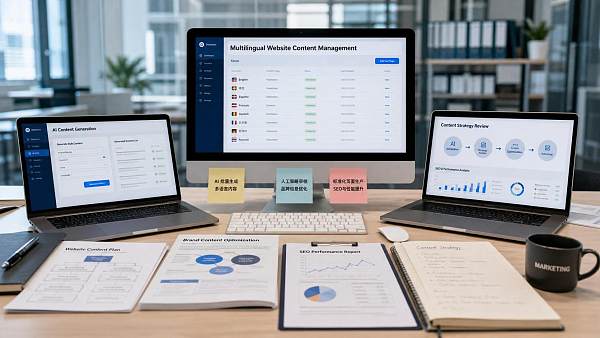
When businesses search for "Can AI marketing replace human creators of multilingual content?", their real intention is usually not technological curiosity, but rather business judgment: can multilingual content be launched faster and acquire traffic at a lower cost, without harming the brand and conversion results?
For companies operating in overseas markets, multilingual content is not simply a translation task, but a shared vehicle for traffic generation, customer awareness, and sales leads. Decision-makers are often most concerned with return on investment, implementation efficiency, long-term risks, and how to allocate human and AI resources to different types of pages.
From this perspective, the value of AI marketing is clear. It's not a "replacement" that handles all content creation alone, but rather an "efficiency engine" that helps businesses expand their content supply capabilities, shorten launch cycles, and reduce basic production costs. However, whether it can truly drive growth still depends on content strategy and human oversight mechanisms.
Which multilingual content is suitable for batch generation by AI?
If a company has a large number of standardized pages, AI is highly valuable in this area. Examples include product category pages, product detail pages, FAQ pages, regional landing pages, case study template pages, basic blog pages, and structured information content tailored to different language versions—all of these are content types suitable for batch AI assistance.
These types of pages share several common characteristics: relatively stable information structure, relatively fixed expression logic, clear keyword coverage requirements, and their primary goals are usually to improve page size, crawling efficiency, and search engine visibility. In this scenario, AI can quickly complete initial draft generation, keyword expansion, semantic rewriting, and multilingual version deployment.
For foreign trade enterprises, manufacturing plants, cross-border e-commerce platforms, and multilingual websites, this efficiency improvement is very practical. In the past, creating a single page required multiple steps, including planning, writing, translation, review, and uploading. Now, with the help of AI website building and AI content systems, businesses can complete the creation of pages in batches much faster, laying the foundation for Google SEO and multi-regional market coverage.
However, there's a crucial premise: batch production doesn't equate to haphazard production. Even standardized pages generated by AI must be structurally designed around product characteristics, target country search habits, and page indexing logic. Truly effective batch pages represent "organized, large-scale production," not simply translating and mass-producing pages.
Why Brand Content Still Relies on Human Creators
The reason why brand content is difficult for AI to completely replace is not because AI can't write, but because brand communication is not just about outputting sentences, but about conveying stance, values, differentiation, and credibility. This content often directly influences whether customers are willing to inquire further, compare, or even place an order.
For example, the copywriting for a company's homepage, brand story, core strengths page, industry solutions, bidding-level case studies, advertising landing pages, social media advocacy content, and high-conversion content targeting key markets—these are not simply about "being fluent." They require a precise understanding of customer psychology, market context, and business communication.
AI can generate content that looks correct, but it can easily lead to problems such as homogenized brand language, blurred selling points, and insufficient emotional impact. Especially in multilingual scenarios, literal translation or generalized expressions often result in content that is "grammatically correct but doesn't feel right," which directly undermines the company's professionalism and trustworthiness in the eyes of overseas customers.
For business decision-makers, the real concern isn't the slowness of AI-generated content, but rather the overly uniformity of the brand content it produces, resulting in a lack of brand memorability in the market. Once brand content loses its distinctiveness, subsequent advertising, SEO traffic, and social media conversion rates will all suffer.
To determine whether content should be handled by AI or human, consider these four criteria.
First, consider the page's commercial value. If the page serves a high-value conversion purpose, such as a core inquiry page, brand homepage, or landing page for key countries, it's recommended to have it led by humans with AI assistance. This is because these types of pages prioritize persuasiveness, trustworthiness, and conversion performance over quantity.
Second, consider the level of standardization of the content. If the page information comes from product parameters, fixed Q&As, and repetitive business introductions, and the goal is to expand indexing and cover long-tail keywords, then AI is well-suited for involvement. The higher the degree of standardization, the more effectively AI can leverage its efficiency advantages.
Third, consider whether it involves a localized context. Multilingual content is not simply replacing Chinese with a foreign language; it must conform to the reading habits, industry terminology, and decision-making logic of local customers. Any content that requires clear localization should not rely solely on machine generation; it must be manually verified by someone familiar with the market.
Fourth, consider the cost of error. If content errors could lead to brand misunderstanding, legal risks, incorrect industry terminology, or customer loss, then the proportion of human intervention must be increased. This is especially true in industries such as healthcare, industrial equipment, compliance services, and high-value B2B, where content accuracy directly impacts transaction quality.
Three common mistakes businesses make
The first misconception is treating AI as a low-cost replacement for writers, rather than as part of a content system. This usually results in rapid content production, but without keyword planning, page hierarchy, or conversion design; ultimately, it just creates many more pages without generating effective traffic assets.
The second misconception is to directly copy the same content to all language markets. Customers in different regions have different priorities. The European and American markets value the credibility of the solution and professional expression, while the Southeast Asian market may place more emphasis on price, delivery, and service responsiveness. The Middle East and Russian-speaking regions also have significantly different reading contexts.
The third misconception is focusing solely on content creation costs while ignoring subsequent customer acquisition costs. If AI-generated pages fail to generate effective inquiries, or if the brand content lacks persuasiveness leading to low ad conversion rates, the initial savings on writing will ultimately be recouped through higher costs in SEO, ad placement, and sales.
A more suitable approach for businesses is to combine AI productivity with human strategic capabilities.
For most companies, the most reasonable approach is not to choose between AI and human, but rather to establish a tiered content mechanism. Let AI handle the large-scale, standardized, and repetitive tasks, while let humans handle strategy, review, brand expression, and optimization of high-value pages. This is the only way to balance efficiency and quality.
A mature multilingual content system typically consists of three layers. The first layer is AI-generated basic pages used for product coverage, keyword expansion, and multilingual website construction. The second layer involves human editing and optimization of key pages to ensure the content is readable, credible, and relevant to the local market. The third layer is the core content strategy led by the brand and growth teams.
This model is particularly suitable for companies that are building overseas independent websites, multilingual websites, Google SEO, and advertising landing page layouts. By using AI to improve launch speed and human intervention to improve conversion quality, companies are not forced to make a choice between "scale" and "brand," but can instead build a more sustainable content growth system.
From the perspective of growth results, AI is suitable for content engines, while human intervention determines the upper limit of brand development.
From a management perspective, the greatest significance of AI marketing is that it frees content production capabilities from the constraints of purely manual speed, helping businesses enter more markets faster, cover more keywords, and support more page scenarios. This is indeed a significant opportunity for companies aiming for global growth.
However, businesses also need to recognize the limitations. AI excels at solving problems of "availability" and "speed," while humans are better at solving problems of "accuracy," "relevance," and "conversion potential." When multilingual content involves brand awareness and high-value transactions, human intervention remains crucial in determining the final outcome.
So, can AI marketing replace human creators of multilingual content? The answer is: it can significantly replace repetitive tasks in mass page creation and basic content production; however, it cannot simply replace brand content and key conversion content, and can only serve as a supplement. Truly mature companies do not treat AI as a universal writer, but rather integrate it into their content growth system, making it part of their global marketing efficiency.
For companies looking to balance intelligent website building, multilingual website development, Google SEO optimization, advertising, and overseas content growth, those who establish an "AI-driven efficiency + human oversight" mechanism earlier are more likely to achieve sustainable traffic and more stable conversion results in the global market. This is closer to the real business answer than debating whether AI can completely replace human intervention.
Related Articles
 AI-generated Marketing Content Efficiency Improvement Methods: How to Balance Mass Production and Brand Consistency
 What capabilities does AI social media marketing software have? From topic generation to private message follow-up, a complete analysis
 Which business scenarios are suitable for AI social media marketing? A full-process analysis from content production to online conversion


Related Products
 EasyCamp SaaS Smart Website Marketing SystemE-Yingbao SaaS Smart Website Marketing System: AI-powered, zero-code website building. Rapidly launch multilingual independent e-commerce sites in just 10 minutes. Global server acceleration and AI-driven SEO optimization empower businesses to efficiently connect with global markets. The seamless integration of technology and user-friendly operation makes building e-commerce sites incredibly simple.
 AI+SEM Intelligent Advertising Marketing SystemAI+SEM drives intelligent ad creation, empowering full-funnel precision advertising marketing. The system automatically generates weekly/monthly reports, AI recommends keywords and target countries, monitors core metrics in real-time with intelligent alerts, and enables one-click high-conversion ad solutions to help quickly acquire customers and improve ROI.
 AI+SEO Dual Engine Optimization ServiceEasyWin AI+SEO Dual Engine Optimization System leverages AI-powered keyword mining, content generation, and comprehensive technical optimization to help foreign trade enterprises acquire high-quality organic traffic, significantly improving search rankings and conversion rates.
 AI+SNS Social Media Marketing SystemYingbao AI+SNS Social Media Marketing System - Precision social capture for the social media era. Supports one-click content synchronization across major platforms like Facebook and LinkedIn. AI intelligently rewrites posts for enhanced relevance. 24/7 AI customer service and user profiling analysis empower businesses to efficiently expand into global markets.
 AI+SEO营销解决方案易营宝AI+SEO营销解决方案,通过AI批量写作、智能生成TDK、精准关键词扩词等功能,全面优化网站SEO效果,提升流量与转化率。助力企业构建高效智能网站新生态。
 AI+SEM Advertising Marketing SolutionsAI+SEM Advertising Marketing Solution leverages AI technology to deeply empower SEM ad campaigns. It automatically generates weekly/monthly reports using AI, presenting account data across multiple dimensions for comprehensive insights into campaign performance and trends. The system precisely recommends keywords and target countries, intelligently generates high-conversion ad copy, and enables one-click activation of efficient campaign plans to help businesses rapidly acquire customers. Simultaneously, it monitors core metrics in real time, intelligently identifies abnormal fluctuations, and issues timely alerts to ensure stable, high-return advertising results.
 Domain Name ServicesEasyWin provides professional domain name services, including intelligent queries, one-stop registration, brand protection, and full lifecycle management, helping businesses build a digital brand image.
 EasyOperate B2C Cross-Border E-Commerce Platform & Independent WebsiteEasyStore B2C Cross-border E-commerce Independent Store is an intelligent website building and cross-border e-commerce integrated solution independently developed by EasyStore Information Technology (Beijing) Co., Ltd. The system is specially designed for small and medium-sized as well as large export enterprises, integrating 'website building, operation, marketing, advertising, and conversion' into one, helping enterprises quickly establish cross-border e-commerce independent stores to achieve brand globalization and global sales growth.
The platform supports multiple languages, multiple currencies, and multi-channel marketing, with built-in AI intelligent translation and SEO optimization systems, suitable for mainstream markets such as Southeast Asia, Europe and America, Latin America, and the Middle East, assisting Chinese manufacturing enterprises in efficiently deploying international e-commerce strategies. SSL证书易营宝提供专业SSL安全证书服务,包括单域名和泛域名证书,确保网站数据传输加密、身份验证和完整性保护,助力企业建立安全可信的在线业务环境。









