









- What stages does the cross-border services ecosystem include? How do website building, promotion, payment, and compliance work togetherJun 22, 2026View details
- How will email marketing costs change in 2026Jun 22, 2026View details
- The China-US tariff arrangement has reached a preliminary consensus, and the trade association will be establishedJun 15, 2026View details
- Should overseas brand marketing start with ads or contentJun 21, 2026View details
- What determines B2C cross-border e-commerce website development costs? A breakdown of features, interfaces, and deployment methodsJun 17, 2026View details
- China-Morocco zero-tariff access, a breakthrough in the cost of Moroccan goods exports to ChinaJun 11, 2026View details
Which growth scenarios are AI content marketing tools suitable for
In practice, first look at what type of growth goal the AI content marketing tool service is serving
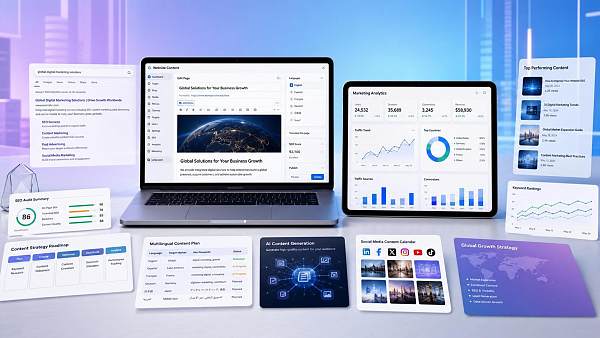
AI content marketing tools are not just about “writing faster.” In a website and marketing integrated scenario, their greater value lies in connecting content production, search visibility, landing page conversion, and multi-channel distribution.
What truly widens the performance gap is not whether a tool is used, but whether the growth goal has first been clearly defined. Lead-generation websites care more about inquiry acceptance, while brand expansion overseas places more emphasis on consistent messaging; multilingual promotion also needs to handle localization differences, and content efficiency must still balance rhythm and quality.
This is also why many teams see output increase after launching AI content marketing tools, but conversions do not grow in step. The content itself may be fine; the problem is often the scenario fit. For a platform like Yiyingbao that combines smart website building, SEO optimization, ad placement, and overseas social media operations, content is never a standalone action, but the hub in the entire growth chain.
Under different growth scenarios, priorities are not the same
In real-world applications, which scenarios are AI content marketing tools suitable for? The key is to see what task the content is meant to carry. If the content is mainly meant to bring natural traffic to a website, the focus will lean toward keyword coverage, page structure, and ongoing updates.
If the content is meant to support ad handoff or social media conversion, the focus shifts to click intent, information density, and action guidance. It may look like everyone is “doing content,” but the underlying production logic is actually quite different.
In lead-generation scenarios, the focus is not on volume, but on whether the content can capture search intent
When the website goal is to generate inquiries or collect leads, AI content marketing tools are best used in the collaborative production of category pages, solution pages, FAQ pages, and long-form article pages. In this scenario, the value of a single article does not lie in the number of pieces, but in whether it can move visitors from “searching for answers” to “willing to contact us.”
A more common way to judge is to first organize core keywords, then look at the page type each keyword belongs to. Informational keywords are suitable for articles and guide pages, while commercial keywords are better suited to service pages and landing pages. If an AI content marketing tool only writes articles, but does not align with website structure, internal linking logic, and form paths, the results are usually discounted.
For platforms like Yiyingbao that cover AI smart website building and SEO/GEO optimization, the advantage is that content is not just “pushed out,” but can directly land in a website system that is indexable and convertible. This integrated capability is often more suitable for long-term growth than a standalone copywriting tool.
When brands go global, AI content marketing tools are better suited for consistent messaging and regional adaptation
Brand globalization is not short of content; what it lacks is a stable, unified, and scalable messaging system. Many sites use different wording in different markets, resulting in a fragmented official website, ad pages, social posts, and short-video scripts, and a diluted brand impression.
At this point, the adaptation value of AI content marketing tools mainly shows up in brand terminology management, regional version expansion, and cross-channel reuse. The North American market places more emphasis on efficiency-oriented expression, parts of Europe pay more attention to compliance and details, and markets in the Middle East and Southeast Asia are often more sensitive to the local language context. Content cannot simply be translated; it must be rewritten in combination with the purpose of the page.
What needs to be confirmed before implementation is whether the tool supports unified management of multilingual website content, and whether it can link the official website, ad copy, and social media materials. If the AI content marketing tool is only used as a one-time writing assistant, it is very difficult for it to truly support the long-term operation of brand globalization.
In multilingual promotion scenarios, the real difficulty is localization, not translation speed
Multilingual promotion is a very typical application scenario for AI content marketing tools, but it is also the easiest to misjudge. Many projects equate “being able to generate pages in batches across multiple languages” with “being able to go live directly,” and as a result the pages may be numerous, but indexing and conversion are far from ideal.
There are usually three reasons. First, keywords are directly translated instead of using local search expressions. Second, the page structure copies the Chinese site and does not match the reading habits of the target region. Third, the content is not aligned with on-site products, logistics, payment, delivery, or case information; only the language has been changed on the surface.
- First distinguish between “showcase multilingual pages” and “lead-generation multilingual pages”; their content depth requirements are different.
- Prioritize high-potential markets first, then expand to long-tail languages; there is no need to cover everything at the beginning.
- Let the AI content marketing tool plug into the keyword strategy, rather than only into the translation workflow.
- Synchronize technical SEO checks, such as link structure, regional tags, and page indexing settings.
If the site still needs knowledge content, white papers, or industry topics, it can also refer to the organization method of data pages such as A study on the digital transformation of enterprise finance under the financial shared services model. The key is not the topic itself, but how the topic content connects search demand and enhances page professionalism.
For content efficiency scenarios, don’t just look at time savings; also see whether team collaboration is connected
Many teams introduce AI content marketing tools because content output cannot keep up with business rhythm. New product launches need pages, ad placement needs materials, social media operations need daily updates, and SEO also requires continuous publishing. Relying on manual work alone, it is easy to fall out of balance.
But efficiency does not equal batch generation. What is more worthy of attention is whether the tool supports content templates, brand word libraries, keyword rules, approval workflows, and channel adaptation. Only by connecting these links can an AI content marketing tool evolve from “accelerating writing” to “accelerating operations.”
Website and marketing integrated teams should pay special attention to one detail: content length, information layers, and conversion actions differ across channels. Official website articles are suitable for in-depth explanation, ad landing pages should emphasize immediate persuasion, and social media content relies more on rhythm and interaction. A single master draft can be expanded by AI into multiple versions, but it cannot be mechanically copied.
What is often overlooked before implementation is not tool functionality, but scenario adaptation conditions
One common misunderstanding is to look only at how much content the AI content marketing tool can generate, while ignoring whether the website foundation supports growth. Slow page indexing, chaotic categories, and weak conversion entry points make it hard for even highly efficient content to deliver stable results at scale.
Another misunderstanding is to treat all markets as the same promotion model. North America, Europe, Japan and Korea, the Middle East, Latin America, and other regions differ significantly in search habits, material preferences, and page trust elements. Without a localization strategy, the more content you produce, the greater the bias may become.
There is also the situation where only the generation side is considered, while the repurposing side is ignored. Whether the AI content marketing tool is truly suitable for the current scenario depends on keyword rankings, page dwell time, inquiry quality, ad handoff rate, and multilingual page indexing, not just on the number of posts published.
A more stable approach is to first establish scenario adaptation standards, then scale up
If you want to determine whether an AI content marketing tool is suitable for your current business, a more stable path is to first validate on a small scale. You can start with one key market, one core category, or one group of high-value keywords, and observe the indexing, click-through, and conversion performance after the content goes live.
- First clarify the growth goal: inquiries, deals, brand exposure, or multilingual coverage.
- Then match the page type, distinguishing official website pages, article pages, topic pages, and ad pages.
- Set evaluation metrics in parallel, such as indexing speed, keyword entry, lead generation rate, and reuse efficiency.
- Finally expand to more country sites, more channels, and more content modules.
In the long run, AI content marketing tools are better suited to being used within a complete overseas growth system. Only when website, SEO, advertising, social media, and AI search visibility are all advancing in coordination can content value continue to accumulate. By sorting out specific scenarios, confirming constraint conditions, and evaluating implementation difficulty before deciding on scaling, the outcome is usually more effective than blindly pursuing content volume.
Related Articles


Related Products
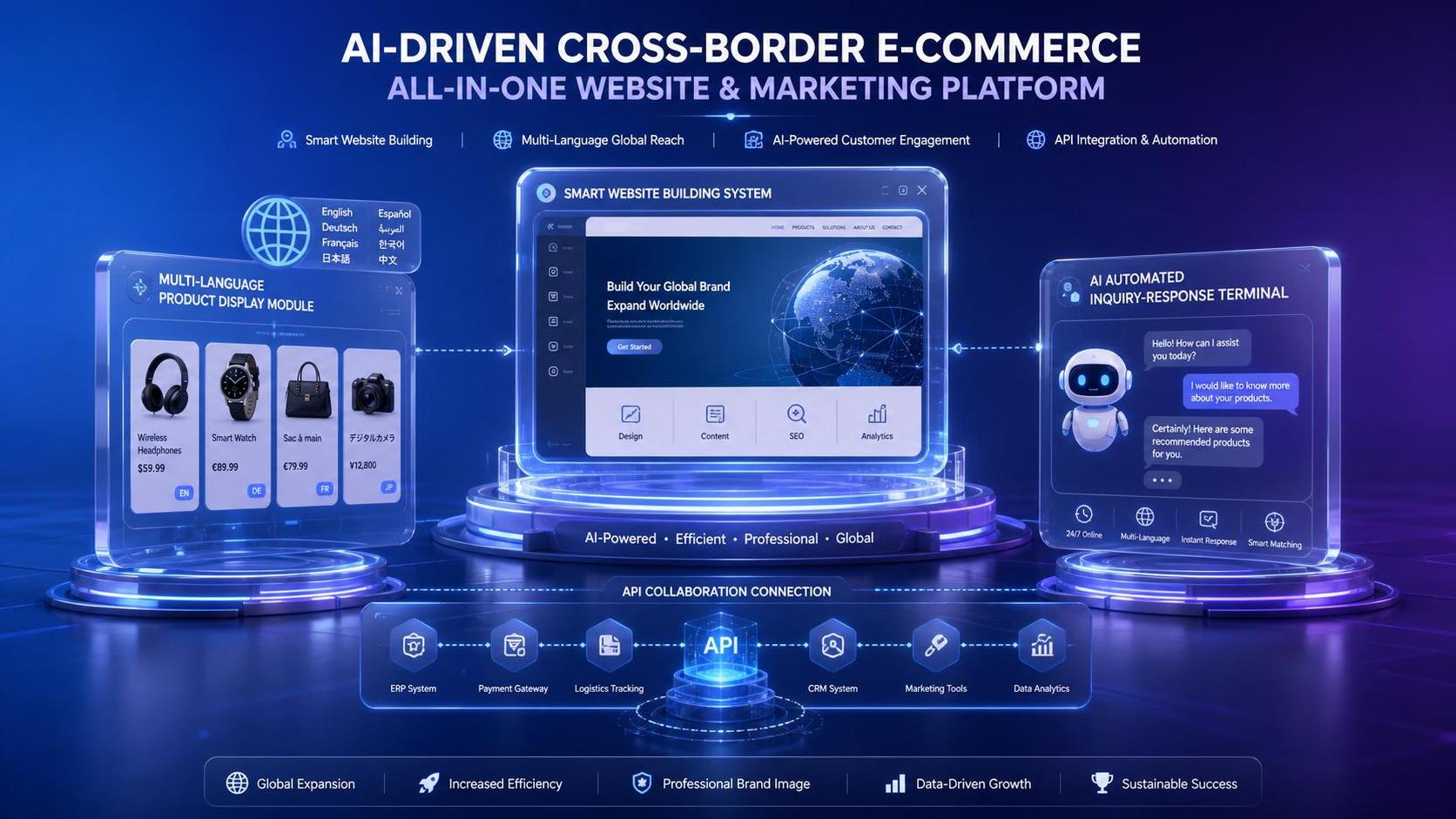
 EasyCamp SaaS Smart Website Marketing SystemE-Yingbao SaaS Smart Website Marketing System: AI-powered, zero-code website building. Rapidly launch multilingual independent e-commerce sites in just 10 minutes. Global server acceleration and AI-driven SEO optimization empower businesses to efficiently connect with global markets. The seamless integration of technology and user-friendly operation makes building e-commerce sites incredibly simple.
 AI+SEM Intelligent Advertising Marketing SystemAI+SEM drives intelligent ad creation, empowering full-funnel precision advertising marketing. The system automatically generates weekly/monthly reports, AI recommends keywords and target countries, monitors core metrics in real-time with intelligent alerts, and enables one-click high-conversion ad solutions to help quickly acquire customers and improve ROI.
 AI+SEO Dual Engine Optimization ServiceEasyWin AI+SEO Dual Engine Optimization System leverages AI-powered keyword mining, content generation, and comprehensive technical optimization to help foreign trade enterprises acquire high-quality organic traffic, significantly improving search rankings and conversion rates.
 AI+SNS Social Media Marketing SystemYingbao AI+SNS Social Media Marketing System - Precision social capture for the social media era. Supports one-click content synchronization across major platforms like Facebook and LinkedIn. AI intelligently rewrites posts for enhanced relevance. 24/7 AI customer service and user profiling analysis empower businesses to efficiently expand into global markets.
 AI+SEO营销解决方案易营宝AI+SEO营销解决方案,通过AI批量写作、智能生成TDK、精准关键词扩词等功能,全面优化网站SEO效果,提升流量与转化率。助力企业构建高效智能网站新生态。
 AI+SEM Advertising Marketing SolutionsAI+SEM Advertising Marketing Solution leverages AI technology to deeply empower SEM ad campaigns. It automatically generates weekly/monthly reports using AI, presenting account data across multiple dimensions for comprehensive insights into campaign performance and trends. The system precisely recommends keywords and target countries, intelligently generates high-conversion ad copy, and enables one-click activation of efficient campaign plans to help businesses rapidly acquire customers. Simultaneously, it monitors core metrics in real time, intelligently identifies abnormal fluctuations, and issues timely alerts to ensure stable, high-return advertising results.
 Domain Name ServicesEasyWin provides professional domain name services, including intelligent queries, one-stop registration, brand protection, and full lifecycle management, helping businesses build a digital brand image.
 EasyOperate B2C Cross-Border E-Commerce Platform & Independent WebsiteEasyStore B2C Cross-border E-commerce Independent Store is an intelligent website building and cross-border e-commerce integrated solution independently developed by EasyStore Information Technology (Beijing) Co., Ltd. The system is specially designed for small and medium-sized as well as large export enterprises, integrating 'website building, operation, marketing, advertising, and conversion' into one, helping enterprises quickly establish cross-border e-commerce independent stores to achieve brand globalization and global sales growth.
The platform supports multiple languages, multiple currencies, and multi-channel marketing, with built-in AI intelligent translation and SEO optimization systems, suitable for mainstream markets such as Southeast Asia, Europe and America, Latin America, and the Middle East, assisting Chinese manufacturing enterprises in efficiently deploying international e-commerce strategies. SSL证书易营宝提供专业SSL安全证书服务,包括单域名和泛域名证书,确保网站数据传输加密、身份验证和完整性保护,助力企业建立安全可信的在线业务环境。









