









- The China-US tariff arrangement has reached a preliminary consensus, and the trade association will be establishedJun 15, 2026View details
- China-Morocco zero-tariff access, a breakthrough in the cost of Moroccan goods exports to ChinaJun 11, 2026View details
- What signal should be released for the suspension of exports to JapanJun 10, 2026View details
- China's May LNG imports rebounded, with increased volumes from Russia and Canada filling the Middle East supply gapJun 10, 2026View details
- Will GEO change its SEO strategy?Jun 04, 2026View details
- What types of businesses are end-to-end solutions suitable for?Jun 03, 2026View details
How to Choose a Cross-Border E-Commerce Platform? The Differences and Suitable Scenarios Between Building Your Own Website and Platform-Based Merchants
How should you choose a cross-border marketplace? It is often not about how many features it has, but about what stage your growth target is at. Some businesses need to validate the market as quickly as possible, while others place more emphasis on brand building, data control, and long-term repeat purchases. Both self-built sites and platform-driven stores can generate business, but the operating logic, cost structure, traffic sources, and risk boundaries behind them are not the same. Only by understanding these differences clearly can you avoid detours and make it easier to turn website development and overseas marketing into one growth path.
First, understand the underlying differences between the two models
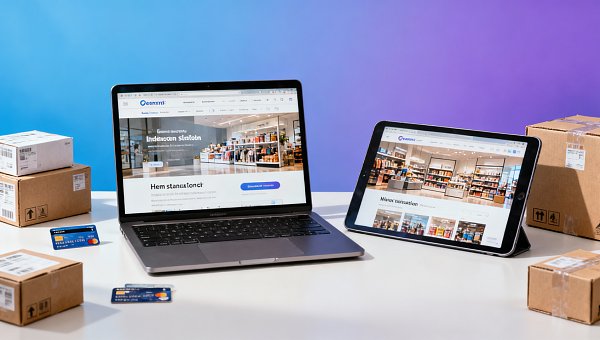
The common paths for cross-border marketplaces can generally be divided into self-built sites and platform-driven stores. The former means building a marketplace on your own independent domain name and system, while the latter means entering an established platform and leveraging its existing rules and traffic to drive sales.
Simply put, a self-built site is more like your own store, where the brand image, page structure, membership system, and marketing methods can all be designed according to business needs. Platform-driven stores are more like opening a store in a large mall: the start is faster, but the operating rhythm must follow the platform's rules.
This is also a point that many businesses easily overlook when planning a cross-border marketplace: the model is different, and not only are the channels different, but the traffic, conversion, repeat purchase, profit, and asset accumulation methods are also different.
Why this issue is receiving more and more attention
In the past, when doing cross-border business, many teams were used to going onto platforms first, because the platform had its own order entry point, making it faster to complete validation from product selection to order placement. But the situation is changing: traffic costs are rising, platform competition is intensifying, homogeneity is severe, and it is becoming increasingly difficult to form a stable advantage by relying on platforms alone.
At the same time, brand going global, private-domain accumulation, and multi-channel customer acquisition have become new priorities. A cross-border marketplace that can be searched, can carry ads, can convert social media traffic, and can still accumulate user data is moving from an “optional” to a “basic capability”.
This is also why the value of integrated website and marketing services is rising. A marketplace is no longer just a transaction page, but the core battlefield connecting search engines, ad placements, social content, retargeting, and repeat-purchase operations.
Why self-built sites are more suitable for long-term operations
The greatest value of a self-built cross-border marketplace is not “building a site yourself”, but being able to gradually turn the brand, content, users, and data into reusable assets.
Page style, product structure, checkout process, multilingual content, membership rules, and marketing plugins can all be designed in detail according to target markets. For businesses hoping to enter North America, Europe, Southeast Asia, and other regions, this flexibility is critical.
More importantly, a self-built site can handle multiple traffic sources. Search engine optimization, Google Ads, social media ads, influencer traffic, short-form video content, and email marketing can all be unified on the site instead of being scattered across multiple pages that cannot accumulate data.
Common advantages of self-built sites
- Complete brand expression, suitable for building differentiated awareness.
- User data can be accumulated, making repeat purchases and retargeting easier.
- Can be combined with SEO for long-term customer acquisition, reducing long-term single-customer acquisition costs.
- Greater rule autonomy, allowing flexible adjustment of pages and conversion paths.
Of course, a self-built site does not mean orders will come naturally once it goes live. It requires higher capabilities in site development, content, advertising, and continuous operations. Without a stable customer acquisition mechanism, an independent site can easily become “a site with no traffic”.
The advantage of platform-driven stores mainly lies in their efficiency at generating initial volume
Platform-driven stores are suitable for transaction models that start quickly. For businesses with a mature supply chain, strong price competitiveness, and a desire to enter the market rapidly, this approach is easier to launch.
Platforms usually already have basic traffic, payment systems, trust mechanisms, and logistics support. After a new project goes live, it can more quickly determine whether a product has demand, which markets respond more positively, and which price points are easier to close deals at.
But the problems with the platform model are also very clear. Traffic does not truly belong to you; changes in rules, commission structures, ad bidding, store ratings, and category competition all directly affect profit and stability.
Situations where platform-driven stores are more suitable
- Just entering overseas markets and needing low-threshold validation of demand.
- Having many SKUs and wanting to test hot-selling products through a platform first.
- A team focused on transaction operations and temporarily lacking independent customer acquisition capabilities.
- In the short term, paying more attention to sales volume and cash flow speed.
Looking at the choice within the business scenario makes the judgment clearer
Choosing a cross-border marketplace cannot be separated from business reality. The following dimensions are more valuable for reference than simply comparing “which is better”.
For many mature businesses, the final answer is often not either-or, but a combined configuration. The platform is responsible for driving sales volume and testing hot products, while the self-built site is responsible for the official brand website, content support, ad conversion, and repeat-purchase operations. Such a cross-border marketplace layout is often more stable.
Website and marketing must be designed together for the marketplace to truly be useful
In actual implementation, the biggest concern for a cross-border marketplace is not insufficient features, but that site development and customer acquisition become disconnected from each other. If the site structure does not consider search indexing, if ad landing pages do not match product details, or if social media traffic enters the site without a conversion path, all of this will dilute investment.
On this point, the value of integrated services is obvious. A platform like Yibao, which has long focused on overseas growth scenarios, integrates intelligent site building, multilingual capabilities, SEO optimization, ad placement, social media operations, and AI-driven data analysis, making it more suitable for businesses that need to continuously expand into overseas markets.
Its core significance is not just “building a site”, but ensuring that the cross-border marketplace has the conditions for promotion, indexing, and conversion from the first day it goes live. Especially in multi-region, multilingual, multi-channel operations, system-level capability is more important than a single tool.
Some teams, when evaluating digital investment, will also pay simultaneous attention to operating data and cash arrangements, which is similar to the logic of reading discussion on enterprise cash management optimization strategies based on cash flow forecasting for electric power enterprises: what truly has reference value is not just the name of the solution, but whether it can connect forecasting, rhythm, and execution.
Before making a decision, it is recommended to verify these points first
If you are preparing to deploy a cross-border marketplace, you can first sort out the following questions, and then decide whether to prioritize a self-built site, a platform, or both in parallel.
- Is the core goal profit margin, sales scale, or brand asset?
- Does the target market require multilingual, local payment, and local content adaptation?
- Do you have the capability to continuously do SEO, advertising, and social media traffic acquisition?
- Can supply chain, customer service, logistics, and after-sales support cross-regional operations?
- Do you want to master user data for repeat purchases and refined operations?
If these questions have no answers, a cross-border marketplace will easily remain at the level of “having built a system” rather than forming a truly sustainable overseas trading capability.
A more stable path is often not an either-or question
For most businesses, choosing a cross-border marketplace is more like a staged strategy. In the early stage, you can leverage platform-driven stores to validate the market; in the middle stage, gradually build an independent site; and in the later stage, integrate search, advertising, social media, and membership systems to form a more complete growth loop.
If you already have a certain product capability and operational foundation, it is even more worthwhile to focus your judgment on three things: whether you can establish your own traffic entry point, whether you can accumulate reusable data assets, and whether you can continuously replicate the conversion model across different overseas markets.
Putting demand, budget, team capabilities, and regional planning on the same table is more effective than rushing to choose “which model is more advanced”. Once the direction is clear, whether it is a self-built site or platform-driven stores, both will become tools for the business growth target rather than mutually exclusive slogans.
Related Articles
 How to choose a cross-border e-commerce platform source code? A comparison of open source, custom, and SaaS solutions
 What are the WordPress alternatives? 5 platform comparisons suitable for corporate websites
 Enterprise Website Platform Comparison: Which Solutions Are Best Suited for Official Websites, Online Stores, and Marketing Websites?
Related Products
 EasyCamp SaaS Smart Website Marketing SystemE-Yingbao SaaS Smart Website Marketing System: AI-powered, zero-code website building. Rapidly launch multilingual independent e-commerce sites in just 10 minutes. Global server acceleration and AI-driven SEO optimization empower businesses to efficiently connect with global markets. The seamless integration of technology and user-friendly operation makes building e-commerce sites incredibly simple.
 AI+SEM Intelligent Advertising Marketing SystemAI+SEM drives intelligent ad creation, empowering full-funnel precision advertising marketing. The system automatically generates weekly/monthly reports, AI recommends keywords and target countries, monitors core metrics in real-time with intelligent alerts, and enables one-click high-conversion ad solutions to help quickly acquire customers and improve ROI.
 AI+SEO Dual Engine Optimization ServiceEasyWin AI+SEO Dual Engine Optimization System leverages AI-powered keyword mining, content generation, and comprehensive technical optimization to help foreign trade enterprises acquire high-quality organic traffic, significantly improving search rankings and conversion rates.
 AI+SNS Social Media Marketing SystemYingbao AI+SNS Social Media Marketing System - Precision social capture for the social media era. Supports one-click content synchronization across major platforms like Facebook and LinkedIn. AI intelligently rewrites posts for enhanced relevance. 24/7 AI customer service and user profiling analysis empower businesses to efficiently expand into global markets.
 AI+SEO营销解决方案易营宝AI+SEO营销解决方案,通过AI批量写作、智能生成TDK、精准关键词扩词等功能,全面优化网站SEO效果,提升流量与转化率。助力企业构建高效智能网站新生态。
 AI+SEM Advertising Marketing SolutionsAI+SEM Advertising Marketing Solution leverages AI technology to deeply empower SEM ad campaigns. It automatically generates weekly/monthly reports using AI, presenting account data across multiple dimensions for comprehensive insights into campaign performance and trends. The system precisely recommends keywords and target countries, intelligently generates high-conversion ad copy, and enables one-click activation of efficient campaign plans to help businesses rapidly acquire customers. Simultaneously, it monitors core metrics in real time, intelligently identifies abnormal fluctuations, and issues timely alerts to ensure stable, high-return advertising results.
 Domain Name ServicesEasyWin provides professional domain name services, including intelligent queries, one-stop registration, brand protection, and full lifecycle management, helping businesses build a digital brand image.
 EasyOperate B2C Cross-Border E-Commerce Platform & Independent WebsiteEasyStore B2C Cross-border E-commerce Independent Store is an intelligent website building and cross-border e-commerce integrated solution independently developed by EasyStore Information Technology (Beijing) Co., Ltd. The system is specially designed for small and medium-sized as well as large export enterprises, integrating 'website building, operation, marketing, advertising, and conversion' into one, helping enterprises quickly establish cross-border e-commerce independent stores to achieve brand globalization and global sales growth.
The platform supports multiple languages, multiple currencies, and multi-channel marketing, with built-in AI intelligent translation and SEO optimization systems, suitable for mainstream markets such as Southeast Asia, Europe and America, Latin America, and the Middle East, assisting Chinese manufacturing enterprises in efficiently deploying international e-commerce strategies. SSL证书易营宝提供专业SSL安全证书服务,包括单域名和泛域名证书,确保网站数据传输加密、身份验证和完整性保护,助力企业建立安全可信的在线业务环境。









