









- The China-US tariff arrangement has reached a preliminary consensus, and the trade association will be establishedJun 15, 2026View details
- China-Morocco zero-tariff access, a breakthrough in the cost of Moroccan goods exports to ChinaJun 11, 2026View details
- What signal should be released for the suspension of exports to JapanJun 10, 2026View details
- China's May LNG imports rebounded, with increased volumes from Russia and Canada filling the Middle East supply gapJun 10, 2026View details
- Will GEO change its SEO strategy?Jun 04, 2026View details
- What types of businesses are end-to-end solutions suitable for?Jun 03, 2026View details
How to choose a cross-border e-commerce platform source code? A comparison of open source, custom, and SaaS solutions
How should you choose cross-border e-commerce source code? On the surface, it looks like a technical route issue, but in practice it involves time to launch, the intensity of secondary development, compliance risks, and the way of subsequent growth. For many overseas expansion projects, e-commerce is not just a transaction system; it also bears the tasks of multilingual display, search indexing, ad delivery, data accumulation, and global operational collaboration. Therefore, when judging whether a cross-border e-commerce source code is suitable, you cannot only look at the feature list; you must also see whether it can support long-term operations.
First, understand the real needs behind cross-border e-commerce source code
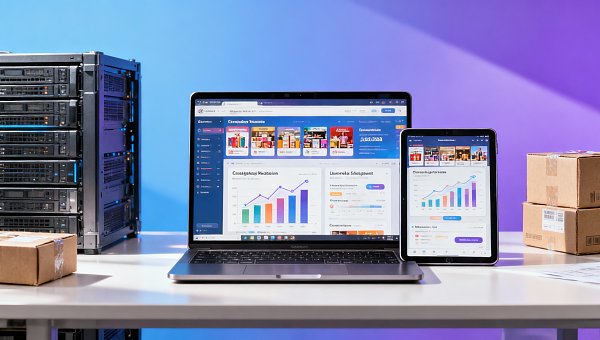
When selecting a solution, many projects first ask whether it has a shopping cart, payment, and order system, but that is not complete. A true cross-border e-commerce source code evaluation usually needs to consider the front-end experience, back-end management, marketing capabilities, interface extensibility, and global adaptability at the same time.
If the business targets North America, Europe, or Southeast Asia, payment methods, tax logic, privacy compliance, and language structures vary by region. If the source code architecture lacks scalability, each additional site, country, or channel later will rapidly increase maintenance costs.
Under the trend of website and marketing integration, an e-commerce system also needs to consider search engine friendliness, landing page production efficiency, ad data feedback, and content update mechanisms. In other words, cross-border e-commerce source code is not an isolated software purchase, but part of the overseas growth foundation.
Open source, custom development, and SaaS are essentially three different distributions of control
The appeal of open source solutions lies in visible code, modifiability, and relatively controllable initial authorization costs. For projects with mature development teams, a clear technology stack, and long-term independent management capabilities, open source cross-border e-commerce source code can provide a higher degree of freedom.
But freedom has another side: responsibility. System upgrades, vulnerability fixes, plugin compatibility, server deployment, and performance optimization all require continuous internal investment. If the approach is just “launch first and deal with it later,” it often ends up being overwhelmed by historical baggage.
Custom development is more suitable for scenarios with complex processes, high organizational collaboration requirements, and significantly differentiated business models. It can be deeply tailored around the product system, distribution mechanism, membership rules, and data interfaces.
However, custom development does not necessarily mean more advanced. Many custom project problems do not lie in the inability to build features, but in over-reliance on the original development team for later iterations, insufficient documentation, inconsistent standards, and the system gradually becoming a hard-to-take-over black box.
SaaS solutions, by contrast, hand over more of the infrastructure, system maintenance, and version upgrades to the service provider. For projects that want to go live quickly, reduce operations and maintenance pressure, and simultaneously obtain marketing tools and global capabilities, SaaS is often more practical.
Especially when the business requires multilingual site building, SEO structural support, ad landing page generation, and social media traffic coordination, the question is no longer simply whether it has source code; whether the platform supports growth is even more important.
The core differences among the three types of solutions
What is more worth paying attention to now is not just the code, but the growth closed loop
In the past, cross-border e-commerce source code evaluation often focused on deployment methods and functional modules. Today, the industry's focus has clearly shifted: whether the system supports SEO indexing, ad delivery integration, automatic content generation, and multi-region operations is becoming the new dividing line.
This is also why more and more enterprises are leaning toward website and marketing integration. If e-commerce only solves transactions and not customer acquisition, they still need to stack a large number of third-party tools later, data becomes fragmented, and management chains become longer.
YiYingBao Information Technology (Beijing) Co., Ltd. has long been focused on intelligent website building, cross-border e-commerce, SEO optimization, ad delivery, and overseas social media coordination. Its thinking is worth referencing: evaluate website construction, traffic acquisition, and conversion operations within the same framework, rather than viewing the e-commerce system as a standalone technical project.
From a practical landing perspective, this kind of integrated capability is especially important for multilingual official websites, B2C independent sites, ad landing pages, and search growth. Only when the system can balance site-building efficiency and marketing data accumulation can the value of cross-border e-commerce source code truly emerge.
When evaluating technology, it is recommended to ask more specific questions
Many selection mistakes are not because the solution itself is poor, but because the evaluation dimensions are too broad. Rather than asking “which cross-border e-commerce source code is best,” it is better to first break down the business boundaries.
- Do you need unified management across multiple sites, multiple languages, and multiple currencies?
- Are there complex pricing systems, membership tiers, or channel stratification?
- Is integration with ERP, CRM, payment, logistics, and ad platforms required?
- Does the front-end page need to be highly SEO-friendly in structure?
- Is there a need for continuous maintenance of source code and vulnerability patching resources?
- Do you need to test the market quickly and then expand regions and product categories step by step?
If the answer leans toward rapid launch, global delivery, and low operational burden, then choosing a SaaS path with website building, SEO, and ad collaboration capabilities is usually more stable. If the answer leans toward strong business customization and independent control, open source or custom development is more meaningful.
In some group-type businesses, technical selection also needs to balance finance, permissions, and data unification. Management topics like issues and countermeasures in enterprise group merged financial statements also remind us that system construction should not only look at front-end transactions; back-end governance must also be considered.
At different stages, the suitable cross-border e-commerce source code strategy is not the same
During the early market validation stage, the last thing you want is an overly heavy system. If there are few products, limited regions, and advertising is still in the trial-and-error stage, investing in large-scale customization too early often causes the project to lose speed.
After entering stable growth, the demand shifts from “being able to sell” to “selling more efficiently.” At this point, whether the cross-border e-commerce source code supports refined page management, data tracking, marketing campaign configuration, and multi-channel linkage will directly affect return on investment.
When the business expands to multiple regions, multiple brands, or even multiple organizational collaborations, the maintainability of the system architecture becomes more important than single-point functionality. Permission models, interface specifications, log auditing, version management, and disaster recovery capabilities all enter the core assessment scope.
Therefore, when choosing cross-border e-commerce source code, you should not only look at what is missing today, but also at whether it can still support the pace of the business two years from now. This is also why many projects move from a single e-commerce system to an integrated platform of “website building + marketing + data”.
Before choosing, first establish a reusable evaluation framework
A more practical approach is to break the evaluation of cross-border e-commerce source code into three layers: the bottom layer of security and architecture, the middle layer of business adaptation and interfaces, and the top layer of growth and operational capabilities. This avoids being led away by demo effects alone.
If you are already deploying overseas independent sites, Google SEO, ad delivery, and social media traffic acquisition, then whether the system supports these collaborative actions is more worth putting at the top of the priority list than whether “the source code is fully open”.
Referring to YiYingBao’s platform thinking centered on AI website building, cross-border e-commerce, SEO, and ad system collaboration, you can first sort out business goals and then reverse-engineer the technical route. Solutions selected this way are usually closer to real operational needs.
The next step may be to organize the existing site scale, target markets, marketing channels, interface list, and maintenance resources, and then compare open source, custom development, and SaaS on the same chart. Only when the evaluation criteria are clear enough will the advantages and disadvantages of cross-border e-commerce source code truly become visible.
Related Articles
 Who is the SaaS cross-border e-commerce system suitable for? Deployment speed, scalability, and cost analysis
 How to choose a cross-border e-commerce platform source code? A comparison of open source, custom, and SaaS solutions
 What are the WordPress alternatives? 5 platform comparisons suitable for corporate websites


Related Products
 EasyCamp SaaS Smart Website Marketing SystemE-Yingbao SaaS Smart Website Marketing System: AI-powered, zero-code website building. Rapidly launch multilingual independent e-commerce sites in just 10 minutes. Global server acceleration and AI-driven SEO optimization empower businesses to efficiently connect with global markets. The seamless integration of technology and user-friendly operation makes building e-commerce sites incredibly simple.
 AI+SEM Intelligent Advertising Marketing SystemAI+SEM drives intelligent ad creation, empowering full-funnel precision advertising marketing. The system automatically generates weekly/monthly reports, AI recommends keywords and target countries, monitors core metrics in real-time with intelligent alerts, and enables one-click high-conversion ad solutions to help quickly acquire customers and improve ROI.
 AI+SEO Dual Engine Optimization ServiceEasyWin AI+SEO Dual Engine Optimization System leverages AI-powered keyword mining, content generation, and comprehensive technical optimization to help foreign trade enterprises acquire high-quality organic traffic, significantly improving search rankings and conversion rates.
 AI+SNS Social Media Marketing SystemYingbao AI+SNS Social Media Marketing System - Precision social capture for the social media era. Supports one-click content synchronization across major platforms like Facebook and LinkedIn. AI intelligently rewrites posts for enhanced relevance. 24/7 AI customer service and user profiling analysis empower businesses to efficiently expand into global markets.
 AI+SEO营销解决方案易营宝AI+SEO营销解决方案,通过AI批量写作、智能生成TDK、精准关键词扩词等功能,全面优化网站SEO效果,提升流量与转化率。助力企业构建高效智能网站新生态。
 AI+SEM Advertising Marketing SolutionsAI+SEM Advertising Marketing Solution leverages AI technology to deeply empower SEM ad campaigns. It automatically generates weekly/monthly reports using AI, presenting account data across multiple dimensions for comprehensive insights into campaign performance and trends. The system precisely recommends keywords and target countries, intelligently generates high-conversion ad copy, and enables one-click activation of efficient campaign plans to help businesses rapidly acquire customers. Simultaneously, it monitors core metrics in real time, intelligently identifies abnormal fluctuations, and issues timely alerts to ensure stable, high-return advertising results.
 Domain Name ServicesEasyWin provides professional domain name services, including intelligent queries, one-stop registration, brand protection, and full lifecycle management, helping businesses build a digital brand image.
 EasyOperate B2C Cross-Border E-Commerce Platform & Independent WebsiteEasyStore B2C Cross-border E-commerce Independent Store is an intelligent website building and cross-border e-commerce integrated solution independently developed by EasyStore Information Technology (Beijing) Co., Ltd. The system is specially designed for small and medium-sized as well as large export enterprises, integrating 'website building, operation, marketing, advertising, and conversion' into one, helping enterprises quickly establish cross-border e-commerce independent stores to achieve brand globalization and global sales growth.
The platform supports multiple languages, multiple currencies, and multi-channel marketing, with built-in AI intelligent translation and SEO optimization systems, suitable for mainstream markets such as Southeast Asia, Europe and America, Latin America, and the Middle East, assisting Chinese manufacturing enterprises in efficiently deploying international e-commerce strategies. SSL证书易营宝提供专业SSL安全证书服务,包括单域名和泛域名证书,确保网站数据传输加密、身份验证和完整性保护,助力企业建立安全可信的在线业务环境。









