









- How to assess foreign trade website development trends?Looking at 2026 changes from multilingual,AI content to conversion pathsJul 04, 2026View details
- What are the new trends in multilingual marketing data analytics tools in 2026? Focus on attribution、automation and complianceJul 04, 2026View details
- Is Brand Globalization Marketing Consulting Worth Buying? At What Stage Should Companies Bring It InJul 01, 2026View details
- Cross-Border Marketing Trend Research: Why More and More Companies Are Starting to Deploy AI Search and GEO OptimizationJun 30, 2026View details
- Cross-Border Marketing Trend Research: How Independent Sites, AI Content, and Short-Video Customer Acquisition Are ChangingJun 30, 2026View details
- How Can a Brand Updates Page Be Made More SEO-Friendly? Analysis of Update Frequency, Content Structure, and Internal Linking StrategyJun 28, 2026View details
How many social media accounts can an overseas social media marketing system manage at the same time
How many social media accounts can an overseas social media marketing system manage at the same time? This is not only about operational efficiency, but also affects brand globalization growth. For enterprises, a platform that supports unified management of multiple accounts, collaborative publishing, and data monitoring is the real key to improving overseas marketing performance.
For foreign trade enterprises, manufacturing factories, cross-border e-commerce sellers, and global brand teams, the number of accounts is never simply the more the better. What matters is whether the system can carry the workload stably, whether permissions are clearly defined, whether the publishing workflow is smooth, and whether data can be attributed. If an overseas social media marketing system only solves the problem of “easy login” but cannot also support content collaboration, lead handoff, and independent website conversion, then no matter how many accounts there are, it will be difficult to form a real growth closed loop.
In the business scenario of website + marketing service integration, social media account management should not be viewed in isolation. Instead, it should be planned together with multilingual official websites, advertising landing pages, SEO content, short video materials, form-based lead generation, and data analytics. 易营宝 has long served enterprise globalization scenarios, and places greater emphasis on converting “account quantity” into “operable, analyzable, and convertible” assets through systematic capabilities.
How many accounts an overseas social media marketing system can manage depends on more than just the quantity limit
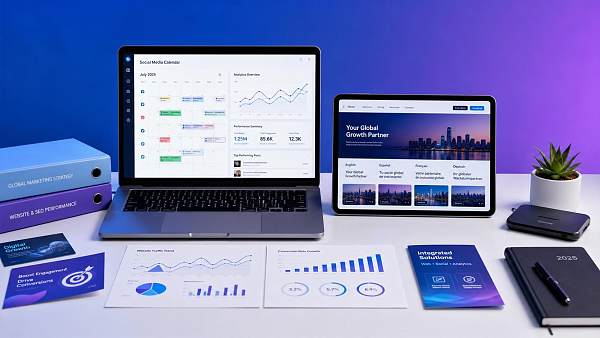
When many enterprises evaluate options, the first question they ask is how many social media accounts an overseas social media marketing system can manage at the same time. In practice, this question usually needs to be broken down into 3 dimensions: the number of system accounts that can be bound, the number of team members who can collaborate, and the concurrent processing capability for cross-platform content and data. Only when all 3 are satisfied does account scale have practical meaning.
Account limits are usually divided into 3 levels
Based on common industry configurations, basic systems are generally suitable for managing 10—30 accounts, and are applicable to single-brand or single-regional market teams; advanced systems commonly support 30—100 accounts, and are suitable for parallel operations across multiple sites and markets; enterprise-level systems focus more on management by organization, role, and business line, and can cover unified scheduling needs for more than 100 accounts.
However, enterprises need to note that when a platform states that it “supports 100+ accounts”, this does not mean that content scheduling, approval workflows, asset access, message replies, and data reports can all remain stable. If the system starts to experience delays, permission confusion, or incomplete reports after 20 accounts, then the nominal capacity has no procurement value.
4 key factors that affect actual carrying capacity
- Number of connected platforms: whether unified access is supported for Facebook, Instagram, LinkedIn, X, YouTube, TikTok, Pinterest, and others.
- Depth of team collaboration: whether role-based approval and operation log tracking are supported for 5 people, 20 people, or even more than 50 people.
- Asset and content reuse capability: whether multilingual versions, template-based publishing, and region-specific rewriting are supported.
- Data processing efficiency: whether account-level, campaign-level, and landing-page-level reports can be generated daily, weekly, and monthly.
The table below can help enterprises more intuitively determine the actual needs for account management scale at different stages, instead of only focusing on the superficial “number of accounts that can be bound”.
From a procurement perspective, what enterprises should truly focus on is “whether the system can stably support account expansion over the next 12 months to 24 months at the current business stage”. If an enterprise plans to add 3 regional sites, 2 product lines, and 3—5 social media positions for each line, then the system should reserve at least 30%—50% scalability.
Why unified account management must be built together with the website and marketing chain
How many social media accounts an overseas social media marketing system can manage at the same time ultimately does not deliver value through backend numbers, but through whether these accounts can continuously bring visits, inquiries, and transactions to the independent website. For B2B enterprises, social media is one of the entrances for customer acquisition; for B2C brands, social media also undertakes functions such as awareness building, interaction, conversion, and repurchase engagement.
5 connection points between social media account management and website conversion
- Whether users can quickly jump to the corresponding language product page or campaign page after content is published.
- Whether paid advertising and organic traffic can share the same set of landing pages and form system.
- Whether leads generated from social media private messages and comment interactions can be deposited into CRM or sales follow-up workflows.
- Whether SEO content, blog articles, and short video scripts can be reused as social media materials.
- Whether visits, inquiries, add-to-carts, and transactions from different platforms can be tracked in the same data dashboard.
If the system only manages publishing on Facebook or Instagram, but cannot connect with the enterprise official website, cross-border mall, and advertising landing pages, the operations team will quickly fall into repetitive work within 2—4 weeks: repeatedly downloading and uploading the same materials, manually replacing the same links, incorrect jumps on multilingual pages, and ultimately causing traffic waste and conversion loss.
This is exactly why 易营宝 emphasizes the integration of website development and overseas marketing. Enterprises do not simply need a “posting tool”. They need an integrated system covering AI intelligent website building, multilingual official websites, SEO content, social media operations, and advertising placement, so that every social media account can be incorporated into the same growth framework.
Recommended account configurations for typical business scenarios
Different types of enterprises have very different requirements for how many social media accounts an overseas social media marketing system can manage at the same time. The following configurations are not fixed standards, but they can serve as common references during selection.
This means that the value of the system is not simply to tell you that it “can connect 100 accounts”, but to answer whether these accounts can be managed by country, brand, product line, and channel goal, and connected to the corresponding website pages and marketing objectives. Only in this way will account scale not become uncontrollable after expansion.
What capabilities should enterprises focus on evaluating during selection
To determine how many social media accounts an overseas social media marketing system can manage at the same time, enterprises are advised to evaluate from 4 directions: “capacity, collaboration, data, and scalability”. Especially for teams that add more than 10 accounts annually and publish more than 20 pieces of content each week, system stability is more important than superficial features.
4 procurement indicators that must be checked
- Capacity indicators: number of accounts supported by a single organization, number of sub-brand accounts, and number of concurrent publishing tasks.
- Collaboration indicators: whether at least 3 levels of permissions, content approval, operation logs, and mistaken deletion traceability are supported.
- Data indicators: whether statistics can be broken down by platform, country, campaign, link, and page conversion.
- Scalability indicators: whether it can connect with the official website, mall, advertising system, SEO content library, and lead system.
Avoid 3 common misunderstandings
First, focusing only on connected platforms while ignoring the operational closed loop. Some tools can connect multiple social media platforms, but cannot feed lead data back, causing a disconnect between the marketing department and the sales department. Second, focusing only on price while ignoring upgrade space. If an enterprise grows from 10 accounts to 40 accounts within 6 months, a low-entry-barrier tool may instead increase migration costs. Third, focusing only on publishing functions while ignoring data attribution. Reports without a conversion perspective can hardly support budget allocation.
For enterprises that want to operate overseas markets in the long term, it is recommended to reserve at least 1 year of business growth needs during selection, and confirm whether the implementation cycle can be controlled within 7—30 days. If multilingual sites, advertising accounts, social media matrices, and short video content collaboration are involved, it is best to adopt a unified service provider or unified system architecture to reduce maintenance risks caused by scattered interfaces.
How to truly convert multi-account management into globalization growth capability
The ultimate purpose of multi-account management is not to make the operations team “look busier”, but to achieve higher market coverage and conversion efficiency with lower labor costs. A mature team usually divides account operations into 3 layers: brand exposure layer, interaction nurturing layer, and conversion handoff layer. Each layer needs to correspond to website content and marketing actions.
A recommended 5-step implementation process
- First sort out target markets, and set up the account matrix by regions such as North America, Europe, and Southeast Asia.
- Then define content templates, distinguishing 4 categories: brand content, product content, case content, and campaign content.
- Build multilingual official websites or independent website pages in parallel, ensuring that every social media link has a clear destination page.
- Establish weekly and monthly reporting mechanisms, tracking at least 5 data points: impressions, interactions, clicks, forms, and inquiries.
- Review account retention, content optimization, and budget adjustment across 3 cycles: 30 days, 90 days, and 180 days.
A platform like 易营宝, which combines intelligent website building, SEO optimization, advertising placement, and overseas social media operation capabilities, is more suitable for enterprises that need to operate overseas customer acquisition chains over the long term. The reason is straightforward: when the social media system, website system, and marketing system can work collaboratively, enterprises can turn account assets into search visibility, site traffic, and sales leads, instead of remaining at the interaction data level of a single platform.
If your enterprise is evaluating how many social media accounts an overseas social media marketing system can manage at the same time, you may wish to push the question one step further: in the next 12 months, how many countries, how many brands, how many product lines do you need to manage, and where should these accounts ultimately direct traffic? Once these 4 questions are clarified, system selection will be more accurate, and investment will be more likely to produce results.
For enterprises that need to build overseas independent websites, integrate social media operations, and improve Google SEO and advertising conversion efficiency, an integrated platform often has more long-term value than single-point tools. 易营宝 can provide collaborative solutions around website building, content, social media, advertising, and data analytics, helping enterprises maintain operational order and growth efficiency while expanding accounts. Contact us now to get a customized solution better suited to your business stage, and learn more about website + marketing service integrated solutions.
Related Articles
 How to choose a responsive website development company?Template capabilities、SEO foundation and maintenance costs must be clearly assessed
 How to evaluate digital marketing strategy agency vendors? Start with strategic capability or the execution team
 What are the core modules of a digital marketing SaaS system?A feature checklist suitable for small and medium-sized teams


Related Products
 EasyCamp SaaS Smart Website Marketing SystemE-Yingbao SaaS Smart Website Marketing System: AI-powered, zero-code website building. Rapidly launch multilingual independent e-commerce sites in just 10 minutes. Global server acceleration and AI-driven SEO optimization empower businesses to efficiently connect with global markets. The seamless integration of technology and user-friendly operation makes building e-commerce sites incredibly simple.
 AI+SEM Intelligent Advertising Marketing SystemAI+SEM drives intelligent ad creation, empowering full-funnel precision advertising marketing. The system automatically generates weekly/monthly reports, AI recommends keywords and target countries, monitors core metrics in real-time with intelligent alerts, and enables one-click high-conversion ad solutions to help quickly acquire customers and improve ROI.
 AI+SEO Dual Engine Optimization ServiceEasyWin AI+SEO Dual Engine Optimization System leverages AI-powered keyword mining, content generation, and comprehensive technical optimization to help foreign trade enterprises acquire high-quality organic traffic, significantly improving search rankings and conversion rates.
 AI+SNS Social Media Marketing SystemYingbao AI+SNS Social Media Marketing System - Precision social capture for the social media era. Supports one-click content synchronization across major platforms like Facebook and LinkedIn. AI intelligently rewrites posts for enhanced relevance. 24/7 AI customer service and user profiling analysis empower businesses to efficiently expand into global markets.
 AI+SEO营销解决方案易营宝AI+SEO营销解决方案,通过AI批量写作、智能生成TDK、精准关键词扩词等功能,全面优化网站SEO效果,提升流量与转化率。助力企业构建高效智能网站新生态。
 AI+SEM Advertising Marketing SolutionsAI+SEM Advertising Marketing Solution leverages AI technology to deeply empower SEM ad campaigns. It automatically generates weekly/monthly reports using AI, presenting account data across multiple dimensions for comprehensive insights into campaign performance and trends. The system precisely recommends keywords and target countries, intelligently generates high-conversion ad copy, and enables one-click activation of efficient campaign plans to help businesses rapidly acquire customers. Simultaneously, it monitors core metrics in real time, intelligently identifies abnormal fluctuations, and issues timely alerts to ensure stable, high-return advertising results.
 Domain Name ServicesEasyWin provides professional domain name services, including intelligent queries, one-stop registration, brand protection, and full lifecycle management, helping businesses build a digital brand image.
 EasyOperate B2C Cross-Border E-Commerce Platform & Independent WebsiteEasyStore B2C Cross-border E-commerce Independent Store is an intelligent website building and cross-border e-commerce integrated solution independently developed by EasyStore Information Technology (Beijing) Co., Ltd. The system is specially designed for small and medium-sized as well as large export enterprises, integrating 'website building, operation, marketing, advertising, and conversion' into one, helping enterprises quickly establish cross-border e-commerce independent stores to achieve brand globalization and global sales growth.
The platform supports multiple languages, multiple currencies, and multi-channel marketing, with built-in AI intelligent translation and SEO optimization systems, suitable for mainstream markets such as Southeast Asia, Europe and America, Latin America, and the Middle East, assisting Chinese manufacturing enterprises in efficiently deploying international e-commerce strategies. SSL证书易营宝提供专业SSL安全证书服务,包括单域名和泛域名证书,确保网站数据传输加密、身份验证和完整性保护,助力企业建立安全可信的在线业务环境。









