









- The China-US tariff arrangement has reached a preliminary consensus, and the trade association will be establishedJun 15, 2026View details
- China-Morocco zero-tariff access, a breakthrough in the cost of Moroccan goods exports to ChinaJun 11, 2026View details
- What signal should be released for the suspension of exports to JapanJun 10, 2026View details
- China's May LNG imports rebounded, with increased volumes from Russia and Canada filling the Middle East supply gapJun 10, 2026View details
- Will GEO change its SEO strategy?Jun 04, 2026View details
- What types of businesses are end-to-end solutions suitable for?Jun 03, 2026View details
- 2026 Global Growth Channel TrendsJun 02, 2026View details
- Changes in Search Engine Ranking Factors in 2026Jun 06, 2026View details
How to Get Started Faster with a Responsive Corporate Website Building System
To quickly master how to use a responsive enterprise website building system, the key is to choose the right solution where the price and features of an enterprise-level self-service website building system are well matched. After aligning the website SEO optimization plan, the domain registration process, and the SSL certificate application process, companies can also simultaneously improve search engine ranking optimization and customer acquisition efficiency.
For users, business decision-makers, project managers, and channel partners, a responsive enterprise website building system is not just about “building a website.” Instead, it is about completing a closed loop from launch, presentation, and lead acquisition to data tracking within 7 days to 30 days. Especially under the trend of integrating websites and marketing services, whether the website building system is easy to use directly affects team execution efficiency and subsequent promotion costs.
Eyingbao Information Technology (Beijing) Co., Ltd. has been deeply engaged in digital marketing services for more than a decade. Through the coordinated advancement of intelligent website building, SEO optimization, social media marketing, and advertising delivery, it provides companies with full-chain support from front-end pages to back-end conversion. For most companies, the truly efficient way to get started is not to blindly stack features, but to implement them step by step according to roles, processes, and business goals.
Why Responsive Enterprise Website Building Systems Are Better Suited for Rapid Business Launches
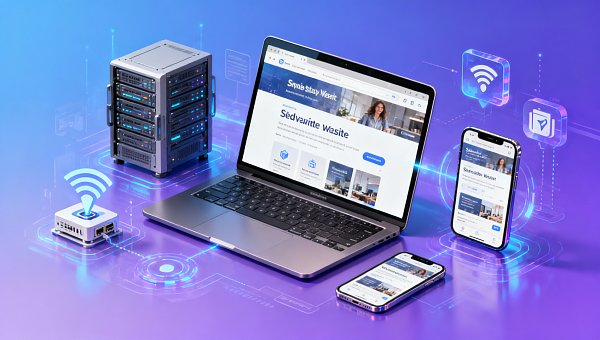
The core value of a responsive enterprise website building system lies in the fact that the same set of content and page structure can adapt to 3 types of devices: PCs, tablets, and mobile phones. For companies, this means there is no need to develop separate versions for multiple devices, which usually reduces repetitive production costs by 30% to 50% and also shortens the initial launch cycle.
For operators, ease of use is mainly reflected in whether the backend is visualized, whether the modules are standardized, and whether content updates have a low learning threshold. A mature system should usually support drag-and-drop layout, section duplication, form management, SEO field completion, and basic data statistics, ensuring that after 1 to 3 days of training, users can independently maintain the site.
For decision-makers, the focus is more on return on investment. The difference between a website that can only display information and a platform that can take on search traffic, support lead collection, and facilitate the reuse of advertising landing pages often becomes clearly visible after 3 months.
If a company serves multiple regions or multiple product lines, a responsive system can also significantly improve project management efficiency. Unified templates, unified permissions, and a unified content review process allow a content team of 2 to 5 people to manage dozens of pages without losing control, which is especially important for distributor and agent networks.
Three Common Onboarding Barriers for Enterprises
- There are too many features but no clear operating path, so new users do not know whether to configure the domain first, create sections first, or build pages first.
- The templates look good but are not suitable for conversion, lacking inquiry buttons, form entry points, and a clear CTA layout.
- After the website is built, basic SEO settings are missing, and the title, description, URL structure, and image ALT are not configured in a standardized way.
What Basic Capabilities Should a System for Rapid Launch Have
At a minimum, it should have 5 types of capabilities: page templates, form components, SEO settings, data statistics, and security configuration. If the company plans to expand into overseas markets or multilingual websites in the future, it is recommended to prioritize solutions that support language expansion, CDN acceleration, and tiered content permissions to avoid secondary migration.
Taking official brand websites for agricultural products and food products as an example, the website must not only display corporate qualifications and product categories, but also highlight visual trust. If the page emphasizes natural visual styles such as green and warm yellow, combined with large image displays, news blogs, and customized packaging application forms, it is often more conducive to improving business inquiry conversion.
For this type of industry display requirement, you can refer to the page ideas related to agriculture, agricultural products, food. Through categorized product grids, service commitment modules, and fully responsive motion effects, brand professionalism and the original quality feel of the products can be strengthened.
A Faster Implementation Sequence: From Account Setup to Official Launch
Many companies are slow to get started not because the system is difficult, but because the implementation sequence is chaotic. The correct approach is to divide website building into 4 stages: preparation, setup, optimization, and launch. Each stage should be controlled within 2 to 7 days, and the overall cycle is usually 7 days to 21 days, while complex projects may be extended to 4 weeks.
During the preparation stage, first clarify the website goal: brand display, inquiry conversion,招商加盟, or a catalog-style official website. Different goals will lead to significantly different section structures. For example, a franchise recruitment website places more emphasis on policy explanations, cooperation cases, and form entry points, while a catalog-style website pays more attention to category filtering and product detail pages.
The focus of the setup stage is not “finishing all pages at once,” but first completing 5 core pages: the homepage, about us, product/service pages, news page, and contact page. In this way, 20% of the pages can first complete 80% of the launch work, avoiding repeated project delays.
In the optimization stage, domain resolution, SSL certificate deployment, mobile adaptation checks, page loading speed, and basic SEO settings should be handled simultaneously. If these links are ignored, even if the website goes live, it will still show obvious shortcomings in search crawling, browsing experience, and conversion entry points.
Recommended Implementation Workflow Table
The table below is suitable for coordinated use by internal project owners, operations personnel, and external service providers, helping reduce communication costs and clarify delivery milestones.
From a process perspective, the key factor affecting onboarding speed is not the number of pages, but whether the milestones are standardized. As long as content preparation, permission allocation, and the testing checklist are moved upfront, most companies can complete the first version of the official website launch within 2 weeks and begin the promotion validation phase in week 3.
5-Item Checklist Before Launch
- Ensure all page titles are controlled within 20 to 35 characters and avoid duplication.
- Check whether mobile buttons, forms, and phone components are clearly visible within 3 seconds.
- Check whether the SSL certificate is working properly and whether the website URL has been uniformly redirected to HTTPS.
- Check whether website analytics tools are installed and whether form submissions have a notification mechanism.
- Check whether the 404 page, privacy policy, contact information, and footer navigation are complete.
How to Choose an Enterprise-Level Self-Service Website Building System with Matching Price and Features
When selecting a system, the easiest mistake companies make is focusing only on website building price while ignoring subsequent maintenance, promotion, and expansion costs. A solution that appears low-cost may require continuous additional investment from month 2 to month 6 if it does not support SEO settings, form data management, multi-device adaptation, and permission control.
A more reasonable evaluation method is to make decisions from 4 dimensions: functionality, service, scalability, and risk. For small and medium-sized enterprises, it is more important to first meet current operational needs for the next 1 to 2 years; for group-based, multi-region, and multi-agent collaborative enterprises, multi-site management and marketing integration capabilities should be considered in advance.
If the company has already made it clear that it will later do SEO optimization, feed advertising, or social media advertising, then the website building system must reserve landing page duplication capability, tracking capability, and data tracking interfaces. Otherwise, the front-end pages and marketing delivery will be disconnected from each other, conversion data will be difficult to track, and management will also find it difficult to judge channel effectiveness.
For the website + integrated marketing services industry, website building is not an isolated action, but the underlying foundation of a lead growth system. A service model like Eyingbao, which has coordinated capabilities in website building and marketing, is more suitable for enterprises that need long-term growth rather than one-time delivery.
Selection Comparison Table: What to Focus on Under Different Needs
The comparison table below is suitable for internal discussions before procurement and can help companies reduce problems such as “not understanding features, difficulty getting budget approval, and inability to clearly explain requirements.”
From the comparison results, what companies truly need is not the most complex system, but the system that best fits the current business pace. It is generally recommended to use “usable, scalable, and promotable” as the 3 basic screening criteria, rather than simply comparing the number of templates or the visual effect of the homepage.
Do Not Overlook These 4 Items When Evaluating Budget
- Domain and certificate costs: usually billed annually, and renewal and management convenience should be considered.
- Content production costs: images, copywriting, videos, and translation often account for more than 20% of total investment.
- Promotion integration costs: whether SEO, advertising delivery, and analytics tracking require additional development.
- Operations and maintenance support costs: whether training, fault response, version upgrades, and backup mechanisms are included.
How to Simultaneously Do SEO, Conversion, and Content Operations Well After Website Launch
Many companies treat “website launch” as the finish line, but in fact launch is only the starting point of a customer acquisition system. A website that truly brings continuous inquiries will usually complete basic SEO groundwork within 30 days after launch, and gradually establish content update frequency and a lead tracking mechanism within 60 days to 90 days.
At the SEO level, at least 3 types of work must be completed: standardizing page titles and descriptions, organizing section and detail page URLs, and continuously updating image-text content. For corporate official websites, product pages, case pages, news pages, and Q&A pages are often the content modules most likely to accumulate search exposure.
At the conversion level, the design should revolve around “making it easier for customers to contact you.” Common practices include placing a phone number or button above the fold, embedding forms on product pages, adding inquiry entry points on case pages, highlighting policy information on franchise pages, and setting different landing pages for different channels to facilitate subsequent statistics on conversion sources.
At the content operations level, it is recommended that companies update at least 4 pieces of industry content every month, covering product knowledge, application scenarios, procurement guides, and frequently asked questions. This is beneficial not only for search engine crawling, but also for helping the sales team use the website as a standardized knowledge base and improve communication efficiency.
A Content Structure Suitable for Continuous Growth of Official Websites
If the company is involved in brand-display products, such as agricultural product or food official websites, it can draw on the page structure ideas of agriculture, agricultural products, food and combine large-image category displays, service commitments, news blogs, and packaging application forms, which not only satisfies brand communication but also improves business cooperation efficiency.
The advantage of this type of structure lies in its clear content blocks. Within the first 8 seconds after entering the page, users can immediately see the core categories, service capabilities, and contact entry points. For end consumers, this builds trust; for distributors and agents, this is the first step in judging the feasibility of cooperation.
90-Day Execution Recommendations After Launch
- Days 1-15: refine page details and confirm the stability of mobile browsing, form submission, and redirects.
- Days 16-30: complete titles, descriptions, and ALT text, submit the sitemap, and connect analytics tools.
- Days 31-60: continuously publish content around product keywords, industry keywords, and question keywords, 1 to 2 articles per week.
- Days 61-90: combine search keywords and advertising data to optimize high-bounce pages and high-exposure low-conversion pages.
When website building, content, and promotion work in coordination, a corporate official website truly upgrades from an “online business card” to an “operable asset.” This is also why an integrated website and marketing service solution has greater long-term value than standalone website delivery.
Common Problems and Practical Suggestions: Avoid Slow Onboarding, Weak Results, and Difficult Subsequent Maintenance
In actual projects, the common problems enterprises face are concentrated at 3 levels: first, unclear early-stage requirements, leading to repeated adjustments to sections; second, no one continues updating after launch, causing the website to quickly “go silent”; third, website building is disconnected from promotion, resulting in traffic coming in but failing to generate effective inquiries. These problems can all be alleviated through upfront planning and standardized processes.
For project managers, it is recommended to divide the official website project into 5 milestones: requirement confirmation, material preparation, page review, launch testing, and operations handover, and set the responsible person and deadline for each milestone. Even if the team has only 3 people, as long as roles are clear, repeated cross-department communication can be reduced.
For business decision-makers, the focus should not only be on “when the website will go live,” but also on tracking basic indicators such as traffic, form volume, and inquiry rate at 30 days, 60 days, and 90 days. Even if there is not yet a large data system at the current stage, at minimum a basic framework that can be observed and reviewed should be established first.
For frontline operators, the secret to faster onboarding is to first master high-frequency actions: adding new pages, replacing banners, editing title descriptions, publishing articles, viewing forms, and checking mobile performance. As long as these 6 actions are mastered, daily maintenance efficiency can usually cover more than 80% of operational needs.
FAQ: The 4 Questions Enterprises Ask Most Often
1. How long does it usually take to get started with a responsive enterprise website building system?
If the backend has a high degree of visualization, basic training can usually be completed in 1 to 3 days. For companies that already have content materials, the first version can go live within 7 to 15 days; if multiple languages, multiple product lines, or complex approval processes are involved, the cycle is usually 2 to 4 weeks.
2. Which indicators should be prioritized during procurement?
It is recommended to focus on 6 items: mobile adaptation, SEO setting capability, form and lead management, page scalability, security capability, and after-sales response time. If the company plans to run ads in the future, it should also confirm whether independent landing page creation and tracking statistics are supported.
3. Why should domain, SSL, and SEO be done together from the very beginning?
Because these 3 items determine whether the website can be accessed stably, crawled by search engines, and trusted by users. If HTTPS, title standards, and URL structure are ignored at the beginning of launch, later changes may lead to redirect confusion, delayed indexing, and invalid historical links.
4. What if no one maintains the website after it is built?
A “monthly light operations” mechanism can be adopted, arranging 1 content update, 1 data review, and 1 page inspection each month. Even if only 4 to 8 hours are invested per month, the website can still have better search activity and customer trust than a website that goes without updates for a long time.
From a practical implementation perspective, if a responsive enterprise website building system is to be mastered more quickly, the key is not whether it has more features, but whether the process is clear, whether the roles are clearly defined, and whether website building is planned together with SEO and marketing. For companies that hope to balance brand presentation, search-based customer acquisition, and subsequent promotion expansion, choosing a service solution with coordinated website building and marketing capabilities is often more reliable and time-saving.
If you are evaluating an enterprise-level self-service website building system, or hope to link your official website with SEO, social media, and advertising delivery, it is recommended to obtain a customized solution as soon as possible based on your industry, budget, and growth goals. Consulting further now on product details, implementation processes, and adaptation recommendations can help your website go live faster and realize business value sooner.
Related Articles



Related Products
 EasyCamp SaaS Smart Website Marketing SystemE-Yingbao SaaS Smart Website Marketing System: AI-powered, zero-code website building. Rapidly launch multilingual independent e-commerce sites in just 10 minutes. Global server acceleration and AI-driven SEO optimization empower businesses to efficiently connect with global markets. The seamless integration of technology and user-friendly operation makes building e-commerce sites incredibly simple.
 AI+SEM Intelligent Advertising Marketing SystemAI+SEM drives intelligent ad creation, empowering full-funnel precision advertising marketing. The system automatically generates weekly/monthly reports, AI recommends keywords and target countries, monitors core metrics in real-time with intelligent alerts, and enables one-click high-conversion ad solutions to help quickly acquire customers and improve ROI.
 AI+SEO Dual Engine Optimization ServiceEasyWin AI+SEO Dual Engine Optimization System leverages AI-powered keyword mining, content generation, and comprehensive technical optimization to help foreign trade enterprises acquire high-quality organic traffic, significantly improving search rankings and conversion rates.
 AI+SNS Social Media Marketing SystemYingbao AI+SNS Social Media Marketing System - Precision social capture for the social media era. Supports one-click content synchronization across major platforms like Facebook and LinkedIn. AI intelligently rewrites posts for enhanced relevance. 24/7 AI customer service and user profiling analysis empower businesses to efficiently expand into global markets.
 AI+SEO营销解决方案易营宝AI+SEO营销解决方案,通过AI批量写作、智能生成TDK、精准关键词扩词等功能,全面优化网站SEO效果,提升流量与转化率。助力企业构建高效智能网站新生态。
 AI+SEM Advertising Marketing SolutionsAI+SEM Advertising Marketing Solution leverages AI technology to deeply empower SEM ad campaigns. It automatically generates weekly/monthly reports using AI, presenting account data across multiple dimensions for comprehensive insights into campaign performance and trends. The system precisely recommends keywords and target countries, intelligently generates high-conversion ad copy, and enables one-click activation of efficient campaign plans to help businesses rapidly acquire customers. Simultaneously, it monitors core metrics in real time, intelligently identifies abnormal fluctuations, and issues timely alerts to ensure stable, high-return advertising results.
 Domain Name ServicesEasyWin provides professional domain name services, including intelligent queries, one-stop registration, brand protection, and full lifecycle management, helping businesses build a digital brand image.
 EasyOperate B2C Cross-Border E-Commerce Platform & Independent WebsiteEasyStore B2C Cross-border E-commerce Independent Store is an intelligent website building and cross-border e-commerce integrated solution independently developed by EasyStore Information Technology (Beijing) Co., Ltd. The system is specially designed for small and medium-sized as well as large export enterprises, integrating 'website building, operation, marketing, advertising, and conversion' into one, helping enterprises quickly establish cross-border e-commerce independent stores to achieve brand globalization and global sales growth.
The platform supports multiple languages, multiple currencies, and multi-channel marketing, with built-in AI intelligent translation and SEO optimization systems, suitable for mainstream markets such as Southeast Asia, Europe and America, Latin America, and the Middle East, assisting Chinese manufacturing enterprises in efficiently deploying international e-commerce strategies. SSL证书易营宝提供专业SSL安全证书服务,包括单域名和泛域名证书,确保网站数据传输加密、身份验证和完整性保护,助力企业建立安全可信的在线业务环境。









