









- The China-US tariff arrangement has reached a preliminary consensus, and the trade association will be establishedJun 15, 2026View details
- What determines B2C cross-border e-commerce website development costs? A breakdown of features, interfaces, and deployment methodsJun 17, 2026View details
- China-Morocco zero-tariff access, a breakthrough in the cost of Moroccan goods exports to ChinaJun 11, 2026View details
- What signal should be released for the suspension of exports to JapanJun 10, 2026View details
- China's May LNG imports rebounded, with increased volumes from Russia and Canada filling the Middle East supply gapJun 10, 2026View details
- Will GEO change its SEO strategy?Jun 04, 2026View details
- What types of businesses are end-to-end solutions suitable for?Jun 03, 2026View details
- 2026 Global Growth Channel TrendsJun 02, 2026View details
What key metrics should be used to analyze website data
When analyzing website data, which key metrics should you look at? On the surface, it seems like you are just looking at a set of numbers, but in reality, you are determining whether the website is truly carrying the responsibility of acquiring leads, driving conversions, and enabling growth. Looking only at traffic volume often shows nothing more than popularity; only by looking at traffic sources, bounce rate, time on site, conversion rate, and behavior paths together can you get closer to real business performance. For scenarios that integrate website building, SEO, ad placement, and overseas marketing, website data analysis not only affects content optimization, but also directly affects budget allocation and subsequent growth decisions.
First, clarify what problem data analysis is actually solving
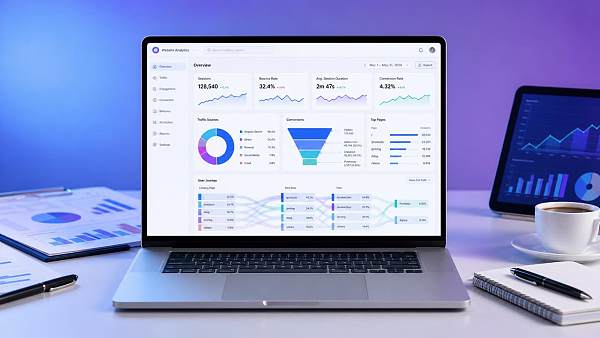
Many websites fall into a common trap after going live: they produce a lot of pages and keep investing in promotion, but inquiries do not increase significantly, or traffic looks decent but it is hard to convert into qualified customers. This is where the value of website data analysis becomes apparent.
Simply put, website data analysis is not about piling up reports, but about answering a few core questions: where does the traffic come from, whether the visitors match the target audience, what they saw after entering the site, at which step they left, and whether they ultimately completed registration, consultation, an order, or a form submission.
In today’s integrated website and marketing service environment, the website is no longer just an isolated display page; it is the core battlefield jointly supported by search engines, advertising systems, social media, and content operations. In particular, platforms like 易营宝, which integrate AI smart website building, SEO optimization, ad placement, and multilingual marketing, place even greater emphasis on whether a site is both indexable and convertible. Therefore, when reviewing data, you must consider both traffic quality and business outcomes.
Several key metrics that are truly worth long-term attention
Website data analysis does not require tracking dozens of metrics all at once; the key is to first grasp the main line. In general, you can judge from four dimensions: traffic, engagement, conversion, and efficiency.
Traffic metrics: first determine “where people come from”
Visits, unique visitors, and the ratio of new to returning visitors are the most basic observation entry points. But what is even more worth paying attention to is the traffic source structure, including organic search, ad placement, social media, direct visits, and external referrals.
If the share of organic search keeps rising, it usually indicates that SEO content and site structure are taking effect; if ad traffic is high but time on site is very short, you need to review whether the keywords, audience targeting, and landing pages are aligned.
Engagement metrics: see whether users are willing to keep browsing
Bounce rate, average time on site, pages per session, and popular entry pages can help determine whether the content has retained visitors. A high bounce rate is not necessarily a bad thing, but if core pages are accompanied by short time on site and low clicks, it indicates there are obvious issues with the content or page guidance.
In foreign trade independent sites, multilingual official websites, and ad landing page scenarios, engagement data is especially critical. Because users who enter the site often arrive with a clear need, whether the page can quickly build trust will directly affect subsequent conversions.
Conversion metrics: determine whether the website has generated results
Conversion rate is the metric in website data analysis that is closest to business results. Different websites may have different conversion goals, such as form submission, online consultation, phone click-to-call, material download, add to cart, or checkout.
If a channel brings relatively low traffic but a clearly better conversion rate, its value is often higher than a high-traffic, low-conversion channel. In other words, website data analysis cannot look only at scale; it must also look at effectiveness.
Efficiency metrics: see whether input and output are aligned
When a website carries SEO, advertising, and social traffic at the same time, you also need to look at cost per conversion, cost per inquiry, page load speed, and mobile experience. Every slowdown in front-end experience can cause a further drop in back-end conversion.
For websites that rely on overseas markets to acquire customers, regional access speed, language version switching, and mobile form completion rate are also key factors affecting efficiency.
Only by placing metrics in context does data become meaningful
Website data analysis is the same: the focus of different business models is not the same. Looking at a single unified metric alone can easily lead to misjudgment.
This is also why more and more companies are choosing to drive growth through the integrated approach of website building and marketing coordination. Site structure, content strategy, landing pages, and data feedback all need to be designed in a unified way; otherwise, data will be fragmented and judgments will easily lose accuracy. 易营宝’s integrated approach to intelligent website building, multilingual websites, AI+SEO/GEO optimization, and advertising systems is essentially about reducing broken links and making website data analysis closer to real business processes.
A decision-making dimension that is often overlooked, but highly important
In addition to common numbers, there are several types of signals that are easily overlooked, but often determine whether the optimization direction is correct.
- Whether the channel and the page match. If ad traffic lands on a page with incomplete information, the bounce rate is usually relatively high.
- Whether the keywords and the conversion align. Some terms can generate a lot of clicks, but not necessarily effective inquiries.
- Differences between new and returning visitors. If returning visitors convert significantly better, it indicates that the first-touch information is not persuasive enough.
- Differences by region and device. Common overseas website issues are often not in the content, but in access speed and mobile form experience.
- Broken points in the path. Which step users drop off at is often more valuable to track than the final result itself.
In actual analysis, you can also refer to structured thinking from other industries. For example, when studying the problems and countermeasures of fixed asset management in public institutions, many people start with problem identification, process decomposition, and attribution of responsibility. Website data analysis is similar: the key is not to memorize how many terms there are, but to find out at which link the problem occurs.
From data to optimization, what can be done operationally
The real premise of website data analysis is that it can drive continuous optimization actions, rather than staying at the level of monthly reports. Practical methods usually include the following directions.
First unify the conversion funnel
First clarify what counts as effective conversion. Is it form submission, leaving contact information, or completing a payment? If the funnel is inconsistent, the data becomes harder to judge.
Then establish page priorities
The homepage, product pages, case pages, content pages, and landing pages are not equally important. Prioritizing pages with high traffic, high exit rates, and high value usually makes results easier to see.
Connect sources and outcomes
Do not only look at which channel brings clicks; also look at which channel brings conversions, inquiries, and repeat visits. Only by linking front-end traffic and back-end conversions together is website data analysis truly complete.
Keep periodic reviews
Look at fluctuations in the short term and trends in the long term. SEO, advertising, and social media have different feedback cycles, so when reviewing, you cannot draw conclusions from just one week of data; you need to combine monthly and quarterly changes to see the direction.
To judge whether a website is healthy, the key is to build your own metric framework
In the end, website data analysis is not about finding a standard answer; it is about building a set of continuously observable metrics according to business goals. For websites that prioritize SEO, place organic traffic and content conversion first; for websites that prioritize advertising, pay more attention to landing page efficiency and conversion cost; for websites targeting overseas markets, also incorporate multilingual experience, regional load speed, and coordination across different channels into the judgment.
If your current website is already connected to multi-channel promotion, but you still do not know where to prioritize improvements, it may be best to start by sorting out the four areas of source structure, core page performance, key conversion actions, and leakage paths. After observing these metrics continuously for a period of time, and then combining website building, SEO, advertising, and content strategy for joint optimization, website data analysis will truly shift from “looking at reports” to a real, executable growth basis.
Related Articles



Related Products
 EasyCamp SaaS Smart Website Marketing SystemE-Yingbao SaaS Smart Website Marketing System: AI-powered, zero-code website building. Rapidly launch multilingual independent e-commerce sites in just 10 minutes. Global server acceleration and AI-driven SEO optimization empower businesses to efficiently connect with global markets. The seamless integration of technology and user-friendly operation makes building e-commerce sites incredibly simple.
 AI+SEM Intelligent Advertising Marketing SystemAI+SEM drives intelligent ad creation, empowering full-funnel precision advertising marketing. The system automatically generates weekly/monthly reports, AI recommends keywords and target countries, monitors core metrics in real-time with intelligent alerts, and enables one-click high-conversion ad solutions to help quickly acquire customers and improve ROI.
 AI+SEO Dual Engine Optimization ServiceEasyWin AI+SEO Dual Engine Optimization System leverages AI-powered keyword mining, content generation, and comprehensive technical optimization to help foreign trade enterprises acquire high-quality organic traffic, significantly improving search rankings and conversion rates.
 AI+SNS Social Media Marketing SystemYingbao AI+SNS Social Media Marketing System - Precision social capture for the social media era. Supports one-click content synchronization across major platforms like Facebook and LinkedIn. AI intelligently rewrites posts for enhanced relevance. 24/7 AI customer service and user profiling analysis empower businesses to efficiently expand into global markets.
 AI+SEO营销解决方案易营宝AI+SEO营销解决方案,通过AI批量写作、智能生成TDK、精准关键词扩词等功能,全面优化网站SEO效果,提升流量与转化率。助力企业构建高效智能网站新生态。
 AI+SEM Advertising Marketing SolutionsAI+SEM Advertising Marketing Solution leverages AI technology to deeply empower SEM ad campaigns. It automatically generates weekly/monthly reports using AI, presenting account data across multiple dimensions for comprehensive insights into campaign performance and trends. The system precisely recommends keywords and target countries, intelligently generates high-conversion ad copy, and enables one-click activation of efficient campaign plans to help businesses rapidly acquire customers. Simultaneously, it monitors core metrics in real time, intelligently identifies abnormal fluctuations, and issues timely alerts to ensure stable, high-return advertising results.
 Domain Name ServicesEasyWin provides professional domain name services, including intelligent queries, one-stop registration, brand protection, and full lifecycle management, helping businesses build a digital brand image.
 EasyOperate B2C Cross-Border E-Commerce Platform & Independent WebsiteEasyStore B2C Cross-border E-commerce Independent Store is an intelligent website building and cross-border e-commerce integrated solution independently developed by EasyStore Information Technology (Beijing) Co., Ltd. The system is specially designed for small and medium-sized as well as large export enterprises, integrating 'website building, operation, marketing, advertising, and conversion' into one, helping enterprises quickly establish cross-border e-commerce independent stores to achieve brand globalization and global sales growth.
The platform supports multiple languages, multiple currencies, and multi-channel marketing, with built-in AI intelligent translation and SEO optimization systems, suitable for mainstream markets such as Southeast Asia, Europe and America, Latin America, and the Middle East, assisting Chinese manufacturing enterprises in efficiently deploying international e-commerce strategies. SSL证书易营宝提供专业SSL安全证书服务,包括单域名和泛域名证书,确保网站数据传输加密、身份验证和完整性保护,助力企业建立安全可信的在线业务环境。









