









- The China-US tariff arrangement has reached a preliminary consensus, and the trade association will be establishedJun 15, 2026View details
- What determines B2C cross-border e-commerce website development costs? A breakdown of features, interfaces, and deployment methodsJun 17, 2026View details
- China-Morocco zero-tariff access, a breakthrough in the cost of Moroccan goods exports to ChinaJun 11, 2026View details
- What signal should be released for the suspension of exports to JapanJun 10, 2026View details
- China's May LNG imports rebounded, with increased volumes from Russia and Canada filling the Middle East supply gapJun 10, 2026View details
- Will GEO change its SEO strategy?Jun 04, 2026View details
5 Things to Know Before Choosing an SSL Certificate
Why can’t you choose an SSL certificate based on price alone?
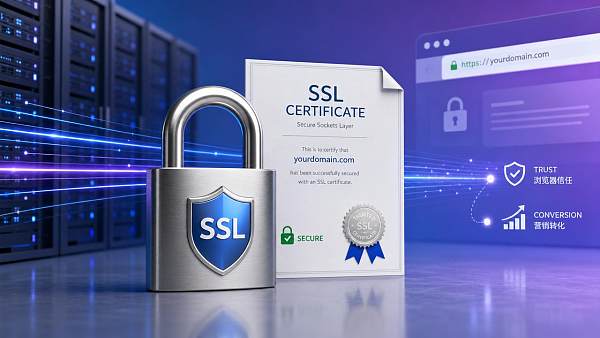
When many people purchase an SSL certificate, they first ask for a quote and then check the term. That order is not ideal. A certificate may look like a simple “padlock” on a website, but it actually affects encrypted transmission, browser trust, search visibility, and customers’ willingness to leave their information.
For businesses that rely on their official website to acquire customers, an SSL certificate is not just a technical setting; it is also part of the marketing infrastructure. If a page shows an “Not secure” warning, bounce rates will rise, ad landing page conversions will be affected, and SEO indexing signals may also weaken.
This is especially true for foreign-trade websites, multilingual sites, and independent e-commerce stores, which usually also integrate forms, inquiries, payments, or login functions. When choosing an SSL certificate in these cases, you need to consider not only the security level, but also whether later deployment and maintenance will be hassle-free.
Platforms like 易营宝, which provide integrated website building, SEO optimization, ad placement, and overseas marketing services, usually treat certificate configuration as part of the website launch process. The reason is simple: if the certificate is chosen incorrectly, it may not only require reconfiguration later, but also affect the pace of promotion and the credibility of the site.
First clarify the types: what exactly is the difference between DV, OV, and EV?
If you only want the conclusion, you can understand it this way: a regular showcase site usually uses DV, a corporate website is more suitable for OV, and EV should be considered when high-trust display or key brand protection is required. The first step in choosing an SSL certificate is not to pick a brand, but to determine the business scenario first.
DV certificates verify domain control, are issued quickly, and are relatively low-cost, making them suitable for test sites, content sites, or basic official websites. OV certificates verify company information and are more suitable for websites that operate in a formal manner. EV verification is stricter and is suitable for scenarios that emphasize brand credibility.
If a site is responsible for lead generation, do not focus only on whether it can encrypt traffic; also consider whether it can build trust. For example, when industrial manufacturing companies showcase process capabilities, quality inspection processes, and global delivery systems, the site often needs to support inquiries and selection communication, and OV SSL certificates are usually more stable in these cases.
The common page structure of this kind of official website is similar to solution sites such as precision machining, hardware components. The focus is not only on displaying products, but also on connecting capability proof, industry solutions, contact entry points, and conversion paths. Choosing the right certificate level helps customers stay longer and submit their needs more willingly.
A simple decision table for quick screening
Brand credibility: why does it affect later costs?
Many people think that as long as an SSL certificate works, the brand difference is not that important. In reality, that is not the case. Different issuing authorities differ in browser compatibility, review procedures, technical support, and exception handling, and these differences translate into time costs and risk costs.
A more common situation is that when site traffic is still low in the early stage, the issue is not obvious. But once you start doing Google SEO, ad placement, or overseas social media traffic generation, any certificate error, incomplete chain, or compatibility problem will directly affect the visitor experience and conversion data.
Therefore, when purchasing an SSL certificate, the brand should not be judged by popularity alone. Three things matter: whether the root certificate is widely trusted by mainstream terminals, whether after-sales support responds quickly, and whether the certificate management console makes renewal and replacement easy.
- If there is overseas traffic demand, first confirm compatibility with mainstream browsers and mobile devices.
- If the site is updated frequently, confirm whether reissuance, replacement, and re-signing are convenient.
- If the internal technical team is limited, see whether the provider can assist with deployment and troubleshooting.
Compatibility and deployment efficiency: why is this often underestimated?
An affordable SSL certificate is not necessarily cheap in the long run, but complex deployment and poorly adapted certificates often make later maintenance more troublesome. Especially when multilingual official websites, e-commerce stores, and landing page systems run in parallel, certificate configuration is often not just a single-server matter.
What needs to be confirmed in advance is the environment in which the current website is running. Is it a cloud host, a website-building SaaS, or a multi-node CDN architecture? Are there multiple subdomains? Is a single-domain, wildcard, or multi-domain certificate more suitable? All of these will affect the purchasing decision.
If the website is responsible for marketing tasks, deployment efficiency is especially critical. Because certificate issuance, installation, redirect configuration, mixed-content checks, and every other step can affect the launch schedule if delayed. For teams advancing with a “website + promotion” collaboration model, this is not a technical detail, but a project scheduling issue.
When industrial companies build overseas websites, they often launch the product center, case studies, inquiry form, and localized pages together. If the page design references structured solutions such as precision machining, hardware components, and has many image assets with clear module layers, it is even more important to ensure that HTTPS is consistently enabled across the entire site to avoid browser warnings caused by insecure local resources.
When purchasing an SSL certificate, which hidden costs are most worth clarifying?
Many budget overruns are not because the certificate itself is expensive, but because the details were not asked about in advance. In addition to the first-year price, the purchase cost of an SSL certificate may also include manual deployment, cross-server installation, emergency reissuance, certificate replacement, and renewal management at expiration.
If you only look at the quotation sheet, it is easy to overlook these details. The truly stable approach is to treat the certificate as part of website operating costs and evaluate it together with website building, SEO, and ad placement, rather than viewing it as a standalone IT procurement expense.
Confirm these items before placing the order
- How many domains does the certificate cover, and will new subdomains be added in the next six months?
- How long does enterprise verification materials preparation take, and will it affect the site launch?
- Are expiration reminders, automatic renewal, and replacement in abnormal situations supported?
- Is server migration supported, and is reinstalling after migration charged extra?
- Is Chinese technical support provided, and can response time meet business pace?
If the provider is also responsible for website building and overseas marketing, these issues can usually be clarified in one go at the project start. The advantage of doing so is that the SSL certificate will not become an obstacle for later SEO migration, landing page launch, or form conversion optimization.
How should you choose in the end to better support long-term operations?
If the website is only for temporary display, a basic option is fine. But as long as the site carries brand building, lead generation, or overseas promotion tasks, the SSL certificate should not be chosen solely by the lowest price. A more reasonable approach is to evaluate security, trust, compatibility, and maintenance together.
In simple terms, before purchasing, confirm five points first: whether the certificate type matches the business, whether the brand is reliable, whether compatibility is sufficient, whether deployment is efficient, and whether after-sales and renewal are hassle-free. Clarifying these five items often controls total cost better than repeatedly comparing prices.
In practical applications, website security configuration rarely exists in isolation. It works together with content publishing, SEO indexing, ad placement, form submissions, and multilingual access. Platforms like 易营宝, which cover intelligent website building, SEO optimization, ad marketing, and AI search optimization, attach importance to certificate solutions precisely because they are directly related to whether a website can steadily handle global traffic.
The next step is to first sort out the number of existing domains, the purpose of the site, the launch time, and the subsequent promotion plan, and then choose an SSL certificate solution accordingly. Define the evaluation criteria first, then compare prices; that is usually more stable and more suitable for long-term operations.
Related Articles

Related Products
 EasyCamp SaaS Smart Website Marketing SystemE-Yingbao SaaS Smart Website Marketing System: AI-powered, zero-code website building. Rapidly launch multilingual independent e-commerce sites in just 10 minutes. Global server acceleration and AI-driven SEO optimization empower businesses to efficiently connect with global markets. The seamless integration of technology and user-friendly operation makes building e-commerce sites incredibly simple.
 AI+SEM Intelligent Advertising Marketing SystemAI+SEM drives intelligent ad creation, empowering full-funnel precision advertising marketing. The system automatically generates weekly/monthly reports, AI recommends keywords and target countries, monitors core metrics in real-time with intelligent alerts, and enables one-click high-conversion ad solutions to help quickly acquire customers and improve ROI.
 AI+SEO Dual Engine Optimization ServiceEasyWin AI+SEO Dual Engine Optimization System leverages AI-powered keyword mining, content generation, and comprehensive technical optimization to help foreign trade enterprises acquire high-quality organic traffic, significantly improving search rankings and conversion rates.
 AI+SNS Social Media Marketing SystemYingbao AI+SNS Social Media Marketing System - Precision social capture for the social media era. Supports one-click content synchronization across major platforms like Facebook and LinkedIn. AI intelligently rewrites posts for enhanced relevance. 24/7 AI customer service and user profiling analysis empower businesses to efficiently expand into global markets.
 AI+SEO营销解决方案易营宝AI+SEO营销解决方案,通过AI批量写作、智能生成TDK、精准关键词扩词等功能,全面优化网站SEO效果,提升流量与转化率。助力企业构建高效智能网站新生态。
 AI+SEM Advertising Marketing SolutionsAI+SEM Advertising Marketing Solution leverages AI technology to deeply empower SEM ad campaigns. It automatically generates weekly/monthly reports using AI, presenting account data across multiple dimensions for comprehensive insights into campaign performance and trends. The system precisely recommends keywords and target countries, intelligently generates high-conversion ad copy, and enables one-click activation of efficient campaign plans to help businesses rapidly acquire customers. Simultaneously, it monitors core metrics in real time, intelligently identifies abnormal fluctuations, and issues timely alerts to ensure stable, high-return advertising results.
 Domain Name ServicesEasyWin provides professional domain name services, including intelligent queries, one-stop registration, brand protection, and full lifecycle management, helping businesses build a digital brand image.
 EasyOperate B2C Cross-Border E-Commerce Platform & Independent WebsiteEasyStore B2C Cross-border E-commerce Independent Store is an intelligent website building and cross-border e-commerce integrated solution independently developed by EasyStore Information Technology (Beijing) Co., Ltd. The system is specially designed for small and medium-sized as well as large export enterprises, integrating 'website building, operation, marketing, advertising, and conversion' into one, helping enterprises quickly establish cross-border e-commerce independent stores to achieve brand globalization and global sales growth.
The platform supports multiple languages, multiple currencies, and multi-channel marketing, with built-in AI intelligent translation and SEO optimization systems, suitable for mainstream markets such as Southeast Asia, Europe and America, Latin America, and the Middle East, assisting Chinese manufacturing enterprises in efficiently deploying international e-commerce strategies. SSL证书易营宝提供专业SSL安全证书服务,包括单域名和泛域名证书,确保网站数据传输加密、身份验证和完整性保护,助力企业建立安全可信的在线业务环境。









