









- Can Zhejiang foreign trade independent websites still be developed today? Look at changes in traffic and lead generationJul 28, 2026View details
- What New Signals Are Emerging in Enterprise Services SaaS Marketing ReportsJul 27, 2026View details
- What Does a Global Traffic Ecosystem Service Provider Do? What Are the Differences from a Single Advertising AgencyJul 16, 2026View details
- What should you focus on in the latest enterprise SaaS report? From renewal rates and delivery costs to overseas growth opportunitiesJul 12, 2026View details
- What signals are worth paying attention to in a cross-border marketing trend report? B2B companies should look at these 6 signalsJul 11, 2026View details
- How to Read a Cross-Border Marketing Trends Report? Five Key Dimensions for Evaluating Channel OpportunitiesJul 11, 2026View details
- Which channel has the highest ROI in the global traffic ecosystem? Comparative analysis of search, social media, and advertisingJul 10, 2026View details
- What multilingual website services are available in Sanya? Which model is more suitable for local businesses going global?Jul 08, 2026View details
Should custom enterprise self-service website-building systems undergo secondary development
In the context of corporate website upgrades, does enterprise-grade self-service website builder customization require secondary development?
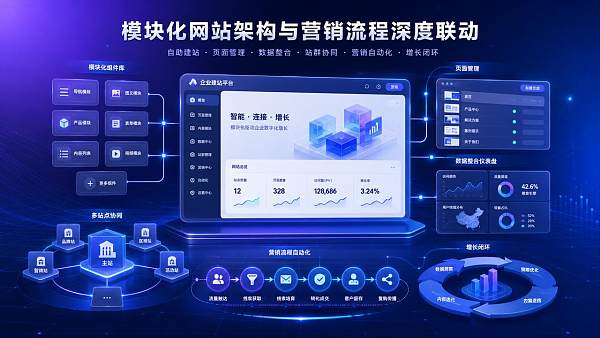
Whether enterprise-grade self-service website builder customization needs secondary development, the key is not “whether it can be done,” but “whether it is worth doing.” For technical evaluators, the judgment should be made comprehensively from the perspectives of architectural scalability, system integration, security compliance, and long-term operations and maintenance costs.
In integrated website + marketing service scenarios, a website is no longer just a standalone display page, but a core node for customer acquisition, conversion, data accumulation, and brand communication. If enterprise-grade self-service website builder customization only focuses on page launch speed, it is easy to underestimate the complexity of subsequent marketing collaboration and business iteration.
E-Marketing Information Technology (Beijing) Co., Ltd. has long served global growth scenarios. Relying on artificial intelligence and big data capabilities, it integrates intelligent website building, SEO optimization, social media marketing, and advertising placement to help enterprises consider future traffic operations and data closed-loop management while building their websites.
First look at the decision background: different business scenarios have completely different requirements for secondary development
Enterprise-grade self-service website builder customization usually includes capabilities such as template management, page drag-and-drop, form collection, basic SEO configuration, and multilingual support. For standardized businesses, these functions are already sufficient to meet launch needs, and there is no need to invest a large development budget at the outset.
However, if the website needs to connect to CRM, ERP, a member center, lead scoring, marketing automation, or even support cross-regional compliance requirements, the platform’s native capabilities may not be enough. At this point, whether to carry out secondary development depends on whether the business process is part of the core competitive advantage.
In other words, enterprise-grade self-service website builder customization is not better the “heavier” it is, nor is it more economical the “lighter” it is. The truly reasonable decision is to match system capabilities with business complexity, rather than letting technology selection in turn constrain the marketing pace.
Scenario 1: For brand showcase official websites, heavy secondary development is usually not recommended too early
Key criteria for being suitable for direct use of standard capabilities
If the website’s goal is to showcase the brand, products, cases, and contact information, and the content update frequency is moderate, then the native modules of enterprise-grade self-service website builder customization are usually sufficient. In such scenarios, more emphasis is placed on launch speed, visual consistency, and basic SEO friendliness.
At this time, doing a large amount of secondary development often prolongs the project cycle and increases the difficulty of subsequent upgrades. In particular, if the template underlying structure is modified too deeply, compatibility issues are likely to occur during platform version updates, which instead weakens the original flexibility advantage of self-service website building.
Directions more worthy of investment
Rather than piling up functions on a showcase official website, it is better to invest the budget in information architecture, landing page conversion paths, content SEO layout, form conversion design, and mobile experience. The practical value of these capabilities for integrated website + marketing services is usually higher than that of complex development itself.
Scenario 2: For marketing and customer acquisition websites, enterprise-grade self-service website builder customization is more likely to require partial secondary development
Which needs will trigger development actions
When the website undertakes ad traffic reception, lead distribution, channel attribution, and automated follow-up, enterprise-grade self-service website builder customization often needs to connect with multiple systems. For example, ad platform parameter feedback, form deduplication, customer tag synchronization, behavioral data warehousing, and marketing automation triggers.
This type of development is not necessarily extensive, but it must be precise. The core principle is to strengthen capabilities around the conversion chain, rather than developing for the sake of “looking advanced.” If partial secondary development can improve lead quality, shorten response time, and optimize delivery attribution, it is usually worth doing.
How to avoid overdevelopment
It is recommended to first clearly map out the closed loop of “traffic entry—page conversion—data synchronization—sales follow-up,” and then determine which nodes must be changed and which can be handled with plugins or interfaces. The goal of enterprise-grade self-service website builder customization should be to serve marketing efficiency, rather than create new maintenance burdens.
Scenario 3: In multi-region and multi-product-line operations, secondary development often relates to long-term scalability
When an enterprise has multilingual sites, multiple country-specific sites, and multiple product matrices, enterprise-grade self-service website builder customization is no longer just about building one website, but about building a replicable and centrally governable digital front-end system. At this point, section permissions, content distribution, site cluster management, and inheritance of SEO rules are all critical.
If the platform does not natively support coordinated multi-site management, problems such as duplicated content maintenance, chaotic URL structures, and inconsistent data standards may arise later. For such medium- to long-term scenarios, moderate secondary development can usually significantly reduce future operating costs.
A similar approach of structurally managing complex business rules is also common in knowledge-based and strategic content development. For example, breaking down professional topics by model, outputting them according to rules, and then reusing them for different businesses. You may refer to A Discussion on Power Enterprise Fund Management Optimization Strategies Based on Cash Flow Forecasting as this kind of structured content organization method also provides inspiration for planning multi-business pages.
How to judge the differences in requirements for enterprise-grade self-service website builder customization under different scenarios
Scenario adaptation recommendations: from “being able to go live” to “being able to grow”
- First sort out the business process, and then determine the development boundaries of enterprise-grade self-service website builder customization.
- Give priority to platforms with clear open interfaces and stable upgrade mechanisms.
- Concentrate development resources on functions that are used frequently and directly affect conversion.
- SEO, content management, form workflows, and data tracking should be planned simultaneously.
- Establish version management and permission management mechanisms to avoid losing control of subsequent maintenance.
For integrated website + marketing service projects, enterprise-grade self-service website builder customization cannot be led solely from a development perspective; operations, content, ad placement, and data analysis must also participate together. Only development decisions made in this way can truly serve subsequent growth, rather than merely completing technical delivery.
Common misjudgments: not all “personalized requirements” are worth developing
The first misjudgment is treating visual differences as system differences. Many page effect issues can be solved through front-end style optimization, without the need to modify underlying capabilities. If display demands are turned into deep functional development in enterprise-grade self-service website builder customization, the cost-performance ratio is usually low.
The second misjudgment is ignoring upgrade costs. Some customized functions may seem efficient when launched, but once the platform is upgraded, they require retesting and reworking. Without a continuous operations and maintenance budget, the deeper the early-stage development, the easier it is to form technical debt later.
The third misjudgment is ignoring marketing collaboration. A website is not an isolated system, especially when SEO, advertising placement, and social media operations run in parallel, page speed, tracking specifications, content structure, and redirection logic will all affect the final customer acquisition results. Enterprise-grade self-service website builder customization must be evaluated within the growth chain.
What to do next: use a layered evaluation method to decide whether secondary development is needed
You can first use a four-layer method for quick judgment. The first layer looks at the business goal: is it for display or customer acquisition? The second layer looks at system integration: is it necessary to connect external data? The third layer looks at the expansion cycle: are there plans for multiple sites, multiple languages, and multiple products within six months? The fourth layer looks at operations and maintenance capabilities: can customized modules be maintained over the long term?
If, among the four-layer evaluations, only display demands are obvious, enterprise-grade self-service website builder customization can prioritize using standard capabilities. If integration, expansion, and compliance demands are all relatively strong, then a secondary development architecture should be planned as early as possible, with SEO and marketing data rules designed simultaneously.
Truly high-quality enterprise-grade self-service website builder customization is not about the more development, the more advanced; rather, it is about using appropriate costs in appropriate scenarios in exchange for higher growth efficiency and lower long-term risk. This is also a key step for website construction to move from a tool mindset to an operational mindset.
Related Articles
 Promoting chemical products on Google is essential—otherwise, you are effectively handing your customers over to competitors
 Can Zhejiang foreign trade independent websites still be developed today? Look at changes in traffic and lead generation
 What New Signals Are Emerging in Enterprise Services SaaS Marketing Reports


Related Products
 EasyCamp SaaS Smart Website Marketing SystemE-Yingbao SaaS Smart Website Marketing System: AI-powered, zero-code website building. Rapidly launch multilingual independent e-commerce sites in just 10 minutes. Global server acceleration and AI-driven SEO optimization empower businesses to efficiently connect with global markets. The seamless integration of technology and user-friendly operation makes building e-commerce sites incredibly simple.
 AI+SEM Intelligent Advertising Marketing SystemAI+SEM drives intelligent ad creation, empowering full-funnel precision advertising marketing. The system automatically generates weekly/monthly reports, AI recommends keywords and target countries, monitors core metrics in real-time with intelligent alerts, and enables one-click high-conversion ad solutions to help quickly acquire customers and improve ROI.
 AI+SEO Dual Engine Optimization ServiceEasyWin AI+SEO Dual Engine Optimization System leverages AI-powered keyword mining, content generation, and comprehensive technical optimization to help foreign trade enterprises acquire high-quality organic traffic, significantly improving search rankings and conversion rates.
 AI+SNS Social Media Marketing SystemYingbao AI+SNS Social Media Marketing System - Precision social capture for the social media era. Supports one-click content synchronization across major platforms like Facebook and LinkedIn. AI intelligently rewrites posts for enhanced relevance. 24/7 AI customer service and user profiling analysis empower businesses to efficiently expand into global markets.
 AI+SEO营销解决方案易营宝AI+SEO营销解决方案,通过AI批量写作、智能生成TDK、精准关键词扩词等功能,全面优化网站SEO效果,提升流量与转化率。助力企业构建高效智能网站新生态。
 AI+SEM Advertising Marketing SolutionsAI+SEM Advertising Marketing Solution leverages AI technology to deeply empower SEM ad campaigns. It automatically generates weekly/monthly reports using AI, presenting account data across multiple dimensions for comprehensive insights into campaign performance and trends. The system precisely recommends keywords and target countries, intelligently generates high-conversion ad copy, and enables one-click activation of efficient campaign plans to help businesses rapidly acquire customers. Simultaneously, it monitors core metrics in real time, intelligently identifies abnormal fluctuations, and issues timely alerts to ensure stable, high-return advertising results.
 Domain Name ServicesEasyWin provides professional domain name services, including intelligent queries, one-stop registration, brand protection, and full lifecycle management, helping businesses build a digital brand image.
 EasyOperate B2C Cross-Border E-Commerce Platform & Independent WebsiteEasyStore B2C Cross-border E-commerce Independent Store is an intelligent website building and cross-border e-commerce integrated solution independently developed by EasyStore Information Technology (Beijing) Co., Ltd. The system is specially designed for small and medium-sized as well as large export enterprises, integrating 'website building, operation, marketing, advertising, and conversion' into one, helping enterprises quickly establish cross-border e-commerce independent stores to achieve brand globalization and global sales growth.
The platform supports multiple languages, multiple currencies, and multi-channel marketing, with built-in AI intelligent translation and SEO optimization systems, suitable for mainstream markets such as Southeast Asia, Europe and America, Latin America, and the Middle East, assisting Chinese manufacturing enterprises in efficiently deploying international e-commerce strategies. SSL证书易营宝提供专业SSL安全证书服务,包括单域名和泛域名证书,确保网站数据传输加密、身份验证和完整性保护,助力企业建立安全可信的在线业务环境。









