









- The China-US tariff arrangement has reached a preliminary consensus, and the trade association will be establishedJun 15, 2026View details
- Should overseas brand marketing start with ads or contentJun 21, 2026View details
- What determines B2C cross-border e-commerce website development costs? A breakdown of features, interfaces, and deployment methodsJun 17, 2026View details
- China-Morocco zero-tariff access, a breakthrough in the cost of Moroccan goods exports to ChinaJun 11, 2026View details
- What signal should be released for the suspension of exports to JapanJun 10, 2026View details
- China's May LNG imports rebounded, with increased volumes from Russia and Canada filling the Middle East supply gapJun 10, 2026View details
- Will GEO change its SEO strategy?Jun 04, 2026View details
- What types of businesses are end-to-end solutions suitable for?Jun 03, 2026View details
Who Is the Cross-Border E-Commerce AI Website Building Solution Suitable For
AI-powered website building solutions for cross-border e-commerce are becoming a new choice for building independent websites for foreign trade and corporate websites. They are especially suitable for teams that seek rapid website building, independent website SEO optimization, and cross-border marketing synergy, efficiently balancing conversion, operation, and global growth.
For users, business decision-makers, project managers, after-sales maintenance personnel, and channel partners, the real concerns are not just "whether a website can be built," but also the speed of launch, content production efficiency, subsequent promotion costs, inquiry conversion quality, and multilingual market adaptability. Once cross-border businesses enter more than three overseas markets, the traditional approach of separating website building and marketing often exposes problems such as slow response, poor coordination, and high content update costs.
With the trend of integrating website and marketing services, the value of AI website building solutions has evolved from "saving manpower" to "reconstructing growth processes." In particular, integrated platforms with capabilities in intelligent website building, SEO optimization, social media distribution, advertising processing, and data analysis are more suitable for teams that need to shorten the initial development cycle and improve overseas customer acquisition efficiency. Service providers like Yiyingbao Information Technology (Beijing) Co., Ltd., leveraging their technological accumulation and localized service experience since 2013, are helping companies integrate website building, promotion, conversion, and maintenance into a unified growth path.
Which teams are best suited to prioritize cross-border e-commerce AI website building solutions?
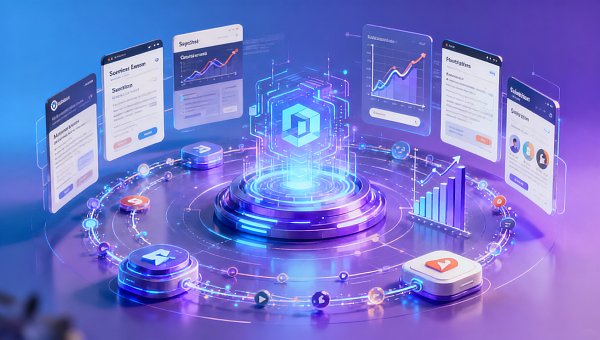
Not all businesses need to start with complex custom development. For companies in the initial to expansion phase of annual export volume, with a team of 5 to 50 people, and planning to launch a multilingual website within 30 days, cross-border e-commerce AI website building solutions are usually more cost-effective. It is especially suitable for independent website projects that need to balance brand display with inquiry conversion and marketing support.
The first type of suitable team is a foreign trade company without a complete technical department. Traditional website projects often require collaboration among multiple roles, including product, design, front-end, back-end, translation, and SEO, with a typical cycle of 4 to 12 weeks. AI website building solutions can centrally handle page construction, initial copywriting, multilingual adaptation, and basic SEO settings, compressing the launch time to 7 to 20 days, which is more conducive to seizing the window of opportunity for new products or traffic before overseas exhibitions.
The second category consists of teams that already have an official website but suffer from low marketing conversion rates. Common problems for these businesses include a bounce rate exceeding 60%, a page update cycle of more than two weeks, and website content that remains largely at the level of company introduction, failing to attract advertising and organic traffic. AI-powered website building is not simply about changing templates; it involves unified optimization of page structure, keyword placement, form logic, and content generation, making it suitable for businesses that want to truly transform their official website into a customer acquisition asset.
The third type is project-based teams with frequent multi-role collaboration. Project managers prioritize controllable scheduling, after-sales maintenance personnel are more concerned with the ease of operation of the backend, and distributors and agents are concerned with the ability to quickly replicate sites in different markets. AI solutions can break down a project into 3 phases and 8 to 12 deliverable milestones through modular pages, permission-based division of labor, and visual editing, significantly reducing cross-departmental communication costs.
Typical characteristics of a fit team
- The plan is to enter more than two overseas markets within one quarter, requiring rapid deployment of multilingual and multi-regional pages.
- We update content more than once a week to reduce manual typesetting, translation, and repetitive publishing.
- Inquiry, social media, and advertising data are scattered, and there is an urgent need to connect the website and marketing system to form a unified analytical standard.
- Technical resources are limited, but there are clear requirements for brand image, search visibility, and the quality of overseas leads.
The table below can help different types of teams quickly determine whether they are suitable for adopting an AI website building solution, and what implementation priorities they should focus on.
As the table shows, AI website building solutions are not just suitable for "small teams." They have clear practical value for any business with needs such as cross-market replication, continuous content operation, and SEO/marketing integration. The key is to choose a service model that truly integrates website building and marketing, rather than simply delivering a static website.
Why is integrating website and marketing more suitable for cross-border businesses than simply building a website?
The most common mistake made by cross-border independent websites is treating website building as a one-time delivery project rather than a continuous customer acquisition system. Launching the website is only the first step; what truly determines the return on investment is the search performance, content update frequency, social media collaboration capabilities, and lead processing efficiency over the following 3 to 12 months. If the website, SEO, social media, and advertising are disconnected, the subsequent operating costs will often be higher than the website itself.
The advantage of integrating website and marketing services lies in simultaneously advancing the closed loop of traffic acquisition, content production, and conversion. For example, when adding a new product page or case study page to an independent website, it shouldn't just stop at on-site display; it should also consider keyword coverage, social media content segmentation, ad landing page integration, and form outreach strategies. This way, the same content can be reused across 2 to 4 channels, reducing redundant work.
For overseas market operations, social media collaboration is particularly crucial. Some companies have begun to combine AI+SNS social media intelligent marketing systems with independent website operations, enabling independent website content to automatically adapt to the formats of platforms such as Facebook, LinkedIn, Instagram, and YouTube, allowing for one-time production and multi-platform distribution. For teams that need stable exposure and continuous inquiries, this model is more efficient than maintaining multiple platforms separately.
Three types of direct benefits from the integrated solution
1. Shorten the customer acquisition chain
When official website content, social media posts, and advertising pages use unified content assets, the operations team can break down a single campaign into 5 to 10 touchpoints, significantly reducing the manpower required for each campaign. This efficiency improvement is particularly noticeable for teams that need to publish more than 20 articles per month.
2. Improve conversion consistency
Visitors arriving through search, social media clicks, or ad landing pages often experience fluctuating inquiry quality if they encounter completely different brand statements, product selling points, and conversion paths. A unified website and marketing system can ensure greater stability in CTAs, form fields, customer service logic, and follow-up allocation.
3. Improve data-driven decision-making efficiency
A common challenge for project managers is not the lack of data, but rather the fragmentation of data across the website backend, advertising accounts, social media platforms, and customer service systems. An integrated platform makes it easier to establish weekly, monthly, and quarterly review mechanisms, typically enabling quick problem identification based on four key metrics: visitor numbers, lead generation rate, source channels, and response time.
The table below is suitable for evaluating the differences between the "simple website building" and "website building + marketing integration" models in actual cross-border business.
If a company's goal is not just to "have a website," but to have the website serve the functions of acquiring overseas customers, building brand awareness, and facilitating channel integration, then an integrated solution typically has higher long-term value and is more in line with the operational realities of cross-border teams.
When choosing a cross-border e-commerce AI website building solution, what capabilities should the team focus on?
While all are called AI website building solutions, their actual capabilities vary greatly. Some only provide templates and basic generation, while others cover keyword planning, page structure optimization, multilingual processing, content operation, and customer interaction. When purchasing or initiating a project, it is recommended to evaluate from at least five dimensions, avoiding comparisons based solely on price or homepage visual effects.
Core evaluation dimensions
- Website building efficiency: Does it support visual building, module reuse, and batch page generation? Can the first version be delivered within 7 to 20 days?
- SEO basics: Does it support titles, descriptions, URLs, custom categories, structured content layouts, and multilingual search entry points?
- Content capabilities: Can it generate initial drafts based on products, application scenarios, FAQs, case studies, etc., and support secondary editing by humans?
- Marketing synergy: Can it connect with social media, advertising, customer service, or CRM to avoid system silos later on?
- Security and Compliance: Does it possess basic data encryption, access control, and compliance requirements common in international markets?
If a company focuses on the European and American markets, the compliance and security capabilities of its systems cannot be ignored. For example, when accessing overseas social media and customer data, it is usually necessary to pay attention to OAuth 2.0 authorization mechanisms, encrypted storage of sensitive data, and compliance with GDPR requirements. For teams managing multiple accounts and multiple country sites, these capabilities directly impact subsequent operational risks.
In terms of marketing collaboration, solutions that can automatically generate multilingual posts, support unlimited binding of SNS accounts, and identify high-value customers through user profiling systems are better suited to the global competitive environment. Especially when customer service response time is reduced from several hours to 15 minutes, inquiry processing efficiency and customer experience will be significantly improved.
Implementation issues to be checked before procurement
- Does it support at least four types of page templates, such as product pages, case study pages, news pages, and landing pages?
- Can permissions be set for different positions to prevent operators from accidentally deleting critical content?
- Does it support continuous SEO optimization after launch, rather than just passive maintenance?
- Does it have a customer service robot and human takeover mechanism to improve the handling capability of more than 85% of common inquiries?
Global digital marketing service providers like EasyMarket, with over 10 years of experience, typically excel not only in their system tools but also in their ability to integrate website building, SEO, social media marketing, and advertising into comprehensive solutions. For business decision-makers, this means they don't need to deal with 3 to 5 different service providers, resulting in higher overall communication and execution efficiency.
How to efficiently implement an AI website building project from project initiation to launch?
The key to a successful cross-border e-commerce AI website building project lies not in piling on numerous features, but in having clear project boundaries, well-defined delivery milestones, and a continuous operational mechanism after launch. For most B2B cross-border enterprises, it is recommended to divide implementation into four phases: planning, building, optimization, and coordination. Each phase has clear inputs and outputs, which can avoid rework.
Recommended 4-phase implementation process
- Demand planning phase: Take 3 to 5 days to clarify the target countries, main products, conversion actions, language versions, and page list.
- Website setup phase: Complete the homepage, product page, case study page, contact page, and basic form configuration within 5 to 10 days.
- Content optimization phase: Spend 7 to 14 days completing keyword pages, FAQs, blog content, and basic SEO settings.
- Channel integration phase: Integrate social media, advertising, customer service, and data analysis to form a closed loop of release and follow-up.
Project managers can break down acceptance criteria into three categories: page integrity, functional stability, and marketing usability. The first two address "whether it works," while the latter determines "whether it can continuously generate leads." For example, at least six key points should be checked: form submission, mobile display, page loading, inquiry notification, site search, and language switching.
For after-sales maintenance personnel, ease of use of the backend is equally important. Ideally, non-technical staff should be able to independently perform tasks such as news updates, banner replacements, product listing/delisting, and basic data viewing after one to three days of training. This way, companies don't have to rely on outsourcing or technical support for every modification, making subsequent maintenance costs more controllable.
The table below is suitable for project initiation meetings or procurement reviews, helping teams to align delivery schedules and division of responsibilities in advance.
Based on experience, the earlier "content updates, social media collaboration, and customer response" are included in a project scope, the easier it is for the site to enter a stable growth phase after launch. Otherwise, even if the page visuals are highly complete, it may still fall into the old problems of content stagnation, insufficient traffic, and untimely lead follow-up after 30 days.
Common Misconceptions, Key Maintenance Points, and Team Upgrade Recommendations
Many companies make three common mistakes when using AI-powered website building solutions for cross-border e-commerce. First, they treat AI as a complete replacement for human labor, resulting in homogenized page content and inaccurate industry terminology. Second, they focus only on homepage design, neglecting core pages such as product pages, FAQs, and case study pages—the pages that actually drive search traffic and convert inquiries. Third, they lack a monthly update mechanism after the website goes live, causing the content to lose its competitiveness after three months.
The correct approach should be "AI for efficiency + human oversight." AI is responsible for accelerating draft generation, structuring, multilingual rewriting, and channel distribution, while humans are responsible for product differentiation, industry application details, brand strategy, and communication with key clients. This collaborative model can typically double content production efficiency while maintaining professional and credible expression.
Maintenance actions to be performed at least after launch
- Check forms, email notifications, and customer service portals once a week to prevent leads from being lost.
- We update 4 to 8 articles per month, including product articles, application scenarios, customer issues, and industry trends.
- We review keyword performance, page dwell time, bounce rate, and inquiry sources every quarter, and continuously optimize high-value pages.
- For different regional markets, fine-tune the landing page copy and conversion buttons every 2 to 3 months.
If your company is also using platforms like LinkedIn and Facebook, it's recommended to integrate social media presence into your routine website operations. Some platforms with automation capabilities can use AI to generate multilingual posts adapted to different platform specifications, and provide predictive suggestions and automated A/B testing, reducing repetitive manual adjustments. For teams looking to improve overseas exposure and the quality of inquiries, this step is often more prudent than simply increasing advertising spending.
FAQ: How long is the delivery cycle?
If the materials are relatively complete, a basic independent website can usually be launched in 7 to 15 days; if it includes multilingual support, industry content planning, SEO pages, and social media integration, the typical cycle is 3 to 6 weeks. What really affects the progress is often not the system, but the efficiency of the company's internal material preparation and review.
FAQ: Is it suitable for traditional manufacturing or distribution systems?
Suitable. Especially for companies with a large number of product SKUs and requiring multi-country websites or channel recruitment pages, AI website building can improve the efficiency of page duplication and content rewriting. For distributors and agents, unified website assets also facilitate consistent brand messaging and coordinated marketing efforts.
FAQ: How do I determine if a project is worth investing in?
We recommend using three metrics for evaluation: whether the launch cycle has been shortened by more than 30%, whether content update efficiency has been improved by about 100%, and whether a stable inquiry tracking mechanism can be established within three months. If all three can be achieved, the solution typically has high long-term value.
For companies planning overseas growth, AI-powered website building solutions for cross-border e-commerce are more suitable for teams that need to balance website building efficiency, content operation, SEO optimization, social media collaboration, and customer conversion. Whether it's a startup foreign trade company or a growing enterprise upgrading its global marketing system, a truly competitive solution shouldn't stop at simply "building a website," but should help businesses transform their websites into sustainable overseas customer acquisition portals. If you wish to further evaluate suitable website building and marketing paths based on your industry characteristics, target market, and internal team configuration, please contact us immediately to obtain a customized solution or inquire about more details of our integrated website + marketing solution.
Related Articles



Related Products
 EasyCamp SaaS Smart Website Marketing SystemE-Yingbao SaaS Smart Website Marketing System: AI-powered, zero-code website building. Rapidly launch multilingual independent e-commerce sites in just 10 minutes. Global server acceleration and AI-driven SEO optimization empower businesses to efficiently connect with global markets. The seamless integration of technology and user-friendly operation makes building e-commerce sites incredibly simple.
 AI+SEM Intelligent Advertising Marketing SystemAI+SEM drives intelligent ad creation, empowering full-funnel precision advertising marketing. The system automatically generates weekly/monthly reports, AI recommends keywords and target countries, monitors core metrics in real-time with intelligent alerts, and enables one-click high-conversion ad solutions to help quickly acquire customers and improve ROI.
 AI+SEO Dual Engine Optimization ServiceEasyWin AI+SEO Dual Engine Optimization System leverages AI-powered keyword mining, content generation, and comprehensive technical optimization to help foreign trade enterprises acquire high-quality organic traffic, significantly improving search rankings and conversion rates.
 AI+SNS Social Media Marketing SystemYingbao AI+SNS Social Media Marketing System - Precision social capture for the social media era. Supports one-click content synchronization across major platforms like Facebook and LinkedIn. AI intelligently rewrites posts for enhanced relevance. 24/7 AI customer service and user profiling analysis empower businesses to efficiently expand into global markets.
 AI+SEO营销解决方案易营宝AI+SEO营销解决方案,通过AI批量写作、智能生成TDK、精准关键词扩词等功能,全面优化网站SEO效果,提升流量与转化率。助力企业构建高效智能网站新生态。
 AI+SEM Advertising Marketing SolutionsAI+SEM Advertising Marketing Solution leverages AI technology to deeply empower SEM ad campaigns. It automatically generates weekly/monthly reports using AI, presenting account data across multiple dimensions for comprehensive insights into campaign performance and trends. The system precisely recommends keywords and target countries, intelligently generates high-conversion ad copy, and enables one-click activation of efficient campaign plans to help businesses rapidly acquire customers. Simultaneously, it monitors core metrics in real time, intelligently identifies abnormal fluctuations, and issues timely alerts to ensure stable, high-return advertising results.
 Domain Name ServicesEasyWin provides professional domain name services, including intelligent queries, one-stop registration, brand protection, and full lifecycle management, helping businesses build a digital brand image.
 EasyOperate B2C Cross-Border E-Commerce Platform & Independent WebsiteEasyStore B2C Cross-border E-commerce Independent Store is an intelligent website building and cross-border e-commerce integrated solution independently developed by EasyStore Information Technology (Beijing) Co., Ltd. The system is specially designed for small and medium-sized as well as large export enterprises, integrating 'website building, operation, marketing, advertising, and conversion' into one, helping enterprises quickly establish cross-border e-commerce independent stores to achieve brand globalization and global sales growth.
The platform supports multiple languages, multiple currencies, and multi-channel marketing, with built-in AI intelligent translation and SEO optimization systems, suitable for mainstream markets such as Southeast Asia, Europe and America, Latin America, and the Middle East, assisting Chinese manufacturing enterprises in efficiently deploying international e-commerce strategies. SSL证书易营宝提供专业SSL安全证书服务,包括单域名和泛域名证书,确保网站数据传输加密、身份验证和完整性保护,助力企业建立安全可信的在线业务环境。









