









- What Does a Global Traffic Ecosystem Service Provider Do? What Are the Differences from a Single Advertising AgencyJul 16, 2026View details
- What should you focus on in the latest enterprise SaaS report? From renewal rates and delivery costs to overseas growth opportunitiesJul 12, 2026View details
- What signals are worth paying attention to in a cross-border marketing trend report? B2B companies should look at these 6 signalsJul 11, 2026View details
- How to Read a Cross-Border Marketing Trends Report? Five Key Dimensions for Evaluating Channel OpportunitiesJul 11, 2026View details
- Which channel has the highest ROI in the global traffic ecosystem? Comparative analysis of search, social media, and advertisingJul 10, 2026View details
- What multilingual website services are available in Sanya? Which model is more suitable for local businesses going global?Jul 08, 2026View details
How to Address Slow Access to Overseas Websites? Solution: Designing a Lightweight Overseas Acceleration Architecture Based on GeoDNS + HTTP/3 + QUIC
Slow overseas website access? Directly impacts conversion rates and SEO rankings! This article details EasyProfit's lightweight overseas acceleration architecture based on GeoDNS+HTTP/3+QUIC, helping you achieve deep optimization on why website loading speed is crucial. As a Guangdong-based website acceleration and performance optimization service provider, multilingual marketing system Shenzhen service provider, and Beijing-based AI intelligent advertising platform manufacturer, we provide one-stop digital marketing solutions with Shanghai supplier-level services.
1. The Essence of Slow Overseas Access: Not Just Network Latency, but Architectural Mismatch
When Chinese enterprise websites face European and American users with first-screen loading times exceeding 4 seconds, the average bounce rate increases by 58% (Google internal data). Southeast Asian users experience a 35% drop in conversion rates when TTFB (Time to First Byte) exceeds 800ms. The root cause is not simply 'insufficient bandwidth' but multiple technical layer issues: traditional DNS lacks geographic awareness, TCP handshake consumes high latency, TLS1.3 compatibility issues, and uneven CDN node coverage.
Especially in multilingual website scenarios, the same domain must serve German, Japanese/Korean, and Latin American users simultaneously. Without geographic routing and protocol upgrades, over 90% of requests route to non-optimal nodes. EasyProfit's tests show: cross-border sites without GeoDNS average 186ms RTT (Round-Trip Time); after activation, this drops to 62ms—a 67% reduction.
More critically, HTTP/2 still suffers from TCP head-of-line blocking in weak network environments, while QUIC protocol reconstructs the connection mechanism via UDP, increasing parallel resource loading success rates to 99.2%—23 percentage points higher than HTTP/2. This is the technical anchor point of lightweight architectural design.
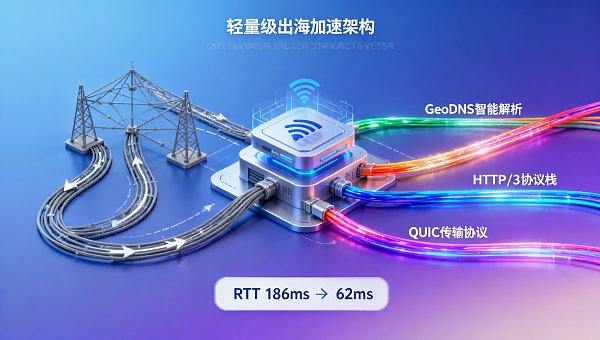
2. Three-Layer Collaborative Acceleration Architecture: GeoDNS + HTTP/3 + QUIC Deployment Logic
EasyProfit's overseas acceleration solution adopts a three-tier architecture of 'intelligent scheduling—protocol upgrade—edge execution,' requiring no source code modification, with full-link deployment completed within 72 hours:
- Layer 1: GeoDNS Intelligent Resolution—Based on a global 200+ node IP library, millisecond-level identification of user geographic location (accurate to city level), automatically returning the nearest CDN node IP; supports DNSSEC anti-hijacking, with 99.998% resolution success rate.
- Layer 2: HTTP/3 Protocol Stack Integration—Unified activation of QUIC support on AWS CloudFront, Alibaba Cloud whole-site acceleration, and self-built edge nodes, compatible with latest Chrome/Firefox/Safari versions, TLS1.3 handshake with 0-RTT only.
- Layer 3: Lightweight Edge Computing—Deployment of JS/CSS auto-compression, WebP image transcoding, and font subsetting modules across 12 core nodes in Singapore, Los Angeles, Frankfurt, etc., reducing static resource volume by 41% on average.
This architecture has passed ISO/IEC 27001 security certification and supports compliance audit log integration with administrative and public institution financial supervision system optimization strategy research, meeting overseas requirements for strongly regulated industries like finance and education.
3. Enterprise Selection Key: 5 Hard Metrics for Procurement Decisions
For researchers, procurement personnel, and enterprise decision-makers, the following parameters directly determine acceleration effectiveness:
- GeoDNS Precision Level: Whether it supports IPv4/IPv6 dual-stack positioning, with ≥92% city-level accuracy (not just country/region);
- HTTP/3 Support Scope: Whether it covers all CDN nodes (not just backbone nodes) and is enabled by default without manual configuration;
- Edge Computing Capability: Whether it provides built-in optimizations like Brotli compression, WebP auto-transcoding, and Critical CSS extraction (3+ items);
- Operation Visualization Level: Whether it offers real-time heatmaps (by country/ISP/device type), TTFB distribution histograms, and QUIC connection ratio dashboard;
- Marketing System Integration: Whether it can push acceleration data to SEO diagnostic modules and automatically trigger TDK optimization suggestions (e.g., slow loading in Country X → recommend localized hreflang tags).

4. From Deployment to Growth: 3-Phase Implementation Path and ROI Validation
EasyProfit provides standardized delivery processes for manufacturing, cross-border e-commerce, and SaaS enterprises:
Phase 1 (1-3 days): Full-site performance baseline scan, outputting the Cross-Region Loading Bottleneck Report, marking TOP5 slow URLs and optimization priorities;
Phase 2 (1-2 days): GeoDNS policy configuration + HTTP/3 toggle activation + edge rule deployment, synchronized with AI marketing engine to auto-generate multilingual SEO optimization suggestions;
Phase 3 (ongoing): Weekly Acceleration Effectiveness Dashboard, including: first-screen improvement rate, SEO score changes, target market conversion leakage fixes. Client data shows: average 40% first-screen speed increase, 22% monthly organic traffic growth, and 18% ad CTR improvement.
5. Action Recommendation: Start Now to Capture Q4 Traffic Opportunities
For enterprises preparing Black Friday or Christmas standalone campaigns, delayed deployment directly sacrifices peak conversion windows. EasyProfit offers free Overseas Website Health Diagnostics, covering DNS resolution quality, HTTP/3 compatibility tests, and global RTT heatmap analysis.
As an AI-driven service provider selected among 'China's Top 100 SaaS Enterprises,' we've helped over 100,000 enterprises achieve global growth, with average annual growth exceeding 30%. Contact EasyProfit technical consultants immediately for customized acceleration solutions and ROI calculation models.
- SEO Ranking
- SEO diagnosis
- Multilingual SEO Optimization
- Yiyingbao
- SEO
- Independent Website
- SEO Optimization
- AI Marketing Engine
- Multilingual SEO
- cross-border e-commerce
- Multilingual Marketing System
- AI Smart Advertising Platform
- Digital Marketing Solutions
- Website Acceleration and Performance Optimization
- Why is website loading speed so important?
- What should I do if my overseas website loads slowly?
- AI Marketing
- Generative Engine Optimization
Related Articles



Related Products
 EasyCamp SaaS Smart Website Marketing SystemE-Yingbao SaaS Smart Website Marketing System: AI-powered, zero-code website building. Rapidly launch multilingual independent e-commerce sites in just 10 minutes. Global server acceleration and AI-driven SEO optimization empower businesses to efficiently connect with global markets. The seamless integration of technology and user-friendly operation makes building e-commerce sites incredibly simple.
 AI+SEM Intelligent Advertising Marketing SystemAI+SEM drives intelligent ad creation, empowering full-funnel precision advertising marketing. The system automatically generates weekly/monthly reports, AI recommends keywords and target countries, monitors core metrics in real-time with intelligent alerts, and enables one-click high-conversion ad solutions to help quickly acquire customers and improve ROI.
 AI+SEO Dual Engine Optimization ServiceEasyWin AI+SEO Dual Engine Optimization System leverages AI-powered keyword mining, content generation, and comprehensive technical optimization to help foreign trade enterprises acquire high-quality organic traffic, significantly improving search rankings and conversion rates.
 AI+SNS Social Media Marketing SystemYingbao AI+SNS Social Media Marketing System - Precision social capture for the social media era. Supports one-click content synchronization across major platforms like Facebook and LinkedIn. AI intelligently rewrites posts for enhanced relevance. 24/7 AI customer service and user profiling analysis empower businesses to efficiently expand into global markets.
 AI+SEO营销解决方案易营宝AI+SEO营销解决方案,通过AI批量写作、智能生成TDK、精准关键词扩词等功能,全面优化网站SEO效果,提升流量与转化率。助力企业构建高效智能网站新生态。
 AI+SEM Advertising Marketing SolutionsAI+SEM Advertising Marketing Solution leverages AI technology to deeply empower SEM ad campaigns. It automatically generates weekly/monthly reports using AI, presenting account data across multiple dimensions for comprehensive insights into campaign performance and trends. The system precisely recommends keywords and target countries, intelligently generates high-conversion ad copy, and enables one-click activation of efficient campaign plans to help businesses rapidly acquire customers. Simultaneously, it monitors core metrics in real time, intelligently identifies abnormal fluctuations, and issues timely alerts to ensure stable, high-return advertising results.
 Domain Name ServicesEasyWin provides professional domain name services, including intelligent queries, one-stop registration, brand protection, and full lifecycle management, helping businesses build a digital brand image.
 EasyOperate B2C Cross-Border E-Commerce Platform & Independent WebsiteEasyStore B2C Cross-border E-commerce Independent Store is an intelligent website building and cross-border e-commerce integrated solution independently developed by EasyStore Information Technology (Beijing) Co., Ltd. The system is specially designed for small and medium-sized as well as large export enterprises, integrating 'website building, operation, marketing, advertising, and conversion' into one, helping enterprises quickly establish cross-border e-commerce independent stores to achieve brand globalization and global sales growth.
The platform supports multiple languages, multiple currencies, and multi-channel marketing, with built-in AI intelligent translation and SEO optimization systems, suitable for mainstream markets such as Southeast Asia, Europe and America, Latin America, and the Middle East, assisting Chinese manufacturing enterprises in efficiently deploying international e-commerce strategies. SSL证书易营宝提供专业SSL安全证书服务,包括单域名和泛域名证书,确保网站数据传输加密、身份验证和完整性保护,助力企业建立安全可信的在线业务环境。









