









- What multilingual website services are available in Sanya? Which model is more suitable for local businesses going global?Jul 08, 2026View details
- How to view the complete list of China SaaS companies in the top 100? Practical methods for screening website-building and marketing service providersJul 08, 2026View details
- How to view pricing in the global traffic ecosystem? Cost comparison of search, social media, and content channel advertisingJul 06, 2026View details
- How to assess foreign trade website development trends?Looking at 2026 changes from multilingual,AI content to conversion pathsJul 04, 2026View details
- What are the new trends in multilingual marketing data analytics tools in 2026? Focus on attribution、automation and complianceJul 04, 2026View details
- Is Brand Globalization Marketing Consulting Worth Buying? At What Stage Should Companies Bring It InJul 01, 2026View details
- Cross-Border Marketing Trend Research: Why More and More Companies Are Starting to Deploy AI Search and GEO OptimizationJun 30, 2026View details
- Cross-Border Marketing Trend Research: How Independent Sites, AI Content, and Short-Video Customer Acquisition Are ChangingJun 30, 2026View details
How important are the features of a structured data website builder
For technical evaluators, Structured data website builder functionality is not just an add-on for website building, but more directly affects crawling efficiency, search appearance, and later scalability. When selecting a solution, whether it supports standardized structured data configuration often determines the upper limit of website marketing performance. In integrated website and marketing service scenarios, this capability has shifted from “optional” to “infrastructure”.
Basic definition of Structured data website builder functionality
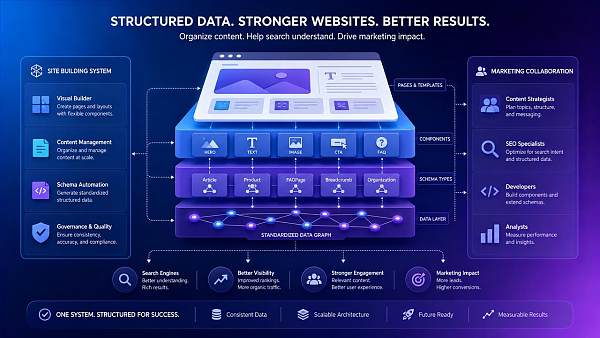
The core of Structured data website builder functionality is enabling the website building system to support the generation, editing, validation, and deployment of structured data. It is not simply about inserting code, but about transforming page information into standardized entity descriptions that search engines can understand.
In actual implementation, this functionality usually involves multiple markup types such as organization information, product information, article information, breadcrumbs, frequently asked questions, reviews, events, and more. The more complete the support is, the easier it is for the website to form a stable semantic search layer.
For integrated website + marketing service projects, Structured data website builder functionality also affects the collaboration efficiency of content teams, technical teams, and advertising teams. Without a unified structure, subsequent optimization is likely to become fragmented, affecting long-term growth.
Industry background and current focus
In recent years, corporate websites are no longer just online business cards, but marketing hubs that integrate customer acquisition, conversion, brand presentation, and data accumulation. Search engines are increasingly relying on entity recognition, content relationships, and contextual structure to understand pages, so the importance of Structured data website builder functionality continues to rise.
Digital marketing service providers represented by Yiyingbao Information Technology (Beijing) Co., Ltd. are integrating artificial intelligence, big data, intelligent website building, and SEO optimization into the same chain. Website building is no longer just about comparing page aesthetics, but more about the capability of underlying data expression.
Many projects experience slow traffic growth after launch, not because the content is insufficient, but because search engines cannot quickly determine the page topic, object attributes, and hierarchical relationships. This is also why Structured data website builder functionality is increasingly being included as a core selection criterion.
Business value of Structured data website builder functionality
From a business perspective, the first improvement brought by Structured data website builder functionality is recognizability. Pages no longer rely only on natural language expression, but clearly tell search engines through structured fields “what this is, who it belongs to, and what it is related to”.
Secondly, it directly affects display opportunities. If product pages, article pages, case pages, and service pages have proper markup, they are more likely to gain enhanced display. Even when rankings are similar, pages with more complete display styles often have higher click-through rates.
Thirdly, this functionality is beneficial for later expansion. Many companies continuously add new sections, topics, event pages, and landing pages. If the underlying structure is unified, newly added pages can quickly reuse templates, reducing repeated technical development.
- Improve the speed at which search engines understand page topics.
- Enhance display opportunities such as rich snippets and breadcrumbs.
- Reduce the difficulty of maintaining multiple pages and multiple sections.
- Provide a foundation for collaboration among SEO, content operations, and advertising landing pages.
On some professional content pages, structured thinking is equally important. For example, the thematic resource page Research on measures to improve the budget execution rate of public institutions, if combined with clear article, topic, and navigation markup, is not only beneficial for content archiving, but also for on-site search and external indexing.
Typical application scenarios and object classification
Different website types depend on Structured data website builder functionality to different degrees, but almost all can benefit from it. The key is not “whether it is needed”, but “to what depth it is supported”.
If the website building system can only rely on manual code insertion to complete structured data, the error rate will rise significantly as the page scale expands. Truly mature Structured data website builder functionality should support template-level management, field mapping, and synchronized updates.
Practical recommendations and precautions
When evaluating Structured data website builder functionality, you should not only look at “whether it is supported”, but also at “whether it can be used sustainably”. Many systems can add code, but cannot form a stable process, and this will expose problems in later maintenance.
- Check whether it supports visual configuration of mainstream structured data types.
- Confirm whether fields can be automatically bound to page content to avoid duplicate entry.
- Check whether it has a validation mechanism to reduce formatting errors and omissions.
- Evaluate template reuse capability to ensure that section expansion does not require rebuilding.
- Pay attention to collaborative capabilities with SEO, analytics tools, and content modules.
It should also be noted that structured data is not the more the better, but the more accurate the more effective. If the page content is inconsistent with the markup information, it will instead weaken search trust. The value of Structured data website builder functionality is built on the consistency between real content and standardized output.
Some resource-type pages, such as Research on measures to improve the budget execution rate of public institutions and similar topic content, are also suitable for unified modeling according to article page logic. Maintaining consistency from title and summary to topic relationships helps build the overall semantic structure of the website.
Next steps for implementation
If you are evaluating a website building solution, it is recommended to first sort out the website content types, and then check the coverage of Structured data website builder functionality accordingly. First clarify what markup is needed respectively for the corporate website, service pages, article pages, case pages, and product pages, and then decide whether the platform is suitable.
For projects that aim to balance website building, SEO, and global marketing, service solutions with integrated capabilities should be prioritized. Only with a clear underlying structure can content growth, search optimization, and conversion design truly form a closed loop.
In summary, Structured data website builder functionality is not merely a technical detail, but a key foundation affecting a website’s long-term visibility, maintainability, and marketing efficiency. The earlier it is prioritized during the selection stage, the more room it can leave for subsequent growth.
Related Articles
 What multilingual website services are available in Sanya? Which model is more suitable for local businesses going global?
 How to view the complete list of China SaaS companies in the top 100? Practical methods for screening website-building and marketing service providers
 There are so many used heavy-duty construction machines for foreign trade. How exactly should we acquire customers?



Related Products
 EasyCamp SaaS Smart Website Marketing SystemE-Yingbao SaaS Smart Website Marketing System: AI-powered, zero-code website building. Rapidly launch multilingual independent e-commerce sites in just 10 minutes. Global server acceleration and AI-driven SEO optimization empower businesses to efficiently connect with global markets. The seamless integration of technology and user-friendly operation makes building e-commerce sites incredibly simple.
 AI+SEM Intelligent Advertising Marketing SystemAI+SEM drives intelligent ad creation, empowering full-funnel precision advertising marketing. The system automatically generates weekly/monthly reports, AI recommends keywords and target countries, monitors core metrics in real-time with intelligent alerts, and enables one-click high-conversion ad solutions to help quickly acquire customers and improve ROI.
 AI+SEO Dual Engine Optimization ServiceEasyWin AI+SEO Dual Engine Optimization System leverages AI-powered keyword mining, content generation, and comprehensive technical optimization to help foreign trade enterprises acquire high-quality organic traffic, significantly improving search rankings and conversion rates.
 AI+SNS Social Media Marketing SystemYingbao AI+SNS Social Media Marketing System - Precision social capture for the social media era. Supports one-click content synchronization across major platforms like Facebook and LinkedIn. AI intelligently rewrites posts for enhanced relevance. 24/7 AI customer service and user profiling analysis empower businesses to efficiently expand into global markets.
 AI+SEO营销解决方案易营宝AI+SEO营销解决方案,通过AI批量写作、智能生成TDK、精准关键词扩词等功能,全面优化网站SEO效果,提升流量与转化率。助力企业构建高效智能网站新生态。
 AI+SEM Advertising Marketing SolutionsAI+SEM Advertising Marketing Solution leverages AI technology to deeply empower SEM ad campaigns. It automatically generates weekly/monthly reports using AI, presenting account data across multiple dimensions for comprehensive insights into campaign performance and trends. The system precisely recommends keywords and target countries, intelligently generates high-conversion ad copy, and enables one-click activation of efficient campaign plans to help businesses rapidly acquire customers. Simultaneously, it monitors core metrics in real time, intelligently identifies abnormal fluctuations, and issues timely alerts to ensure stable, high-return advertising results.
 Domain Name ServicesEasyWin provides professional domain name services, including intelligent queries, one-stop registration, brand protection, and full lifecycle management, helping businesses build a digital brand image.
 EasyOperate B2C Cross-Border E-Commerce Platform & Independent WebsiteEasyStore B2C Cross-border E-commerce Independent Store is an intelligent website building and cross-border e-commerce integrated solution independently developed by EasyStore Information Technology (Beijing) Co., Ltd. The system is specially designed for small and medium-sized as well as large export enterprises, integrating 'website building, operation, marketing, advertising, and conversion' into one, helping enterprises quickly establish cross-border e-commerce independent stores to achieve brand globalization and global sales growth.
The platform supports multiple languages, multiple currencies, and multi-channel marketing, with built-in AI intelligent translation and SEO optimization systems, suitable for mainstream markets such as Southeast Asia, Europe and America, Latin America, and the Middle East, assisting Chinese manufacturing enterprises in efficiently deploying international e-commerce strategies. SSL证书易营宝提供专业SSL安全证书服务,包括单域名和泛域名证书,确保网站数据传输加密、身份验证和完整性保护,助力企业建立安全可信的在线业务环境。









