









- What stages does the cross-border services ecosystem include? How do website building, promotion, payment, and compliance work togetherJun 22, 2026View details
- How will email marketing costs change in 2026Jun 22, 2026View details
- The China-US tariff arrangement has reached a preliminary consensus, and the trade association will be establishedJun 15, 2026View details
- Should overseas brand marketing start with ads or contentJun 21, 2026View details
- What determines B2C cross-border e-commerce website development costs? A breakdown of features, interfaces, and deployment methodsJun 17, 2026View details
- China-Morocco zero-tariff access, a breakthrough in the cost of Moroccan goods exports to ChinaJun 11, 2026View details
SEO Professionals Must Read: How Does Enterprise Website Content Structure Affect Overseas Marketing Effectiveness? Detailed Explanation of EasyYun Template-Level Optimization Logic
The content architecture of an enterprise website quietly determines the success of overseas marketing! How can SEO professionals leverage website platforms to optimize corporate websites? EasyMarketing uses AI-driven template-level SEO logic to integrate website construction, multilingual adaptation, and global search ranking improvements—overseas marketing starts from the first line of code on the official website.
1. Content Structure Is Not a "Layout Issue" but the Foundational Framework for Overseas Search Visibility
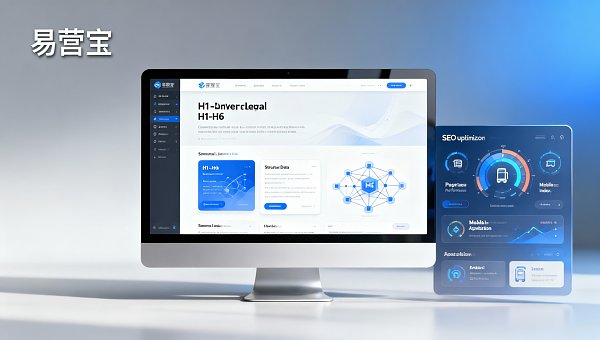
Many SEO professionals still interpret the content structure of corporate websites as visual organization at the UI/UX level, which is a serious misconception. In the crawling logic of mainstream search engines like Google, Bing, and Yandex, semantic hierarchy (H1-H6 nesting depth), content block accessibility (ARIA tag support), internal link topology density, and structured data embedding integrity collectively form the core factors influencing indexing priority and keyword relevance scoring. Particularly in overseas marketing scenarios targeting non-Chinese markets, an HTML document not modeled according to ISO semantic standards may directly prevent target-country users from triggering Google's "Featured Snippet" or localized knowledge graph display when searching for "industrial machinery supplier."

According to BrightEdge's 2023 global search trends report, for multilingual sites, every one-level improvement in content structure compliance (based on W3C Web Content Accessibility Guidelines 2.1 AA standards) increases average dwell time on the homepage in top 3 Google SERP positions by 47 seconds and reduces bounce rates by 22%. This means: corporate websites are not static information containers but dynamic "semantic nodes" participating in the global search ecosystem. What truly enables this capability is whether the website platform pre-configures JSON-LD structured data modules compliant with the latest Schema.org specifications at the template level, natively supports intelligent hreflang tag generation, and automatically injects FAQPage and HowTo Schema for core product pages—these are precisely the "SEO pre-hardening" features completed by EasyMarketing's intelligent website system during template design.
2. Multilingual ≠ Translation Patching: AI-Driven Semantic Alignment Is the Decider of Overseas SEO Success
A common mistake is equating "supporting multilingual" with "providing translation buttons." In real overseas marketing scenarios, German users searching for "hydraulische Pressen Hersteller" and American users searching for "hydraulic press manufacturer" exhibit significant intent differences: the former leans toward technical parameters and CE certification details, while the latter focuses more on delivery cycles and after-sales responsiveness. Relying solely on machine translation can lead to keyword density imbalance, loss of localized terminology, and even cultural misinterpretation.
EasyMarketing's AI marketing engine employs a "three-layer semantic alignment" mechanism: Layer 1 uses BERT-multilingual models for cross-language intent clustering; Layer 2 integrates Google Trends and SE Ranking regional hotword databases to dynamically generate high-converting long-tail phrases; Layer 3 ensures technical parameters (e.g., IP ratings, operating temperature ranges) strictly correspond to target-market regulatory terminology through NLP entity recognition. For example, when the system detects a page needs publishing for the Japanese market, it automatically replaces "dustproof" with "防塵構造" compliant with JIS C 0920 standards and converts "2-year warranty" into "24ヶ月間の無償修理保証" per Japan's Specific Commercial Transactions Act. This deep semantic adaptation grants client websites natural "geo-authority" weighting in Japanese searches, beyond mere TDK stuffing.
3. From "Accessible" to "Trusted": Technical Foundations Determine the Starting Point of Overseas User Decision Chains
Website loading speed is just the baseline. True overseas marketing trust begins with explicit expressions of technical reliability. According to Cloudflare's 2024 global network performance whitepaper, sites enabling Internet Protocol Version 6 (IPv6) see 31% lower Time to First Byte (TTFB) in North America and Europe, with built-in IPSec protocols and end-to-end encryption significantly improving SSL certificate verification rates for heavily regulated industries like banking and healthcare.
EasyMarketing's global CDN nodes default to dual-stack IPv6 support, with templates pre-embedded with HTTP/3 compatibility markers and QUIC protocol negotiation headers. This means: when a French procurement officer accesses a client site via Chrome, the system automatically triggers 0-RTT handshakes, compressing page resource delays to millisecond levels; simultaneously, all API calls transmit through AES-256-GCM encrypted channels, meeting GDPR's mandatory data security requirements. This "invisible technical trust" has become a key implicit metric for overseas B2B buyers to assess suppliers' digital maturity.
4. Elevating SEO from "Firefighter" to "Growth Architect"
Over a decade serving 100,000+ export enterprises, EasyMarketing has crystallized a reusable "template-level SEO governance framework": embedding SEO health dashboards during template development to validate 912 indicators—from page load performance and structured data coverage to mobile adaptation and localized semantic consistency; post-launch, AI engines continuously scan Google Search Console API dataflows, identifying "high-click-low-conversion" keywords for reverse content structure optimization; most critically, all optimizations are recorded in "auditable, reversible, attributable" ways, forming proprietary SEO knowledge graphs.
This fundamentally transforms SEO roles—no longer reactive to algorithm updates but proactively defining enterprises' semantic coordinates in the global search ecosystem. When homepage H1 tags auto-match target markets' top 3 search intents, when product page FAQ modules synchronize with Google Discover trending Q&A, when multilingual versions form Hub & Spoke semantic link networks, overseas marketing evolves from "traffic acquisition" to "mindshare dominance."
EasyMarketing transcends website platforms—it's an enterprise globalization semantic operating system. Contact us now for exclusive overseas SEO structural diagnostics and template-level optimization solutions.
Related Articles
Related Products
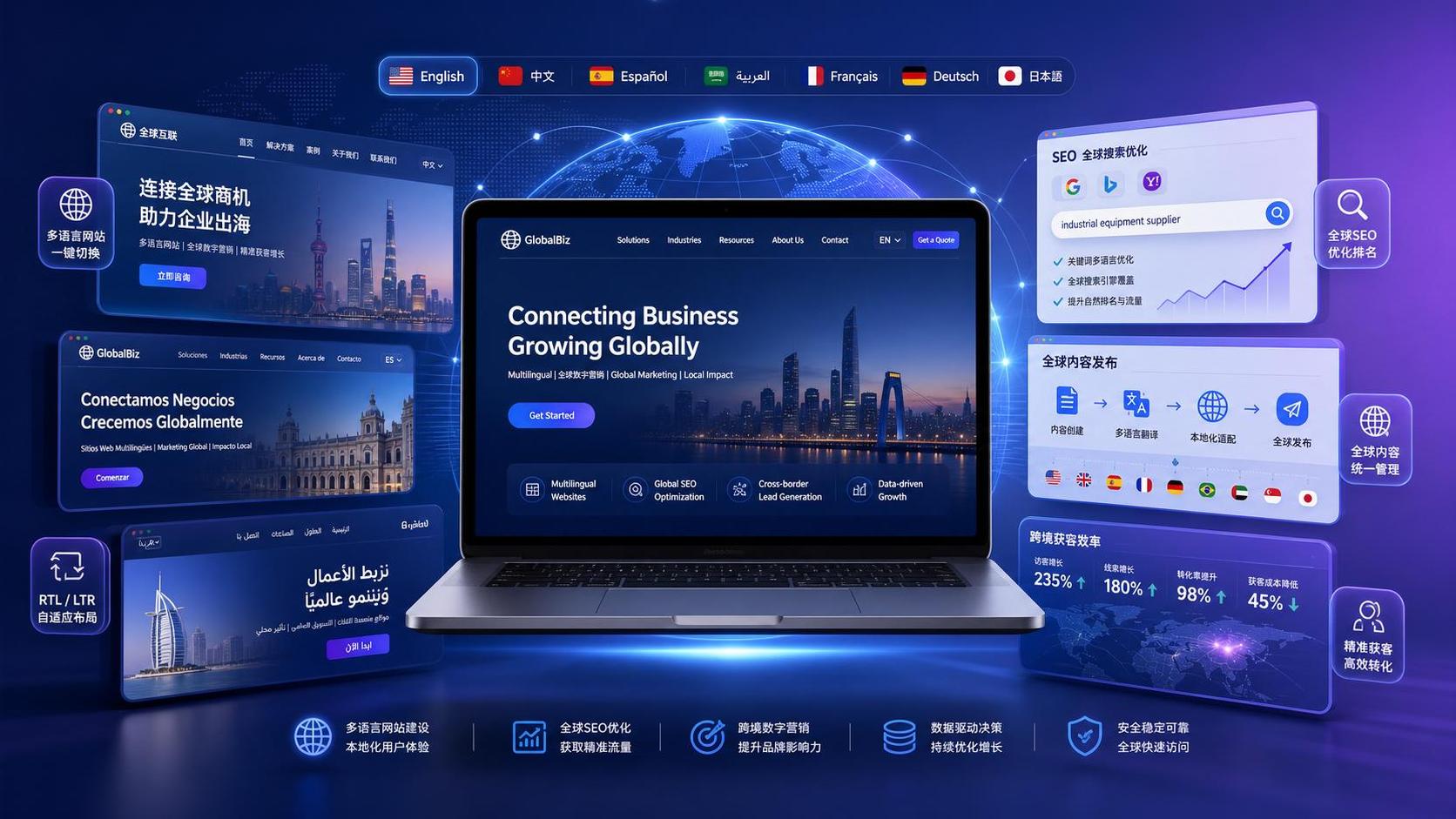
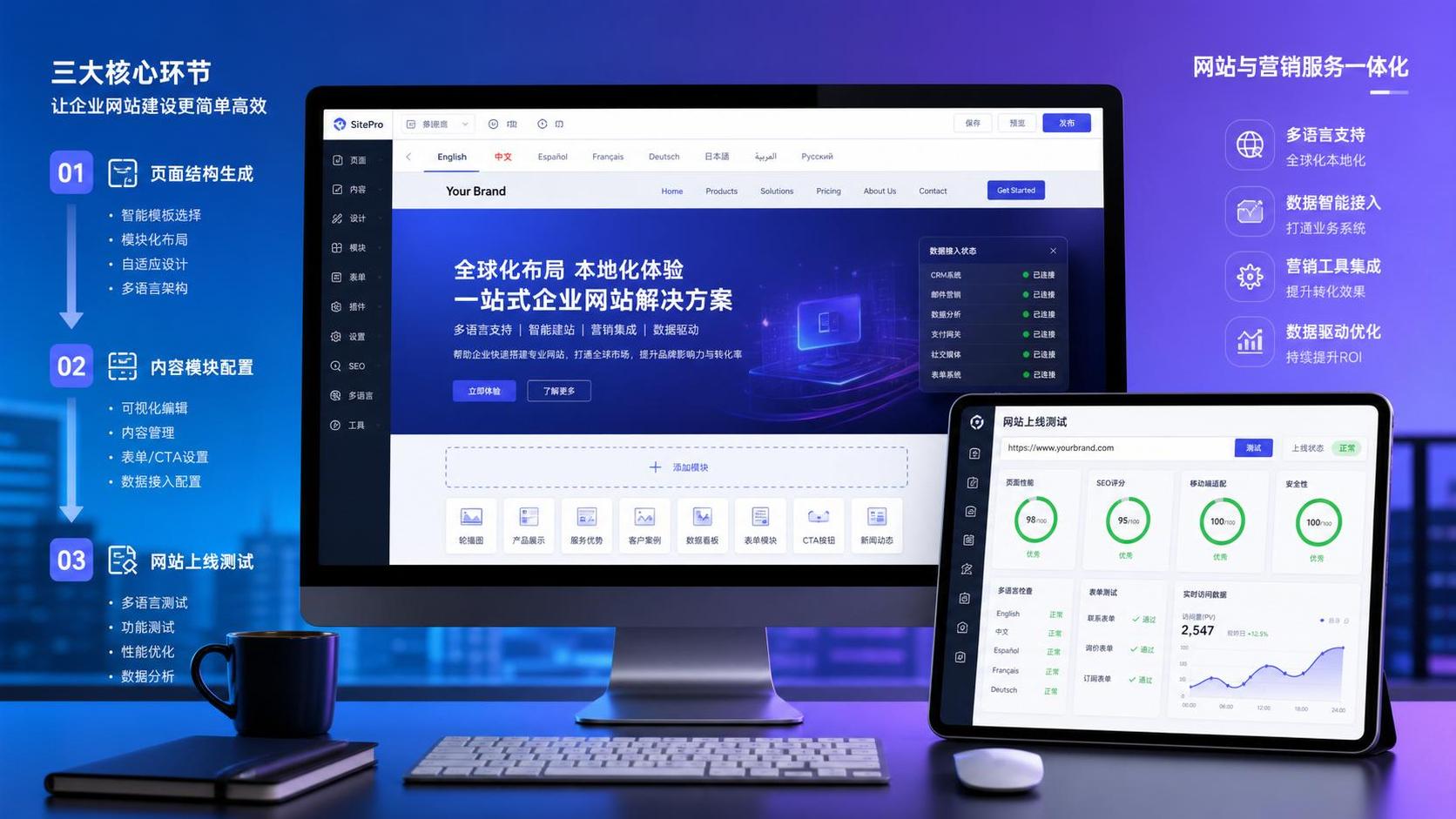
 EasyCamp SaaS Smart Website Marketing SystemE-Yingbao SaaS Smart Website Marketing System: AI-powered, zero-code website building. Rapidly launch multilingual independent e-commerce sites in just 10 minutes. Global server acceleration and AI-driven SEO optimization empower businesses to efficiently connect with global markets. The seamless integration of technology and user-friendly operation makes building e-commerce sites incredibly simple.
 AI+SEM Intelligent Advertising Marketing SystemAI+SEM drives intelligent ad creation, empowering full-funnel precision advertising marketing. The system automatically generates weekly/monthly reports, AI recommends keywords and target countries, monitors core metrics in real-time with intelligent alerts, and enables one-click high-conversion ad solutions to help quickly acquire customers and improve ROI.
 AI+SEO Dual Engine Optimization ServiceEasyWin AI+SEO Dual Engine Optimization System leverages AI-powered keyword mining, content generation, and comprehensive technical optimization to help foreign trade enterprises acquire high-quality organic traffic, significantly improving search rankings and conversion rates.
 AI+SNS Social Media Marketing SystemYingbao AI+SNS Social Media Marketing System - Precision social capture for the social media era. Supports one-click content synchronization across major platforms like Facebook and LinkedIn. AI intelligently rewrites posts for enhanced relevance. 24/7 AI customer service and user profiling analysis empower businesses to efficiently expand into global markets.
 AI+SEO营销解决方案易营宝AI+SEO营销解决方案,通过AI批量写作、智能生成TDK、精准关键词扩词等功能,全面优化网站SEO效果,提升流量与转化率。助力企业构建高效智能网站新生态。
 AI+SEM Advertising Marketing SolutionsAI+SEM Advertising Marketing Solution leverages AI technology to deeply empower SEM ad campaigns. It automatically generates weekly/monthly reports using AI, presenting account data across multiple dimensions for comprehensive insights into campaign performance and trends. The system precisely recommends keywords and target countries, intelligently generates high-conversion ad copy, and enables one-click activation of efficient campaign plans to help businesses rapidly acquire customers. Simultaneously, it monitors core metrics in real time, intelligently identifies abnormal fluctuations, and issues timely alerts to ensure stable, high-return advertising results.
 Domain Name ServicesEasyWin provides professional domain name services, including intelligent queries, one-stop registration, brand protection, and full lifecycle management, helping businesses build a digital brand image.
 EasyOperate B2C Cross-Border E-Commerce Platform & Independent WebsiteEasyStore B2C Cross-border E-commerce Independent Store is an intelligent website building and cross-border e-commerce integrated solution independently developed by EasyStore Information Technology (Beijing) Co., Ltd. The system is specially designed for small and medium-sized as well as large export enterprises, integrating 'website building, operation, marketing, advertising, and conversion' into one, helping enterprises quickly establish cross-border e-commerce independent stores to achieve brand globalization and global sales growth.
The platform supports multiple languages, multiple currencies, and multi-channel marketing, with built-in AI intelligent translation and SEO optimization systems, suitable for mainstream markets such as Southeast Asia, Europe and America, Latin America, and the Middle East, assisting Chinese manufacturing enterprises in efficiently deploying international e-commerce strategies. SSL证书易营宝提供专业SSL安全证书服务,包括单域名和泛域名证书,确保网站数据传输加密、身份验证和完整性保护,助力企业建立安全可信的在线业务环境。









