









- The China-US tariff arrangement has reached a preliminary consensus, and the trade association will be establishedJun 15, 2026View details
- China-Morocco zero-tariff access, a breakthrough in the cost of Moroccan goods exports to ChinaJun 11, 2026View details
- What signal should be released for the suspension of exports to JapanJun 10, 2026View details
- China's May LNG imports rebounded, with increased volumes from Russia and Canada filling the Middle East supply gapJun 10, 2026View details
- Will GEO change its SEO strategy?Jun 04, 2026View details
- What types of businesses are end-to-end solutions suitable for?Jun 03, 2026View details
- 2026 Global Growth Channel TrendsJun 02, 2026View details
- Changes in Search Engine Ranking Factors in 2026Jun 06, 2026View details
Is AI-generated writing suitable for bulk publishing
Is AI-generated writing suitable for bulk publishing? The answer is: yes, but it is not suitable for bulk publishing with “no strategy, no review, and no quality control.” For companies integrating websites + marketing services, AI writing can indeed significantly improve content production efficiency and reduce the cost of basic content. However, if it is treated as a one-click mass production tool, it often leads to unstable search engine optimization service results, high page duplication, distorted brand expression, and may even affect the overall SEO performance of the website. The truly effective approach is not to simply pursue publishing volume, but to establish a content production mechanism of “topic strategy + content layering + manual review + continuous optimization.”
Can AI bulk writing be used? Let’s start with the conclusion: yes, but it must be scenario-based

Many companies searching for “Is AI-generated writing suitable for bulk publishing?” are essentially not trying to discuss the technology itself, but rather to determine whether this approach can truly bring stable traffic, leads, and conversions to the business.
From a practical perspective, AI writing is suitable for bulk publishing, but only if the content type matches. For content such as information compilation, basic Q&A, long-tail keyword pages, product description pages, and industry knowledge pages, where the structure is relatively clear and the information granularity is well-defined, AI-generated drafts can usually be put into use quickly after editorial refinement.
However, for highly competitive industry topics, brand opinion articles, highly specialized niche content, and conversion-focused pages that require support from real case studies, relying solely on AI for bulk generation often fails to achieve ideal results. This is because what users truly need is not “text that looks like an article,” but information that solves problems, builds trust, and supports decision-making.
For business decision-makers, the core criterion is not “whether AI can write,” but “whether AI-generated content can achieve effective indexing, ranking, and conversion.” For execution teams, the key is “which content is suitable for AI to produce first, and which must be led by humans.”
What the target audience really cares about is not efficiency itself, but the results after bulk publishing
From the perspective of different roles, the questions they care about are actually very specific:
- Business decision-makers care about ROI: whether AI content can reduce customer acquisition costs, improve content production capacity, and support SEO growth.
- Users and operators care about whether the workflow is easy to execute, whether publishable content can be produced quickly, and how rework can be reduced.
- Quality control or compliance management personnel care about whether the content contains factual errors, sensitive expressions, copyright risks, or brand control issues.
- After-sales and service staff care about whether the content can truly answer customers’ common questions and reduce the pressure of repetitive inquiries.
- Distributors, agents, and channel partners care about whether unified content can be replicated and disseminated while also meeting localized marketing needs.
- End consumers care about whether the information is truthful, clear, and trustworthy, not who wrote it.
Therefore, when AI writing is used for bulk publishing, what deserves the most attention is not the superficial quantity, but four outcome indicators: content indexing rate, keyword coverage rate, page engagement performance, and lead conversion capability. If these four metrics do not improve, then even a very high publishing frequency may only mean “looking busy.”
Where exactly do the advantages of AI bulk publishing lie?
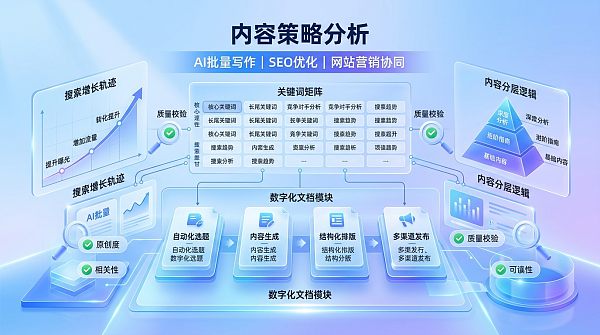
If used properly, AI content generation does have clear advantages in SEO content optimization.
First, it can quickly cover long-tail search demand. A large number of user searches are not concentrated on a few major keywords, but distributed across a massive number of niche keywords. AI is good at rapidly generating topic-related content in a unified structure, making it suitable for building a keyword matrix.
Second, it can improve the stability of content supply. Many companies do not lack content direction, but rather production capacity and update consistency. AI can serve as a drafting tool to help teams maintain a steady publishing frequency.
Third, it is suitable for expansion across multiple websites, regions, and products. For companies with multilingual, multi-business-line, or multi-city page requirements, AI can improve standardized content production capacity. Combined with localized editing, it becomes easier to scale results.
Fourth, it can reduce labor costs for basic content. Especially for standardized content such as FAQs, product parameter descriptions, knowledge base articles, and basic tutorials, AI can take on a considerable portion of the initial drafting work.
This is also why more and more companies integrating websites + marketing services are incorporating AI writing into their content middle-platform capabilities. For companies like Yiyingbao Information Technology (Beijing) Co., Ltd., which have long focused on collaborative services in intelligent website building, SEO optimization, social media marketing, and advertising placement, the greater priority is not standalone content generation, but how content forms a closed loop with site structure, search demand, conversion paths, and brand expression.
Why do many companies publish a large number of AI articles, yet still see poor SEO results?
The problem usually is not “using AI,” but “using AI incorrectly.” The following situations are the most common:
- Severe content homogenization: During bulk generation, if prompt templates are too uniform and structures are too similar, pages can easily become highly repetitive, affecting indexing and rankings.
- Mechanical keyword placement: If the focus is only on keyword stuffing without considering search intent and semantic relevance, the article may look SEO-optimized, but in reality it is neither user-friendly nor likely to be recognized by search engines.
- Lack of industry experience and case studies: Pure AI text is often “correct but useless,” lacking practical detail, so users still do not know what to do after reading it.
- Disconnect between content and brand tone: If articles published in different batches do not maintain a consistent voice, the company’s professional image can easily be weakened.
- No review mechanism: Factual errors, inconsistent terminology, and imprecise policy-related statements can all create risks.
This risk is even more obvious in professional industries. For example, content in certain vertical fields involves not only language organization, but also institutions, data, and professional background. Without verification, even if an article reads smoothly on the surface, it may still mislead readers. Professional topics such as Research on Financial Management of Hospital Infrastructure Projects Under the Background of the New Accounting System are not suitable for simple bulk publishing directly from general-purpose templates, and instead require professional review mechanisms.
Which types of content are suitable for AI bulk generation, and which are not recommended for direct bulk publishing?
If a company wants to truly apply AI writing to search engine optimization services, it is recommended to first establish content grading.
Content suitable for AI bulk generation and publication after editing:
- Long-tail keyword Q&A pages
- Basic industry knowledge articles
- Product feature introductions and FAQ pages
- Service process explanation pages
- Standardized landing pages for multiple regions and scenarios
- Knowledge bases, help centers, and after-sales support content
Content not recommended for direct reliance on AI bulk publishing:
- Core brand opinion articles
- High-value conversion page copy
- Highly specialized niche content involving law, finance, healthcare, engineering, etc.
- Articles requiring real customer cases and data proof
- Highly competitive topic content requiring deep insight
In simple terms: standardized, structured, and verifiable information is suitable for AI to improve efficiency; content that requires judgment, experience, and trust endorsement should be led by humans, with AI assisting.
How can companies use AI for bulk publishing in a safer and more effective way?
A truly practical approach is not “generate - publish,” but “plan - generate - edit - review - optimize.”
- Start with keyword segmentation, not article writing.
Divide keywords into brand terms, product terms, question terms, scenario terms, regional terms, and comparison terms, then decide which are suitable for bulk generation. - Create templates for different content types.
FAQ pages, tutorial pages, product pages, and case pages should use different structures to avoid site-wide content patterning. - Let AI generate drafts, not final versions.
Position AI as a “content assistant,” not the “final editor.” - Add human experience-based information.
This includes common customer questions, frontline sales feedback, pain points in the implementation process, and after-sales cases. These are the elements that most improve the real value of an article. - Set up a review mechanism.
Check facts, terminology, sensitive wording, brand consistency, duplication rate, and readability. - Continue monitoring data after publication.
Observe indexing, rankings, click-through rate, time on page, and inquiry conversions, then optimize prompts and content structure.
If a company itself lacks a mature content team, it is more suitable to cooperate with an integrated service provider that has capabilities in website building, SEO, and data analysis. Because what bulk publishing really needs to solve is not only “writing content,” but “making content create sustained growth value within the website system.”
How can you tell whether your company is currently suitable for adopting AI bulk content?
You can quickly self-assess with the following questions:
- Does the company already have a clear keyword strategy, instead of writing whatever comes to mind?
- Does the website structure support content accumulation and internal linking?
- Is someone responsible for content review and quality control?
- Can you distinguish between traffic-oriented content, educational content, and conversion-oriented content?
- Are you willing to keep iterating based on data results, instead of abandoning management after a one-time mass publication?
If most of the above answers are negative, then strengthening the foundational capabilities is more important than rushing into bulk publishing. Conversely, if a company already has a basic SEO framework, content management workflow, and quality standards, then AI writing can become a highly effective growth lever.
In some specialized niche scenarios, even content that appears standardized still requires secondary enhancement. For example, articles involving finance, systems, engineering construction, healthcare management, and similar areas can introduce authoritative research or professional reference materials into the source library to assist editing, thereby improving credibility and differentiation. Topics such as Research on Financial Management of Hospital Infrastructure Projects Under the Background of the New Accounting System are more suitable for an approach of “AI-organized structure + professional finalization,” rather than fully automated generation.
Conclusion: AI writing is suitable for bulk publishing, but only when “quantity” is built on top of “quality” and “strategy”
Returning to the original question, is AI-generated writing suitable for bulk publishing? The answer is very clear: yes, but it is definitely not simple copy-and-paste mass production. For companies integrating websites + marketing services, the greatest value of AI lies in improving content production efficiency, expanding keyword coverage, and supporting the SEO content optimization system, rather than replacing professional judgment and quality control.
Truly effective bulk publishing should revolve around user search intent, while balancing search engine optimization service performance, brand consistency, and actual conversion value. Whoever can apply AI to the right content types, establish a stable editing and review mechanism, and continuously optimize content strategy with data will be more likely to truly transform “content production capacity” into “growth capability.”
Related Articles



Related Products
 EasyCamp SaaS Smart Website Marketing SystemE-Yingbao SaaS Smart Website Marketing System: AI-powered, zero-code website building. Rapidly launch multilingual independent e-commerce sites in just 10 minutes. Global server acceleration and AI-driven SEO optimization empower businesses to efficiently connect with global markets. The seamless integration of technology and user-friendly operation makes building e-commerce sites incredibly simple.
 AI+SEM Intelligent Advertising Marketing SystemAI+SEM drives intelligent ad creation, empowering full-funnel precision advertising marketing. The system automatically generates weekly/monthly reports, AI recommends keywords and target countries, monitors core metrics in real-time with intelligent alerts, and enables one-click high-conversion ad solutions to help quickly acquire customers and improve ROI.
 AI+SEO Dual Engine Optimization ServiceEasyWin AI+SEO Dual Engine Optimization System leverages AI-powered keyword mining, content generation, and comprehensive technical optimization to help foreign trade enterprises acquire high-quality organic traffic, significantly improving search rankings and conversion rates.
 AI+SNS Social Media Marketing SystemYingbao AI+SNS Social Media Marketing System - Precision social capture for the social media era. Supports one-click content synchronization across major platforms like Facebook and LinkedIn. AI intelligently rewrites posts for enhanced relevance. 24/7 AI customer service and user profiling analysis empower businesses to efficiently expand into global markets.
 AI+SEO营销解决方案易营宝AI+SEO营销解决方案,通过AI批量写作、智能生成TDK、精准关键词扩词等功能,全面优化网站SEO效果,提升流量与转化率。助力企业构建高效智能网站新生态。
 AI+SEM Advertising Marketing SolutionsAI+SEM Advertising Marketing Solution leverages AI technology to deeply empower SEM ad campaigns. It automatically generates weekly/monthly reports using AI, presenting account data across multiple dimensions for comprehensive insights into campaign performance and trends. The system precisely recommends keywords and target countries, intelligently generates high-conversion ad copy, and enables one-click activation of efficient campaign plans to help businesses rapidly acquire customers. Simultaneously, it monitors core metrics in real time, intelligently identifies abnormal fluctuations, and issues timely alerts to ensure stable, high-return advertising results.
 Domain Name ServicesEasyWin provides professional domain name services, including intelligent queries, one-stop registration, brand protection, and full lifecycle management, helping businesses build a digital brand image.
 EasyOperate B2C Cross-Border E-Commerce Platform & Independent WebsiteEasyStore B2C Cross-border E-commerce Independent Store is an intelligent website building and cross-border e-commerce integrated solution independently developed by EasyStore Information Technology (Beijing) Co., Ltd. The system is specially designed for small and medium-sized as well as large export enterprises, integrating 'website building, operation, marketing, advertising, and conversion' into one, helping enterprises quickly establish cross-border e-commerce independent stores to achieve brand globalization and global sales growth.
The platform supports multiple languages, multiple currencies, and multi-channel marketing, with built-in AI intelligent translation and SEO optimization systems, suitable for mainstream markets such as Southeast Asia, Europe and America, Latin America, and the Middle East, assisting Chinese manufacturing enterprises in efficiently deploying international e-commerce strategies. SSL证书易营宝提供专业SSL安全证书服务,包括单域名和泛域名证书,确保网站数据传输加密、身份验证和完整性保护,助力企业建立安全可信的在线业务环境。









