- What is the role of HTTPS for websites? Why is the decision-making level increasingly emphasizing digital trust systems2026-01-15View details
- EasyYunbao Usage Evaluation: The Real Performance of Intelligent Website Building Platforms in B2B Official Website Applications2026-01-15View details
- The Era of GEO Has Arrived: Rankings No Longer Matter, Appearing in AI Responses is the Key to Foreign Trade Lead Generation2026-01-14View details
- EasyOperate GEO Layout: How to Become the 'Priority Recommendation' of AI Engines Through Structured Brand Semantics?2026-01-15View details
- How to Choose the Right Global Website SaaS Platform for Your Business? The Latest 2023 Selection Guide2026-01-13View details
- City Partner Program Explained: How to Achieve Business Growth Through Global Website Building SaaS Platform2026-01-13View details
- How does EasySales B2B platform help companies reduce customer acquisition costs? 2024 latest data analysis2026-01-12View details
- From 0 to 1: EasyYunbao Multilingual Website Helps Businesses Succeed in Overseas Markets with Case Studies2026-01-12View details
How to achieve global traffic ecosystem collaboration for website building tools
2. When enterprises need to simultaneously cover search engine and social media traffic, priority should be given to verifying whether partners possess Meta/Google dual official certifications rather than just comparing prices
3. In multilingual website scenarios, AI translation engines must achieve accuracy rates above 92% of industry benchmarks to avoid cultural adaptation risks
4. If daily ad spending exceeds $5000, focus should shift to evaluating real-time data analytics capabilities of traffic platforms rather than basic website tool functionalities
5. When selecting CDN providers, emerging market node coverage rates can better predict actual user experience than global average latency metrics
6. For enterprises operating both brand standalone sites and e-commerce platform stores, transparency in traffic allocation algorithms should be the primary evaluation dimension for technical selection
7. In strictly regulated regions (e.g., EU), GDPR compliance and local server deployment take precedence over marketing feature richness
Implementation Logic and Evaluation Framework for Global Traffic Ecosystem Collaboration
The essence of integrating website tools with global traffic ecosystems lies in resolving the contradiction between "technical standardization" and "market fragmentation". According to the International Digital Marketing Association's 2023 benchmark report, successful cases typically exhibit three characteristics: over 75% API integration for traffic channels, multilingual support covering G20 official languages, and server response times controlled within 1.5 seconds. Evaluations must distinguish between infrastructure capabilities (e.g., CDN nodes) and operational capabilities (e.g., localized content production), with their weightings dynamically adjusted based on the company's overseas revenue ratio.

How to Define Effective Global Traffic Ecosystem Collaboration?
Effective collaboration requires meeting both technical interface standardization and operational localization requirements. Taking Google Ads API integration as an example, industry standards demand at least deep integration of three modules: keyword grouping, bidding strategies, and creative libraries. In practice, regional platforms like Yandex require additional consideration of payment currency and tax compliance requirements.
What Are the Key Metrics for Assessing Traffic Ecosystem Quality?
Core metrics include: API call success rate (≥99.9%), ad approval rate (85% for mainstream platforms), cross-platform user ID recognition accuracy (95% being industry excellence). Note that in emerging markets like Southeast Asia, Facebook pixel installation completeness may better reflect operational quality than CTR.
What Hidden Costs Does Multilingual Support Bring?
Beyond translation fees, cultural adaptation costs must be calculated. A cross-border e-commerce case showed Arabic sites without RTL (right-to-left) adaptation suffered 27% lower conversion rates. The industry recommends a "AI translation + local editing" hybrid model to keep language maintenance costs below 3% of revenue.
How Does Server Deployment Strategy Impact Traffic Acquisition Efficiency?
In regions with weak infrastructure like Latin America, using AWS local nodes reduced landing page load times from 4.2s to 1.8s. However, note countries like Brazil mandate local data storage, where global CDN solutions may face legal risks.
Why Does Ad Placement Require Deep Integration with Website Systems?
MarTech Alliance research shows integrated systems can shorten conversion paths by 40%. Typical scenario: When users click Spanish ads, they should automatically redirect to corresponding language landing pages without intermediate redirects. This requires real-time language recognition and URL parameter processing capabilities.
How to Evaluate Technical Maturity of Traffic Partners?

Request partners provide: ① Stress test reports handling 100k QPS ② GDPR/CCPA compliance certificates ③ API stability logs for past 12 months. A smart hardware brand discovered periodic latency peaks in UTC+8 timezone through this method.
How Should SMEs Develop Collaboration Strategies with Limited Resources?
Prioritize platforms offering "website-traffic-payment" bundled solutions. An apparel export case showed all-in-one solutions reduced initial technical investment by 60%, but carefully review traffic allocation clauses to avoid being locked into specific channels.
Typical Implementation Paths in Industry Practice
Leading service providers typically adopt three models: ① Direct partnerships with Google/Meta ② Aggregating regional traffic through middleware platforms ③ Building private PCDN networks. For example, EasyProfit's Meta-authorized solution includes: NLP-based ad copy generation (54 languages), real-time bidding algorithms (optimizing strategies every 15 minutes), and compliance databases covering 190 countries. Such integrated solutions can reduce cross-platform management costs by 35% when operating in multiple regions.
- Traffic quality validation shouldn't rely solely on CPC; establish full-funnel monitoring covering "impression-click-conversion-repurchase"
- In Southeast Asia, WhatsApp Business API connectivity may offer more foresight than Facebook ad ROI
- Server location selection must consider both physical distance and legal jurisdiction, like Russian citizen data storage requirements
When evaluating global traffic collaborations, prioritize verifying compatibility between existing IT infrastructure and traffic platform data specifications, plus local digital marketing regulations on data flows.
Related Articles
 How to achieve global traffic ecosystem collaboration for website building tools
 Why is website loading speed so important? How does it impact brand perception and business opportunities for enterprises?
 What is adaptive website building? Analysis of key trends in corporate website design and promotion for 2024


Related Products
 EYB SaaS Intelligent Station Building and Marketing SystemYiyingbao SaaS intelligent station building and marketing system, AI-driven zero-code station building, 10-minute rapid construction of multi-language foreign trade independent station, global server acceleration, AI intelligent SEO optimization, help enterprises efficiently connect to the global market. The perfect fusion of technology and operation, so that foreign trade station building simple to the extreme!
 AI+SEM Advertising Intelligent Investment Marketing SystemAI+SEM drives intelligent VC and empowers accurate advertising and marketing in the whole chain. The system automatically generates weekly/monthly reports, AI recommends keywords and placement countries, real-time monitoring of core indicators and intelligent early warning, and one-click start of high-conversion placement programs, helping to quickly acquire customers and improve ROI.
 AI+SEO Dual-Engine System Optimization ServiceE-Yingbao AI+SEO Dual-Engine Optimization System leverages AI-powered keyword mining, content generation, and comprehensive technical optimization to help export-oriented enterprises capture high-quality organic traffic, significantly boosting search rankings and conversion rates.
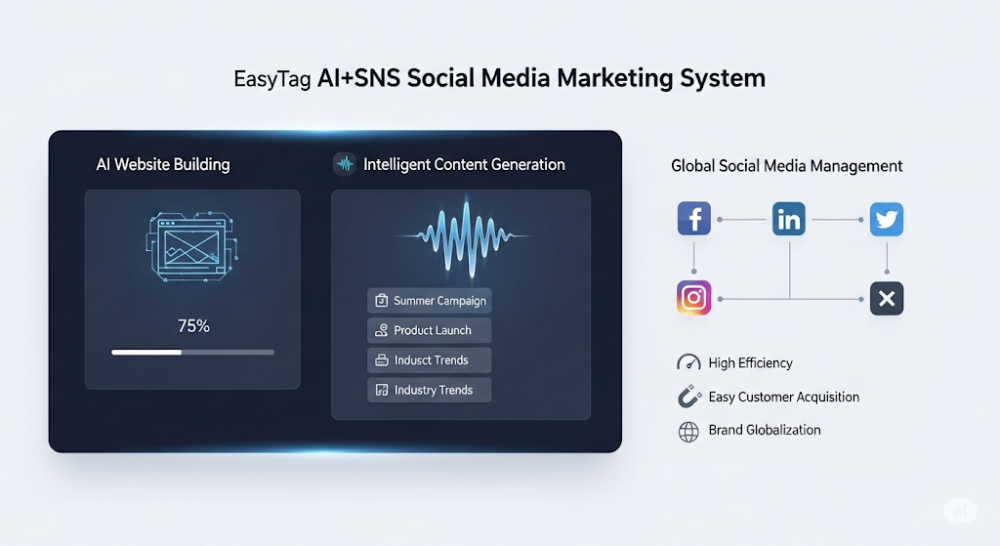
 AI+SNS Social Media Full Intelligence Marketing SystemEYBao AI+SNS Social Media All Intelligent Marketing System - Precise social capture in the era of social media, supporting one-click synchronization of content on mainstream platforms such as Facebook, LinkedIn, etc., AI intelligent rewriting of postings to enhance the degree of adaptability, 24/7 intelligent customer service and user profile analysis, helping enterprises to efficiently expand the global market.
 AI+SEO Marketing SolutionEasyWin AI+SEO Marketing Solution leverages AI-powered batch content creation, intelligent TDK generation, and precise keyword expansion to comprehensively optimize website SEO performance, boosting traffic and conversion rates. Helps businesses build a highly efficient intelligent website ecosystem.
 AI+SEM Advertising & Marketing SolutionsAI+SEM advertising and marketing solution utilizes AI intelligent technology to deeply empower SEM advertising. Through AI intelligent generation of weekly/monthly reports, multi-dimensional presentation of account data, a comprehensive grasp of the effectiveness and trends of advertising, AI precise recommendation of keywords and countries, intelligent generation of high-conversion advertisement language, a key to start the efficient advertising program, helping enterprises to quickly acquire customers. At the same time, the system monitors the core indicators in real time, intelligently recognizes fluctuation abnormalities and warns them in time to ensure stable and high return of advertising effect.
 Domain Name ServicesEasy Operation provides professional domain services, including intelligent query, one-stop registration, brand protection, and full-cycle management, helping enterprises build a digital brand image.
 EasyStore B2C Cross-border E-commerce Platform, Independent SiteEasyStore B2C Cross-border E-commerce Independent Store is an intelligent website building and cross-border e-commerce integrated solution independently developed by EasyStore Information Technology (Beijing) Co., Ltd. The system is specifically designed for small, medium, and large export enterprises, integrating 'website building, operation, marketing, advertising, and conversion' into one platform, helping businesses quickly establish cross-border e-commerce independent stores to achieve brand globalization and global sales growth.
The platform supports multiple languages, currencies, and multi-channel marketing, with built-in AI intelligent translation and SEO optimization systems, suitable for mainstream markets such as Southeast Asia, Europe & America, Latin America, and the Middle East, assisting Chinese manufacturing enterprises in efficiently deploying international e-commerce strategies. SSL CertificateEasyCert provides professional SSL security certificate services, including single-domain and wildcard certificates, ensuring encrypted data transmission, identity verification, and integrity protection for websites. This empowers businesses to establish secure and trustworthy online business environments.