









- Cross-Border Marketing Trend Research: Why More and More Companies Are Starting to Deploy AI Search and GEO OptimizationJun 30, 2026View details
- Cross-Border Marketing Trend Research: How Independent Sites, AI Content, and Short-Video Customer Acquisition Are ChangingJun 30, 2026View details
- How Can a Brand Updates Page Be Made More SEO-Friendly? Analysis of Update Frequency, Content Structure, and Internal Linking StrategyJun 28, 2026View details
- What stages does the cross-border services ecosystem include? How do website building, promotion, payment, and compliance work togetherJun 22, 2026View details
- How will email marketing costs change in 2026Jun 22, 2026View details
- The China-US tariff arrangement has reached a preliminary consensus, and the trade association will be establishedJun 15, 2026View details
- Should overseas brand marketing start with ads or contentJun 21, 2026View details
- What determines B2C cross-border e-commerce website development costs? A breakdown of features, interfaces, and deployment methodsJun 17, 2026View details
How can SEO optimization for foreign trade websites reduce multilingual maintenance costs?
How can SEO optimization for foreign trade websites reduce multilingual maintenance costs? The key is not to “create a few more sets of translations,” but to first unify the website architecture, content rules, and operational workflows. For most foreign trade companies, what truly drives up costs is not the number of languages itself, but duplicated page development, long-term loss of version control, a disconnect between translation and SEO, and repeated multilingual rework every time the website is revised later.
If a company wants to balance overseas search performance with team execution efficiency, a more practical approach is to build a unified technical foundation, then advance with AI-assisted translation, localized proofreading, and standardized SEO workflows. This can improve the indexability and ranking foundation of multilingual pages while significantly reducing the long-term costs of content maintenance, site updates, and cross-market expansion.
Why the maintenance costs of multilingual foreign trade websites keep rising over time
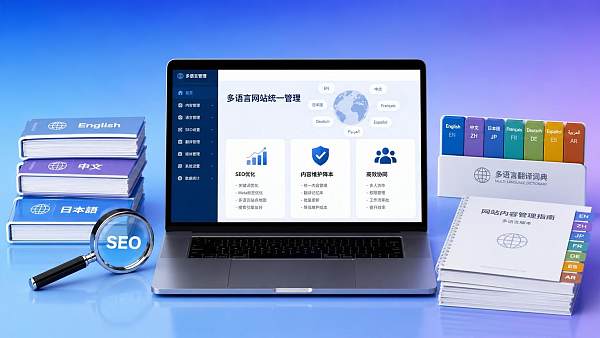
When many companies first build multilingual websites, their approach is to copy the Chinese or English main site several times, then translate each copy into French, Spanish, German, Russian, or Arabic. In the short term, this makes launch very fast. But later, whenever products are updated, page structures are adjusted, or SEO strategies change, every language version must be revised repeatedly, and the maintenance pressure quickly multiplies.
A more common problem is that different language versions are maintained by different staff members, different service providers, or even different website-building systems. This leads to inconsistent URL rules, category naming, TDK writing, internal linking logic, and conversion components. As a result, labor costs are high, and search engines also find it harder to accurately understand the relationships between different language versions.
From an SEO perspective, the core answer to how SEO optimization for foreign trade websites can reduce multilingual maintenance costs is not to cut the translation budget, but to reduce repetitive work. Any process that requires repeated manual handling, such as page duplication, content rewriting, keyword reorganization, and rebuilding internal links, will multiply as more languages are added.
What companies should solve first is not translation speed, but whether the website foundation is unified
If the underlying architecture is not unified, costs cannot be reduced later, whether manual translation or AI translation is used. A multilingual website truly suitable for foreign trade should expand into different markets as much as possible based on the same website-building system, the same template rules, and the same SEO field management mechanism.
For example, product pages, industry solution pages, case study pages, and landing pages should ideally be built with structured modules. In this way, once the primary language page is updated, other languages can inherit the page structure, field logic, and SEO configuration at the same time. The team only needs to maintain differentiated content instead of rebuilding the entire page.
For managers, the value of this step is very direct: it reduces cross-language rework, lowers dependence on a single manual editor, and makes the launch speed of new markets more controllable. For execution teams, a unified foundation means clearer publishing workflows, and later checks, modifications, and expansion also take less time.
To reduce multilingual SEO costs, the content strategy must shift from “full translation” to “tiered operations”
A common misconception among many companies is that multilingual SEO requires translating all pages, all articles, and all product descriptions completely at one time. In reality, different pages contribute very differently to traffic and conversions. Blindly translating everything often requires major investment, but the results are not proportional.
A more effective approach is to divide content into three tiers. The first tier is key customer acquisition pages, including the homepage, core product pages, category pages, and inquiry pages. These should be prioritized for high-quality localization. The second tier is content pages that support indexing and topical relevance, which can be produced semi-automatically. The third tier consists of low-value or highly repetitive supporting pages, where investment can be appropriately reduced.
This tiered method directly answers the question of “how SEO optimization for foreign trade websites can reduce multilingual maintenance costs.” Instead of applying equal effort to all content, companies focus budget and manpower on pages that truly affect rankings and inquiries, making costs and results better aligned.
AI translation can greatly improve efficiency, but only when combined with human localization review
Many companies have already started using AI for multilingual content generation and translation, and this is indeed an important way to control maintenance costs. Especially for product specifications, common page descriptions, basic category content, and bulk description updates, AI can significantly shorten production cycles and reduce repetitive labor.
But AI does not mean content can be released without any human review. Foreign trade websites face buyers, channel customers, and end consumers from different countries, and their expression habits, search term preferences, and industry terminology are not the same. If content is translated mechanically, it can easily result in stiff wording, keyword deviations, or even inaccurate conversion messages.
A safer approach is to let AI complete the first draft and bulk mapping first, then have someone familiar with the target market perform a lightweight review, focusing on titles, selling points, CTA buttons, product terminology, and core keywords. This preserves the efficiency advantage while avoiding negative effects on SEO performance and inquiry conversion caused by unnatural language.
The SEO workflow that truly saves money is standardized, not patched together after problems appear
Another reason many multilingual websites have high maintenance costs is that SEO work is often added only after launch. Pages are published first, and only after some time does the team discover that there are no unique titles, no canonical URLs, no hreflang tags, or incorrect mapping between different languages. Reworking at that point repeatedly consumes both time and manpower.
If companies embed SEO standards into the workflow from the website-building stage, costs will be much lower. For example, they can unify URL naming rules, page template fields, TDK writing standards, image ALT writing methods, and language-version mapping logic, then turn pre-publication checks into a fixed checklist. Execution efficiency will improve significantly.
For foreign trade companies, standardization is not only about saving maintenance expenses, but also about ensuring stable long-term growth. Multilingual SEO is not a one-time project, but an ongoing operational effort. The more standardized the process is, the less pressure the system faces when adding new languages, expanding product lines, or adjusting market strategies.
What capabilities should companies focus on when choosing a service provider or system
If a company plans to use a website-building platform or an external service team to advance multilingual SEO, the evaluation criteria should not be limited to whether they can provide translation or launch several language versions. What truly affects long-term costs is whether the system supports unified management and whether the service workflow is suitable for continuous operation afterward.
First, check whether it supports unified website building and centralized maintenance for multilingual pages, including template reuse, content field synchronization, language-version correspondence, and SEO tag management. Second, check whether it has AI-assisted capabilities and whether it can improve efficiency in translation, page generation, keyword organization, and content updates.
Going further, companies should see whether the service covers website building, SEO, ad placement, and social media collaboration. This is because the real business goal of foreign trade companies is not simply to own multilingual pages, but to continuously acquire overseas customers through an independent website. Only when technology, content, and the customer acquisition chain are connected can reduced maintenance costs have real business value.
To determine whether your multilingual website needs restructuring, start by looking for these signals
If every time a company adds a new language, it needs to separately copy a complete set of pages; if content updated on the main site is often missed in other languages; if site data for different languages is scattered and cannot be analyzed uniformly; or if pages have been translated but remain unindexed, unranked, and unable to convert for a long time, these all indicate that the original model is no longer suitable for further expansion.
At this point, instead of continuing to add more manual labor, it is better to go back and rebuild the content and SEO management mechanism. First unify the site architecture, then reclassify high-value pages, and then introduce AI efficiency improvements and standardized operational workflows. This is often more cost-effective than continuing to patch an old system, and it is also more beneficial for subsequent market expansion.
Especially for companies targeting multiple regions such as North America, Europe, Southeast Asia, the Middle East, and Latin America, multilingual capability is not a presentation-layer issue, but part of the global marketing infrastructure. Once the foundation is solid, companies can continue to amplify traffic value across search engines, ad placement, and AI search scenarios.
Conclusion: To reduce multilingual maintenance costs, the key is to turn growth capability into system capability
Returning to the original question: how can SEO optimization for foreign trade websites reduce multilingual maintenance costs? The answer is not simply to reduce the number of languages, nor to fully rely on low-cost translation. Instead, it is to turn originally scattered tasks into replicable system capabilities through a unified technical foundation, a tiered content strategy, AI-assisted translation, and standardized SEO workflows.
For companies that want to expand overseas for the long term, a multilingual website should not merely be “built”; it must also be manageable, promotable, and able to convert. When website development, SEO optimization, and localized operations truly work together, companies can not only reduce maintenance pressure, but also gain a better chance of achieving stable and sustainable organic traffic growth in the global market.
Related Articles
 4 Major Reasons Behind WhatsApp Account Bans, A Quick Self-Check for Foreign Trade Professionals
 Cross-Border Marketing Trend Research: Why More and More Companies Are Starting to Deploy AI Search and GEO Optimization
 Cross-Border Marketing Trend Research: How Independent Sites, AI Content, and Short-Video Customer Acquisition Are Changing

Related Products
 EasyCamp SaaS Smart Website Marketing SystemE-Yingbao SaaS Smart Website Marketing System: AI-powered, zero-code website building. Rapidly launch multilingual independent e-commerce sites in just 10 minutes. Global server acceleration and AI-driven SEO optimization empower businesses to efficiently connect with global markets. The seamless integration of technology and user-friendly operation makes building e-commerce sites incredibly simple.
 AI+SEM Intelligent Advertising Marketing SystemAI+SEM drives intelligent ad creation, empowering full-funnel precision advertising marketing. The system automatically generates weekly/monthly reports, AI recommends keywords and target countries, monitors core metrics in real-time with intelligent alerts, and enables one-click high-conversion ad solutions to help quickly acquire customers and improve ROI.
 AI+SEO Dual Engine Optimization ServiceEasyWin AI+SEO Dual Engine Optimization System leverages AI-powered keyword mining, content generation, and comprehensive technical optimization to help foreign trade enterprises acquire high-quality organic traffic, significantly improving search rankings and conversion rates.
 AI+SNS Social Media Marketing SystemYingbao AI+SNS Social Media Marketing System - Precision social capture for the social media era. Supports one-click content synchronization across major platforms like Facebook and LinkedIn. AI intelligently rewrites posts for enhanced relevance. 24/7 AI customer service and user profiling analysis empower businesses to efficiently expand into global markets.
 AI+SEO营销解决方案易营宝AI+SEO营销解决方案,通过AI批量写作、智能生成TDK、精准关键词扩词等功能,全面优化网站SEO效果,提升流量与转化率。助力企业构建高效智能网站新生态。
 AI+SEM Advertising Marketing SolutionsAI+SEM Advertising Marketing Solution leverages AI technology to deeply empower SEM ad campaigns. It automatically generates weekly/monthly reports using AI, presenting account data across multiple dimensions for comprehensive insights into campaign performance and trends. The system precisely recommends keywords and target countries, intelligently generates high-conversion ad copy, and enables one-click activation of efficient campaign plans to help businesses rapidly acquire customers. Simultaneously, it monitors core metrics in real time, intelligently identifies abnormal fluctuations, and issues timely alerts to ensure stable, high-return advertising results.
 Domain Name ServicesEasyWin provides professional domain name services, including intelligent queries, one-stop registration, brand protection, and full lifecycle management, helping businesses build a digital brand image.
 EasyOperate B2C Cross-Border E-Commerce Platform & Independent WebsiteEasyStore B2C Cross-border E-commerce Independent Store is an intelligent website building and cross-border e-commerce integrated solution independently developed by EasyStore Information Technology (Beijing) Co., Ltd. The system is specially designed for small and medium-sized as well as large export enterprises, integrating 'website building, operation, marketing, advertising, and conversion' into one, helping enterprises quickly establish cross-border e-commerce independent stores to achieve brand globalization and global sales growth.
The platform supports multiple languages, multiple currencies, and multi-channel marketing, with built-in AI intelligent translation and SEO optimization systems, suitable for mainstream markets such as Southeast Asia, Europe and America, Latin America, and the Middle East, assisting Chinese manufacturing enterprises in efficiently deploying international e-commerce strategies. SSL证书易营宝提供专业SSL安全证书服务,包括单域名和泛域名证书,确保网站数据传输加密、身份验证和完整性保护,助力企业建立安全可信的在线业务环境。









