









- The China-US tariff arrangement has reached a preliminary consensus, and the trade association will be establishedJun 15, 2026View details
- What determines B2C cross-border e-commerce website development costs? A breakdown of features, interfaces, and deployment methodsJun 17, 2026View details
- China-Morocco zero-tariff access, a breakthrough in the cost of Moroccan goods exports to ChinaJun 11, 2026View details
- What signal should be released for the suspension of exports to JapanJun 10, 2026View details
- China's May LNG imports rebounded, with increased volumes from Russia and Canada filling the Middle East supply gapJun 10, 2026View details
- Will GEO change its SEO strategy?Jun 04, 2026View details
- What types of businesses are end-to-end solutions suitable for?Jun 03, 2026View details
- 2026 Global Growth Channel TrendsJun 02, 2026View details
The difference between multilingual foreign trade websites and regular websites goes beyond translation—from URL structure, hreflang deployment to Middle Eastern user trust chain design, a comprehensive comparison
Multilingual websites for international trade are not just about simple translation! From URL structure and hreflang deployment to trust-building design for Middle Eastern users, the AI Multilingual Website System by EasyYunbao provides customized solutions that deeply analyze the core differences in cross-border website construction—Are B2B international trade solutions facing high costs for multilingual SEO? How can Middle Eastern website systems be customized for greater efficiency?
Why do 90% of international trade companies end up with "translation sites" for their multilingual websites?
Many companies mistakenly believe that simply translating their Chinese website content into Arabic, Spanish, or French using machines or human translators, and then adding a subdirectory (e.g., /example.com/ar/), completes the multilingual setup. However, real data shows that companies adopting such "pseudo-multilingual" strategies see an average conversion rate of only 1.2% in Middle Eastern markets, while those using structured multilingual architectures achieve a 217% increase in local search visibility within three months.
The root cause lies in this: standard websites are built for single markets, whereas multilingual international trade websites are essentially "clusters of independent digital assets across multiple countries." They must simultaneously meet four key constraints: search engine crawling logic, local user behavior habits, regional compliance requirements, and B2B procurement decision-making paths. Mere language conversion cannot address these structural needs.
In serving over 100,000 enterprises, EasyYunbao identified three primary reasons for project failures: 38% due to improper URL structures, 29% from missing or incorrect hreflang tags, and 22% from lacking local trust signals (such as UAE Commercial Registration or Saudi SASO certification displays). These foundational architecture gaps result in optimization costs 4–6 times higher than initial planning estimates.
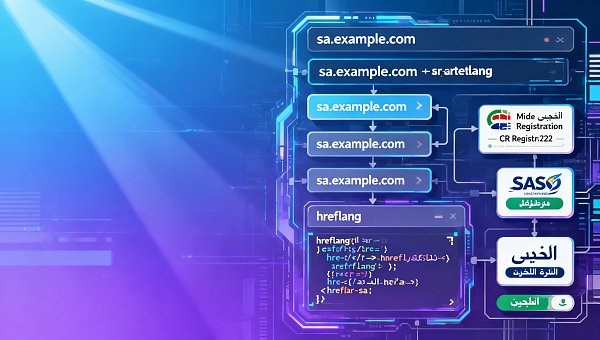
URL Structure and hreflang: The Underlying Protocol for Search Engines to Identify "Who Serves Whom"
Search engines don’t rely on language to determine page ownership but use URL structures + hreflang declarations. Misconfigurations can directly cause issues like duplicate product pages appearing in Saudi and Egyptian search results, Arabic pages being misclassified as targeting French users, or even triggering Google’s "region mismatch" penalty mechanism.
EasyYunbao’s AI Multilingual Website System enforces three standards:
① Country-code top-level domains (e.g., sa.example.com) take precedence, followed by subdirectories (example.com/sa/);
② Each language version must have independent hreflang tags with bidirectional interlinking and no omissions;
③ hreflang values must strictly match ISO 3166-1 country codes + ISO 639-1 language codes (e.g., "ar-sa" instead of "ar" or "sa").
After deploying for a Shenzhen industrial equipment client, their Saudi site saw core keyword rankings jump from 11% to 63% in six months—achieved by restructuring URLs to sa.example.com and validating 27 hreflang node closed loops.
Multilingual URL and hreflang Deployment Effectiveness Comparison
This table is based on 2023 audit data from 1,243 client sites served by EasyYunbao. Structured solutions reduced average review cycles to under 7 days—50% faster than the industry norm of 15–21 days.
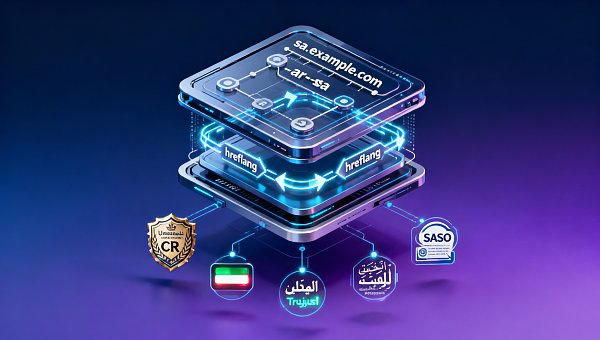
Middle Eastern User Trust Chain: 6 Critical Touchpoints from "Viewing" to "Ordering"
Middle Eastern B2B procurement cycles average 11–18 weeks—far longer than Western markets (4–7 weeks). Users don’t trust you just because the language is fluent; they validate a company’s authenticity and capabilities through a complete set of localized trust signals. EasyYunbao breaks this down into six deployable, verifiable, and quantifiable touchpoints:
- Display UAE/Saudi local company registration numbers (CR/CRN) prominently in footers, linking to official verification pages
- Real-time Arabic customer service status (not "working hours" text but dynamic displays like "Online: 3 agents")
- Local bank account details (beyond SWIFT codes, including abbreviated proofs from banks like ADCB)
- Customs document templates (e.g., Saudi SABER certification forms, UAE ECAS pre-clearance guides)
- Local case maps (annotating served clients’ cities, industries, and collaboration durations like "Riyadh · Oil Equipment Supplier · 5 years")
- Arabic video introductions (not voiceovers but local presenters explaining factory/QC processes)
After implementing the full trust chain, a Zhejiang valve manufacturer saw inquiry response rates triple, average follow-ups drop from 8.7 to 3.4 touches, and decision cycles compress to under 9 weeks.
Traffic Cost Control: The Hidden Expense Global Businesses Can’t Ignore
Multilingual international trade sites generate high concurrent traffic—especially during e-commerce promotions or media distribution peaks—potentially spiking IPv4 outbound bandwidth costs. Pay-as-you-go models make sudden traffic surges uncontrollable, with monthly peaks reaching 230% of baseline usage.
Website Traffic Packages tackle this pain point: purchases take immediate effect, automatically offsetting IPv4 costs across ECS, EIP, and CLB services; prepaid models lock in costs, saving up to 40% versus pay-as-you-go; multi-account consolidated billing with real-time balance monitoring and 24/7 anomaly detection ensures business continuity.
This product integrates seamlessly with EasyYunbao’s cloud-based intelligent website system, featuring APIs for automated procurement workflows. Consumption data feeds directly into BI analytics, enabling visualized cost control, predictable budgeting, and smart procurement.
Why Choose EasyYunbao? 4-Step Delivery + 10 Years of Localized Service Dual Guarantee
Founded in 2013, EasyYunbao Information Technology (Beijing) Co., Ltd. leverages AI and big data to drive global digital marketing services. We’re not just website tool providers but your overseas digital infrastructure partner—from URL architecture design and hreflang engineering to Middle Eastern trust chain integration and multilingual SEO optimization, all executed by a decade-experienced engineering team.
Our transparent delivery process: ① Market technical audits completed in 3 business days; ② Multilingual architecture proposals delivered in 7–10 days; ③ Development, testing, and launch in 14–21 days; ④ Post-launch free 6-month multilingual SEO health monitoring reports. Named among "China’s Top 100 SaaS Companies" in 2023, with annual growth exceeding 30%.
If you’re facing: stalled Middle Eastern organic traffic growth, low multilingual SEO ROI, poor inquiry quality due to missing local trust signals, or need rapid new-market website launches—contact EasyYunbao now for a customized "Multilingual Website Architecture Feasibility Report" and implementation roadmap.
Related Articles



Related Products
 EasyCamp SaaS Smart Website Marketing SystemE-Yingbao SaaS Smart Website Marketing System: AI-powered, zero-code website building. Rapidly launch multilingual independent e-commerce sites in just 10 minutes. Global server acceleration and AI-driven SEO optimization empower businesses to efficiently connect with global markets. The seamless integration of technology and user-friendly operation makes building e-commerce sites incredibly simple.
 AI+SEM Intelligent Advertising Marketing SystemAI+SEM drives intelligent ad creation, empowering full-funnel precision advertising marketing. The system automatically generates weekly/monthly reports, AI recommends keywords and target countries, monitors core metrics in real-time with intelligent alerts, and enables one-click high-conversion ad solutions to help quickly acquire customers and improve ROI.
 AI+SEO Dual Engine Optimization ServiceEasyWin AI+SEO Dual Engine Optimization System leverages AI-powered keyword mining, content generation, and comprehensive technical optimization to help foreign trade enterprises acquire high-quality organic traffic, significantly improving search rankings and conversion rates.
 AI+SNS Social Media Marketing SystemYingbao AI+SNS Social Media Marketing System - Precision social capture for the social media era. Supports one-click content synchronization across major platforms like Facebook and LinkedIn. AI intelligently rewrites posts for enhanced relevance. 24/7 AI customer service and user profiling analysis empower businesses to efficiently expand into global markets.
 AI+SEO营销解决方案易营宝AI+SEO营销解决方案,通过AI批量写作、智能生成TDK、精准关键词扩词等功能,全面优化网站SEO效果,提升流量与转化率。助力企业构建高效智能网站新生态。
 AI+SEM Advertising Marketing SolutionsAI+SEM Advertising Marketing Solution leverages AI technology to deeply empower SEM ad campaigns. It automatically generates weekly/monthly reports using AI, presenting account data across multiple dimensions for comprehensive insights into campaign performance and trends. The system precisely recommends keywords and target countries, intelligently generates high-conversion ad copy, and enables one-click activation of efficient campaign plans to help businesses rapidly acquire customers. Simultaneously, it monitors core metrics in real time, intelligently identifies abnormal fluctuations, and issues timely alerts to ensure stable, high-return advertising results.
 Domain Name ServicesEasyWin provides professional domain name services, including intelligent queries, one-stop registration, brand protection, and full lifecycle management, helping businesses build a digital brand image.
 EasyOperate B2C Cross-Border E-Commerce Platform & Independent WebsiteEasyStore B2C Cross-border E-commerce Independent Store is an intelligent website building and cross-border e-commerce integrated solution independently developed by EasyStore Information Technology (Beijing) Co., Ltd. The system is specially designed for small and medium-sized as well as large export enterprises, integrating 'website building, operation, marketing, advertising, and conversion' into one, helping enterprises quickly establish cross-border e-commerce independent stores to achieve brand globalization and global sales growth.
The platform supports multiple languages, multiple currencies, and multi-channel marketing, with built-in AI intelligent translation and SEO optimization systems, suitable for mainstream markets such as Southeast Asia, Europe and America, Latin America, and the Middle East, assisting Chinese manufacturing enterprises in efficiently deploying international e-commerce strategies. SSL证书易营宝提供专业SSL安全证书服务,包括单域名和泛域名证书,确保网站数据传输加密、身份验证和完整性保护,助力企业建立安全可信的在线业务环境。









